


24 Jul UPSC Alert: 13,550 SC Students in Karnataka Benefit from Central Scholarships 2025-26
Subject Relevance — Where This Topic Fits
- GS Paper II — Welfare Schemes for Vulnerable Sections | GS Paper III — Issues Relating to Poverty and Inclusive Growth
- Prelims: Scheduled Castes (SC) Sub-Plan, Direct Benefit Transfer (DBT), Pre-Matric and Post-Matric Scholarships, Union Budget Allocations for SC Welfare, National Commission for Scheduled Castes (NCSC), NITI Aayog’s Aspirational Districts Programme
- Essay: Inclusive Education as a Tool for Social Justice, Role of Technology in Governance and Service Delivery
Quick Revision: Central scholarship schemes for SC students—Pre-Matric, Post-Matric, and Top Class Education—are implemented via the National Scholarship Portal with Direct Benefit Transfer to ensure timely, transparent, and equitable financial support, directly addressing dropout rates and economic barriers in education.
Why is this in the news?
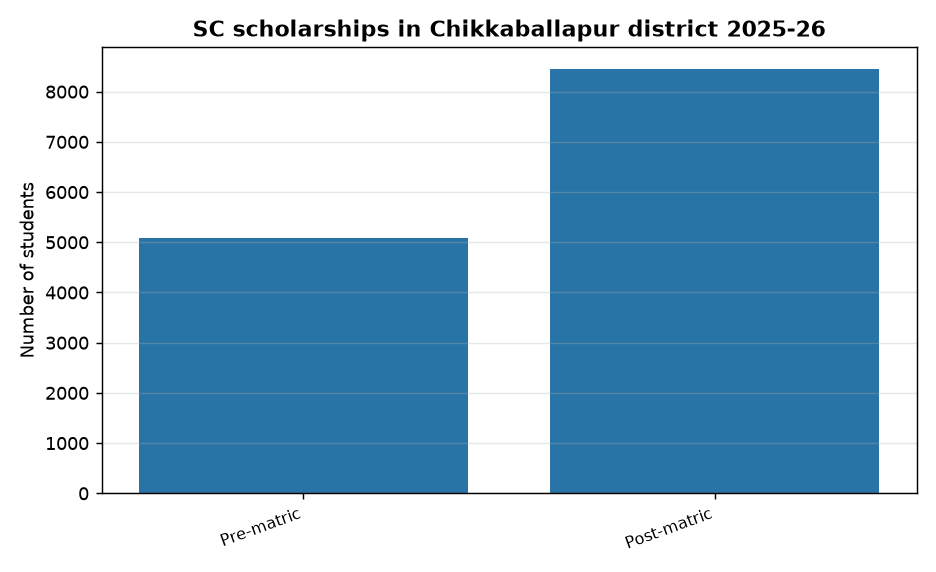
The Ministry of Social Justice and Empowerment, in a written reply to the Lok Sabha on 24 July 2026, reported that over 13,550 Scheduled Caste (SC) students in Chikkaballapur district, Karnataka, benefited from central scholarship schemes during the academic year 2025-26. This development underscores the government’s ongoing efforts to enhance educational access and reduce economic barriers for marginalised communities through targeted welfare interventions.
Background
- The constitutional mandate under Articles 15(4), 16(4), and 46 of the Indian Constitution directs the State to promote educational and economic upliftment of Scheduled Castes (SCs) through affirmative action.
- Central scholarship schemes for SC students were formalised under the Scheduled Castes Sub-Plan (SCSP), introduced in the 1970s and expanded through subsequent Five-Year Plans and budgetary allocations.
- The Pre-Matric and Post-Matric Scholarship Schemes for SCs were launched to address dropout rates and financial constraints faced by SC students at the school and higher education levels, respectively.
- The Direct Benefit Transfer (DBT) mechanism was integrated into these schemes in 2021-22 (Pre-Matric) and 2022-23 (Post-Matric) to enhance transparency, reduce leakages, and ensure timely disbursement of funds.
- NITI Aayog’s evaluations have highlighted the role of these scholarships in reducing economic barriers and improving retention rates among SC students, particularly in rural and semi-urban areas.
What are the Central Scholarship Schemes for Scheduled Castes?
- The **Pre-Matric Scholarship Scheme** for SCs targets students from Class 1 to 10, providing financial assistance to cover tuition fees, maintenance allowance, and other incidental expenses to prevent dropout due to economic hardship.
- The **Post-Matric Scholarship Scheme** for SCs supports students pursuing higher education (Class 11 to PhD), including professional and technical courses, with a focus on reducing financial barriers to advanced studies.
- The maintenance allowance under these schemes varies by class and hostel status, with higher amounts for students in Class 9-10 and those residing in hostels, to account for increased living costs.
- The schemes are implemented by the Ministry of Social Justice and Empowerment in collaboration with state governments, which act as the nodal agencies for disbursement and monitoring.
- Since 2021, the schemes have adopted a **technology-driven approach**, including the use of the **National Scholarship Portal (NSP)** for online applications, verification, and DBT-based disbursement to ensure efficiency and transparency.
- The **Scheduled Castes Sub-Plan (SCSP)** ensures that a proportionate share of the Union Budget is earmarked for SC-specific development, including education, to address historical injustices and systemic inequalities.
Key Features
| Feature | Significance |
|---|---|
| Direct Benefit Transfer (DBT) | Eliminates intermediaries, reduces delays, and ensures transparent, time-bound disbursal of scholarships directly to beneficiaries’ Aadhaar-linked bank accounts. |
| Technology-based Service Delivery | Enhances efficiency, reduces duplication, and improves accessibility, particularly for rural and semi-urban students. |
| Three Central Scholarship Schemes | Targeted financial support for SC students at pre-matric and post-matric levels, and for higher education under the ‘Youth Achievers Scheme’. |
| Awareness Initiatives | Ensures eligible students are informed about scholarship opportunities, reducing exclusion due to lack of information. |
| Continuous Monitoring and Evaluation | Facilitates data-driven improvements in implementation, as evidenced by policy evaluations highlighting the impact of scholarships on educational outcomes. |
Why it Matters
Educational Equity
- Bridges financial gaps for Scheduled Caste (SC) students, enabling access to quality education at pre-matric and post-matric levels.
- Reduces dropout rates by providing sustained financial support, particularly for students in rural and semi-urban areas.
- Promotes inclusive growth by ensuring marginalised communities are not excluded from educational opportunities due to economic constraints.
Social Justice
- Advances the constitutional mandate of equality (Article 14) by addressing historical and structural disadvantages faced by SC communities.
- Strengthens affirmative action through targeted welfare measures, aligning with the Directive Principles of State Policy (Article 46).
- Contributes to reducing intergenerational poverty by enabling higher educational attainment among SC students.
Governance and Transparency
- Demonstrates the efficacy of digital governance in welfare delivery, reducing leakages and enhancing accountability in fund utilisation.
- Sets a precedent for other welfare schemes to adopt DBT and technology-driven monitoring for improved outcomes.
- Enhances trust in government initiatives by ensuring timely and transparent disbursal of benefits.
Challenges
1. Digital Divide and Exclusion
- Rural and semi-urban students may face challenges in accessing digital platforms for application and verification processes.
- Lack of awareness about digital tools can lead to underutilisation of scholarship schemes among eligible beneficiaries.
UPSC Link: GS-II: Welfare schemes
2. Implementation Gaps in States
- Variations in state-level execution of central schemes may result in uneven coverage or delays in disbursement.
- Coordination between central and state agencies requires strengthening to ensure seamless implementation.
UPSC Link: GS-II: Centre-State relations
3. Socio-Cultural Barriers
- Deep-rooted caste-based discrimination may discourage SC students from pursuing higher education despite financial support.
- Social stigma and lack of role models in higher education institutions can impact retention and academic performance.
UPSC Link: GS-I: Social empowerment
4. Data Gaps and Monitoring
- Limited disaggregated data on dropout rates and academic performance of SC students hinders targeted interventions.
- Need for real-time monitoring to assess the long-term impact of scholarships on educational and career trajectories.
UPSC Link: GS-II: Government policies
Challenges — UPSC Perspective
| Issue | Concern |
|---|---|
| Digital Literacy Deficit | Hampers access to scholarship portals and online verification processes. |
| State-Level Implementation Delays | Leads to uneven distribution of benefits across regions. |
| Caste-Based Discrimination | Discourages participation in higher education despite financial support. |
| Lack of Awareness Campaigns | Results in under-enrolment of eligible students in scholarship schemes. |
| Inadequate Post-Secondary Support | Limits the effectiveness of scholarships in reducing dropout rates at higher education levels. |
Government Initiatives — Must-Memorise for Prelims
- Pre-Matric Scholarship for SC and Others
- Yuva Achievers Scheme for Higher Education
Way Forward
- Expand digital literacy programmes in rural and semi-urban areas to ensure equitable access to scholarship portals.
- Strengthen state-level coordination mechanisms to minimise implementation delays and ensure uniform coverage.
- Launch targeted awareness campaigns in collaboration with local bodies and educational institutions to reach marginalised SC students.
- Enhance post-secondary support, including mentorship and career guidance, to improve retention and academic performance.
- Develop a real-time monitoring dashboard to track scholarship disbursement, beneficiary performance, and dropout rates.
- Conduct periodic evaluations to assess the long-term impact of scholarships on educational attainment and socio-economic mobility.
- Integrate scholarship schemes with skill development and employment initiatives to ensure holistic support for SC students.
UPSC Value Addition
Keywords for Mains Answer-Writing
Scheduled Castes (SCs) · Central Sector Scholarships · Pre-Matric Scholarship Scheme · Post-Matric Scholarship Scheme for SCs · Direct Benefit Transfer (DBT) · equitable access to quality education · financial barriers in education · educational equity · Ministry of Social Justice and Empowerment · Chikkaballapura district Karnataka · Youth for Excellence Scheme (SHREYAS-SC) · dropout rates among SC students
Constitutional & Policy Linkages
- Article 14: Equality before law and equal protection of laws.
- Article 15(4): Special provisions for advancement of socially and educationally backward classes.
- Article 46: Promotion of educational and economic interests of weaker sections.
- Seventh Schedule: Concurrent List (Entry 25) empowers both Centre and States to legislate on education.
Concept Flow
Constitutional mandate for social justice (Article 14, 15(4), 46) → Central government’s welfare schemes for SCs → Implementation via DBT and digital platforms → Beneficiary identification and disbursal (e.g., Chikkaballapura district) → Reduction in financial barriers to education → Improved access to quality education → Enhanced socio-economic mobility and reduced intergenerational poverty.
Prelims Practice Questions
Q1. Which of the following is NOT one of the three key scholarship schemes for Scheduled Castes (SCs) implemented by the Ministry of Social Justice and Empowerment?
- A. Pre-Matric Scholarship Scheme for SCs
- B. Post-Matric Scholarship Scheme for SCs
- C. Merit-cum-Means Scholarship Scheme for SCs
- D. Scheme for Higher Education for Young Achievers (SHREYAS-SC)
Answer: C. Merit-cum-Means Scholarship Scheme for SCs — The three key scholarship schemes for SCs are: Pre-Matric Scholarship Scheme, Post-Matric Scholarship Scheme for SCs, and Scheme for Higher Education for Young Achievers (SHREYAS-SC). The Merit-cum-Means Scholarship Scheme is not specifically for SCs but is a general scheme for minority communities.
Q2. The introduction of Direct Benefit Transfer (DBT) in scholarship schemes for SCs primarily aims to:
- A. Increase the quantum of scholarship amounts
- B. Ensure timely and transparent disbursement of funds
- C. Reduce the number of eligible beneficiaries
- D. Centralize the implementation of all welfare schemes
Answer: B. Ensure timely and transparent disbursement of funds — DBT was introduced to improve the efficiency, transparency, and timeliness of scholarship disbursement by transferring funds directly to the bank accounts of beneficiaries, thereby eliminating delays and duplication.
Q3. According to the latest data, which district in Karnataka benefited the most from central scholarship schemes for SC students in the academic year 2025-26?
- A. Bengaluru Urban
- B. Mysuru
- C. Chikkaballapura
- D. Mangaluru
Answer: C. Chikkaballapura — The Press Information Bureau release explicitly states that Chikkaballapura district in Karnataka had over 13,550 SC students benefiting from central scholarship schemes in 2025-26.
Mains Practice Question
✍ Critically examine the role of central scholarship schemes for Scheduled Castes (SCs) in reducing educational inequities and dropout rates. How has the introduction of Direct Benefit Transfer (DBT) enhanced the effectiveness of these schemes? Provide a structured analysis with relevant examples.
Approach: Begin by outlining the objectives of central scholarship schemes for SCs, such as the Pre-Matric and Post-Matric Scholarship Schemes, and their role in addressing financial barriers and promoting equitable access to education. Discuss the impact of these schemes on reducing dropout rates among SC students, citing data from evaluations like those by NITI Aayog. Analyze the significance of DBT in improving transparency, reducing delays, and ensuring timely disbursement of funds, particularly in rural and semi-urban areas. Conclude by highlighting the need for continuous monitoring and stakeholder consultations to further strengthen these schemes.
Source: PIB (Press Information Bureau)
Generated by AanyaAi for educational purpose.


No Comments