


27 Jul Anti-Paper Leak Bill 2026: Key Provisions & Lok Sabha Deadlock Explained
Subject Relevance — Where This Topic Fits
- GS Paper II — Governance, Transparency and Accountability | GS Paper III — Issues Relating to Education, Human Resource Development
- Prelims: Public Examinations (Prevention of Unfair Means) Act, 2024, Special Fast Track Courts, Central Investigative Agency, Examination malpractice, Union Government’s legislative competence, Lok Sabha proceedings and adjournment, Dharmendra Pradhan’s resignation, Paper leak protests, Union Budget and legislative agenda, Constitutional provisions on public order and administration
- Essay: The erosion of trust in public examinations: A threat to meritocracy and social justice, Balancing deterrence and due process in combating examination malpractice
Quick Revision: The Public Examinations (Prevention of Unfair Means) Amendment Bill, 2026, seeks to deter examination malpractice by enhancing penalties.
Why is this in the news?
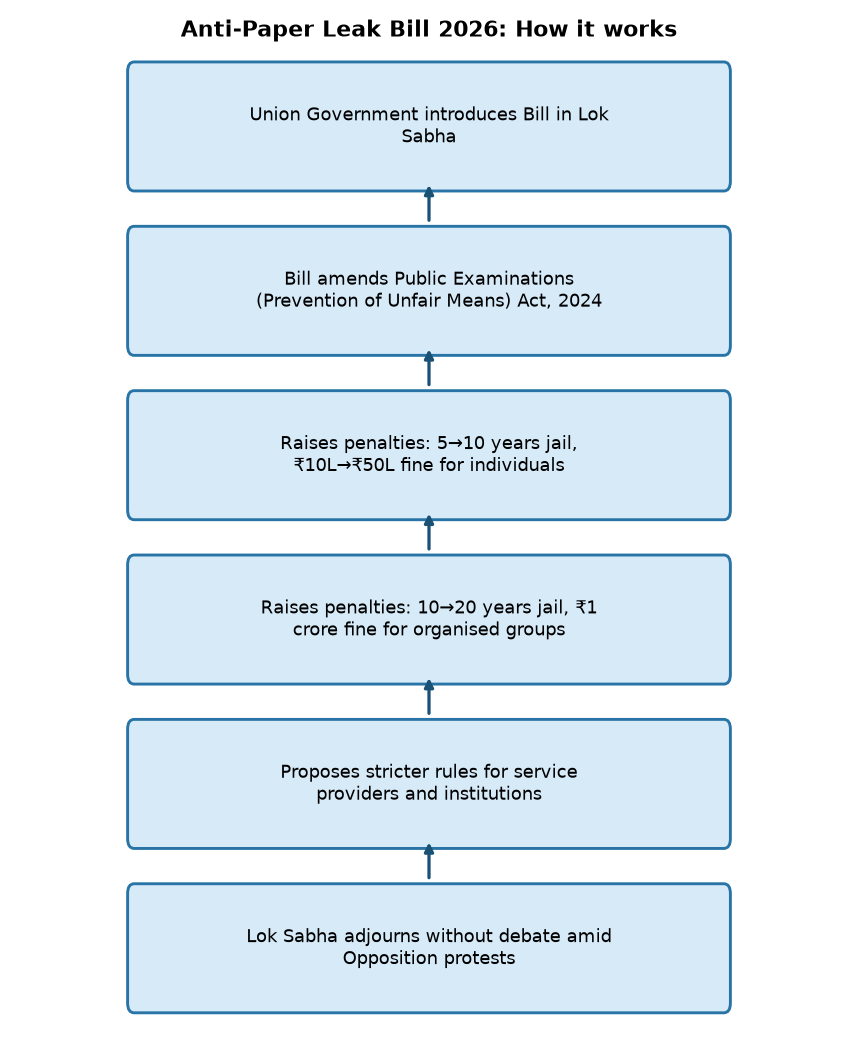
The Union Government introduced the Public Examinations (Prevention of Unfair Means) Amendment Bill, 2026, in the Lok Sabha on July 27, 2026, to amend the Public Examinations (Prevention of Unfair Means) Act, 2024. The Bill proposes significantly enhanced penalties for individuals and organised groups involved in examination paper leaks. The move follows widespread student-led protests over paper leaks, which culminated in the resignation of the former Education Minister, Dharmendra Pradhan. The Bill’s introduction coincides with parliamentary disruptions, highlighting its contentious nature and the Opposition’s demands for accountability regarding police action during protests.
Background
- The Public Examinations (Prevention of Unfair Means) Act, 2024, was enacted to address the growing menace of examination malpractice, particularly paper leaks, which have undermined the credibility of public examinations such as the UPSC Civil Services Examination, NEET, and JEE.
- The Act was introduced in response to repeated incidents of paper leaks across multiple states, including Bihar, Gujarat, and Rajasthan, which led to widespread cancellations of examinations and public outrage.
- The resignation of Dharmendra Pradhan as Union Education Minister in July 2026 followed sustained protests by students and examination aspirants, who demanded stringent action against those responsible for paper leaks and systemic reforms in examination conduct.
- Parliamentary proceedings on the Bill were stalled due to Opposition protests, which demanded a statement from the government regarding the use of police force against protestors during a Parliament march on July 20, 2026.
- The Bill is part of the Union Government’s broader legislative agenda to enhance transparency, accountability, and fairness in public examinations, aligning with constitutional principles of equality and meritocracy.
What is the Public Examinations (Prevention of Unfair Means) Amendment Bill, 2026?
- The Bill seeks to amend the Public Examinations (Prevention of Unfair Means) Act, 2024, by introducing stricter penalties for individuals and organised groups involved in examination paper leaks and other unfair means.
- It proposes to increase the maximum imprisonment for individuals convicted of paper leaks from five years to ten years, with fines raised from ₹10 lakh to ₹50 lakh.
- For directors, senior management personnel, and officials found complicit in paper leaks, the Bill introduces imprisonment of up to five years (previously three years).
- Organised offences involving paper leaks will now attract a maximum imprisonment of seven years (previously five years) and fines up to ₹10 crore.
- The Bill empowers the Union Government to refer paper leak incidents to a Central Investigative Agency, ensuring a coordinated and specialised approach to investigation.
- It retains the government’s autonomy to constitute a separate task force for investigating paper leaks, enhancing flexibility in addressing regional variations in malpractice.
- The proposed amendments aim to deter future instances of examination malpractice by imposing severe penalties and ensuring swift judicial recourse, thereby restoring public trust in the examination system.
Key Features
| Feature | Significance |
|---|---|
| Increased imprisonment for individuals | Deters individual offenders by elevating maximum punishment from 5 to 10 years, aligning with the gravity of exam fraud. |
| Enhanced penalties for colluding officials | Imposes stricter penalties on directors and senior management involved in paper leaks, with imprisonment up to 5 years and fines up to ₹50 lakh. |
| Organised offence provisions | Raises maximum imprisonment for organised groups from 5 to 7 years and fines from ₹1 crore to ₹10 crore, targeting syndicates behind large-scale leaks. |
| Central investigative agency referral | Empowers the Union Government to refer paper leak cases to a Central Investigative Agency, ensuring uniformity and expertise in investigations. |
| Special Fast Track Courts | Mandates daily hearings and completion of trials within 3 months of charge sheet filing, addressing delays in judicial proceedings. |
| Two-month investigation deadline | Imposes a strict timeline for completing investigations, reducing procedural delays and ensuring timely justice. |
Why it Matters
Governance and Accountability
- Strengthens the institutional framework to combat corruption in public examinations, a critical component of meritocratic governance.
- Demonstrates the state’s commitment to upholding the sanctity of competitive examinations, which are pivotal for recruitment and admissions.
- Enhances public trust in examination systems by addressing systemic vulnerabilities to malpractices.
Economic Implications
- Reduces the economic burden on students and families who invest resources in preparation for examinations that may be compromised by leaks.
- Mitigates the opportunity cost of time and effort lost due to unfair means in examinations, which can distort labour market signals.
- Prevents the misallocation of human capital by ensuring that selection processes remain fair and transparent.
Social Equity
- Promotes social justice by ensuring that deserving candidates are not disadvantaged by the actions of a few unscrupulous elements.
- Reduces disparities in access to opportunities, particularly for marginalised sections who may lack resources to contest unfair outcomes.
- Fosters a level playing field in competitive examinations, which are often gateways to higher education and employment.
Judicial Efficiency
- Accelerates the judicial process through Special Fast Track Courts, reducing backlog and ensuring timely dispensation of justice.
- Encourages timely investigations and prosecutions, thereby deterring potential offenders.
- Enhances the credibility of the judicial system by demonstrating its ability to handle complex cases efficiently.
Challenges
1. Implementation and Enforcement
- Ensuring uniform enforcement across states and Union Territories, given the federal structure of governance.
- Addressing potential resistance from vested interests within examination bodies or administrative hierarchies.
- Balancing the need for swift justice with the principles of due process and fair trial.
UPSC Link: GS-II: Role of State in Governance
2. Technological and Operational Challenges
- Developing robust mechanisms to prevent digital leaks, such as secure online examination platforms and encryption protocols.
- Ensuring the integrity of examination centres through stringent monitoring and surveillance technologies.
- Training law enforcement and judicial personnel to handle complex cyber and forensic investigations.
UPSC Link: GS-III: Science and Technology
3. Political and Institutional Constraints
- Overcoming opposition from political parties or groups that may perceive the Bill as an attempt to centralise power.
- Ensuring bipartisan support to prevent legislative gridlock and expedite the passage of the Bill.
- Addressing concerns about the autonomy of state governments in managing local examination processes.
UPSC Link: GS-II: Parliament and State Legislatures
4. Public Perception and Trust
- Building public confidence in the new measures, particularly among students and parents who have faced repeated disillusionment.
- Addressing scepticism about the effectiveness of the Bill in deterring well-organised syndicates behind paper leaks.
- Ensuring transparency in the investigation and prosecution processes to maintain credibility.
UPSC Link: GS-IV: Ethics and Integrity in Governance
5. Resource Allocation
- Allocating adequate financial and human resources to establish Special Fast Track Courts and investigative agencies.
- Ensuring continuous training and capacity-building for judges, prosecutors, and investigative personnel.
- Providing logistical support for the implementation of technological solutions to prevent leaks.
UPSC Link: GS-III: Resource Mobilisation
Challenges — UPSC Perspective
| Issue | Concern |
|---|---|
| Federalism and State Autonomy | Risk of over-centralisation of examination processes, potentially encroaching on the domain of state governments. |
| Digital Vulnerabilities | Examination systems remain susceptible to cyber threats, including hacking and data breaches. |
| Judicial Backlog | Existing judicial infrastructure may struggle to accommodate the additional workload of Special Fast Track Courts. |
| Corruption in Investigation Agencies | Potential for collusion or inefficiency within investigative agencies tasked with probing paper leaks. |
| Public Resistance | Scepticism among stakeholders about the Bill’s efficacy in addressing systemic corruption. |
| Resource Constraints | Limited financial and human resources to implement the Bill’s provisions effectively. |
Way Forward
- Constitute a high-powered committee comprising representatives from the Union Government, state governments, and judicial authorities to oversee the implementation of the Bill.
- Develop a national framework for secure examination processes, including standardised protocols for online and offline examinations.
- Invest in advanced technologies such as blockchain, AI-driven proctoring, and encrypted data storage to prevent digital leaks.
- Establish a dedicated training programme for judges, prosecutors, and investigative personnel to handle paper leak cases efficiently.
- Ensure transparency in the investigation process by publishing periodic reports on the progress of cases and convictions.
- Strengthen whistle-blower protection mechanisms to encourage reporting of unfair means in examinations.
- Conduct periodic audits of examination bodies to identify vulnerabilities and implement corrective measures.
- Foster public awareness campaigns to educate stakeholders about the provisions of the Bill and their rights under it.
UPSC Value Addition
Keywords for Mains Answer-Writing
Public Examinations (Prevention of Unfair Means) Act · exam paper leaks · sanctity of examinations · harsher penalties for malpractice · Special Fast Track Courts · Central Investigative Agency for paper leaks · timely investigation and prosecution · collusion in unfair means · organised crime in examinations · UPSC Civil Services Examination integrity
Constitutional & Policy Linkages
- {‘article’: ‘Article 348’, ‘note’: ‘Language of proceedings in Supreme Court’}
- {‘article’: ‘Article 21’, ‘note’: ‘Right to fair trial and dignity’}
- {‘article’: ‘Article 14’, ‘note’: ‘Equality before law and equal protection’}
- {‘article’: ‘Article 51A(h)’, ‘note’: ‘Duty to develop scientific temper’}
Concept Flow
Public examinations compromised by paper leaks → Erosion of meritocracy and social equity → Introduction of the Public Examinations (Prevention of Unfair Means) Amendment Bill, 2026 → Stricter penalties and faster trials → Deterrence of offenders → Restoration of trust in examination systems → Enhanced governance and institutional credibility
Prelims Practice Questions
Q1. Which of the following is NOT a provision of the Public Examinations (Prevention of Unfair Means) Amendment Bill, 2026?
- A. Increase in maximum imprisonment for individuals from five years to ten years
- B. Mandatory establishment of Special Fast Track Courts for speedy trials
- C. Imposition of a fine of ₹1 crore on organised offenders
- D. Prohibition of all competitive examinations in the country
Answer: D. Prohibition of all competitive examinations in the country — The Bill does not prohibit competitive examinations; it aims to prevent unfair means in such examinations. Provisions include increased penalties, Special Fast Track Courts, and higher fines for organised offenders.
Q2. Under the proposed amendment, what is the maximum fine for an individual convicted of paper leak offences?
- A. ₹10 lakh
- B. ₹25 lakh
- C. ₹50 lakh
- D. ₹1 crore
Answer: C. ₹50 lakh — The amendment raises the fine for individual offenders from ₹10 lakh to ₹50 lakh, as part of deterrent measures against paper leaks.
Q3. Which authority is empowered to constitute a Special Task Force for investigating paper leak incidents under the proposed amendment?
- A. State Police Forces
- B. Union Government
- C. Supreme Court
- D. National Human Rights Commission
Answer: B. Union Government — The Union Government retains the autonomy to constitute a separate task force to investigate paper leak offences, as per the proposed amendment.
Mains Practice Question
✍ Examine the significance of the Public Examinations (Prevention of Unfair Means) Amendment Bill, 2026, in ensuring the integrity of competitive examinations in India. Critically analyse the measures proposed to deter paper leaks and organised malpractice, while evaluating their potential effectiveness and challenges in implementation.
Approach: The answer should begin by contextualising the Bill within the broader issue of paper leaks in competitive examinations, highlighting the sanctity of such examinations for meritocracy. Discuss the key provisions, such as increased penalties, Special Fast Track Courts, and the role of investigative agencies, while evaluating their deterrent value. Address potential challenges, including the need for robust implementation, inter-state coordination, and the balance between speedy trials and due process. Conclude by assessing whether the measures are sufficient to restore public trust in the examination system.
Source: Times of India
Generated by AanyaAi for educational purpose.

- उत्तराखंड राज्यपाल के 5 वर्ष: पांच मिशन और AI क्रांति का लेखा-जोखा - September 15, 2026
- UPSC Focus: Uttarakhand Governor’s 5-Year Journey & 5 Key Missions Explained - September 15, 2026
- AI का वादा और खतरा: क्या मानवता के लिए खतरा है कृत्रिम बुद्धिमत्ता? - September 15, 2026

No Comments