


27 Jul Lok Sabha Introduces Public Exams (Malpractices Prevention) Amendment Bill 2026: Key Provisions & UPSC Relevance
Subject Relevance — Where This Topic Fits
- GS Paper II — Governance, Transparency and Accountability | GS Paper III — Issues Relating to Development and Management of Social Sector/Services relating to Health, Education, Human Resources
- Prelims: Lok Pariksha (Prevention of Unfair Means) Act, 2024, Fast-track courts, Union Public Service Commission (UPSC), National Testing Agency (NTA), Organised examination fraud
- Essay: Role of technology in ensuring transparency in public examinations, Ethical dimensions of competitive examination reforms in India
Quick Revision: The Lok Pariksha (Prevention of Unfair Means) Amendment Bill, 2026 introduces stricter penalties, fast-track courts, and expedited investigations to combat organised examination fraud, with imprisonment up to 10 years and fines up to ₹10 crore for organised crimes.
Why is this in the news?
The Union Minister of State (Independent Charge) for the Ministry of Science and Technology and Earth Sciences, Dr. Jitendra Singh, introduced the Lok Pariksha (Prevention of Unfair Means) Amendment Bill, 2026 in the Lok Sabha on 27 July 2026. The Bill seeks to amend the Lok Pariksha (Prevention of Unfair Means) Act, 2024 by introducing stringent penal provisions, expedited investigations, and fast-track courts to address organised malpractices and question paper leaks in competitive examinations. The Bill is a legislative response to recurring instances of examination-related fraud that undermine the integrity of public recruitment processes.
Background
- Recent years have witnessed high-profile cases of question paper leaks and organised malpractices in competitive examinations, including those conducted by the NTA and state-level recruitment bodies.
- The 2024 Act was introduced following a surge in examination-related frauds, particularly in national-level tests such as NEET and JEE, which necessitated stricter legal deterrents and procedural reforms.
- The Act applies to examinations conducted by UPSC, SSC, RRB, IBPS, NTA, and other central government departments, as well as examinations notified by the central government.
- The amendment is part of a broader governance reform agenda aimed at enhancing transparency and accountability in public recruitment processes.
- The Bill reflects the government’s commitment to ensuring that competitive examinations remain fair, credible, and free from organised criminal interference.
What is the Lok Pariksha (Prevention of Unfair Means) Amendment Bill, 2026?
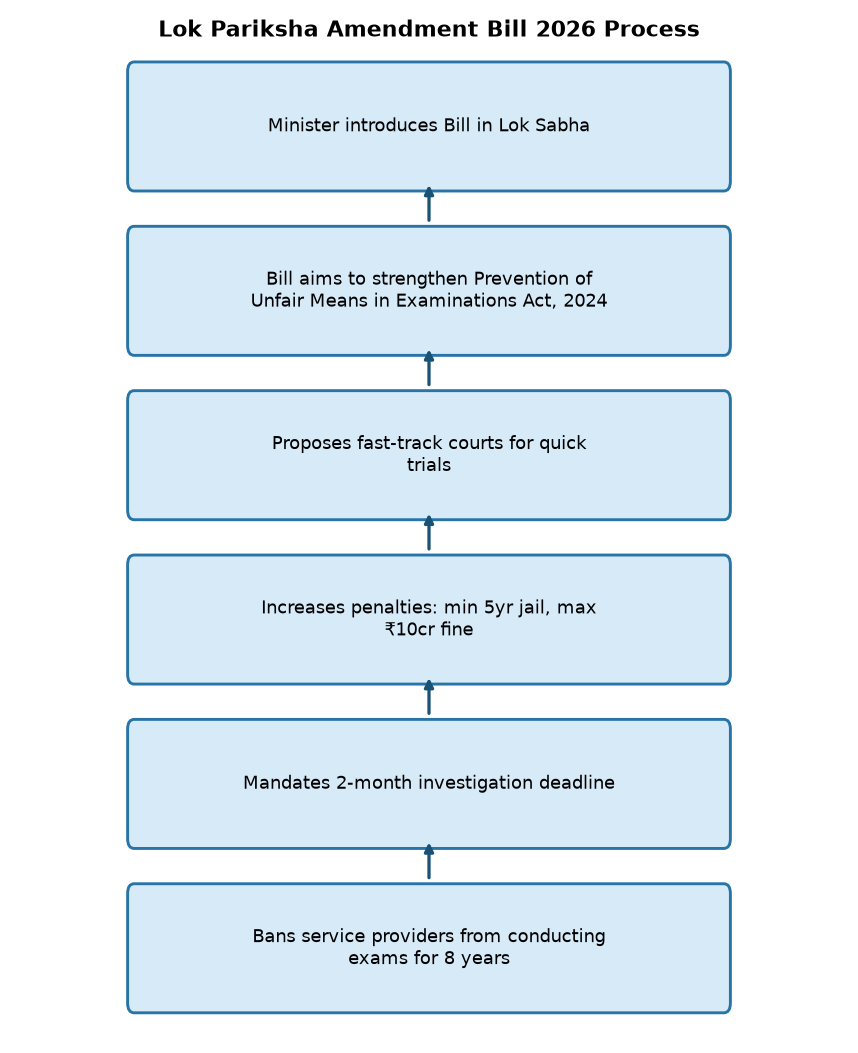
- The Bill seeks to amend the Lok Pariksha (Prevention of Unfair Means) Act, 2024 to introduce stricter penal provisions, expedited investigations, and fast-track judicial mechanisms for addressing examination-related frauds.
- It mandates the establishment of special fast-track courts to ensure daily hearings and disposal of cases within three months of charge-sheet filing, with appeals to be disposed of within three months.
- A new Section 12A is proposed to ensure investigations are completed within two months, with daily hearings in designated fast-track courts.
- A new Section 12B is proposed to limit appeals against fast-track court orders to 30 days, with mandatory disposal within three months by the High Court.
- The Bill empowers the central government to assign investigation of offences under the Act to a special task force, ensuring coordinated and expedited action against organised examination frauds.
- The amendments aim to deter organised criminal syndicates that exploit examination processes for pecuniary gains, thereby safeguarding the sanctity of competitive examinations.
Key Features
| Feature | Significance |
|---|---|
| Increased minimum imprisonment (3 to 5 years → 5 to 10 years) | Deters organised malpractices through harsher deterrence; aligns with global best practices in examination integrity. |
| Enhanced financial penalties (₹10 lakh to ₹50 lakh) | Increases cost of violation for individuals; acts as economic disincentive for malpractice. |
| Stricter penalties for service providers (₹1 crore to ₹5 crore fine, 4 to 8-year ban) | Holds intermediaries accountable; prevents repeat offences by disqualifying errant agencies. |
| Special fast-track courts with time-bound trials (2 months investigation, 3 months trial) | Ensures expeditious justice; reduces pendency in examination fraud cases. |
| Mandatory appointment of special public prosecutors | Improves prosecution efficiency; strengthens legal framework against organised crime in exams. |
Why it Matters
Governance and Administrative Integrity
- Strengthens the legal framework under the Public Examinations (Prevention of Unfair Means) Act, 2024, to safeguard the sanctity of competitive examinations.
- Enhances accountability of examination-conducting agencies and service providers, reducing systemic vulnerabilities.
- Demonstrates the state’s commitment to maintaining fairness in public employment and admissions.
Economic and Social Impact
- Protects the investments of millions of aspirants by ensuring examination integrity, thereby preserving meritocracy.
- Reduces financial losses incurred by governments and institutions due to examination fraud and re-conducts.
- Promotes social equity by preventing unfair advantages to a privileged few through organised malpractice.
Legal and Judicial Reforms
- Introduces procedural reforms such as fast-track adjudication and time-bound appeals, reducing judicial delays.
- Empowers specialised agencies for investigation, ensuring focused and expert-led probes into examination fraud.
- Aligns with the constitutional mandate of Article 14 (Right to Equality) by ensuring a level playing field in examinations.
Challenges
1. Implementation and Enforcement Gaps
- Risk of underutilisation of fast-track courts due to lack of adequate infrastructure or judicial capacity.
- Potential for selective targeting or misuse of provisions against political or administrative opponents.
- Challenges in coordinating between multiple agencies (e.g., NTA, UPSC, state bodies) for seamless enforcement.
UPSC Link: GS2: Role of statutory bodies
2. Technological and Operational Vulnerabilities
- Inability of existing digital safeguards to counter advanced methods of malpractice (e.g., deepfake question papers, AI-generated cheating tools).
- Dependence on third-party service providers for examination logistics, creating new avenues for collusion.
- Lack of real-time monitoring mechanisms to detect and prevent malpractice during examinations.
UPSC Link: GS3: Cybersecurity and digital governance
3. Legal and Constitutional Concerns
- Possibility of over-criminalisation leading to disproportionate punishment for minor infractions.
- Need for clear definitions of ‘unfair means’ to avoid ambiguity in prosecution.
- Balancing stringent penalties with principles of natural justice and due process.
UPSC Link: GS2: Fundamental Rights
Challenges — UPSC Perspective
| Issue | Concern |
|---|---|
| Infrastructure deficit for fast-track courts | Delays in justice delivery despite legal provisions. |
| Collusion between service providers and organised crime | Systemic corruption undermining examination integrity. |
| Lack of inter-agency coordination | Fragmented enforcement reduces efficacy of the Act. |
| Evolving nature of malpractice (AI, deepfakes) | Existing laws may become obsolete without technological updates. |
| Risk of false positives in investigations | Innocent individuals may face harassment due to stringent measures. |
Way Forward
- Establish a dedicated digital monitoring framework for real-time detection of malpractice during examinations.
- Conduct periodic audits of examination-conducting agencies to assess compliance with integrity protocols.
- Develop a national database of blacklisted service providers to prevent their re-engagement in future examinations.
- Strengthen collaboration between law enforcement agencies and cybersecurity experts to counter tech-driven malpractice.
- Introduce mandatory integrity training for examination staff and invigilators to sensitise them to emerging threats.
- Ensure adequate funding and infrastructure for fast-track courts to meet the timelines prescribed in the Bill.
- Promote public awareness campaigns to educate aspirants about legal consequences of malpractice and reporting mechanisms.
UPSC Value Addition
Keywords for Mains Answer-Writing
Lok Pariksha (Unfair Means Prevention) Amendment Bill 2026 · examination malpractice · fast-track courts for exam fraud · penalties for cheating in exams · Public Examination Act 2024 · organized exam fraud · UPSC, SSC, NTA · exam integrity · preventive measures in recruitment exams · judicial reforms for exam malpractice
Constitutional & Policy Linkages
- [‘Article 14: Equality before law and equal protection of laws (ensuring fair examinations).’]
- [‘Article 21: Right to livelihood and fair opportunity in public employment.’]
Concept Flow
Organised malpractice in examinations → Public outrage and loss of trust → Legislative response (Public Examinations Act, 2024) → Amendment to strengthen deterrence → Fast-track courts and special prosecutors → Time-bound justice → Restoration of examination integrity.
Prelims Practice Questions
Q1. Which of the following provisions is NOT included in the Lok Pariksha (Unfair Means Prevention) Amendment Bill, 2026?
- A. Mandatory completion of investigation within two months of filing FIR
- B. Establishment of special fast-track courts for speedy trial of exam fraud cases
- C. Increase in minimum imprisonment for exam fraud from 3 years to 5 years
- D. Exemption of government officials from prosecution under this Act
Answer: D. Exemption of government officials from prosecution under this Act — The Bill does not provide any exemption for government officials; it explicitly includes provisions for strict penalties and fast-track trials for all offenders, including service providers and managerial staff.
Q2. The Lok Pariksha (Unfair Means Prevention) Act, 2024, applies to examinations conducted by which of the following entities?
- A. Only Union Public Service Commission (UPSC) and Staff Selection Commission (SSC)
- B. UPSC, SSC, Railway Recruitment Board (RRB), and Institute of Banking Personnel Selection (IBPS) exclusively
- C. UPSC, SSC, RRB, IBPS, National Testing Agency (NTA), and other notified authorities by the Central Government
- D. Only central government ministries and their subordinate offices
Answer: C. UPSC, SSC, RRB, IBPS, National Testing Agency (NTA), and other notified authorities by the Central Government — The Act applies to examinations conducted by UPSC, SSC, RRB, IBPS, NTA, central government ministries/departments, and other notified authorities, covering a broad spectrum of recruitment exams.
Q3. Under the proposed amendments in the Lok Pariksha (Unfair Means Prevention) Amendment Bill, 2026, what is the maximum fine that can be imposed on service providers involved in exam malpractice?
- A. ₹1 crore
- B. ₹5 crore
- C. ₹10 crore
- D. ₹50 crore
Answer: C. ₹10 crore — The Bill proposes to increase the maximum fine for service providers from ₹1 crore to ₹10 crore, with additional penalties including disqualification from conducting exams for up to 8 years.
Mains Practice Question
✍ Critically examine the efficacy of the Lok Pariksha (Unfair Means Prevention) Amendment Bill, 2026, in addressing the menace of organized examination fraud in India. Substantiate your answer with reference to the proposed institutional mechanisms and penal provisions.
Approach: The candidate should analyze the Bill’s provisions such as fast-track courts, time-bound investigations, enhanced penalties, and disqualification of service providers, while assessing their potential to deter organized fraud. Highlight the gaps, if any, in enforcement mechanisms or jurisdictional overlaps, and suggest supplementary measures like technological interventions (AI-based proctoring) or multi-agency coordination to strengthen the legal framework.
Source: PIB (Press Information Bureau)
Generated by AanyaAi for educational purpose.

- उत्तराखंड राज्यपाल के 5 वर्ष: पांच मिशन और AI क्रांति का लेखा-जोखा - September 15, 2026
- UPSC Focus: Uttarakhand Governor’s 5-Year Journey & 5 Key Missions Explained - September 15, 2026
- AI का वादा और खतरा: क्या मानवता के लिए खतरा है कृत्रिम बुद्धिमत्ता? - September 15, 2026

No Comments