


29 Jul Kerala CM Challenges 16th Finance Commission’s Census Town Classification
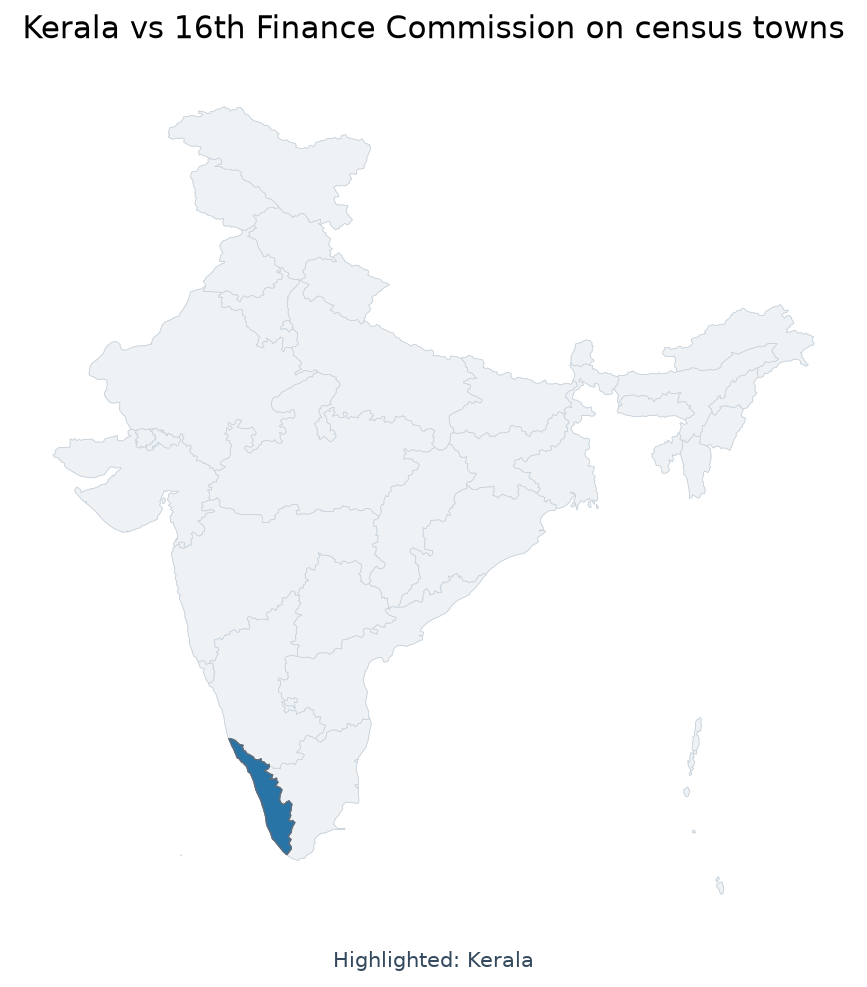
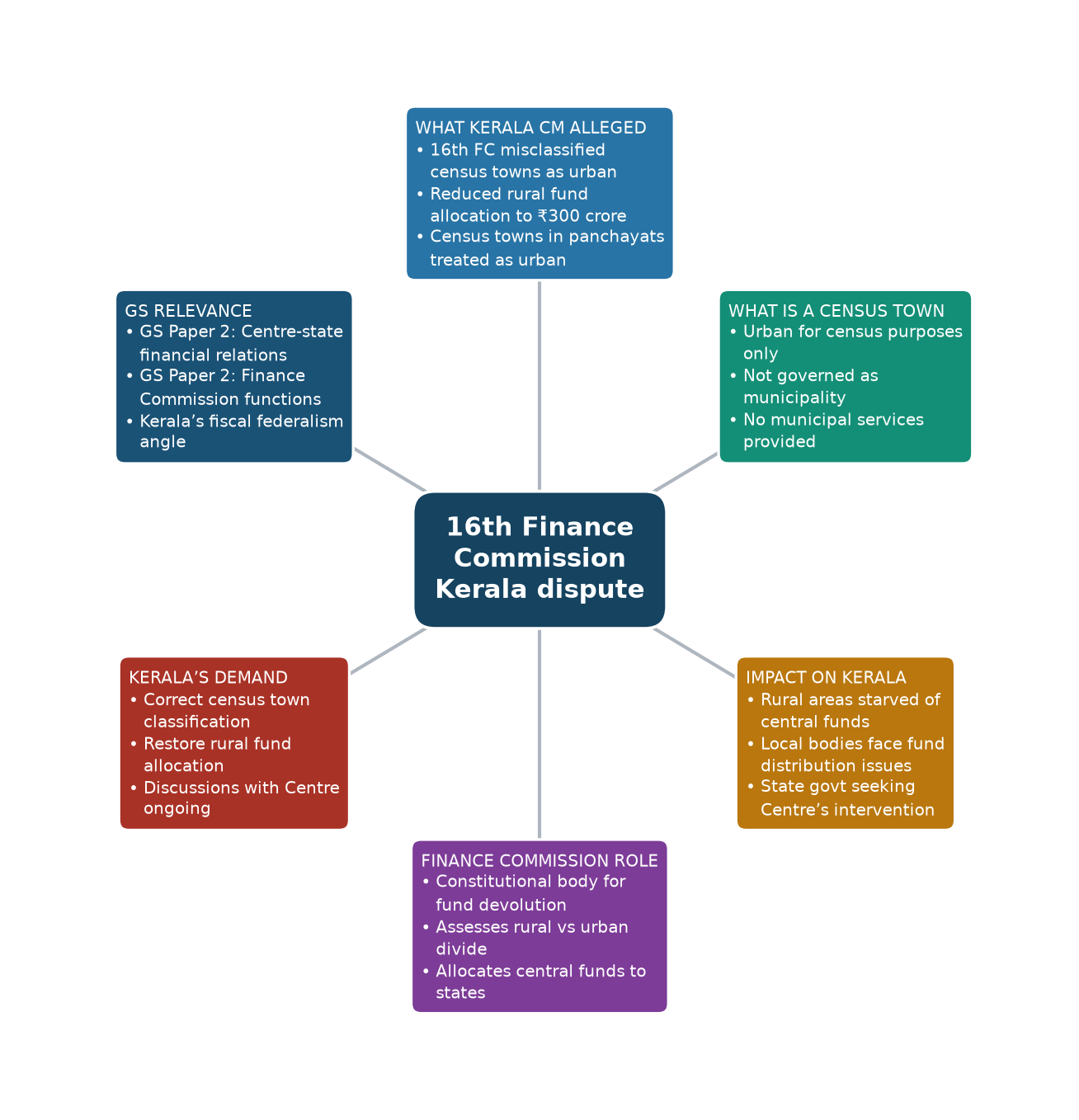
Map & concept mind-map: Kerala vs 16th Finance Commission on census towns
Subject Relevance — Where This Topic Fits
- GS Paper II — Functions and Responsibilities of the Union and the States, Issues and Challenges Pertaining to the Federal Structure | GS Paper III — Indian Economy and Issues Relating to Planning, Mobilisation of Resources, Growth, Development and Employment
- Prelims: 16th Finance Commission, Census Towns, Urban Local Bodies (ULBs), Panchayati Raj Institutions (PRIs), Vertical and Horizontal Devolution of Taxes, Article 280 of the Constitution
- Essay: The evolving dynamics of fiscal federalism in India: Balancing rural development and urbanisation, The role of data classification in governance: Challenges and consequences
Quick Revision: The Finance Commission’s classification of census towns as urban areas can distort the rural-urban divide in resource allocation, disproportionately affecting states with a high proportion of such settlements.
Why is this in the news?
The Chief Minister of Kerala has alleged that the 16th Finance Commission incorrectly classified census towns as urban areas, thereby reducing the allocation of central funds to rural areas in the state to a mere ₹300 crore. This misclassification is claimed to have distorted the distribution of funds to local bodies, particularly panchayats, and has raised concerns over the fiscal federalism framework in India. The issue underscores the broader challenges in defining and classifying urban and rural spaces, which have direct implications for resource allocation and governance.
Background
- The Finance Commission is a constitutional body constituted under Article 280 of the Constitution, tasked with recommending the distribution of tax revenues between the Union and the states and among the states themselves.
- Census towns are defined by the Census of India as places that possess urban characteristics (e.g., population density, non-agricultural workforce) but are not statutorily recognised as urban local bodies (ULBs) like municipalities or municipal corporations.
- Kerala, with its high population density and significant number of census towns, is particularly sensitive to the classification of urban and rural areas for resource allocation purposes.
- The Finance Commission’s methodology for classifying areas as urban or rural has historically been a subject of debate, particularly in states with a high proportion of census towns.
- The Constitution mandates that the Finance Commission must ensure that the distribution of funds is equitable, efficient, and based on objective criteria.
What are Census Towns and How Are They Classified?
- Census towns are defined by the Census of India as settlements with a population of at least 5,000, a density of at least 400 persons per square kilometre, and at least 75% of the male working population engaged in non-agricultural pursuits.
- Unlike statutory urban local bodies (ULBs), census towns lack formal municipal governance structures, such as elected municipal councils or revenue-generating powers.
- The classification of an area as a census town is based on decennial census data and does not automatically confer urban status for administrative or fiscal purposes.
- Census towns often exhibit urban characteristics in terms of infrastructure, services, and economic activities but remain administratively rural, falling under the jurisdiction of panchayats.
- The distinction between census towns and statutory urban areas is critical for the Finance Commission’s criteria for vertical and horizontal devolution of funds.
- The 74th Constitutional Amendment Act, 1992, sought to empower ULBs but left many census towns outside its ambit due to their non-statutory status.
- States like Kerala, Tamil Nadu, and West Bengal have a high concentration of census towns, which complicates the Finance Commission’s task of classifying areas for fund allocation.
Key Features
| Feature | Significance |
|---|---|
| Classification of census towns as urban areas | Alters the demographic and fiscal classification of localities, impacting fund allocation under the Finance Commission’s devolution formula. |
| Devolution of funds to local bodies | Determines the quantum of financial resources transferred from the Union to States and subsequently to rural and urban local governments. |
| Planned expenditure by State governments | Reflects the prioritisation of developmental outlays by States based on anticipated central transfers. |
| Shortfall in central funds | Creates fiscal gaps in State budgets, necessitating reallocation or reduction in planned expenditures. |
| Local body fund distribution | Affects the operational capacity of municipalities and panchayats to execute developmental projects. |
Why it Matters
Fiscal Federalism
- The Finance Commission’s assessment directly influences the horizontal devolution of resources among States, based on criteria such as population, income, and area.
- Misclassification of census towns distorts the fiscal balance between urban and rural entities, leading to inequitable fund distribution.
- Kerala’s contention highlights the need for accurate demographic and administrative data in fiscal assessments to ensure fairness in inter-State resource allocation.
Local Governance
- Census towns, though not statutorily urban, are treated as urban for census purposes, creating administrative ambiguity in fund utilisation.
- The misclassification affects the ability of panchayats to access central funds, which are often earmarked for rural development schemes.
- Local bodies lose financial autonomy when central funds are tied to urban-centric allocations, undermining grassroots governance.
Developmental Planning
- Planned expenditure by States is contingent on predictable central transfers; misclassification disrupts fiscal planning and project execution.
- Shortfalls in central funds force States to reallocate resources, potentially delaying or downscaling critical developmental initiatives.
- The reduction in planned expenditure, as cited by Kerala, underscores the cascading impact of fiscal misclassification on socio-economic development.
Data Accuracy in Policy
- The episode underscores the criticality of accurate and updated demographic data in policy formulation and fiscal transfers.
- Census towns, by definition, lack municipal governance but are treated as urban for statistical purposes; this duality requires nuanced fiscal treatment.
- States must advocate for precise data classification to prevent distortions in resource allocation and ensure equitable development outcomes.
Challenges
1. Misclassification of Census Towns
- Distorts the urban-rural divide in fiscal devolution, leading to inequitable fund allocation.
- Undermines the fiscal autonomy of panchayats by excluding them from rural development fund streams.
- Creates administrative confusion in fund utilisation, as central funds are often tied to urban or rural designations.
- Exacerbates fiscal stress for States by reducing the quantum of central transfers available for rural development.
UPSC Link: GS-II: Federalism, Local Governance
2. Fiscal Shortfalls in State Budgets
- Forces States to reallocate or reduce planned expenditures, impacting developmental priorities.
- Delays or downsizes critical infrastructure and social sector projects due to resource constraints.
- Undermines the predictability of central transfers, complicating long-term fiscal planning by States.
- May lead to inter-departmental conflicts over resource allocation, affecting policy coherence.
UPSC Link: GS-III: Public Finance
3. Administrative Ambiguity in Local Governance
- Census towns, though not statutorily urban, are treated as urban for census purposes, creating dual administrative identities.
- Lack of clear fiscal guidelines for census towns complicates fund utilisation and project execution by local bodies.
- Panchayats, despite administering census towns, are excluded from rural development fund streams, limiting their operational capacity.
- States face challenges in reconciling census data with administrative realities, leading to policy misalignments.
UPSC Link: GS-II: Local Governance
4. Data Discrepancies in Fiscal Transfers
- Inaccurate or outdated demographic data distorts the Finance Commission’s assessment of urban and rural areas.
- States must invest in robust data systems to ensure accurate classification of census towns and other administrative units.
- Lack of transparency in data collection and classification exacerbates fiscal inequities among States.
- The episode highlights the need for periodic reviews and updates of demographic and administrative data.
UPSC Link: GS-II: Federalism
5. Centre-State Fiscal Coordination
- States must engage in sustained advocacy to correct fiscal misclassifications, as seen in Kerala’s efforts to convince the Centre.
- Delays in resolving fiscal disputes between the Centre and States can disrupt developmental planning and project execution.
- The episode underscores the need for institutionalised mechanisms to address fiscal disputes and ensure equitable resource allocation.
- States may face challenges in reconciling their fiscal priorities with the Centre’s assessment criteria.
UPSC Link: GS-II: Centre-State Relations
Challenges — UPSC Perspective
| Issue | Concern |
|---|---|
| Misclassification of census towns | Distorts urban-rural fiscal devolution, reducing funds for rural areas. |
| Shortfall in central funds | Forces States to reallocate or reduce planned expenditures, impacting developmental projects. |
| Administrative ambiguity in local governance | Creates dual identities for census towns, complicating fund utilisation by panchayats. |
| Data discrepancies in fiscal transfers | Undermines the accuracy of Finance Commission assessments, leading to inequitable resource allocation. |
| Centre-State fiscal coordination | Delays in resolving disputes disrupt developmental planning and project execution. |
| Predictability of central transfers | Uncertainty in fund flows complicates long-term fiscal planning by States. |
Way Forward
- States must conduct a comprehensive audit of census towns and other administrative units to ensure accurate classification for fiscal purposes.
- The Finance Commission should incorporate a mechanism for periodic reviews of demographic and administrative data to prevent misclassification.
- States should establish a dedicated cell to coordinate with the Centre on fiscal disputes arising from data discrepancies.
- Local bodies, particularly panchayats, should be empowered with clear guidelines on fund utilisation for census towns within their jurisdiction.
- The Centre and States should collaborate on a unified data framework to ensure consistency in demographic and fiscal assessments.
- States should prioritise capacity-building for local bodies to enhance their ability to utilise central funds effectively.
- The Finance Commission should consider introducing a weighted devolution formula that accounts for the unique administrative status of census towns.
- States should advocate for the inclusion of census towns in rural development fund streams, given their administrative alignment with panchayats.
UPSC Value Addition
Keywords for Mains Answer-Writing
Sixteenth Finance Commission · Census towns · Urban-rural classification · Local body finance · Devolution of funds · Kerala fiscal federalism · Panchayati Raj Institutions · Planned expenditure · 15th Finance Commission · Article 280 · Fiscal federalism · Urban governance
Concept Flow
Census towns are classified as urban for census purposes but lack statutory urban governance, creating an administrative duality. → The 16th Finance Commission’s assessment treats these census towns as urban, altering the urban-rural demographic balance in fiscal devolution. → This misclassification reduces the quantum of funds allocated to rural areas, as rural local bodies (panchayats) are excluded from central fund streams. → States like Kerala face fiscal shortfalls, forcing reallocation or reduction in planned expenditures, impacting developmental projects. → The administrative ambiguity exacerbates fiscal inequities, as panchayats administering census towns are denied access to rural development funds. → States must engage in advocacy and data audits to correct the misclassification and restore fiscal balance. → The episode underscores the need for accurate data and institutionalised mechanisms to prevent such distortions in future fiscal assessments.
Prelims Practice Questions
Q1. Consider the following statements regarding census towns in India:
1. A census town is officially governed as a municipality or municipal corporation.
2. Census towns are treated as urban for census purposes but lack urban governance structures.
3. The 16th Finance Commission has included some census towns in Kerala under urban areas for fund allocation purposes.
How many of the above statements are correct?
- Only one
- Only two
- All three
- None
Answer: Only two — Statement 1 is incorrect because census towns are not officially governed as municipalities. Statements 2 and 3 are correct as they accurately describe the nature of census towns and the issue raised by Kerala’s Chief Minister regarding the 16th Finance Commission’s assessment.
Q2. Assertion (A): The 16th Finance Commission’s classification of census towns as urban areas has reduced the allocation of funds to rural areas in Kerala.
Reason (R): The Finance Commission’s criteria for urban-rural classification are based solely on population density and do not account for governance structures.
In the context of the above two statements, which one of the following is correct?
- Both A and R are true and R is the correct explanation of A
- Both A and R are true but R is not the correct explanation of A
- A is true but R is false
- A is false but R is true
Answer: A is true but R is false — Assertion (A) is true as per the news report. Reason (R) is partially true but incomplete because the Finance Commission’s criteria also include other factors like population size and economic activity, not solely population density. Hence, R does not fully explain A.
Q3. Match the following pairs related to Finance Commissions in India:
Column I (Finance Commission) Column II (Key Features)
A. 14th Finance Commission 1. Increased the share of States in the divisible pool of taxes to 42%
B. 15th Finance Commission 2. Introduced performance-based incentives for local bodies
C. 16th Finance Commission 3. Recommended a fiscal deficit target of 3% of GDP for States
D. 13th Finance Commission 4. Focused on balancing equity and efficiency in devolution
Select the correct match:
- A-1, B-2, C-4, D-3
- A-2, B-1, C-3, D-4
- A-4, B-3, C-2, D-1
- A-3, B-4, C-1, D-2
Answer: A-1, B-2, C-4, D-3 — The 14th Finance Commission (2015-20) increased the States’ share to 42% (A-1). The 15th Finance Commission (2020-25) introduced performance-based incentives for local bodies (B-2). The 16th Finance Commission’s key features are still under formulation, but it is expected to focus on balancing equity and efficiency (C-4). The 13th Finance Commission (2010-15) recommended a fiscal deficit target of 3% of GDP for States (D-3).
Mains Practice Question
✍ The classification of census towns as urban areas by the 16th Finance Commission has led to a significant reduction in fund allocation to rural areas in Kerala, thereby disrupting fiscal federalism. Critically examine this assertion with reference to the constitutional provisions governing the Finance Commission, the criteria for urban-rural classification, and the implications for local governance. (15 Marks)
Approach: MODEL-ANSWER SKELETON:
1. Constitutional Provisions: Article 280 of the Constitution establishes the Finance Commission (FC) to recommend principles governing the distribution of taxes between the Union and States and among States. The FC’s recommendations are advisory but carry significant weight in fiscal federalism.
2. Criteria for Urban-Rural Classification: The FC uses multiple criteria, including population size, density, economic activity, and governance structures. Census towns, defined in the Census of India, are settlements with a population of 5,000+, density of 400 persons per sq km, and 75%+ male workforce engaged in non-agricultural activities. However, they lack municipal governance.
3. Issue Raised by Kerala: The 16th FC’s inclusion of census towns under urban areas for fund allocation has reduced rural allocations in Kerala to ₹300 crore, disrupting planned expenditure for local bodies. This raises questions about the FC’s interpretation of ‘urban’ under Article 280.
4. Implications for Local Governance: Panchayati Raj Institutions (PRIs) and municipalities rely on FC devolution. Misclassification risks underfunding rural areas, exacerbating urban-rural disparities. The FC’s mandate under Article 280(3)(c) includes reviewing the financial position of PRIs, implying a need for accurate urban-rural delineation.
5. Balancing Views: Supporters of the FC’s approach argue that census towns exhibit urban characteristics and should be treated as such for equitable resource distribution. Critics contend that governance structures (e.g., lack of municipal bodies) justify their inclusion in rural allocations to preserve fiscal federalism.
6. Way Forward: The FC must clarify its criteria for urban-rural classification, ensuring alignment with constitutional principles and local governance realities. Kerala’s efforts to engage the Centre highlight the need for a consultative process in FC recommendations.
7. Relevant Case/Committee: The 15th FC’s recommendations on performance-based incentives for local bodies (e.g., sanitation, health) could serve as a model for addressing such discrepancies in future FCs.
Source: Hindustan Times
Generated by AanyaAi for educational purpose.

- भारत-आसियान व्यापार 128 अरब डॉलर तक पहुंचा, जानिए क्या हुआ 14वें पूर्वी एशिया शिखर सम्मेलन में - September 24, 2026
- UPSC Focus: India’s Role in 14th EAS & 23rd ASEAN-India Economic Meetings - September 24, 2026
- यूपीएससी-एसयूवाई: कचरा उठाने से मिली आर्थिक सुरक्षा, सरकारी योजना से बदला जीवन - September 24, 2026

No Comments