


24 Sep UPSC Focus: India’s Role in 14th EAS & 23rd ASEAN-India Economic Meetings
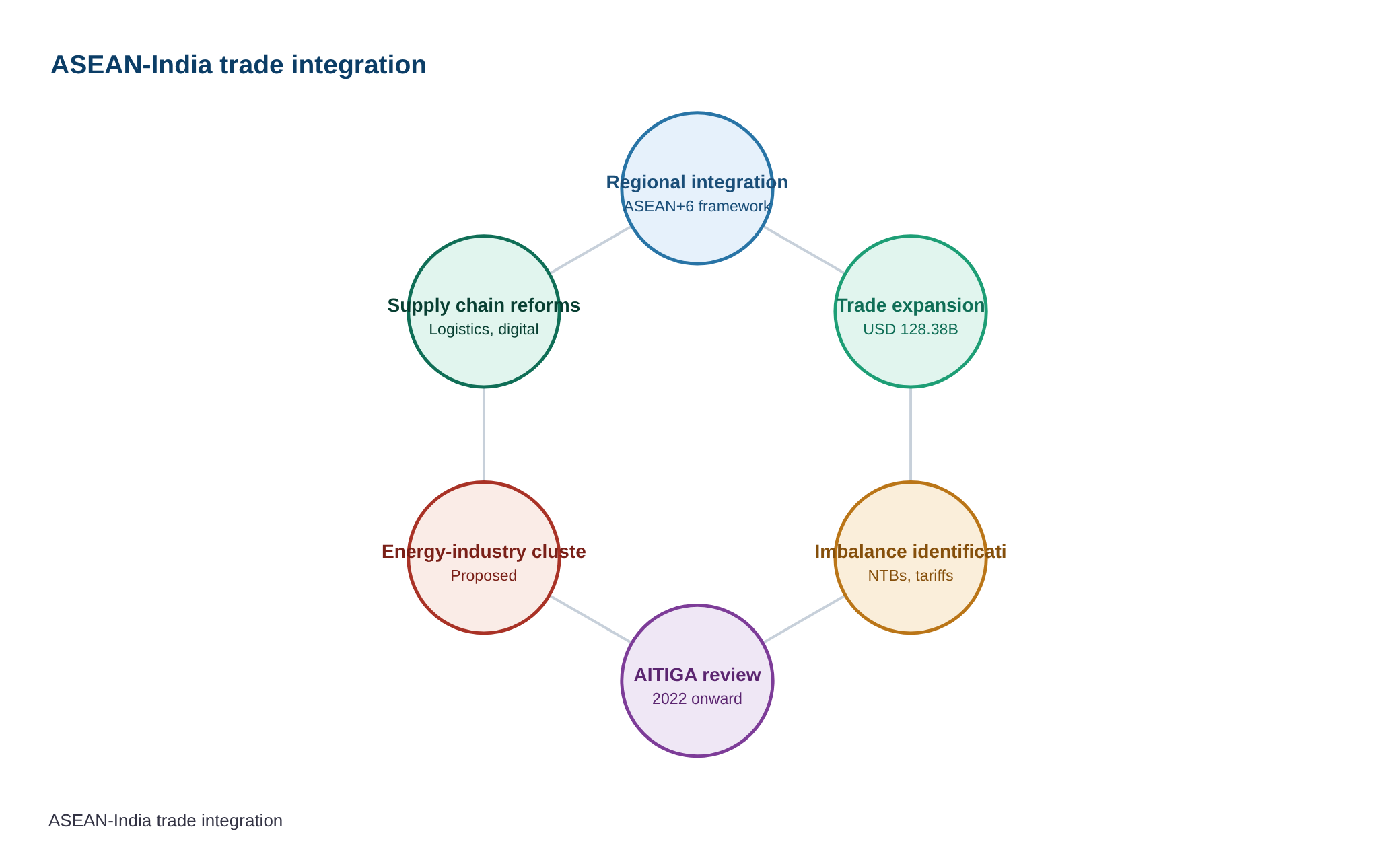
✎ The AITIGA review aims to balance trade flows, reduce non-tariff barriers, and align India-ASEAN trade with global supply chain resilience under the Act East Policy.
Subject Relevance — Where This Topic Fits
- GS Paper II — International Relations: Regional Groupings and Agreements involving India
- Prelims: ASEAN, East Asia Summit, AITIGA, ERIA, Trade in Goods Agreement, Regional Comprehensive Economic Partnership (RCEP), India-ASEAN FTA, Energy Security, Industrial Clusters
- Essay: India’s Act East Policy: Opportunities and Challenges in the Indo-Pacific, The Role of Regional Economic Integration in Sustainable Development
Quick Revision: The AITIGA review aims to balance trade flows, reduce non-tariff barriers, and align India-ASEAN trade with global supply chain resilience under the Act East Policy.
Why is this in the news?
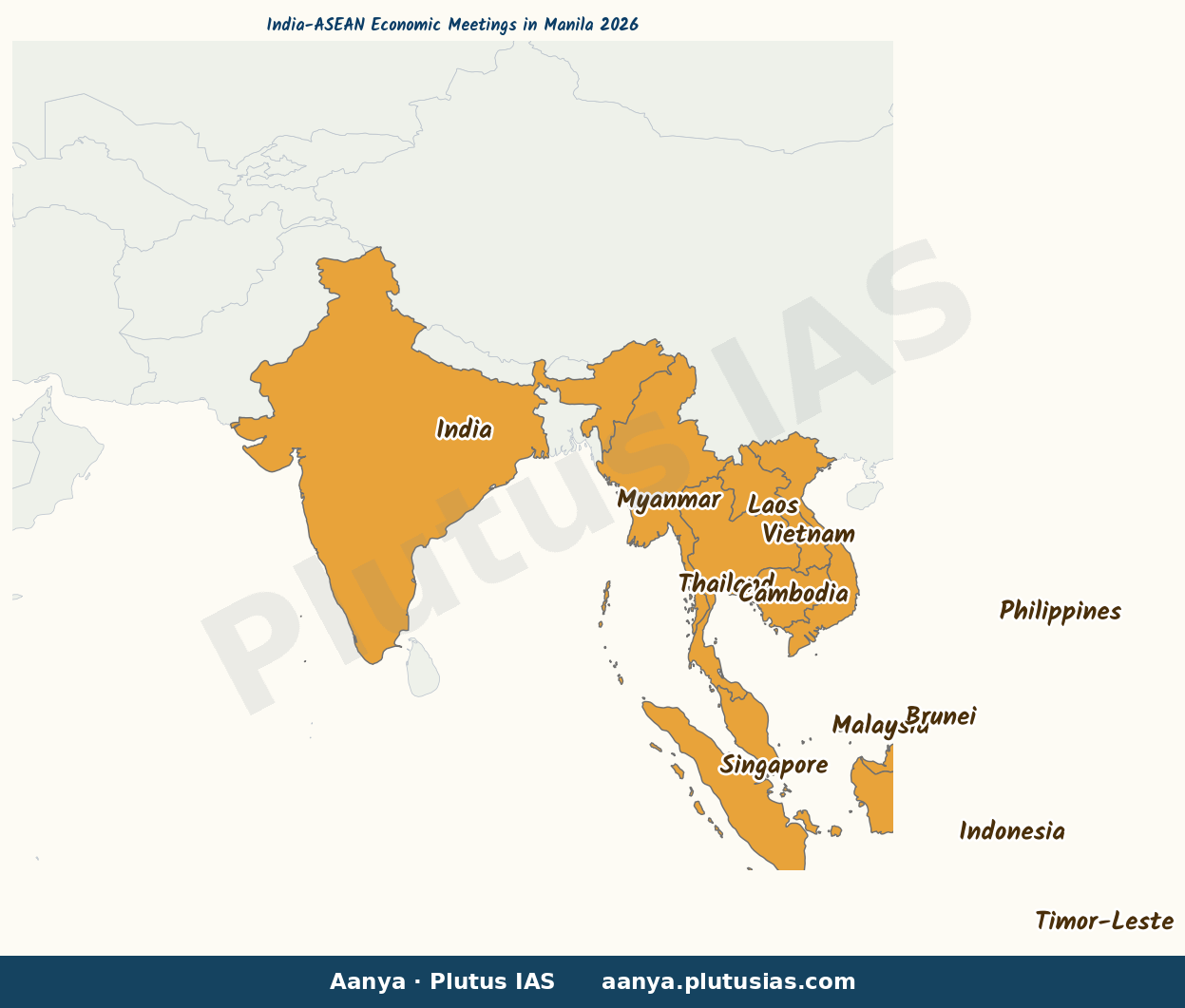
India participated in the 14th East Asia Summit (EAS) Economic Ministers’ Meeting (EMM) and the 23rd ASEAN-India Economic Ministers’ Consultation in Manila, Philippines, on 24 September 2026. These engagements are significant as they underscore India’s commitment to deepening economic ties with ASEAN amid evolving regional trade dynamics, including the ongoing review of the ASEAN-India Trade in Goods Agreement (AITIGA) and the pursuit of mutually beneficial trade frameworks.
Background
- The ASEAN-India partnership, formalised in 1992, has evolved into a comprehensive dialogue mechanism covering trade, investment, and connectivity.
- The ASEAN-India Free Trade Area (AIFTA) was operationalised in 2010, reducing tariffs on over 90% of traded goods, though trade imbalances persisted.
- The Regional Comprehensive Economic Partnership (RCEP), signed in 2020, excluded India, prompting a renewed focus on bilateral and sub-regional trade arrangements with ASEAN.
- The East Asia Summit (EAS), established in 2005, includes 18 members and serves as a platform for strategic economic and security dialogue in the Indo-Pacific.
- India’s Act East Policy, launched in 2014, prioritises economic integration with ASEAN and East Asia through trade, infrastructure, and people-to-people ties.
- The ASEAN-India Trade in Goods Agreement (AITIGA) was signed in 2009 and has been under review since 2022 to address trade imbalances and enhance market access.
What are the East Asia Summit (EAS) and ASEAN-India Economic Ministerial Consultations?
- The East Asia Summit (EAS) is a premier leaders-led forum for strategic dialogue and cooperation in the Indo-Pacific, established in 2005. It includes 18 member states: ASEAN-10, Australia, China, India, Japan, New Zealand, South Korea, Russia, and the United States.
- The EAS Economic Ministers’ Meeting (EAS-EMM) is a Track 1.5 dialogue mechanism where economic ministers and senior officials discuss trade, investment, and regional economic integration, aligning with the EAS’s broader security and strategic objectives.
- ASEAN-India Economic Ministers’ Consultation is a bilateral mechanism established under the ASEAN-India Free Trade Area (AIFTA) framework, held annually to review trade agreements, resolve disputes, and explore new areas of economic cooperation.
- The 23rd ASEAN-India Economic Ministers’ Consultation in 2026 focused on the mid-term review of the AITIGA, aiming to enhance trade facilitation, address non-tariff barriers, and promote balanced trade flows.
- The EAS and ASEAN-India dialogues are critical for addressing supply chain resilience, digital trade, and energy security in the context of global geopolitical shifts and economic fragmentation.
- The ASEAN Secretariat and the Economic Research Institute for ASEAN and East Asia (ERIA) provide analytical inputs to support evidence-based policymaking in these forums.
Key Features
| Feature | Significance |
|---|---|
| 14th East Asia Summit – Economic Ministers’ Meeting (EAS-EMM) | Provides a multilateral platform for dialogue on regional economic integration, trade facilitation, and supply-chain resilience among 18 EAS partner countries, including India. |
| 23rd ASEAN-India Economic Ministers’ Consultation | Institutionalises bilateral trade policy coordination between India and ASEAN’s 10 member states, ensuring alignment with the ASEAN Economic Community Blueprint. |
| ASEAN-India Trade in Goods Agreement (AITIGA) Review | Aims to modernise tariff structures, address non-tariff barriers, and correct trade imbalances to enhance two-way merchandise trade, currently valued at USD 128.38 billion (2025-26). |
| Regional Economic Outlook 2027 (ASEAN Secretariat) | Offers forward-looking analysis of trade and investment flows, enabling policymakers to anticipate structural shifts in supply chains and demand patterns. |
| ERIA Research Paper on ‘Powering the EAS Region’s Next Wave of Growth’ | Proposes an integrated framework linking energy security, industrial clusters, and digital infrastructure to sustain high-value manufacturing and export competitiveness. |
Why it Matters
Economic Integration
- Strengthens India’s position within the ASEAN+6 framework, deepening trade and investment linkages with East and Southeast Asia.
Trade Policy Modernisation
- The AITIGA review seeks to harmonise standards, reduce transaction costs, and improve market access for Indian MSMEs and ASEAN firms.
Supply Chain Resilience
- Discussions focused on diversifying trade routes, reducing dependency on single markets, and enhancing logistics efficiency in the Indo-Pacific.
Energy and Industrial Strategy
- The ERIA paper highlights the need for joint investments in renewable energy infrastructure and smart industrial parks to support green transition.
Global Value Chain Participation
- India’s engagement in EAS-EMM and ASEAN-India forums positions it to capture higher value-added segments in electronics, pharmaceuticals, and automotive components.
Challenges
1. Trade Imbalance in AITIGA
- India’s trade deficit with ASEAN widened to USD 38.2 billion in 2025-26, driven by higher imports of electronics, palm oil, and chemicals.
UPSC Link: WTO rules on trade remedies
2. Non-Tariff Barriers (NTBs)
- Divergent sanitary and phytosanitary (SPS) norms, technical regulations, and customs procedures increase compliance costs for exporters.
UPSC Link: WTO Agreement on TBT
3. Logistics and Connectivity Gaps
- Inadequate port infrastructure, cross-border rail links, and digital trade facilitation systems hinder seamless movement of goods.
UPSC Link: Sagarmala and Bharatmala projects
4. Energy Transition Costs
- High capital expenditure required for renewable energy integration and grid modernisation poses fiscal challenges for ASEAN and India.
UPSC Link: Paris Agreement commitments
5. Geopolitical Fragmentation
- Rising trade blocs (CPTPP, RCEP) and unilateral tariffs may divert trade flows away from India-ASEAN corridors.
UPSC Link: WTO dispute settlement mechanism
Challenges — UPSC Perspective
| Issue | Concern |
|---|---|
| Trade Deficit | Structural imbalance in merchandise trade, particularly in electronics and chemicals. |
| Regulatory Divergence | Lack of harmonised standards across ASEAN member states increases compliance burden. |
| Infrastructure Bottlenecks | Limited port capacity and cross-border rail networks delay cargo movement. |
| Digital Trade Barriers | Fragmented e-commerce regulations and data localisation norms hinder cross-border services. |
| Climate Policy Alignment | Differing carbon pricing mechanisms and renewable energy subsidies distort market signals. |
| Currency Volatility | Fluctuations in USD-INR and ASEAN currencies impact pricing and profitability of traded goods. |
Way Forward
- Conclude the AITIGA review with a balanced outcome that reduces tariffs on labour-intensive sectors while protecting sensitive industries.
- Launch a joint ASEAN-India logistics corridor under the ASEAN Connectivity Master Plan 2025 to improve port efficiency and cross-border rail links.
- Establish a digital trade facilitation task force to harmonise e-commerce regulations and reduce data localisation barriers.
- Create a green energy investment fund to co-finance renewable energy projects in ASEAN and India, aligning with the ASEAN Power Grid initiative.
- Develop a dispute resolution mechanism for non-tariff barriers to provide timely redress for exporters facing regulatory hurdles.
- Enhance trade promotion activities through ‘Brand India’ campaigns in ASEAN markets to diversify export baskets beyond traditional items.
- Strengthen institutional linkages between India’s Export Credit Guarantee Corporation (ECGC) and ASEAN counterparts to mitigate payment risks.
UPSC Value Addition
Keywords for Mains Answer-Writing
ASEAN-India economic relations · ASEAN-India Trade in Goods Agreement (AITIGA) · Regional Comprehensive Economic Partnership (RCEP) · East Asia Summit (EAS) · India-ASEAN bilateral trade · Trade facilitation mechanisms · Economic diplomacy · Indo-Pacific economic integration · Foreign Trade Policy of India · Regional economic blocs · Trade deficit management · Non-tariff barriers in trade · Digital trade and industrial clusters · Energy security in trade agreements
Concept Flow
Regional economic integration → Expansion of ASEAN-India trade (USD 128.38 billion) → Identification of trade imbalances and NTBs → Initiation of AITIGA review → Proposal for integrated energy-industry clusters → Policy recommendations for supply chain resilience → Implementation of logistics and digital trade reforms → Enhanced participation in global value chains → Sustainable economic growth in the Indo-Pacific.
Prelims Practice Questions
Q1. Consider the following statements regarding the ASEAN-India Trade in Goods Agreement (AITIGA):
1. AITIGA aims to enhance trade flows between India and ASEAN nations.
2. AITIGA is currently under review to address trade imbalances.
3. AITIGA includes provisions for non-tariff barriers only.
4. AITIGA was signed in 2010 and came into force immediately.
How many of the above statements are correct?
- Only one
- Only two
- Only three
- All
Answer: Only three — Statements 1 and 2 are correct as AITIGA aims to enhance trade flows and is under review to address trade imbalances. Statement 3 is incorrect because AITIGA addresses both tariff and non-tariff barriers. Statement 4 is incorrect as AITIGA was signed in 2009 and came into force in 2010, not immediately.
Q2. Which of the following institutions is responsible for presenting economic research papers at the East Asia Summit (EAS) meetings?
- A. ASEAN Secretariat
- B. ASEAN+3 Macroeconomic Research Office (AMRO)
- C. Economic Research Institute for ASEAN and East Asia (ERIA)
- D. World Bank
Answer: C. Economic Research Institute for ASEAN and East Asia (ERIA) — The Economic Research Institute for ASEAN and East Asia (ERIA) is tasked with presenting research papers at EAS meetings, including on energy security and industrial clusters.
Q3. Assertion (A): India’s bilateral trade with ASEAN reached USD 128.38 billion in 2025-26.
Reason (R): The ASEAN-India Trade in Goods Agreement (AITIGA) has successfully eliminated all trade barriers between India and ASEAN.
In the context of the above statements, which of the following is correct?
- Both A and R are true, and R is the correct explanation of A
- Both A and R are true, but R is NOT the correct explanation of A
- A is true, but R is false
- A is false, but R is true
Answer: A is true, but R is false — Assertion (A) is true as India’s bilateral trade with ASEAN reached USD 128.38 billion in 2025-26. However, Reason (R) is false because AITIGA has not eliminated all trade barriers; it is under review to address trade imbalances and other barriers.
Mains Practice Question
✍ The ASEAN-India Trade in Goods Agreement (AITIGA) is a cornerstone of India’s economic diplomacy in the Indo-Pacific region. Critically examine the challenges faced by AITIGA in achieving its objectives of enhancing trade flows and addressing trade imbalances between India and ASEAN. Also, outline the measures being undertaken to reform AITIGA in contemporary times. (15 Marks)
Approach: MODEL-ANSWER SKELETON:
1. **Introduction (2 Marks)**
– Brief overview of AITIGA: signed in 2009, came into force in 2010, covering goods trade between India and ASEAN.
– Objective: Enhance trade flows, reduce tariff and non-tariff barriers, and address trade imbalances.
2. **Challenges in Achieving Objectives (6 Marks)**
– **Trade Imbalance**: India’s trade deficit with ASEAN widened despite AITIGA, reaching USD 44 billion in 2025-26.
– **Non-Tariff Barriers (NTBs)**: Persistent issues such as sanitary and phytosanitary (SPS) measures, technical barriers to trade (TBT), and customs procedures.
– **Rules of Origin (RoO)**: Complex RoO criteria leading to circumvention and misuse of trade benefits.
– **Sectoral Imbalances**: Over-reliance on certain sectors (e.g., electronics, chemicals) while others (e.g., agriculture, textiles) face stiff competition.
– **Regional Economic Integration**: Competition from other blocs like RCEP and the EU-ASEAN FTA.
3. **Reforms and Contemporary Measures (5 Marks)**
– **Review of AITIGA**: Ongoing negotiations to simplify RoO, reduce NTBs, and address trade imbalances.
– **Digital Trade and Industrial Clusters**: Integration of digital trade and energy security frameworks (as highlighted in ERIA’s research paper).
– **Enhanced Trade Facilitation**: Streamlining customs procedures, mutual recognition agreements, and capacity building.
– **Diversification of Trade**: Focus on services trade, investment, and MSMEs to reduce over-reliance on goods trade.
– **Institutional Mechanisms**: Strengthening the ASEAN-India Business Council and joint committees for dispute resolution.
4. **Conclusion (2 Marks)**
– AITIGA remains critical for India’s Act East Policy and Indo-Pacific economic integration.
– Success depends on balancing trade liberalization with domestic industry protection and addressing structural challenges.
Source: PIB (Press Information Bureau)
Generated by AanyaAi for educational purpose.
Related guides on our sites
- Best PSIR optional coaching for upsc
- Best economics optional coaching for upsc
- Best PSIR optional teacher for upsc
- Best teacher of PSIR optional for upsc

- हिमाचल में प्रमाण पत्रों पर लगेगा शुल्क, जानिए नई दरें और प्रक्रिया - September 25, 2026
- Himachal Pradesh Introduces Fees for Birth, Marriage & Family Certificates - September 25, 2026
- आईसीएआई ने सीए पाठ्यक्रम में एआई, ईएसजी और वैश्विक कार्यक्रम शामिल करने की योजना बनाई - September 25, 2026

No Comments