


30 Jul Vande Mataram Bill in Lok Sabha: Key UPSC Polity Updates for Exam 2026
Subject Relevance — Where This Topic Fits
- GS Paper II — Polity and Governance | GS Paper III — Economy and Social Justice
- Prelims: Prevention of Insults to National Honour Act, 1971, Supreme Court (Number of Judges) Act, 1956, Public Examination (Prevention of Unfair Means) Amendment Bill, 2026, MSME Development Act, 2006, Labour Codes and gig economy, e-Shram portal
- Essay: The role of Parliament in safeguarding national symbols and cultural heritage, Balancing security and civil liberties in legislative frameworks
Quick Revision: The Prevention of Insults to National Honour (Amendment) Bill, 2026 seeks to criminalise the disruption of ‘Vande Mataram’, placing it on par with the national anthem under the 1971 Act.
Why is this in the news?
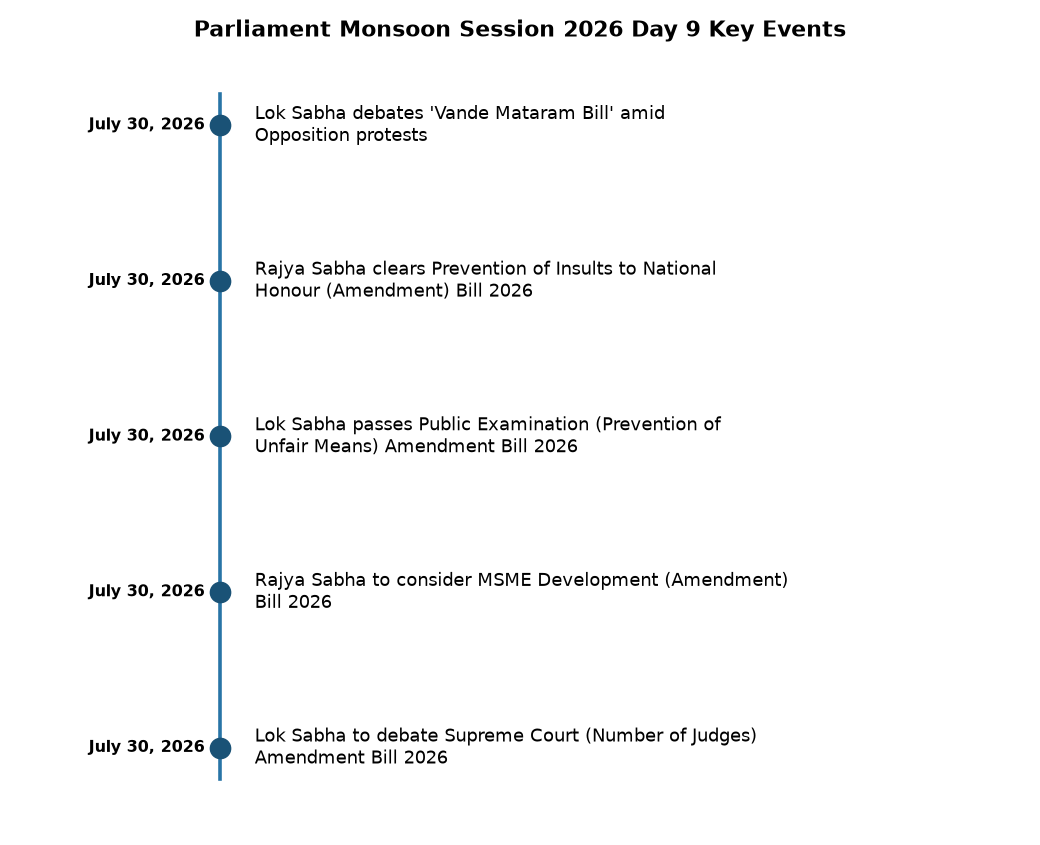
The Monsoon Session 2026 of Parliament has witnessed significant legislative activity, including the introduction and passage of bills aimed at strengthening national symbols, enhancing judicial capacity, and curbing examination malpractices. The ‘Vande Mataram Bill’ seeks to elevate the national song to a legal status equivalent to the national anthem, while amendments to the Supreme Court (Number of Judges) Act aim to increase the sanctioned strength of the apex court. Concurrently, the Public Examination (Prevention of Unfair Means) Amendment Bill has been passed to address the menace of exam paper leaks, reflecting the government’s commitment to upholding integrity in public examinations.
Background
- The Prevention of Insults to National Honour Act, 1971, currently protects the national flag, national anthem, and constitution of India from acts of insult or disrespect.
- The Supreme Court (Number of Judges) Act, 1956, originally fixed the maximum number of judges in the Supreme Court at 11, which has been amended multiple times to accommodate the growing judicial workload.
- The MSME Development Act, 2006, provides the legal framework for the promotion, development, and enhancement of competitiveness of micro, small, and medium enterprises in India.
- The Labour Codes, enacted in 2020, aim to consolidate and simplify labour laws in India, including provisions for gig workers and their social security.
- The e-Shram portal, launched in 2021, is a national database of unorganised workers, including gig workers, to facilitate their registration and access to social security benefits.
Key Legislative Developments in the Monsoon Session 2026
- The Prevention of Insults to National Honour (Amendment) Bill, 2026 seeks to amend the 1971 Act to include the intentional disruption or prevention of the singing of ‘Vande Mataram’ as a punishable offence, placing it on par with the national anthem, ‘Jana Gana Mana’.
- The Supreme Court (Number of Judges) Amendment Bill, 2026 proposes to increase the sanctioned strength of the Supreme Court from 34 to 38 judges, excluding the Chief Justice of India, to address the mounting backlog of cases and enhance judicial efficiency.
- The MSME Development (Amendment) Bill, 2026 aims to streamline compliance, improve payment systems, and expedite dispute resolution for micro, small, and medium enterprises, thereby fostering a conducive business environment.
- The recognition of gig workers under the Labour Codes and their inclusion in the e-Shram portal reflects the government’s efforts to extend social security benefits to this emerging segment of the workforce.
Key Features
| Feature | Significance |
|---|---|
| Prevention of Insults to National Honour (Amendment) Bill, 2026 | Elevates ‘Vande Mataram’ to the same legal protection as the national anthem, reinforcing cultural nationalism and social cohesion under Article 51A(a) of the Constitution. |
| Supreme Court (Number of Judges) Amendment Bill, 2026 | Increases the sanctioned strength of the Supreme Court from 34 to 38 judges, addressing judicial pendency and enhancing constitutional adjudication capacity. |
| Public Examination (Prevention of Unfair Means) Amendment Bill, 2026 | Strengthens legal deterrence against examination malpractices, ensuring fairness in competitive examinations critical for merit-based governance recruitment. |
| MSME Development (Amendment) Bill, 2026 | Introduces reforms to streamline compliance, improve payment mechanisms, and expedite dispute resolution for MSMEs, fostering economic resilience and employment generation. |
| Recognition of gig workers in Labour Codes | Formalises gig economy workers within the social security framework, addressing precarity and aligning with evolving labour market dynamics. |
Why it Matters
Constitutional and Legal
- The ‘Vande Mataram Bill’ operationalises Article 51A(a) of the Constitution, which enjoins citizens to cherish and follow the noble ideals of the freedom struggle, including national symbols.
- The Supreme Court judge strength amendment addresses the constitutional mandate under Article 124(1) to ensure an adequate number of judges for efficient justice delivery.
- The examination malpractice law reinforces Articles 14 and 16, ensuring equality of opportunity in public employment examinations.
Economic and Social
- MSME reforms aim to reduce compliance burdens, improve cash flows, and resolve disputes expeditiously, directly impacting 6.3 crore MSMEs that contribute ~30% to GDP and 45% to exports.
- Gig worker recognition under Labour Codes provides a legal basis for social security coverage, addressing the informalisation of the workforce and reducing vulnerability.
- Strengthening judicial capacity through higher judge strength can expedite case disposal, reducing the pendency of ~5 crore pending cases in Indian courts.
Governance and Institutional
- The legislative agenda reflects the government’s emphasis on institutional reforms to enhance transparency, accountability, and efficiency in public examinations and judicial processes.
- The Opposition’s disruption during debates underscores the need for consensus-building in Parliament to ensure smooth legislative functioning.
- Expungement of remarks in parliamentary records highlights the importance of decorum and the role of parliamentary authorities in maintaining institutional integrity.
Challenges
1. Parliamentary Disruptions and Legislative Gridlock
- Frequent adjournments and disruptions in the Monsoon Session impede legislative productivity, delaying critical reforms.
- Opposition protests over police action during student agitations reflect broader societal tensions that can spill into legislative debates.
- Expungement of remarks risks eroding transparency and public trust in parliamentary proceedings.
UPSC Link: Parliamentary Procedures and Conduct
2. Judicial Pendency and Infrastructure Constraints
- Despite increasing judge strength, systemic issues such as inadequate infrastructure, vacancies in subordinate judiciary, and archaic processes may limit the impact of the amendment.
- The Supreme Court’s sanctioned strength increase must be accompanied by better case management systems to ensure timely justice delivery.
UPSC Link: Judicial Reforms and Pendency
3. Implementation Gaps in Labour and Social Security Reforms
- While gig workers are recognised in Labour Codes, the actualisation of social security benefits hinges on effective implementation and enrolment on portals like e-Shram.
- The gap between ILO-prescribed frameworks and domestic implementation may lead to suboptimal coverage and benefits for informal workers.
UPSC Link: Informal Sector and Labour Codes
4. Examination Malpractices and Institutional Integrity
- The amendment bill addresses legal deterrence but does not resolve systemic issues such as weak invigilation, technological vulnerabilities, or collusion in examination bodies.
- Ensuring fairness in examinations requires multi-stakeholder coordination among education boards, technology providers, and law enforcement agencies.
UPSC Link: Ethics in Governance and Examination Reforms
Challenges — UPSC Perspective
| Issue | Concern |
|---|---|
| Parliamentary disruptions | Delays legislative agenda and erodes institutional trust |
| Judicial pendency | Undermines constitutional guarantee of timely justice |
| Gig worker social security | Implementation gaps may leave workers without benefits |
| Examination malpractices | Systemic vulnerabilities persist despite legal deterrence |
| MSME compliance burden | Complex regulations deter entrepreneurship and growth |
Way Forward
- Strengthen parliamentary discipline through strict adherence to Rules of Procedure and Conduct of Business in Parliament to minimise disruptions.
- Accompany the Supreme Court judge strength amendment with infrastructure upgrades, digital case management, and appointment of additional support staff.
- Establish a multi-agency task force comprising education boards, technology providers, and law enforcement to address examination malpractices holistically.
- Launch a nationwide awareness campaign to enrol gig workers on e-Shram and ensure seamless integration with social security schemes.
- Simplify MSME compliance by digitising processes, reducing documentation, and establishing dedicated dispute resolution mechanisms.
- Conduct periodic reviews of Labour Codes implementation to identify and rectify gaps in gig worker coverage and benefit delivery.
- Enhance inter-ministerial coordination to ensure that legislative reforms are complemented by executive action and judicial support.
UPSC Value Addition
Keywords for Mains Answer-Writing
Vande Mataram Bill 2026 · Prevention of Insults to National Honour (Amendment) Bill, 2026 · National Song vs National Anthem · Supreme Court (Number of Judges) Amendment Bill, 2026 · Public Examination (Prevention of Unfair Means) Amendment Bill, 2026 · MSME Development (Amendment) Bill 2026 · Gig workers and Labour Codes · Parliamentary procedures and legislative scrutiny · Constitutional provisions on national symbols · Social security for gig workers · Judicial appointments and sanctioned strength · Legislative accountability and Opposition-Government dynamics
Constitutional & Policy Linkages
- Article 51A(a): Fundamental duties regarding national symbols
- Article 124(1): Supreme Court’s constitutional status and judge strength
- Articles 14 and 16: Equality before law and equal opportunity in public employment
Concept Flow
Legislative agenda announcement → Parliamentary debate and opposition protests → Passage of bills with amendments → Implementation challenges → Impact on governance and society → Feedback loop for future reforms
Prelims Practice Questions
Q1. Consider the following statements regarding the Prevention of Insults to National Honour (Amendment) Bill, 2026:
1. The Bill seeks to make the intentional disruption or prevention of the singing of Vande Mataram a punishable offence.
2. The Bill places the national song on the same legal footing as the national anthem, Jana Gana Mana, under the Prevention of Insults to National Honour Act.
3. The Bill was introduced in the Lok Sabha and referred to a Select Committee for detailed scrutiny.
How many of the above statements are correct?
- Only one
- Only two
- All three
- None
Answer: Only two — Statement 1 and 2 are correct as per the Bill’s provisions. Statement 3 is incorrect because the Bill was introduced in the Rajya Sabha and cleared by it before being moved to the Lok Sabha.
Q2. Assertion (A): The Supreme Court (Number of Judges) Amendment Bill, 2026 proposes to increase the sanctioned strength of the Supreme Court from 34 to 38 judges.
Reason (R): The existing Supreme Court (Number of Judges) Act, 1956, provides for a maximum of 33 judges, excluding the Chief Justice of India.
- Both A and R are true, and R is the correct explanation of A
- Both A and R are true, but R is not the correct explanation of A
- A is true but R is false
- A is false but R is true
Answer: Both A and R are true, but R is not the correct explanation of A — The Assertion is correct as the Bill proposes to increase the sanctioned strength from 34 to 38. The Reason is also correct, but the increase to 38 is not directly explained by the existing limit of 33 (excluding CJI), as the current sanctioned strength is already 34 (including CJI).
Q3. Match the following Bills with their respective objectives:
Column I (Bill) | Column II (Objective)
—————-|———————-
A. Public Examination (Prevention of Unfair Means) Amendment Bill, 2026 | 1. Recognises gig workers under Labour Codes and provides a social security framework
B. MSME Development (Amendment) Bill 2026 | 2. Increases the sanctioned strength of the Supreme Court from 34 to 38 judges
C. Supreme Court (Number of Judges) Amendment Bill, 2026 | 3. Introduces stricter measures to curb exam paper leaks
D. Labour Codes (Gig Workers) Framework | 4. Proposes changes to improve payment systems and dispute resolution for MSMEs
- A-3, B-4, C-2, D-1
- A-2, B-3, C-4, D-1
- A-1, B-2, C-3, D-4
- A-4, B-1, C-2, D-3
Answer: A-3, B-4, C-2, D-1 — A matches with 3 (Public Examination Bill aims to curb exam leaks), B matches with 4 (MSME Bill focuses on payment systems and dispute resolution), C matches with 2 (Supreme Court Bill increases judicial strength), and D matches with 1 (Labour Codes recognise gig workers).
Mains Practice Question
✍ Critically examine the constitutional and legal implications of placing the national song, Vande Mataram, on the same legal footing as the national anthem, Jana Gana Mana, through the Prevention of Insults to National Honour (Amendment) Bill, 2026. Also, analyse the significance of this move in the context of India’s cultural and political ethos. (15 Marks)
Approach: MODEL-ANSWER SKELETON:
1. **Constitutional Provisions and Legal Framework**:
– Art. 51A(a) of the Constitution: Fundamental duty to abide by the Constitution and respect its ideals and institutions.
– Prevention of Insults to National Honour Act, 1971: Existing legal protection for the national flag, anthem, and Constitution.
– Supreme Court judgments (e.g., *Union of India v. Naveen Jindal*, 2004; *Shyam Narayan Chouksey v. Union of India*, 2017) on the national anthem and flag.
2. **Legal Implications of the Amendment**:
– **Expansion of Protected Symbols**: Does the Bill equate Vande Mataram with Jana Gana Mana in terms of legal sanctity?
– **Punitive Provisions**: Potential for misuse or selective enforcement; compare with existing penalties under the Act.
– **Freedom of Expression**: Balancing Article 19(1)(a) (freedom of speech) with Article 51A(a) (fundamental duties).
3. **Cultural and Political Significance**:
– **Historical Context**: Vande Mataram’s role in India’s freedom struggle (Bankim Chandra Chatterjee, 1876; adopted in 1937 by the Indian National Congress).
– **Symbolic Unity vs. Pluralism**: Does the move risk marginalising other cultural symbols or languages?
– **Political Narratives**: Link to contemporary debates on nationalism, secularism, and cultural homogenisation.
4. **Comparative Perspectives**:
– **Other Nations**: How do other countries protect their national symbols (e.g., USA’s Flag Code, France’s secularism laws)?
– **Judicial Precedents**: Reference to cases where courts have balanced national symbols with fundamental rights (e.g., *Bijoe Emmanuel v. State of Kerala*, 1986).
5. **Conclusion**:
– Weigh the need for legal protection of national symbols against the risk of over-criminalisation.
– Suggest safeguards: judicial review, clear definitions of ‘insult’, and public awareness campaigns.
Source: The Indian Express
Generated by AanyaAi for educational purpose.

- उत्तराखंड राज्यपाल के 5 वर्ष: पांच मिशन और AI क्रांति का लेखा-जोखा - September 15, 2026
- UPSC Focus: Uttarakhand Governor’s 5-Year Journey & 5 Key Missions Explained - September 15, 2026
- AI का वादा और खतरा: क्या मानवता के लिए खतरा है कृत्रिम बुद्धिमत्ता? - September 15, 2026

No Comments