


31 Jul Cabinet Approves PM-KISAN Scheme Extension till 2031 with ₹3.15 Lakh Crore Budget
✎ PM-KISAN is a Direct Benefit Transfer (DBT)-based income support scheme providing ₹6,000 annually to land-holding farmers via Aadhaar-seeded bank accounts, ensuring transparency, reducing leakages, and enhancing rural economic…
Subject Relevance — Where This Topic Fits
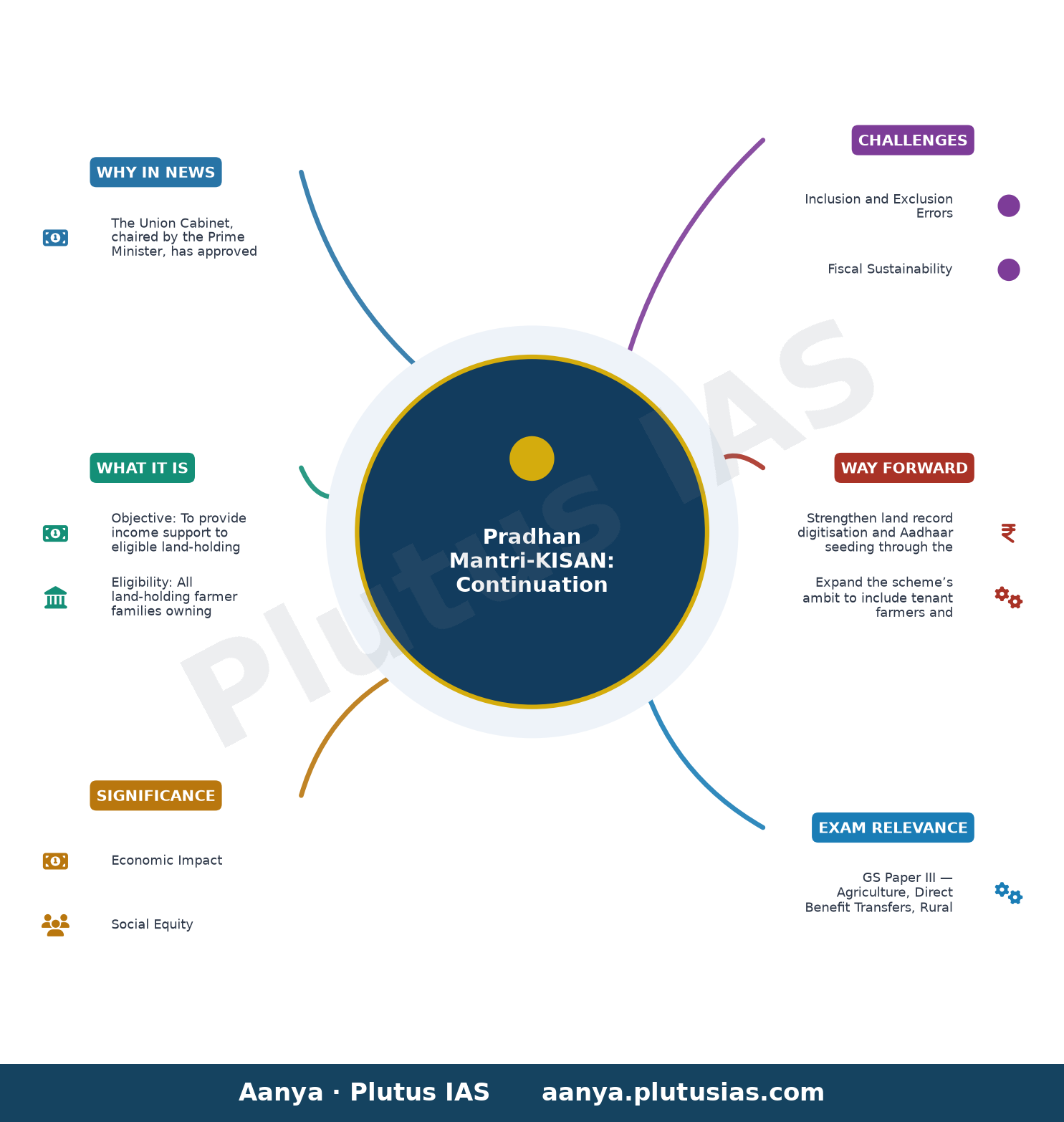
- GS Paper III — Agriculture, Direct Benefit Transfers, Rural Development
- Prelims: Pradhan Mantri-KISAN Samman Nidhi (PM-KISAN), Direct Benefit Transfer (DBT), Aadhaar-enabled Payment System (AePS), Kisan Credit Card (KCC), Minimum Support Price (MSP), Agricultural productivity, Rural economy, Atmanirbhar Bharat
- Essay: Agrarian distress and rural transformation: Can income support policies redefine India’s farming future?, Digital governance as a tool for socio-economic equity: Lessons from PM-KISAN
Quick Revision: PM-KISAN is a Direct Benefit Transfer (DBT)-based income support scheme providing ₹6,000 annually to land-holding farmers via Aadhaar-seeded bank accounts, ensuring transparency, reducing leakages, and enhancing rural economic resilience.
Why is this in the news?
The Union Cabinet, chaired by the Prime Minister, has approved the continuation of the Pradhan Mantri-KISAN Samman Nidhi (PM-KISAN) scheme from 2026-27 to 2030-31 with a financial outlay of ₹3.15 lakh crore. This decision underscores the government’s long-term commitment to enhancing farm incomes through direct cash transfers, thereby reinforcing agricultural productivity and rural economic resilience amid evolving climatic and market uncertainties.
Background
- Launched in February 2019, PM-KISAN is a Central Sector Scheme under the Ministry of Agriculture and Farmers’ Welfare, aimed at providing income support to land-holding farmer families.
- The scheme operates on a Direct Benefit Transfer (DBT) model, transferring ₹6,000 per year in three equal instalments directly to beneficiaries’ bank accounts.
- 23वीं किस्त के तहत, 9.49 करोड़ से अधिक किसानों को लाभ मिला, जिसके तहत 18,984 करोड़ रुपये से अधिक की राशि जारी की गई। इस योजना के तहत 23 किस्तों में किसानों के बैंक खातों में सीधे 4.47 लाख करोड़ रुपये से अधिक की राशि हस्तांतरित की गई है।
- The scheme integrates digital governance tools such as Aadhaar-based authentication, geo-tagging of land records, and real-time monitoring to ensure transparency, reduce leakages, and enhance accountability.
- Independent evaluations by NITI Aayog’s Development Monitoring and Evaluation Office (DMEO) have validated the scheme’s positive impact on agricultural investment, income growth, and reduction in informal debt dependency among farmers.
What is the Pradhan Mantri-KISAN Samman Nidhi (PM-KISAN)?
- Objective: To provide income support to eligible land-holding farmer families to enable them to meet agricultural expenses and sustain livelihoods, thereby enhancing farm productivity and rural economic stability.
- Eligibility: All land-holding farmer families owning cultivable land, subject to exclusion criteria such as high-income taxpayers, retired government employees, and professionals in specified categories.
- Benefit Structure: ₹6,000 per year, disbursed in three equal instalments of ₹2,000 each, directly credited to beneficiaries’ bank accounts via DBT.
- Implementation Framework: The scheme leverages the Public Financial Management System (PFMS) and Aadhaar seeding to ensure seamless fund flow and prevent duplication or exclusion errors.
- Digital Integration: PM-KISAN exemplifies the Digital India initiative through end-to-end digitisation, including Aadhaar-based e-KYC, geo-referenced land records, and real-time monitoring dashboards for transparency and efficiency.
- पीएम-किसान योजना के तहत महिला किसानों को 1.06 लाख करोड़ रुपये से अधिक की राशि प्राप्त हुई है, और लाभार्थियों में से लगभग 3 करोड़ महिला किसान हैं।
- Impact on Agriculture: Studies indicate that the scheme has contributed to a 9.65% increase in agricultural productivity and a 21.18% rise in foodgrain production between 2020-21 and 2025-26, alongside a reduction in informal credit dependency.
- Policy Synergy: PM-KISAN aligns with broader agricultural policies such as the Kisan Credit Card (KCC) scheme, Minimum Support Price (MSP) mechanisms, and crop insurance programmes to create a comprehensive safety net for farmers.
Key Features
| Feature | Significance |
|---|---|
| Direct Benefit Transfer (DBT) | Ensures timely, transparent, and leak-proof transfer of ₹6,000 annually to eligible farmers via Aadhaar-linked bank accounts, eliminating intermediaries and reducing corruption. |
| Aadhaar-based Authentication | Mandatory for beneficiary verification, enhancing accuracy, preventing duplication, and ensuring only genuine landholding farmers receive benefits. |
| Three Equal Instalments | Distributed annually (April-July, August-November, December-March), aligning with agricultural cycles to support seasonal input purchases and mitigate liquidity constraints. |
| Digital Land Records Integration | Leverages land ownership databases (e.g., land records digitisation under Digital India Land Records Modernisation Programme) to validate eligibility and prevent exclusion errors. |
| Gender Inclusivity | Approximately 25% of beneficiaries are women farmers, promoting financial autonomy and reducing gender disparities in agricultural decision-making. |
Why it Matters
Economic Impact
- Enhances farm investment capacity by providing liquidity for inputs (seeds, fertilisers, machinery), thereby increasing agricultural productivity and output.
- Reduces reliance on informal credit sources (e.g., moneylenders), lowering debt burdens and improving rural financial resilience.
- Stimulates rural demand for agricultural inputs and services, creating indirect employment in allied sectors (e.g., agri-input dealers, transport).
- Contributes to food security by supporting higher kharif and rabi crop yields, as evidenced by a 21.18% increase in foodgrain production (2020-21 to 2025-26).
Social Equity
- Provides income support to marginal and small farmers (landholding ≤2 hectares), who constitute ~86% of India’s farming households, reducing agrarian distress.
- Promotes gender equity by directly transferring benefits to women farmers, empowering them in household financial decisions.
- Mitigates seasonal income volatility, particularly for rainfed regions, by ensuring a predictable cash flow during lean periods.
- Supports tenant farmers and sharecroppers indirectly by stabilising rural incomes, though direct inclusion remains a challenge.
Governance and Technology
- Demonstrates the efficacy of DBT in welfare delivery, reducing leakages to <1% (vs. 20-30% in pre-DBT schemes) and improving fiscal efficiency.
- Showcases the integration of Aadhaar, land records, and banking infrastructure to create a robust, scalable welfare architecture.
- Sets a precedent for future schemes (e.g., PM-KISAN MAHOTSAV, agro-forestry initiatives) by embedding transparency and accountability in implementation.
Strategic Agriculture Policy
- Aligns with the government’s vision of doubling farmer incomes by 2022 (extended to 2030) by providing direct income support alongside productivity-enhancing measures.
- Complements other schemes (e.g., PM-KISAN SAMMAN, PM-AASHA) to address both income and price risks in agriculture.
- Supports the goal of ‘Atmanirbhar Bharat’ by reducing import dependency in pulses and oilseeds through increased domestic production.
Challenges
1. Inclusion and Exclusion Errors
- Approximately 20-25% of eligible farmers remain excluded due to incomplete land records, Aadhaar seeding gaps, or failure to update beneficiary databases.
- Inclusion of ineligible beneficiaries (e.g., urban landowners, non-farmers) persists in some states due to weak verification mechanisms.
- Tenant farmers and sharecroppers, who lack land titles, are systematically excluded despite contributing significantly to agricultural output.
UPSC Link: GS3: Agricultural Marketing
2. Fiscal Sustainability
- Annual outlay of ₹63,000 crore (2026-31) poses a fiscal burden, especially amid competing demands for infrastructure, health, and education.
- Risk of fiscal slippage if the scheme’s scope expands (e.g., higher per-farmer transfers) without commensurate revenue augmentation.
- Dependence on direct transfers limits the scheme’s ability to address structural issues like input subsidies or MSP reforms.
UPSC Link: GS3: Fiscal Policy
3. Productivity and Investment Constraints
- Income support alone cannot address deeper issues like soil degradation, water scarcity, or lack of market access for smallholders.
- Limited impact on long-term productivity growth, as the scheme does not mandate or incentivise adoption of modern technologies (e.g., precision farming, drip irrigation).
- Risk of ‘income support dependency’ where farmers reduce productive investments in favour of short-term consumption.
UPSC Link: GS3: Farming Systems
4. Climate Vulnerability
- Increased farm incomes may not translate to climate-resilient agriculture, as the scheme does not integrate risk mitigation (e.g., crop insurance, drought-resistant varieties).
- Higher input use (e.g., fertilisers) driven by liquidity could exacerbate soil health degradation and greenhouse gas emissions.
- Lack of climate-smart agricultural practices in the scheme’s design limits its contribution to India’s NDCs (Nationally Determined Contributions).
UPSC Link: GS3: Environmental Pollution
5. Digital Divide and Infrastructure Gaps
- Aadhaar seeding and DBT transfers require robust digital infrastructure (e.g., internet connectivity, banking access), which is uneven across states (e.g., Bihar vs. Kerala).
- Cybersecurity risks (e.g., data breaches, fraud) increase with the scale of digital transactions, necessitating stronger safeguards.
- Low digital literacy among elderly farmers and women in remote areas hampers effective utilisation of benefits.
UPSC Link: GS3: Science and Technology
Challenges — UPSC Perspective
| Issue | Concern |
|---|---|
| Land Record Digitisation Gaps | Incomplete or outdated land records lead to exclusion of eligible farmers and inclusion of ineligible beneficiaries. |
| Aadhaar-Seeding Deficiencies | Failure to link Aadhaar with land records and bank accounts delays or denies benefits to deserving farmers. |
| Tenant Farmer Exclusion | Lack of legal land titles for tenant farmers and sharecroppers results in systematic exclusion from the scheme. |
| Fiscal Strain on Exchequer | Annual outlay of ₹63,000 crore may crowd out other critical agricultural and social sector expenditures. |
| Climate-Resilient Agriculture Gap | Scheme does not integrate climate-smart practices, limiting long-term sustainability of farm incomes. |
| Digital Divide | Poor digital infrastructure and low literacy in rural areas restrict equitable access to benefits. |
Way Forward
- Strengthen land record digitisation and Aadhaar seeding through the Digital India Land Records Modernisation Programme (DILRMP) to reduce exclusion errors.
- Expand the scheme’s ambit to include tenant farmers and sharecroppers by recognising community land records and self-declaration mechanisms.
- Integrate climate-smart agricultural practices (e.g., soil health cards, precision irrigation) into the scheme to enhance long-term productivity and resilience.
- Link PM-KISAN benefits to crop insurance (e.g., PMFBY) and market access initiatives (e.g., e-NAM) to address price and production risks.
- Enhance fiscal sustainability by exploring co-financing models with state governments or leveraging corporate social responsibility (CSR) funds for agricultural R&D.
- Conduct periodic third-party audits to assess impact on farm incomes, productivity, and gender equity, with findings publicly disseminated.
- Promote financial literacy among farmers, particularly women, to ensure optimal utilisation of income support for productive investments.
- Explore phased integration with Direct Benefit Transfer 2.0 (DBT 2.0) to enable real-time, need-based transfers aligned with agricultural cycles.
UPSC Value Addition
Keywords for Mains Answer-Writing
Pradhan Mantri Kisan Samman Nidhi (PM-KISAN) · Direct Benefit Transfer (DBT) · Agrarian distress alleviation · Farm income support · Digital governance in welfare delivery · Aadhaar-based authentication · Agricultural productivity enhancement · Rural economic resilience · Income support schemes · Central sector schemes · Union Budget allocations for agriculture · Kisan credit and investment · Transparent welfare delivery · Agricultural sector reforms · Sustainable farming incentives
Constitutional & Policy Linkages
- [‘Article 39(b)’, ‘Directive Principles: equitable distribution of resources’]
- [‘Article 48’, ‘Directive Principles: modernisation of agriculture’]
- [‘Seventh Schedule’, ‘Union-State distribution of agricultural welfare responsibilities’]
Concept Flow
Fiscal Allocation Approval (₹3.15 lakh crore for 2026-31) → Expansion of PM-KISAN Scheme → Direct Benefit Transfer (DBT) to Farmers → Increased Liquidity for Agricultural Inputs → Higher Productivity and Output → Improved Rural Incomes and Food Security → Strengthened Rural Economy and Self-Reliance (Atmanirbhar Bharat) → Aadhaar-Based Authentication → Digital Land Records Integration → Beneficiary Identification → Reduced Leakages and Corruption → Enhanced Transparency and Accountability → Income Support (₹6,000/year) → Reduced Reliance on Informal Credit → Lower Debt Burdens → Improved Financial Resilience of Smallholders → PM-KISAN Implementation → Adoption of Digital Infrastructure (DBT, Aadhaar) → Scalability of Welfare Architecture → Replicability in Other Schemes (e.g., PM-KISAN MAHOTSAV) → PM-KISAN Benefits → Increased Consumption of Agricultural Inputs → Stimulated Demand for Agri-Input Industry → Employment Generation in Rural Areas → Income Support to Farmers → Higher Savings and Investment Capacity → Diversification into Allied Activities (e.g., dairy, horticulture) → Enhanced Rural Livelihoods → PM-KISAN Expansion → Alignment with Government’s Doubling Farmer Incomes Goal → Synergy with Other Schemes (e.g., PM-AASHA, PM-KISAN SAMMAN) → Holistic Agricultural Development
Prelims Practice Questions
Q1. Consider the following statements regarding the Pradhan Mantri Kisan Samman Nidhi (PM-KISAN) scheme:
1. The scheme provides direct income support of ₹6,000 per year to eligible landholding farmer families in three equal instalments.
2. The financial assistance is transferred directly to the bank accounts of the beneficiaries through the Direct Benefit Transfer (DBT) mechanism.
3. The scheme was launched in 2020 and is implemented by the Ministry of Rural Development.
4. Aadhaar-based authentication is used to verify the eligibility of beneficiaries.
How many of the above statements are correct?
- Only one
- Only two
- Only three
- All four
Answer: Only three — Statements 1, 2, and 4 are correct. Statement 3 is incorrect as the PM-KISAN scheme was launched in February 2019 and is implemented by the Ministry of Agriculture and Farmers’ Welfare, not the Ministry of Rural Development.
Q2. Assertion (A): The Pradhan Mantri Kisan Samman Nidhi (PM-KISAN) scheme utilises the Direct Benefit Transfer (DBT) system for disbursing financial assistance to farmers.
Reason (R): DBT ensures transparency, minimises leakages, and directly credits the amount to the beneficiaries’ bank accounts, thereby enhancing the efficiency of welfare delivery.
In the context of the above two statements, which one of the following is correct?
- Both A and R are true, and R is the correct explanation of A.
- Both A and R are true, but R is not the correct explanation of A.
- A is true, but R is false.
- A is false, but R is true.
Answer: Both A and R are true, and R is the correct explanation of A. — Both A and R are true, and R correctly explains A. The PM-KISAN scheme uses DBT to transfer ₹6,000 annually to farmers’ bank accounts, ensuring transparency and minimising leakages.
Q3. Match the following columns related to the Pradhan Mantri Kisan Samman Nidhi (PM-KISAN) scheme:
Column I (Feature/Component) | Column II (Description)
1. Financial Outlay (2026-31) | A. ₹3.15 lakh crore
2. Annual Support per Farmer | B. ₹6,000
3. Number of Instalments per Year | C. Three
4. Implementing Ministry | D. Ministry of Agriculture and Farmers’ Welfare
Select the correct match:
- 1-A, 2-B, 3-C, 4-D
- 1-B, 2-A, 3-D, 4-C
- 1-C, 2-D, 3-A, 4-B
- 1-D, 2-C, 3-B, 4-A
Answer: 1-A, 2-B, 3-C, 4-D — The correct matches are: 1-A (Financial Outlay for 2026-31 is ₹3.15 lakh crore), 2-B (Annual support per farmer is ₹6,000), 3-C (Number of instalments per year is three), and 4-D (Implementing Ministry is the Ministry of Agriculture and Farmers’ Welfare).
Mains Practice Question
✍ The Pradhan Mantri Kisan Samman Nidhi (PM-KISAN) scheme represents a paradigm shift in India’s agricultural policy by transitioning from input subsidies to direct income support. Critically examine the efficacy of this transition in addressing agrarian distress and enhancing farm productivity. Also, analyse the role of digital governance in ensuring the scheme’s transparency and efficiency. (15 Marks)
Approach: MODEL-ANSWER SKELETON:
1. **Introduction (2 marks)**
– Brief background: Launch of PM-KISAN in February 2019, its objective of providing direct income support to landholding farmer families.
– Context: Shift from input subsidies (fertilizers, seeds, irrigation) to direct income support as a welfare measure.
2. **Efficacy in Addressing Agrarian Distress (5 marks)**
– **Direct Income Support**: Explain how ₹6,000 annual support in three instalments provides liquidity to farmers, reducing dependence on informal credit (e.g., moneylenders). Cite data: Over ₹4.47 lakh crore transferred to 9.49 crore farmers (as of 23rd instalment).
– **Impact on Farm Investment**: Highlight how the scheme enables farmers to invest in seeds, fertilizers, irrigation, and machinery, thereby enhancing productivity. Reference NITI Aayog’s DMEO evaluation: 92% of beneficiaries used funds for agricultural activities.
– **Income Stabilisation**: Discuss how the scheme cushions farmers against price volatility and climate shocks (e.g., COVID-19 pandemic, where ₹1.71 lakh crore was disbursed).
– **Gender Inclusivity**: Note that 25% of beneficiaries are women farmers, contributing to household income stability.
– **Limitations**: Critique the exclusion of tenant farmers, sharecroppers, and landless agricultural labourers; highlight the need for land record digitisation to expand coverage.
3. **Enhancing Farm Productivity (4 marks)**
– **Productivity Trends**: Reference data: 9.65% growth in agriculture sector, 10.53% increase in productivity, and 21.18% rise in foodgrain production (2020-21 to 2025-26).
– **Mechanism**: Explain how income support reduces distress sales, enables timely agricultural operations, and improves soil health through better input use.
– **Critique**: Acknowledge that productivity gains are also influenced by other factors (e.g., monsoon, technology adoption, MSP policies), requiring further empirical validation.
4. **Role of Digital Governance (3 marks)**
– **Aadhaar-Based Authentication**: Explain how Aadhaar ensures unique identification, reduces duplication, and prevents leakages.
– **DBT Mechanism**: Highlight the role of the Public Financial Management System (PFMS) and core banking solutions in ensuring timely and transparent transfers.
– **Challenges**: Discuss issues like Aadhaar seeding gaps, bank account linkage delays, and cybersecurity risks in digital welfare delivery.
5. **Conclusion (1 mark)**
– Summarise: PM-KISAN’s transition to direct income support is a progressive step but requires expansion to cover all farmers, including tenant farmers. Digital governance has been instrumental in ensuring transparency and efficiency, though challenges persist in last-mile delivery.
Source: PIB (Press Information Bureau)
Generated by AanyaAi for educational purpose.

- कर्नाटक सरकार ने पूर्ण रूप से लागू करेगी अनुच्छेद 371(जे), जानिए क्या है इसका महत्व - September 16, 2026
- Karnataka to Fully Implement Article 371(J) for Kalyana Karnataka Development - September 16, 2026
- एल नीनो से प्रभावित केरल की चाय उत्पादन में 2% की गिरावट, जानें कारण और प्रभाव - September 16, 2026

No Comments