


16 Sep Karnataka to Fully Implement Article 371(J) for Kalyana Karnataka Development
✎ Article 371(J) is a constitutional safeguard for Kalyana Karnataka, ensuring reservations in education and employment, and mandating the establishment of a Regional Development Board to address historical developmental…
Subject Relevance — Where This Topic Fits
- GS Paper II — Functions and Responsibilities of the Union and the States, Issues and Challenges Pertaining to the Federal Structure | GS Paper III — Development, Inclusive Growth and Issues Arising from their Design and Implementation
- Prelims: Article 371(J), Kalyana Karnataka, Special Category Status, Kalyana Karnataka Regional Development Board, Kalyana Karnataka Economic Mission, 18,000 crore rupees
- Essay: Federalism in India: Balancing Regional Aspirations with National Integration, Inclusive Development: Addressing Regional Disparities through Constitutional Provisions
Quick Revision: Article 371(J) is a constitutional safeguard for Kalyana Karnataka, ensuring reservations in education and employment, and mandating the establishment of a Regional Development Board to address historical developmental disparities.
Why is this in the news?
The Karnataka government’s renewed commitment to the full implementation of Article 371(J), as articulated by Home Minister Priyank Kharge and Medical Education Minister Sharan Prakash Patil, underscores the constitutional safeguards for the Kalyana Karnataka region and their implications for regional development, employment, and education. This development is significant as it highlights the operationalisation of a constitutional provision designed to address historical imbalances and foster inclusive growth.
Background
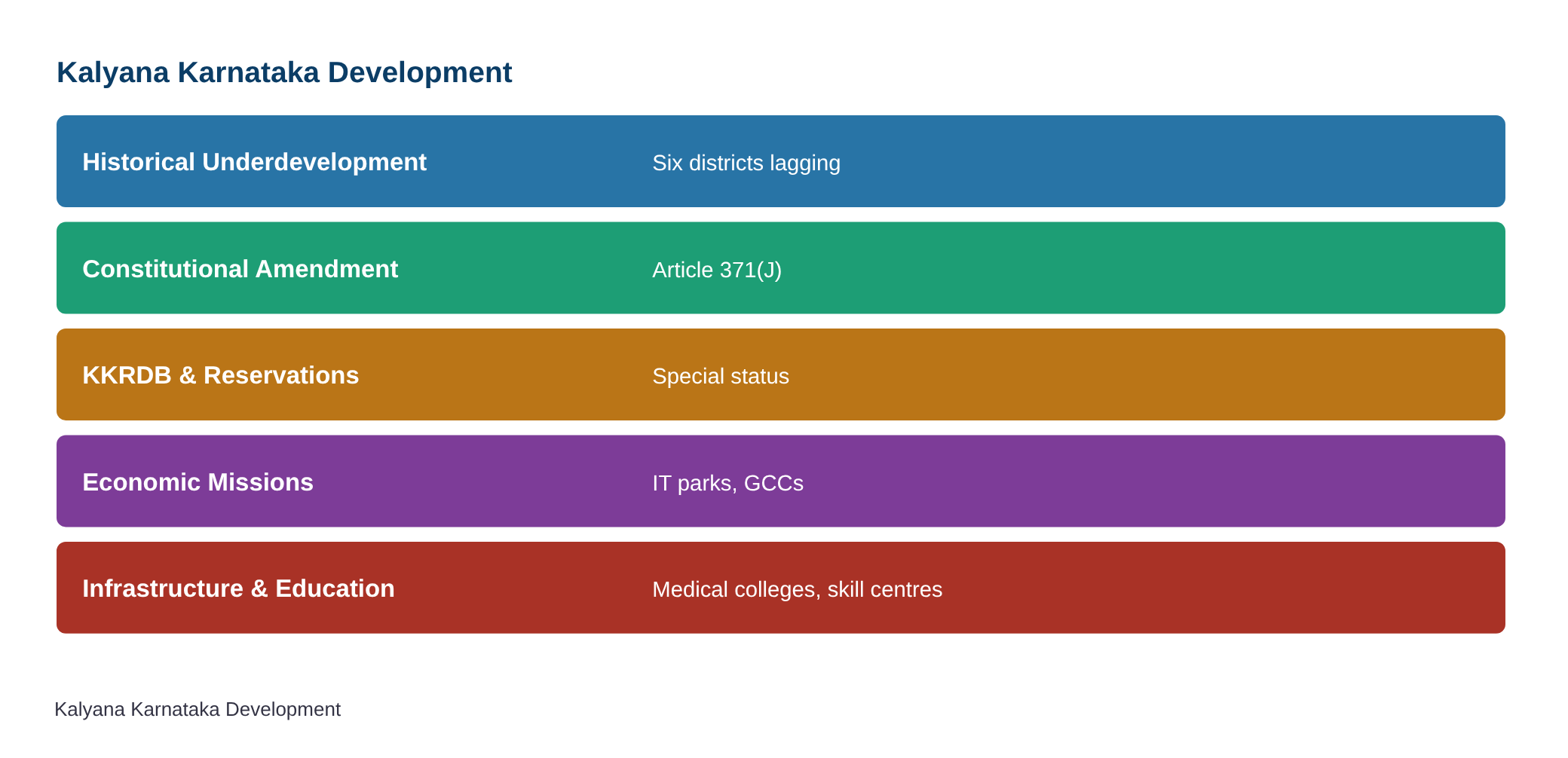
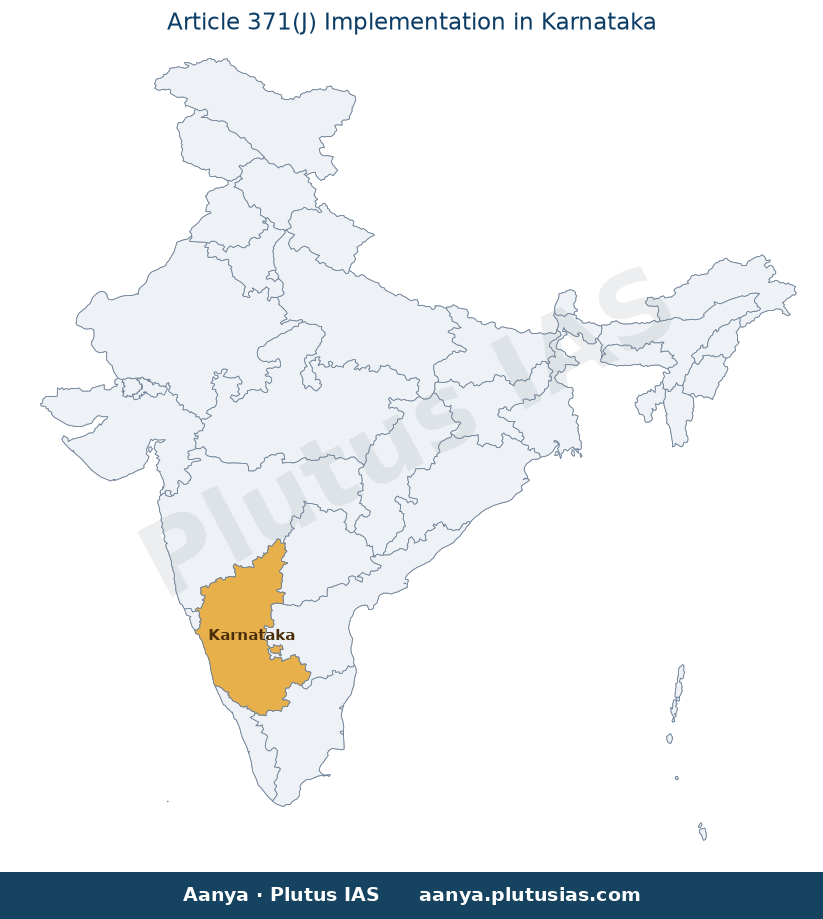
- The region comprises six districts of North Karnataka: Bidar, Gulbarga (Kalaburagi), Yadgir, Raichur, Koppal, and Ballari, historically lagging in socio-economic indicators compared to other parts of the state.
- The provision was enacted to provide special status to the region, including reservations in education and employment, and to establish a Regional Development Board for focused planning and resource allocation.
- The Kalyana Karnataka Regional Development Board (KKRDB) was constituted under Article 371(J) to oversee the implementation of developmental schemes and ensure the equitable distribution of resources.
- The region has witnessed significant infrastructure and educational investments, including the establishment of medical colleges, IT parks, and skill development centres, aimed at bridging developmental gaps.
- The commitment to full implementation follows decades of advocacy by regional leaders and civil society organisations for the realisation of constitutional guarantees.
What is Article 371(J)?
- Constitutional Provision: Article 371(J) is a special provision under Part XXI of the Constitution of India, applicable exclusively to the Kalyana Karnataka region of Karnataka.
- Objective: The provision aims to address historical disparities by ensuring equitable development, employment opportunities, and educational access for the region’s residents.
- Key Features: It mandates reservations in education and public employment for locals, establishes a Regional Development Board, and provides for special financial assistance from the state government.
- Regional Development Board: The Kalyana Karnataka Regional Development Board (KKRDB) is tasked with planning, monitoring, and implementing developmental schemes tailored to the region’s needs.
- Economic Mission: The Kalyana Karnataka Economic Mission is a strategic initiative to accelerate economic growth through targeted investments in infrastructure, industry, and human capital development.
- Legal Framework: The provision is grounded in the constitutional amendment process, requiring parliamentary approval and subsequent state-level implementation through legislative and administrative measures.
- Impact on Governance: It empowers the state government to formulate policies that prioritise the region’s development while maintaining the overarching framework of federal governance.
- Monitoring and Accountability: The implementation is subject to periodic review by state authorities to ensure transparency, efficiency, and the delivery of promised benefits to the local population.
Key Features
| Feature | Significance |
|---|---|
| Constitutional Provision under Article 371(J) | Provides special status and safeguards for the Kalyana Karnataka region, including reservations in education and employment, to address historical underdevelopment and promote equitable growth. |
| Kalyana Karnataka Economic Mission | A dedicated initiative to accelerate economic development in the region through targeted investments, policy interventions, and sector-specific growth strategies. |
| Reservation in Education and Employment | Ensures proportional representation for local candidates in educational institutions and government jobs, enhancing socio-economic mobility and reducing regional disparities. |
| LEAP Programme Laboratory in Kalaburagi | A skill-development initiative aimed at fostering innovation, entrepreneurship, and technical expertise among the youth of the region. |
| Global Capability Centre and IT Park | Establishment of high-value employment hubs to attract investment, generate jobs, and integrate the region into the global digital economy. |
| Kalyana Karnataka Regional Development Board (KKRDB) | A statutory body tasked with planning, funding, and monitoring development projects in education, healthcare, and infrastructure within the region. |
Why it Matters
Economic Development
- Article 371(J) mandates targeted economic interventions to bridge the developmental gap between Kalyana Karnataka and other regions of Karnataka.
- The establishment of economic missions, IT parks, and global capability centres aims to diversify the regional economy beyond traditional sectors.
- Job creation under the provision has exceeded 1 lakh, providing immediate economic relief and long-term skill-building opportunities.
- Infrastructure projects funded by the KKRDB, including healthcare and educational facilities, enhance the region’s attractiveness for investment and human capital retention.
Social Justice and Equity
- Reservations in education and employment are constitutional safeguards to correct historical injustices and ensure proportional representation for marginalised communities.
- The provision addresses systemic exclusion by prioritising local candidates in key sectors, fostering a sense of ownership and participation among the youth.
- Increased medical seats and skill development programmes empower the region’s population, particularly in healthcare and technical fields.
- The commitment to rectify implementation shortcomings ensures that the benefits of Article 371(J) are not diluted or misdirected.
Regional Governance and Autonomy
- Article 371(J) grants the Kalyana Karnataka region a degree of administrative autonomy, enabling tailored governance mechanisms to address local needs.
- The Kalyana Karnataka Regional Development Board operates as a statutory body, ensuring decentralised planning and execution of development projects.
- The provision allows for region-specific policies, such as economic missions and educational reservations, without compromising the state’s overall federal structure.
- Local leadership and stakeholder engagement, as seen in seminars and awareness campaigns, strengthen democratic participation and accountability.
Strategic and Geopolitical Implications
- The development of Kalyana Karnataka, a border region, enhances national integration and reduces vulnerabilities to socio-economic disparities that could be exploited by external actors.
- Strengthening the region’s economic and educational infrastructure contributes to India’s broader goals of inclusive growth and regional stability.
Challenges
1. Implementation Gaps and Awareness Deficits
- Despite constitutional guarantees, the effective translation of Article 371(J) into tangible benefits remains uneven due to bureaucratic delays and administrative bottlenecks.
- Lack of awareness among the local population, particularly youth and marginalised communities, limits their ability to avail of reserved opportunities in education and employment.
- Inadequate coordination between the state government, KKRDB, and local institutions may lead to suboptimal utilisation of allocated funds and resources.
- Monitoring and evaluation mechanisms are often weak, making it difficult to assess the impact of development projects and rectify deficiencies in real time.
UPSC Link: GS-II: Federalism, Centre-State Relations
2. Sustainable Economic Growth
- Over-reliance on reservations without concurrent investments in skill development and entrepreneurship may create a dependency culture rather than fostering self-sustaining growth.
- The region’s economic base remains narrow, with limited diversification beyond traditional sectors like agriculture and handicrafts.
- High unemployment rates, despite job creation under Article 371(J), indicate a mismatch between the skills imparted and market demands, necessitating alignment with industry needs.
- Infrastructure bottlenecks, such as inadequate transport and digital connectivity, hinder the region’s integration into broader economic networks.
UPSC Link: GS-III: Inclusive Growth, Employment
3. Equitable Distribution of Benefits
- Ensuring that reserved opportunities reach the most marginalised sections of the region, including Scheduled Castes, Scheduled Tribes, and Other Backward Classes, remains a persistent challenge.
- Elite capture of reserved seats in higher education and government jobs may exclude the most needy, undermining the provision’s intended social justice outcomes.
- Geographical disparities within Kalyana Karnataka, such as between urban centres like Kalaburagi and rural areas, require targeted interventions to prevent further marginalisation.
- The influx of non-local candidates in reserved seats, if not monitored, could dilute the provision’s benefits for the region’s permanent residents.
UPSC Link: GS-II: Social Justice, Welfare Schemes
4. Institutional Capacity and Governance
- The KKRDB and other implementing agencies often face capacity constraints, including shortages of skilled personnel and inadequate technical expertise to design and execute complex projects.
- Political interference and bureaucratic red tape can delay or derail development initiatives, despite constitutional mandates.
- Weak accountability mechanisms make it difficult to hold officials and institutions responsible for underperformance or misallocation of funds.
- The absence of a robust grievance redressal system hampers the resolution of disputes related to the implementation of Article 371(J).
UPSC Link: GS-II: Governance, Accountability
Challenges — UPSC Perspective
| Issue | Concern |
|---|---|
| Bureaucratic Delays | Administrative bottlenecks slow down the disbursement of funds and approval of projects under Article 371(J). |
| Awareness Deficits | Limited knowledge among beneficiaries about reserved opportunities and development schemes reduces their utilisation. |
| Skill Mismatch | Training programmes do not align with market demands, leading to underemployment despite job creation. |
| Elite Capture | Reserved seats in education and employment may be dominated by privileged sections, excluding the most marginalised. |
| Infrastructure Gaps | Poor transport and digital connectivity hinder the region’s economic integration and growth. |
| Monitoring and Evaluation | Weak oversight mechanisms fail to track the impact of development projects or rectify deficiencies promptly. |
Government Initiatives — Must-Memorise for Prelims
- Kalyana Karnataka Economic Mission
- Kalyana Karnataka Regional Development Board (KKRDB) Projects
Way Forward
- Strengthen institutional capacity of the KKRDB and local implementing agencies through training, technology adoption, and personnel recruitment to enhance project execution.
- Launch targeted awareness campaigns in local languages, leveraging schools, colleges, and community centres to educate beneficiaries about reserved opportunities and development schemes.
- Align skill development programmes under the LEAP initiative with industry needs through public-private partnerships and industry advisory councils.
- Establish a real-time monitoring and evaluation framework for all projects funded under Article 371(J), with public dashboards for transparency and accountability.
- Prioritise infrastructure development, including digital connectivity and transport networks, to integrate Kalyana Karnataka into broader economic circuits.
- Institute a grievance redressal mechanism, including district-level committees, to address implementation challenges and beneficiary complaints promptly.
- Encourage entrepreneurship by providing seed funding, mentorship, and incubation support through the Kalyana Karnataka Economic Mission.
- Conduct periodic impact assessments of the Kalyana Karnataka Regional Development Board’s projects to identify successes and areas for improvement.
UPSC Value Addition
Keywords for Mains Answer-Writing
Article 371(J) · Kalyana Karnataka · Special Provisions for Backward Regions · Constitutional Amendments · Regional Development Boards · Reservation in Education and Employment · Kalyana Karnataka Regional Development Board · LEAP Programme · Global Capability Centre · IT Parks in Karnataka · Special Category Status · Constitutional Asymmetry · Backward Region Development · Federalism in India · Scheduled Areas and Tribal Areas · Karnataka State Policies
Constitutional & Policy Linkages
- Article 371(J) – Special provisions for the state of Karnataka
Concept Flow
Historical underdevelopment and regional disparities in Kalyana Karnataka → Constitutional amendment (Article 371(J)) to address inequities → Enactment of Article 371(J) under UPA-II government → Establishment of KKRDB and reservation policies → Implementation of economic missions and skill development programmes → Creation of employment hubs (IT parks, GCCs) and infrastructure projects → Monitoring of outcomes and rectification of implementation gaps → Sustainable regional development and equitable growth
Prelims Practice Questions
Q1. Consider the following statements regarding Article 371(J) of the Constitution of India:
1. It provides for reservation in education and employment for the Kalyana Karnataka region.
2. It mandates the establishment of a separate High Court for the region.
3. It empowers the Governor of Karnataka to create a separate development board for the region.
4. It grants special financial assistance to the region from the Union Government.
How many of the above statements are correct?
- Only one
- Only two
- Only three
- All four
Answer: Only three — Statements 1 and 3 are correct. Article 371(J) provides for reservations in education and employment and empowers the Governor to create a separate development board. Statement 2 is incorrect as it does not mandate a separate High Court. Statement 4 is incorrect as it does not explicitly grant special financial assistance from the Union Government, though financial allocations may be part of the board’s functions.
Q2. Assertion (A): Article 371(J) is a constitutional provision that grants special status to the Kalyana Karnataka region.
Reason (R): It was inserted through the 118th Constitutional Amendment Act, 2012, to address the developmental needs of the region.
In the context of the above two statements, which one of the following is correct?
- Both A and R are true, and R is the correct explanation of A.
- Both A and R are true, but R is not the correct explanation of A.
- A is true, but R is false.
- A is false, but R is true.
Answer: Both A and R are true, but R is not the correct explanation of A. — Both the assertion and reason are true. Article 371(J) is indeed a constitutional provision granting special status to the Kalyana Karnataka region, and it was inserted through the 118th Constitutional Amendment Act, 2012, to address developmental disparities.
Q3. Match the following provisions under Article 371(J) with their corresponding descriptions:
Column I
A. Reservation in education and employment
B. Kalyana Karnataka Regional Development Board
C. Special financial assistance
D. Governor’s powers to make regulations
Column II
1. Created to ensure balanced regional development
2. Governor may make regulations for the peace and good government of the region
3. Provides for reservation in educational institutions and government jobs
4. Financial allocations for the region’s development
Select the correct match:
- A-3, B-1, C-4, D-2
- A-1, B-3, C-2, D-4
- A-4, B-2, C-1, D-3
- A-2, B-4, C-3, D-1
Answer: A-3, B-1, C-4, D-2 — The correct match is: A-3 (Reservation in education and employment), B-1 (Kalyana Karnataka Regional Development Board), C-4 (Special financial assistance), D-2 (Governor’s powers to make regulations).
Mains Practice Question
✍ Examine the constitutional and administrative framework of Article 371(J) of the Constitution of India. How does this provision seek to address the developmental disparities in the Kalyana Karnataka region? Also, discuss the role of the Kalyana Karnataka Regional Development Board in this context. (15 Marks)
Approach: MODEL-ANSWER SKELETON:
1. **Introduction (2 marks)**: Define Article 371(J) as a constitutional provision under Part XXI (Temporary, Transitional, and Special Provisions) inserted by the 118th Constitutional Amendment Act, 2012. State its objective: to address historical backwardness and ensure balanced regional development in the Kalyana Karnataka region.
2. **Constitutional Framework (5 marks)**:
– **Article 371(J) Provisions**:
a. Reservation in education and employment for local candidates (Article 371(J)(1)(a)).
b. Creation of the Kalyana Karnataka Regional Development Board (Article 371(J)(1)(b)).
c. Governor’s powers to make regulations for the peace and good government of the region (Article 371(J)(1)(c)).
d. Special financial assistance and planning for the region’s development.
– **Governor’s Role**: Highlight the Governor’s constitutional mandate to ensure the implementation of these provisions and report to the President.
3. **Administrative Framework (4 marks)**:
– **Kalyana Karnataka Regional Development Board**: Discuss its composition, functions (healthcare, education, infrastructure), and financial allocations (e.g., ₹18,000 crore as mentioned in the news).
– **LEAP Programme and IT Parks**: Explain how these initiatives align with the board’s objectives to boost employment and economic growth.
4. **Critical Analysis (3 marks)**:
– **Challenges**: Discuss implementation gaps, bureaucratic delays, and the need for greater autonomy in fund utilisation.
– **Comparative Perspective**: Contrast with other Article 371 provisions (e.g., Article 371(A) for Nagaland) to highlight the uniqueness of Article 371(J).
5. **Conclusion (1 mark)**: Summarise the significance of Article 371(J) in promoting inclusive development and the need for sustained political will and administrative efficiency for its success.
Source: The Hindu
Generated by AanyaAi for educational purpose.
Related guides on our sites
- Current affairs for upsc 2026
- Best PSIR optional coaching for upsc
- Best PSIR optional teacher for upsc
- Best teacher of PSIR optional for upsc

- Karnataka to Fully Implement Article 371(J) for Kalyana Karnataka Development - September 16, 2026
- एल नीनो से प्रभावित केरल की चाय उत्पादन में 2% की गिरावट, जानें कारण और प्रभाव - September 16, 2026
- El Niño Impact: Kerala Tea Production Drops 2% in 2026, UPASI Data Reveals - September 16, 2026

No Comments