


02 Aug RBI MPC Policy & Q1 FY27 Earnings: Key Drivers for Dalal Street This Week
✎ The Monetary Policy Committee (MPC) of the RBI, through its bi-monthly meetings, determines the repo rate to balance inflation control with growth support, directly influencing India’s equity markets, bond yields, and the Indian…
Subject Relevance — Where This Topic Fits
- GS Paper III — Indian Economy: Issues relating to Planning, Mobilization of Resources, Growth, Development and Employment; Inclusive growth and issues arising from it | GS Paper III — Money and Banking; Monetary Policy Framework; Role of RBI | GS Paper III — Effects of Liberalization on the Economy, Changes in Industrial Policy and their Effects on Industrial Growth | GS Paper III — Infrastructure: Energy, Ports, Roads, Airports, Railways etc.
- Prelims: Monetary Policy Committee (MPC), Repo rate, Purchasing Managers’ Index (PMI), Foreign Portfolio Investors (FPIs), Crude oil price benchmarks (Brent/WTI), US-Iran geopolitical tensions, Quarterly earnings season, BSE Sensex, NSE Nifty
- Essay: Economic governance in a multipolar world: Balancing domestic imperatives with global volatility, The interplay of fiscal prudence and monetary policy in sustaining long-term growth
Quick Revision: The Monetary Policy Committee (MPC) of the RBI, through its bi-monthly meetings, determines the repo rate to balance inflation control with growth support, directly influencing India’s equity markets, bond yields, and the Indian rupee.
Why is this in the news?
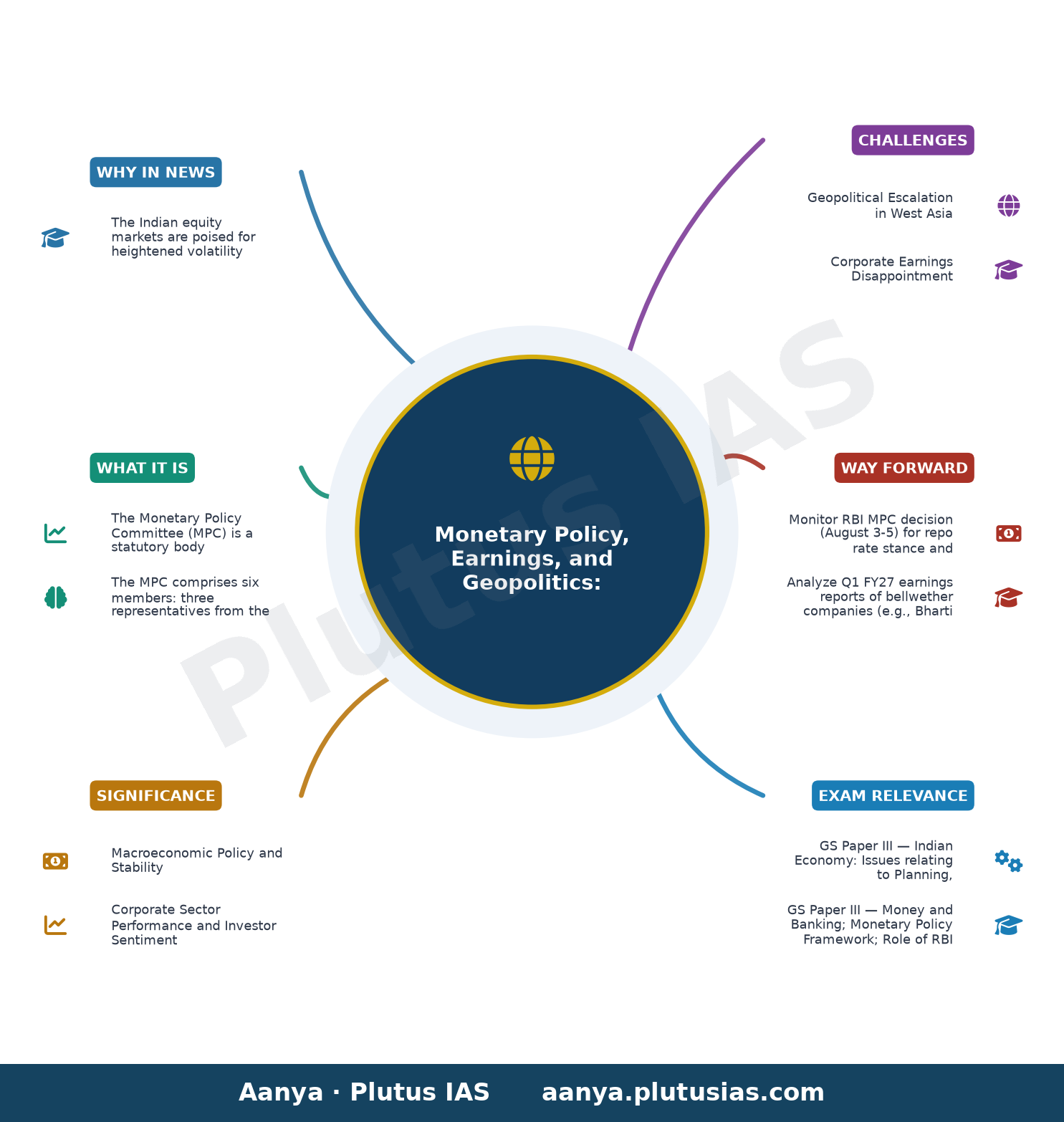
The Indian equity markets are poised for heightened volatility during the first week of August 2026, driven by three critical domestic and global catalysts: (1) the Reserve Bank of India’s (RBI) bi-monthly Monetary Policy Committee (MPC) meeting scheduled from August 3 to 5, 2026, which will determine the trajectory of interest rates and liquidity conditions; (2) the onset of the June quarter earnings season for major corporations, including DLF, Bharti Airtel, ONGC, Hero MotoCorp, LIC, and State Bank of India, which will provide insights into corporate performance and sectoral trends; and (3) escalating geopolitical tensions in West Asia, particularly the US-Iran conflict, which threaten to disrupt crude oil supplies through the Strait of Hormuz, thereby influencing global risk sentiment and commodity prices. These factors collectively underscore the multifaceted nature of market drivers, where domestic macroeconomic policies intersect with external shocks, warranting a nuanced understanding by aspirants preparing for the UPSC Civil Services Examination.
Background
- The Reserve Bank of India (RBI) conducts bi-monthly Monetary Policy Committee (MPC) meetings to review the prevailing monetary policy stance, including decisions on the repo rate, reverse repo rate, and other liquidity management tools, with the primary objective of achieving the inflation target while supporting economic growth.
- The Purchasing Managers’ Index (PMI), compiled by S&P Global, is a leading indicator of economic activity, providing real-time insights into the health of the manufacturing and services sectors through surveys of purchasing managers, with readings above 50 indicating expansion and below 50 signaling contraction.
- Crude oil prices are a critical determinant of India’s macroeconomic stability, as the country imports over 80% of its crude oil requirements, making it highly sensitive to geopolitical disruptions in major supply routes such as the Strait of Hormuz, Bab el-Mandeb, and the Suez Canal.
- The US-Iran conflict has historically been a significant geopolitical risk factor, with potential implications for global oil markets, given Iran’s strategic position in the Persian Gulf and its influence over key shipping lanes.
- Foreign Portfolio Investors (FPIs) play a pivotal role in India’s equity markets, with their investment decisions influenced by factors such as domestic economic growth prospects, corporate earnings, and global risk sentiment, as evidenced by their net inflows of ₹20,200 crore in July 2026 after four consecutive months of outflows.
- The June quarter earnings season is a critical period for equity markets, as it provides investors with updated financial performance data of listed companies, enabling them to reassess valuations and adjust portfolio allocations accordingly.
What is the Monetary Policy Committee (MPC) and its significance for India’s financial markets?
- The Monetary Policy Committee (MPC) is a statutory body established under the Reserve Bank of India Act, 1934, with the primary mandate to determine the monetary policy stance of the RBI, including decisions on policy rates such as the repo rate, reverse repo rate, and marginal standing facility (MSF) rate.
- The MPC comprises six members: three representatives from the RBI (including the Governor, who serves as the Chairperson) and three external members appointed by the Central Government, ensuring a balanced representation of technical expertise and independent perspectives.
- The MPC operates under a flexible inflation-targeting framework, with the primary objective of maintaining retail inflation within a target range of 4% ± 2% over a five-year horizon, while also supporting economic growth and financial stability.
- The MPC’s decisions are guided by a forward-looking assessment of macroeconomic conditions, including inflation trends, growth prospects, fiscal developments, and global economic conditions, with the aim of anchoring inflation expectations and fostering a stable macroeconomic environment.
- For financial markets, the MPC’s decisions on policy rates and liquidity measures have direct implications for borrowing costs, asset prices, and investor sentiment, as changes in the repo rate influence the cost of funds for banks and corporates, thereby affecting equity valuations, bond yields, and currency movements.
- The MPC’s communication strategy, including the Monetary Policy Statement and press conferences, plays a crucial role in shaping market expectations and reducing uncertainty, as clarity on the policy stance helps investors align their strategies with the RBI’s objectives.
- In the context of the current week, the MPC’s decision on the repo rate will be closely scrutinized for signals on the RBI’s stance on inflation, growth, and liquidity, with potential implications for equity markets, bond yields, and the Indian rupee.
- Historically, the MPC has adopted a data-dependent approach, adjusting policy rates in response to evolving macroeconomic conditions, such as inflationary pressures, growth slowdowns, or external shocks, thereby underscoring the importance of its decisions for market participants.
Key Features
| Feature | Significance |
|---|---|
| RBI Monetary Policy Committee (MPC) Meeting (August 3-5, 2026) | Determines repo rate, influencing liquidity, borrowing costs, inflation expectations, and market sentiment; decisions are benchmarked for economic stability and growth trajectory. |
| Q1 FY27 Earnings Season | Provides quarterly financial performance data of listed companies, impacting stock valuations, investor confidence, and sectoral allocations; largecaps like DLF, Bharti Airtel, and SBI set market tone. |
| India’s Manufacturing and Services PMI Data | Reflects real-time economic activity; PMI above 50 indicates expansion, below 50 signals contraction; serves as a leading indicator for GDP growth and policy adjustments. |
| US-Iran Conflict and Crude Oil Prices | Geopolitical tensions disrupt supply chains (e.g., Strait of Hormuz); crude oil price volatility directly affects inflation, fiscal deficit, and corporate margins, especially in energy-intensive sectors. |
| Foreign Institutional Investor (FII) Activity | Net FII inflows (e.g., Rs 20,200 crore in July 2026) signal global risk appetite; influences Rupee stability, liquidity, and benchmark indices like Sensex and Nifty. |
Why it Matters
Macroeconomic Policy and Stability
- The RBI’s MPC decision on interest rates will anchor monetary policy, balancing inflation control (CPI target: 4±2%) with growth support, particularly in light of rising crude oil prices and geopolitical risks.
- PMI data will validate the RBI’s growth-inflation assessment, providing granular insights into sectoral performance (e.g., manufacturing vs. services) and policy efficacy.
- FII inflows reflect India’s attractiveness amid global uncertainty, reinforcing the role of stable macroeconomic fundamentals in sustaining capital markets.
Corporate Sector Performance and Investor Sentiment
- Q1 FY27 earnings from bellwether companies (e.g., Bharti Airtel, ONGC) will test corporate resilience, especially in sectors vulnerable to input cost inflation (e.g., telecom, energy).
- Strong earnings can offset geopolitical headwinds, while weak results may trigger corrections, particularly in midcaps and export-driven sectors.
- Market breadth (e.g., Sensex up 2.67%, Nifty up 2.59%) suggests selective optimism, but earnings dispersion may widen sectoral performance gaps.
Geopolitical Risks and Energy Security
- The US-Iran conflict poses a systemic risk to global oil supply chains, with potential disruptions in the Strait of Hormuz affecting 20% of global crude oil transit.
- India’s energy import dependence (crude oil: ~85% of needs) makes it highly sensitive to price shocks, impacting fiscal deficit, CAD, and inflation dynamics.
- Policy responses (e.g., strategic petroleum reserves, diplomacy) will be critical to mitigate supply-side vulnerabilities.
Capital Market Dynamics and Liquidity
- FII flows, now net positive after four months of outflows, indicate a shift in global risk perception, potentially easing liquidity constraints in domestic markets.
- Rupee stability (influenced by FII flows and oil prices) is pivotal for import costs, export competitiveness, and inflation management.
- Benchmark indices (Sensex, Nifty) serve as barometers for economic sentiment, with corporate earnings and policy decisions acting as key drivers.
Challenges
1. Geopolitical Escalation in West Asia
- Risk of oil supply disruptions due to US-Iran conflict, potentially spiking crude prices and derailing India’s inflation and fiscal targets.
- Impact on investor sentiment, leading to capital flight and heightened volatility in equity and currency markets.
- Limited policy levers for India to directly influence geopolitical outcomes, necessitating diplomatic and strategic stockpiling measures.
UPSC Link: GS-II: Global groupings & agreements
2. Corporate Earnings Disappointment
- Weak Q1 FY27 results from largecaps (e.g., telecom, auto) could erode market confidence, triggering sell-offs and widening valuation gaps.
- Sectoral underperformance may expose structural issues (e.g., debt levels, margin pressures) in India Inc., particularly in interest-sensitive sectors.
- Risk of earnings downgrades in subsequent quarters if macroeconomic headwinds persist.
UPSC Link: GS-III: Indian economy & issues
3. Monetary Policy Dilemma for RBI
- Balancing inflation control (target: 4±2%) with growth support amid rising crude prices and geopolitical uncertainties.
- Risk of overtightening policy if inflation persists, potentially stifling private investment and consumption.
- Communication challenges in managing market expectations amid global spillovers.
UPSC Link: GS-III: Monetary policy & its tools
4. FII Volatility and Rupee Depreciation
- Sudden FII outflows could trigger Rupee depreciation, increasing import costs and inflationary pressures.
- Liquidity constraints in domestic markets if FIIs reduce exposure, affecting SMEs and midcaps disproportionately.
- Policy response (e.g., RBI intervention, capital controls) may face constraints due to global liquidity conditions.
UPSC Link: GS-III: External sector & BoP
5. Supply Chain Disruptions from Middle East Tensions
- Potential blockades in critical shipping routes (e.g., Strait of Hormuz) could disrupt energy and commodity supplies, affecting industrial output.
- Logistics costs may rise, impacting manufacturing competitiveness and export growth.
- India’s limited strategic reserves for critical commodities (e.g., crude, fertilizers) exacerbate vulnerability.
UPSC Link: GS-III: Infrastructure & logistics
Challenges — UPSC Perspective
| Issue | Concern |
|---|---|
| US-Iran Conflict Escalation | Disruption in oil supply chains, crude price volatility, and inflationary pressures. |
| RBI Policy Dilemma | Balancing inflation control with growth support amid global uncertainties. |
| Corporate Earnings Weakness | Risk of market corrections and erosion of investor confidence. |
| FII Volatility | Potential Rupee depreciation, liquidity constraints, and capital outflows. |
| Supply Chain Disruptions | Impact on industrial output, logistics costs, and export competitiveness. |
Way Forward
- Monitor RBI MPC decision (August 3-5) for repo rate stance and inflation projections; align investment strategies accordingly.
- Analyze Q1 FY27 earnings reports of bellwether companies (e.g., Bharti Airtel, ONGC) to assess sectoral resilience and valuation gaps.
- Track India’s Manufacturing and Services PMI data for real-time economic activity insights and policy implications.
- Assess geopolitical developments in West Asia, particularly US-Iran tensions, and their impact on crude oil prices and market sentiment.
- Evaluate FII flow trends post-July 2026 to gauge global risk appetite and Rupee stability; adjust portfolio allocations.
- Strengthen India’s strategic petroleum reserves and diplomatic engagements to mitigate supply-side vulnerabilities.
- Diversify investments across sectors to hedge against earnings volatility and geopolitical risks.
- Enhance liquidity management in domestic markets to mitigate FII outflow risks and support midcaps.
UPSC Value Addition
Keywords for Mains Answer-Writing
Monetary Policy Committee (MPC) · Repo rate and inflation targeting · Purchasing Managers’ Index (PMI) · Crude oil price volatility · US-Iran geopolitical tensions · Quarterly earnings season · Foreign portfolio investors (FPIs) · Macroeconomic stability · Capital market regulation · Monetary policy transmission · Global risk sentiment · Corporate earnings and investor confidence
Concept Flow
Geopolitical tensions (US-Iran conflict) → Crude oil price volatility → Inflationary pressures → RBI MPC policy decision → Liquidity and borrowing costs → Corporate earnings and market sentiment. → Q1 FY27 earnings season → Corporate financial performance → Investor confidence → Benchmark indices (Sensex, Nifty) → FII flows and Rupee stability. → India’s PMI data → Real-time economic activity → RBI policy assessment → Growth-inflation balance → Market reactions. → FII inflows (July 2026) → Rupee appreciation → Import cost reduction → Corporate margins → Sectoral performance. → RBI repo rate decision → Borrowing costs → Private investment → GDP growth → Fiscal deficit management. → Crude oil price shock → CAD widening → Rupee depreciation → Import inflation → RBI intervention (forex reserves, rates).
Prelims Practice Questions
Q1. Consider the following statements regarding the Monetary Policy Committee (MPC) of the Reserve Bank of India (RBI):
1. The MPC is a statutory body established under the Reserve Bank of India Act, 1934.
2. The MPC consists of six members, including three external members appointed by the Government of India.
3. The MPC is chaired by the Governor of the RBI.
4. The MPC meets at least four times a year to decide on the repo rate.
How many of the above statements are correct?
- Only one
- Only two
- Only three
- All four
Answer: All four — Statements 1, 2, and 3 are correct. The MPC is indeed a statutory body under the RBI Act, 1934, with six members (three from RBI and three external members appointed by the Government). It is chaired by the RBI Governor. Statement 4 is incorrect as the MPC meets at least six times a year.
Q2. Assertion (A): The Reserve Bank of India (RBI) is constitutionally mandated to maintain price stability while keeping in mind the objective of growth.
Reason (R): The RBI Act, 1934, and the amended Section 45ZB of the Act explicitly state that the central bank shall operate the monetary policy framework to primarily achieve the objective of price stability while considering growth.
- Both A and R are true, and R is the correct explanation of A
- Both A and R are true, but R is not the correct explanation of A
- A is true, but R is false
- A is false, but R is true
Answer: Both A and R are true, and R is the correct explanation of A — Both the Assertion and Reason are true, and the Reason correctly explains the Assertion. Section 45ZB of the RBI Act, 1934, mandates the RBI to maintain price stability as the primary objective of monetary policy, with growth as a secondary consideration.
Q3. Match the following terms related to monetary policy with their correct descriptions:
Column I
A. Repo Rate
B. Reverse Repo Rate
C. Statutory Liquidity Ratio (SLR)
D. Cash Reserve Ratio (CRR)
Column II
1. The rate at which the RBI borrows money from commercial banks
2. The minimum percentage of deposits that banks must maintain in liquid form
3. The rate at which the RBI lends money to commercial banks
4. The minimum percentage of deposits that banks must maintain in government securities or cash
- A-3, B-1, C-4, D-2
- A-1, B-3, C-2, D-4
- A-2, B-4, C-1, D-3
- A-4, B-2, C-3, D-1
Answer: A-3, B-1, C-4, D-2 — Repo Rate (A) is the rate at which the RBI lends money to commercial banks (3). Reverse Repo Rate (B) is the rate at which the RBI borrows money from commercial banks (1). Statutory Liquidity Ratio (SLR) (C) is the minimum percentage of deposits banks must maintain in government securities or cash (4). Cash Reserve Ratio (CRR) (D) is the minimum percentage of deposits banks must maintain in liquid form (2).
Mains Practice Question
✍ Critically examine the role of the Monetary Policy Committee (MPC) in maintaining macroeconomic stability in India, with particular reference to its impact on inflation targeting and economic growth. Also, analyse how geopolitical tensions, such as the US-Iran conflict, can influence the MPC’s policy decisions. (15 Marks)
Approach: MODEL-ANSWER SKELETON:
1. **Introduction (2 marks)**:
– Define the Monetary Policy Committee (MPC) under the RBI Act, 1934, and its composition (3 RBI members + 3 external members).
– State the primary objective of the MPC: to maintain price stability while keeping in mind the objective of growth (Section 45ZB of the RBI Act).
2. **Role of MPC in Inflation Targeting (5 marks)**:
– Explain the inflation targeting framework: 4% CPI inflation target with a ±2% band (as per the amended RBI Act, 2016).
– Discuss the MPC’s decision-making process (bi-monthly meetings, voting mechanism, and transparency).
– Highlight the transmission mechanism: How repo rate changes influence lending rates, aggregate demand, and inflation.
– Cite recent examples (e.g., MPC decisions in 2023-24 to combat inflation).
3. **Impact on Economic Growth (4 marks)**:
– Analyse the trade-off between inflation control and growth: Higher interest rates to curb inflation may dampen investment and consumption.
– Discuss the MPC’s balancing act, citing instances where growth was prioritised (e.g., accommodative stance during the COVID-19 pandemic).
– Reference the RBI’s growth projections and their alignment with MPC decisions.
4. **Geopolitical Influences on MPC Decisions (4 marks)**:
– Explain how geopolitical tensions (e.g., US-Iran conflict) impact crude oil prices and supply chains.
– Analyse the spillover effects on domestic inflation (e.g., fuel price pass-through) and growth (e.g., supply-side disruptions).
– Discuss the MPC’s response to such external shocks (e.g., tightening or loosening monetary policy to stabilise markets).
– Cite recent examples where geopolitical risks influenced MPC decisions (e.g., 2022-23 global commodity price shocks).
Source: Times of India
Generated by AanyaAi for educational purpose.

- KWML’s Feasibility Reports for Water Metro in 18 Cities: UPSC & PCS Insights - October 3, 2026
- ओडिशा में वन्यजीव अनुसंधान अनुदान कार्यक्रम शुरू, सिमिलिपाल में 300 कैमरे और बढ़ेंगे - October 3, 2026
- India Summons Pakistan High Commission Official Over Violation - October 3, 2026

No Comments