


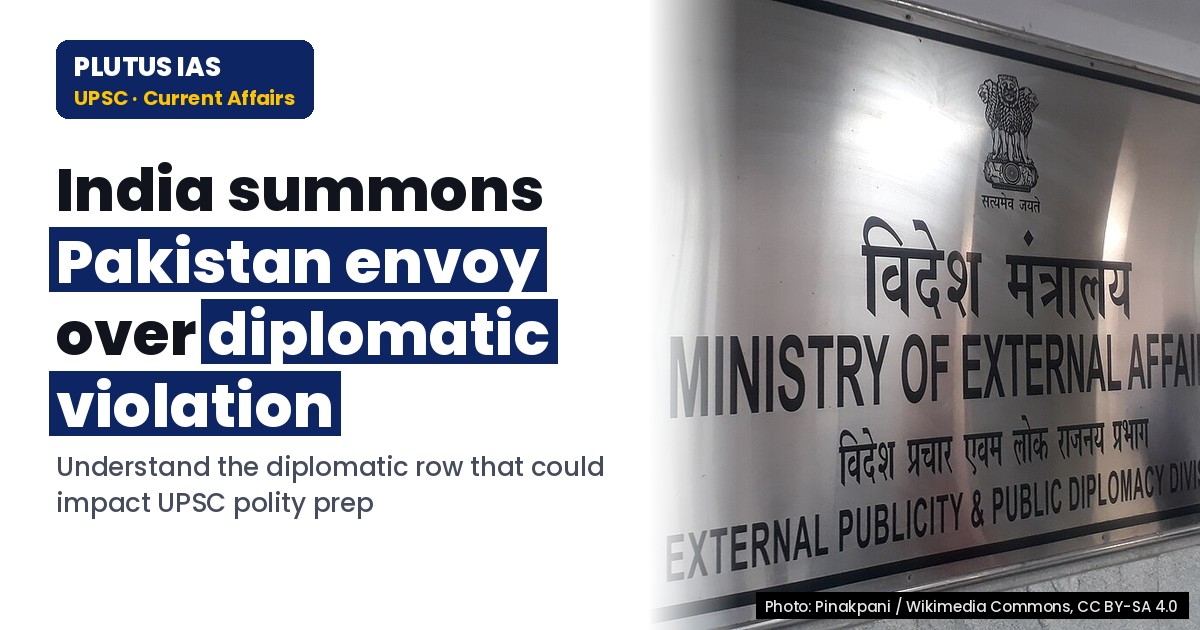
03 Oct India Summons Pakistan High Commission Official Over Violation
✎ A diplomatic summons is a formal protest mechanism under international law, conducted by the host state’s Ministry of External Affairs to address violations of bilateral norms or concerns regarding a foreign mission’s conduct…
Subject Relevance — Where This Topic Fits
- GS Paper II — India and its Neighbourhood — Relations with Pakistan | GS Paper II — Structure, Organisation and Functioning of the Executive
- Prelims: Chargé d’Affaires, Ministry of External Affairs, Vienna Convention on Diplomatic Relations, 1961, Article 3(1)(a) of the Diplomatic Relations Act, 1972, Parity in diplomatic missions, Summons in diplomatic practice, Protocol Division of MEA, Article 253 of the Constitution
- Essay: Diplomacy as the Art of the Possible: Navigating Bilateral Tensions Through Established Protocols, The Role of Institutions in Managing Asymmetric Power Relations in South Asia
Quick Revision: A diplomatic summons is a formal protest mechanism under international law, conducted by the host state’s Ministry of External Affairs to address violations of bilateral norms or concerns regarding a foreign mission’s conduct, without constituting a legal proceeding.
Why is this in the news?
The summoning of the Chargé d’Affaires of the Pakistan High Commission by the Ministry of External Affairs (MEA) signifies a formal diplomatic démarche in response to a perceived violation of bilateral norms or a matter of serious concern to India’s national interests. Such actions are governed by established protocols under international law and domestic diplomatic practice, reflecting the structured nature of India’s foreign policy responses.
Background
- The summoning of a foreign diplomat is a standard diplomatic tool used by states to express displeasure or to seek clarification on actions deemed inconsistent with bilateral agreements or international norms.
- India and Pakistan maintain diplomatic missions in each other’s capitals under the Vienna Convention on Diplomatic Relations, 1961, which codifies the rights and obligations of diplomatic missions.
- The Vienna Convention grants immunity to diplomats from prosecution under local laws, but does not immunise them from adherence to the laws and regulations of the host country regarding conduct and protocol.
- Diplomatic missions are expected to conduct themselves in accordance with the principles of reciprocity and mutual respect as enshrined in bilateral agreements, such as the 1972 Simla Agreement.
- The Protocol Division of the Ministry of External Affairs is the nodal agency responsible for managing diplomatic relations, including summoning foreign diplomats when necessary.
- Such summons are not uncommon in bilateral relations marked by periodic tensions, particularly in the context of cross-border terrorism or violations of ceasefire agreements.
What is a diplomatic summons and how is it conducted?
- A diplomatic summons is a formal request by a host state’s Ministry of External Affairs to a foreign diplomat to appear for a meeting to address a matter of concern. It is a tool of diplomatic protest rather than a legal proceeding.
- The summoning is typically conducted by the Protocol Division of the MEA, which handles all matters related to foreign missions in India.
- The diplomat summoned is usually the Chargé d’Affaires, who serves as the acting head of the mission in the absence of the Ambassador, and is empowered to represent the sending state’s interests.
- The purpose of the summons is to convey the host state’s displeasure, seek an explanation, or demand corrective action regarding an issue that violates bilateral agreements or international norms.
- The Vienna Convention on Diplomatic Relations, 1961, does not explicitly provide for summons, but it recognises the host state’s right to request explanations from foreign missions under Article 41, which mandates that diplomats must respect the laws and regulations of the host country.
- The summoning does not imply the severance of diplomatic relations but is a strong signal of disapproval. Diplomatic relations may be downgraded or severed only through a separate, more formal process.
- The host state may also choose to reciprocate with similar measures, such as summoning the host country’s diplomat in the sending state, to maintain parity in diplomatic engagements.
- Such actions are governed by the principles of reciprocity and non-interference, as outlined in the Simla Agreement, 1972, which emphasises bilateral dialogue and peaceful resolution of disputes.
UPSC Value Addition
Keywords for Mains Answer-Writing
Ministry of External Affairs · diplomatic summoning · Chargé d’Affaires · Vienna Convention on Diplomatic Relations · bilateral relations · foreign policy instruments · sovereignty · reciprocity principle · diplomatic immunity · Article 2(3) of the UN Charter · confidence-building measures · non-interference · strategic autonomy
Prelims Practice Questions
Q1. Consider the following statements regarding the summoning of a foreign diplomat by the Ministry of External Affairs:
1. The summoning is a routine diplomatic courtesy with no legal or procedural implications.
2. The summoning is conducted under the provisions of the Vienna Convention on Diplomatic Relations, 1961.
3. The summoning may be used as a tool to register protest or convey displeasure without severing diplomatic ties.
4. The summoning is always followed by the immediate expulsion of the diplomat.
How many of the above statements are correct?
- Only one
- Only two
- Only three
- All
Answer: Only three — Statements 2 and 3 are correct. The summoning is a formal diplomatic instrument under the Vienna Convention (1961) to convey displeasure or protest, while preserving diplomatic relations. Statements 1 and 4 are incorrect as the summoning carries procedural and diplomatic significance and does not automatically lead to expulsion.
Q2. Assertion (A): The summoning of a foreign diplomat by the Ministry of External Affairs is a unilateral act of the host state.
Reason (R): The Vienna Convention on Diplomatic Relations, 1961, grants the host state absolute discretion in summoning a diplomat without requiring prior consultation or justification.
In the context of the above two statements, which one of the following is correct?
- Both A and R are true, and R is the correct explanation of A.
- Both A and R are true, but R is not the correct explanation of A.
- A is true, but R is false.
- A is false, but R is true.
Answer: A is true, but R is false. — Assertion (A) is true: summoning is a unilateral act. However, Reason (R) is false because while the host state has discretion, the Vienna Convention does not grant absolute discretion without any procedural or diplomatic context. The summoning must align with the Convention’s provisions on reciprocity and non-interference.
Q3. Match the following diplomatic actions with their corresponding legal or procedural frameworks:
Column I (Action) Column II (Framework)
A. Summoning of a foreign diplomat 1. Article 9 of the Vienna Convention on Diplomatic Relations, 1961
B. Declaration of persona non grata 2. Article 41 of the Vienna Convention on Diplomatic Relations, 1961
C. Diplomatic immunity 3. Article 29 of the Vienna Convention on Diplomatic Relations, 1961
D. Invitation to a bilateral meeting 4. Bilateral agreements or memoranda of understanding
Select the correct match:
- A-1, B-2, C-3, D-4
- A-2, B-1, C-3, D-4
- A-1, B-4, C-2, D-3
- A-4, B-2, C-1, D-3
Answer: A-1, B-2, C-3, D-4 — The correct matches are: A (Summoning) is governed by Article 9 of the Vienna Convention on Diplomatic Relations, 1961; B (Declaration of persona non grata) is also under Article 9; C (Diplomatic immunity) is covered under Article 29; and D (Invitation to a bilateral meeting) is typically governed by bilateral agreements or memoranda of understanding.
Mains Practice Question
✍ The summoning of a foreign diplomat by the Ministry of External Affairs is a critical instrument in the conduct of India’s foreign policy. In this context, critically examine the legal and diplomatic dimensions of such summoning, with reference to the Vienna Convention on Diplomatic Relations, 1961. Also, analyse its implications for bilateral relations and strategic autonomy. (15 Marks)
Approach: MODEL-ANSWER SKELETON:
1. **Legal Framework**:
– Define the summoning as a diplomatic tool under Article 9 of the Vienna Convention on Diplomatic Relations, 1961.
– Explain the conditions for summoning: ‘any time and without explanation’ but within the bounds of reciprocity and non-interference (Article 41).
– Distinguish between summoning and declaration of persona non grata (Article 9(1)).
2. **Diplomatic Dimensions**:
– Purpose of summoning: protest, register displeasure, or seek clarification without escalating tensions.
– Role of the Ministry of External Affairs: as the nodal agency for diplomatic engagements and crisis management.
– Importance of maintaining diplomatic channels even during periods of strain.
3. **Implications for Bilateral Relations**:
– Impact on trust and confidence-building measures (CBMs).
– Potential for escalation or de-escalation depending on the context and follow-up actions.
– Role of reciprocity in shaping the response of the other state.
4. **Strategic Autonomy**:
– How summoning aligns with India’s policy of strategic autonomy and non-alignment.
– Balancing sovereignty with engagement in multilateral and bilateral forums.
– Case study: Recent instances of summoning and their outcomes (e.g., 2016 surgical strikes, 2019 Balakot airstrikes, or other relevant examples).
5. **Balancing Views**:
– Proponents argue that summoning is a necessary tool to assert sovereignty and protect national interests.
– Critics may argue that it risks escalating tensions or undermines long-term diplomatic engagement.
6. **Conclusion**:
– Summoning is a calibrated tool that must be used judiciously to serve broader foreign policy objectives.
– Emphasise the need for diplomacy to complement coercive instruments in foreign policy.
Source: Ministry of External Affairs
Generated by AanyaAi for educational purpose.
Related guides on our sites
- Current affairs for upsc 2026
- Best PSIR optional coaching for upsc
- Best PSIR optional teacher for upsc
- Best teacher of PSIR optional for upsc

- India Summons Pakistan High Commission Official Over Violation - October 3, 2026
- मुंबई का जवाहर द्वीप बना भारत का पहला प्लास्टिक-मुक्त ऑयल टर्मिनल - October 3, 2026
- Gujarat HC orders FIR in ITS officer’s 2023 custodial death - October 3, 2026

No Comments