


04 Aug How AI is Revolutionizing Food Aid Delivery in Somalia for UPSC 2026
✎ AI-driven platforms like WFP’s HungerMap Live exemplify the integration of technology in humanitarian logistics, enabling predictive interventions to mitigate food insecurity in crisis-prone regions like Somalia.
Subject Relevance — Where This Topic Fits
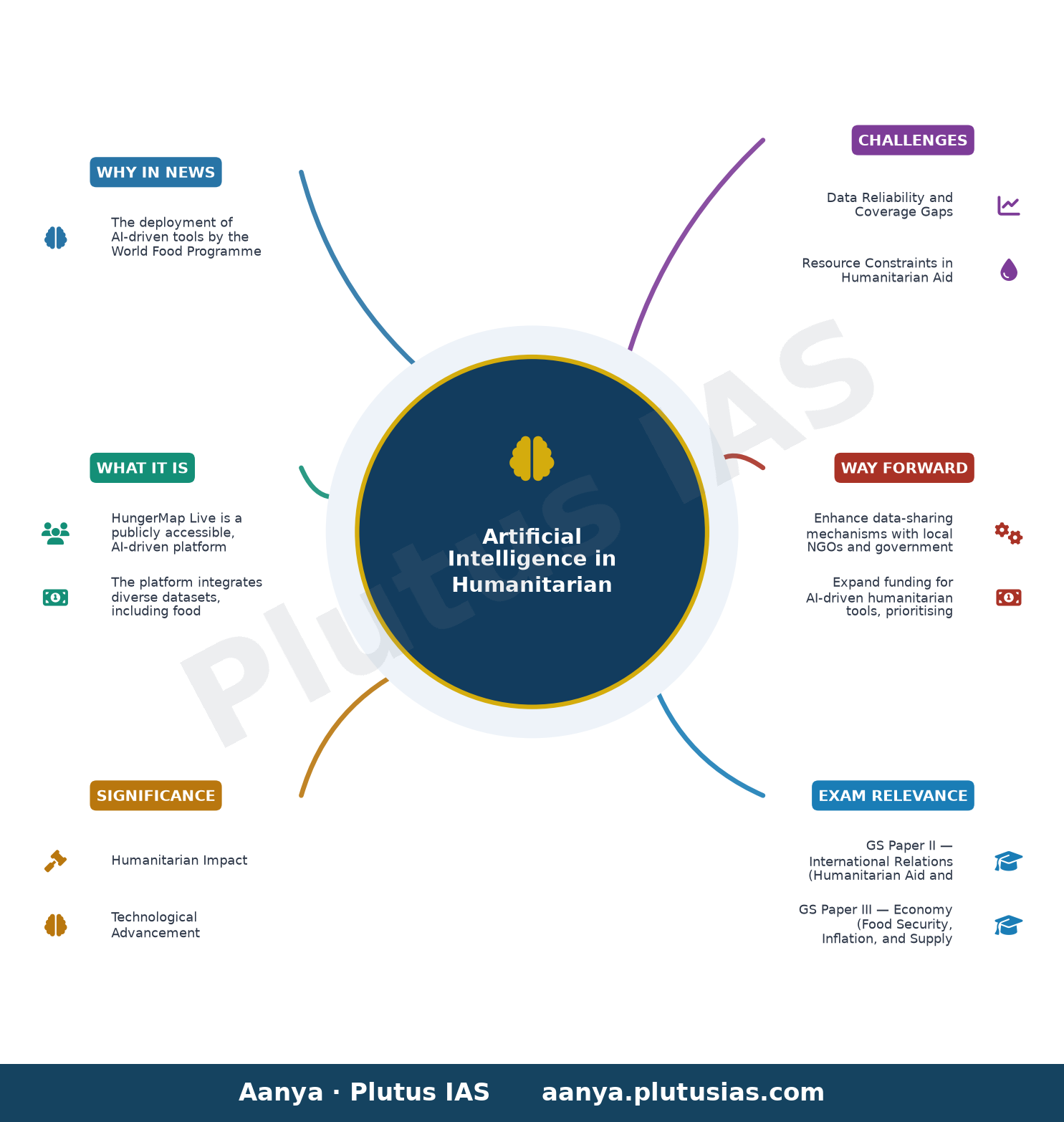
- GS Paper II — International Relations (Humanitarian Aid and International Organisations) | GS Paper III — Economy (Food Security, Inflation, and Supply Chain Disruptions) | GS Paper III — Science and Technology (Applications of AI in Governance and Humanitarian Assistance)
- Prelims: HungerMap Live, World Food Programme (WFP), Food and Agriculture Organization (FAO), Somalia food crisis, AI in humanitarian aid, malnutrition hotspots, climate-induced droughts, flash floods, Horn of Africa conflict, global food price shocks
- Essay: The Role of Technology in Addressing Global Humanitarian Crises, Balancing Technological Innovation with Ethical Governance in Public Policy
Quick Revision: AI-driven platforms like WFP’s HungerMap Live exemplify the integration of technology in humanitarian logistics, enabling predictive interventions to mitigate food insecurity in crisis-prone regions like Somalia.
Why is this in the news?
The deployment of AI-driven tools by the World Food Programme (WFP) in Somalia to predict and mitigate food insecurity represents a paradigm shift in humanitarian logistics. This initiative, particularly the upgraded HungerMap Live 2.0 platform, underscores the intersection of technology and governance in addressing acute food crises exacerbated by climate change, conflict, and economic vulnerabilities. The case of Somalia, where 6 million people face crisis levels of food insecurity, highlights the urgency and efficacy of AI in resource allocation, making it a critical study point for UPSC aspirants examining modern governance mechanisms.
Background
- Somalia is experiencing a severe humanitarian crisis, with 6 million people facing crisis levels of food insecurity due to prolonged droughts, flash floods, and a protracted conflict spanning 35 years.
- In June 2026, Somalia was designated as a ‘hunger hotspot of highest concern’ by the WFP and FAO, alongside regions like northeast Nigeria, Sudan, South Sudan, Yemen, and Palestine.
- Climate change-induced environmental degradation, including desertification and erratic rainfall patterns, has exacerbated food production deficits in Somalia.
- The Horn of Africa’s geopolitical instability and recurrent climate disasters create a compounded crisis, demanding adaptive humanitarian strategies.
What is HungerMap Live and AI’s Role in Humanitarian Assistance?
- HungerMap Live is a publicly accessible, AI-driven platform developed by the World Food Programme (WFP) to monitor and predict food insecurity across over 90 countries, including Somalia.
- The platform integrates diverse datasets, including food insecurity metrics, climate patterns, economic indicators, agricultural output, and inflation rates, to generate real-time and predictive analyses of hunger risks.
- HungerMap Live 2.0, launched in April 2026, represents an upgraded version with enhanced predictive capabilities, improved user interface, and the ability to explain the drivers of food insecurity, such as droughts or economic shocks.
- AI tools within HungerMap Live enable WFP to identify ‘hunger hotspots’ before conditions deteriorate, facilitating preemptive resource allocation, such as food assistance or malnutrition treatment, in high-risk areas like Burhakaba District in Somalia.
- The platform does not replace ground-level assessments but complements them by providing data-driven insights to prioritise communities and tailor aid interventions, such as cash transfers or specialised nutrition support for women and children.
- HungerMap Live’s predictive analytics help governments and humanitarian agencies mobilise resources proactively, reducing the lag between crisis identification and intervention, which is critical in acute emergencies.
- The AI model underlying HungerMap Live relies on machine learning algorithms trained on historical and real-time data to forecast food insecurity trends, though its accuracy is contingent on data quality and coverage.
- Ethical considerations in AI deployment, such as data privacy and the risk of algorithmic bias, are addressed through transparent methodologies and collaboration with local stakeholders to ensure equitable resource distribution.
Key Features
| Feature | Significance |
|---|---|
| AI-driven HungerMap Live 2.0 platform | Enables predictive analysis of food insecurity by integrating climate, economic, and agricultural data to forecast hunger crises before they escalate. |
| Real-time data integration | Combines inputs from food insecurity, malnutrition rates, and displacement patterns to prioritise humanitarian interventions dynamically. |
| Predictive capabilities | Identifies emerging hunger hotspots, allowing pre-emptive resource allocation to mitigate deterioration in vulnerable regions. |
| Public accessibility | Provides open-source data to governments and NGOs, fostering coordinated responses across humanitarian actors. |
| Nutritional focus | Tracks dietary quality alongside food availability, ensuring interventions address both quantity and nutritional needs. |
Why it Matters
Humanitarian Impact
- Facilitates targeted aid delivery to 48,000 individuals in Burhakaba district, reducing malnutrition-related displacement and mortality risks.
- Enhances early warning systems, enabling proactive rather than reactive humanitarian responses in conflict and climate-affected regions.
- Supports vulnerable populations, including internally displaced persons (IDPs) and malnourished children, through precise resource allocation.
Technological Advancement
- Demonstrates the application of AI in humanitarian logistics, bridging data gaps in resource-scarce environments.
- Improves the accuracy of food security assessments by incorporating multi-dimensional datasets, reducing reliance on outdated or incomplete information.
- Sets a precedent for AI integration in global food security frameworks, particularly in regions facing compounded crises.
Geopolitical and Regional Stability
- Highlights Somalia’s vulnerability to climate-induced disasters and protracted conflict, exacerbating food insecurity and regional instability.
- Underscores the Horn of Africa’s exposure to global shocks, such as Middle Eastern conflicts and supply chain disruptions, necessitating regional cooperation.
Economic Implications
- Reduces long-term economic costs by preventing malnutrition-related healthcare burdens and productivity losses in affected populations.
- Highlights the economic strain on Somalia’s food import-dependent economy, exacerbated by global price volatility and climate variability.
Challenges
1. Data Reliability and Coverage Gaps
- Limited ground-truthing in conflict zones and remote areas may compromise the accuracy of AI-driven predictions.
- Incomplete or delayed data from partner organisations can skew the platform’s effectiveness in real-time decision-making.
UPSC Link: GS3: Data Governance and Challenges
2. Resource Constraints in Humanitarian Aid
- WFP’s reach in Somalia covers only 10% of those in need, highlighting severe funding and logistical shortfalls.
- High operational costs of AI integration and maintenance in resource-limited settings restrict scalability.
UPSC Link: GS2: International Organisations and Funding
3. Climate Change and Environmental Degradation
- Increasing frequency of droughts and flash floods disrupts agricultural cycles, exacerbating chronic food insecurity.
- Soil degradation and water scarcity reduce Somalia’s self-sufficiency, deepening reliance on food imports.
UPSC Link: GS3: Climate Change and Food Security
4. Protracted Conflict and Governance Issues
- Decades of instability and insurgency hinder humanitarian access and impede long-term development solutions.
- Weak governance structures limit the implementation of AI-driven solutions at the local level.
UPSC Link: GS2: Internal Security and Governance
5. Global Supply Chain Vulnerabilities
- Dependence on food imports exposes Somalia to external shocks, such as geopolitical conflicts and economic downturns.
- Trade restrictions and inflation further strain food affordability for vulnerable populations.
UPSC Link: GS3: Globalisation and Food Security
Challenges — UPSC Perspective
| Issue | Concern |
|---|---|
| Conflict-induced displacement | Restricts access to affected populations, complicating aid delivery and data collection. |
| Climate variability | Disrupts agricultural productivity and increases the frequency of extreme weather events. |
| Data scarcity in remote areas | Undermines the accuracy of AI predictions, leading to potential misallocation of resources. |
| Limited funding for AI integration | Delays the expansion of predictive tools to other high-risk regions. |
| Nutritional quality gaps | AI tools may not fully capture micronutrient deficiencies, requiring supplementary assessments. |
| Logistical bottlenecks | Inadequate infrastructure in Somalia hampers the timely distribution of aid. |
Way Forward
- Enhance data-sharing mechanisms with local NGOs and government agencies to improve ground-truthing and reduce prediction errors.
- Expand funding for AI-driven humanitarian tools, prioritising regions with the highest food insecurity and least access to traditional aid.
- Strengthen climate-resilient agricultural policies to reduce Somalia’s dependence on food imports and mitigate supply chain shocks.
- Integrate AI predictions with existing early warning systems, such as the Integrated Food Security Phase Classification (IPC), for standardised assessments.
- Promote public-private partnerships to develop low-cost, scalable AI solutions tailored to resource-constrained environments.
- Advocate for regional cooperation in the Horn of Africa to address shared climate and conflict challenges affecting food security.
- Invest in community-based nutrition programmes to complement AI-driven interventions, ensuring sustainable health outcomes.
- Develop contingency plans for AI tool failures or data disruptions, ensuring continuity of humanitarian operations.
UPSC Value Addition
Keywords for Mains Answer-Writing
Artificial Intelligence in humanitarian aid · World Food Programme (WFP) · HungerMap Live platform · Food insecurity in Somalia · Predictive analytics in crisis management · Climate change and food security · AI-driven resource allocation in emergencies · UN humanitarian operations · Malnutrition in conflict zones · Data-driven decision-making in governance
Concept Flow
Prolonged conflict and climate-induced disasters → Chronic food insecurity and malnutrition → AI-driven HungerMap Live 2.0 platform → Predictive analysis of hunger hotspots → Targeted humanitarian interventions → Reduced displacement and mortality → Sustainable food security outcomes
Prelims Practice Questions
Q1. Consider the following statements regarding the HungerMap Live platform developed by the World Food Programme (WFP):
1. HungerMap Live uses artificial intelligence to predict future hunger crises in over 90 countries.
2. The platform was first launched in January 2020 and has since been updated to include predictive AI features.
3. HungerMap Live 2.0 can track the nutritional quality of diets in the countries it monitors.
How many of the above statements are correct?
- Only one
- Only two
- All three
- None
Answer: All three — Statements 1 and 2 are correct. Statement 3 is incorrect because HungerMap Live 2.0 does not track the nutritional quality of diets; this was a limitation of the initial version and remains unaddressed in the update.
Q2. Assertion (A): The World Food Programme (WFP) uses AI tools in its HungerMap Live platform to position resources in specific areas before conditions deteriorate.
Reason (R): Somalia faces climate change-induced droughts, flash floods, and prolonged conflict, exacerbating food insecurity.
Options:
A. Both A and R are true, and R is the correct explanation of A.
B. Both A and R are true, but R is not the correct explanation of A.
C. A is true, but R is false.
D. A is false, but R is true.
Answer: ? — Both Assertion (A) and Reason (R) are true, and R correctly explains A. The AI tools in HungerMap Live are specifically designed to preemptively allocate resources in regions like Somalia, where climate and conflict-driven food insecurity is severe.
Q3. Match the following columns related to the World Food Programme (WFP) and its initiatives:
Column I (Initiative/Platform) | Column II (Description)
1. HungerMap Live | A. A platform that uses AI to monitor food insecurity and predict hunger crises in real-time.
2. WFP Somalia | B. A district in Somalia where AI-driven aid delivery has been implemented to address malnutrition.
3. Burhakaba District | C. A UN agency providing food assistance to 6 million Somalis facing hunger.
Options:
A. 1-A, 2-C, 3-B
B. 1-B, 2-A, 3-C
C. 1-C, 2-B, 3-A
D. 1-A, 2-B, 3-C
Answer: ? — 1 matches with A (HungerMap Live is the AI-driven platform), 2 matches with C (WFP Somalia is the UN agency providing aid), and 3 matches with B (Burhakaba District is the specific area in Somalia where AI-driven aid was implemented).
Mains Practice Question
✍ Artificial intelligence is transforming humanitarian aid delivery by enabling predictive resource allocation in crisis situations. Critically examine the role of AI in addressing food insecurity, with particular reference to the World Food Programme’s HungerMap Live platform and its application in Somalia. Substantiate your answer with relevant examples and discuss the limitations of such technological interventions. (15 Marks)
Approach: MODEL-ANSWER SKELETON:
1. **Introduction (2 marks)**: Define AI in humanitarian aid and its relevance in crisis management. Briefly introduce the World Food Programme (WFP) and HungerMap Live platform.
2. **AI in Humanitarian Aid (4 marks)**:
– Explain the mechanism of AI-driven predictive analytics in HungerMap Live (e.g., data integration from food insecurity, climate, economy, agriculture).
– Highlight its role in preemptive resource allocation (e.g., Burhakaba District in Somalia, where AI identified malnutrition risks before deterioration).
– Cite the update to HungerMap Live 2.0 (April 2026) and its predictive AI features.
3. **Application in Somalia (4 marks)**:
– Discuss Somalia’s context: climate-induced droughts, flash floods, prolonged conflict, and food import dependency.
– Explain how AI tools in HungerMap Live helped WFP reach 48,000 people in Burhakaba District and provide nutrition support to 3,000 women and children.
– Mention the inclusion of Somalia in the UN’s list of ‘hunger hotspots of highest concern’ (June 2026).
4. **Limitations and Challenges (3 marks)**:
– AI cannot replace on-ground assessments; discuss the need for ground-truthing.
– Limitations in tracking nutritional quality of diets (as noted in the initial version of HungerMap Live).
– Challenges in scaling AI interventions due to resource constraints (e.g., WFP requires $192 million to reach all in need by January 2027).
5. **Conclusion (2 marks)**: Summarize the transformative potential of AI in humanitarian aid while emphasizing the need for complementary ground-level interventions and ethical considerations.
Source: news.un.org
Generated by AanyaAi for educational purpose.

- KWML’s Feasibility Reports for Water Metro in 18 Cities: UPSC & PCS Insights - October 3, 2026
- ओडिशा में वन्यजीव अनुसंधान अनुदान कार्यक्रम शुरू, सिमिलिपाल में 300 कैमरे और बढ़ेंगे - October 3, 2026
- India Summons Pakistan High Commission Official Over Violation - October 3, 2026

No Comments