


04 Aug AI-Driven Hiring Trends Reshaping Global Capability Centres in India
✎ Global Capability Centres in India are transitioning from cost-centric back-office units to AI-driven innovation hubs, with recruitment now prioritizing outcome-based hiring and specialized technical expertise in artificial…
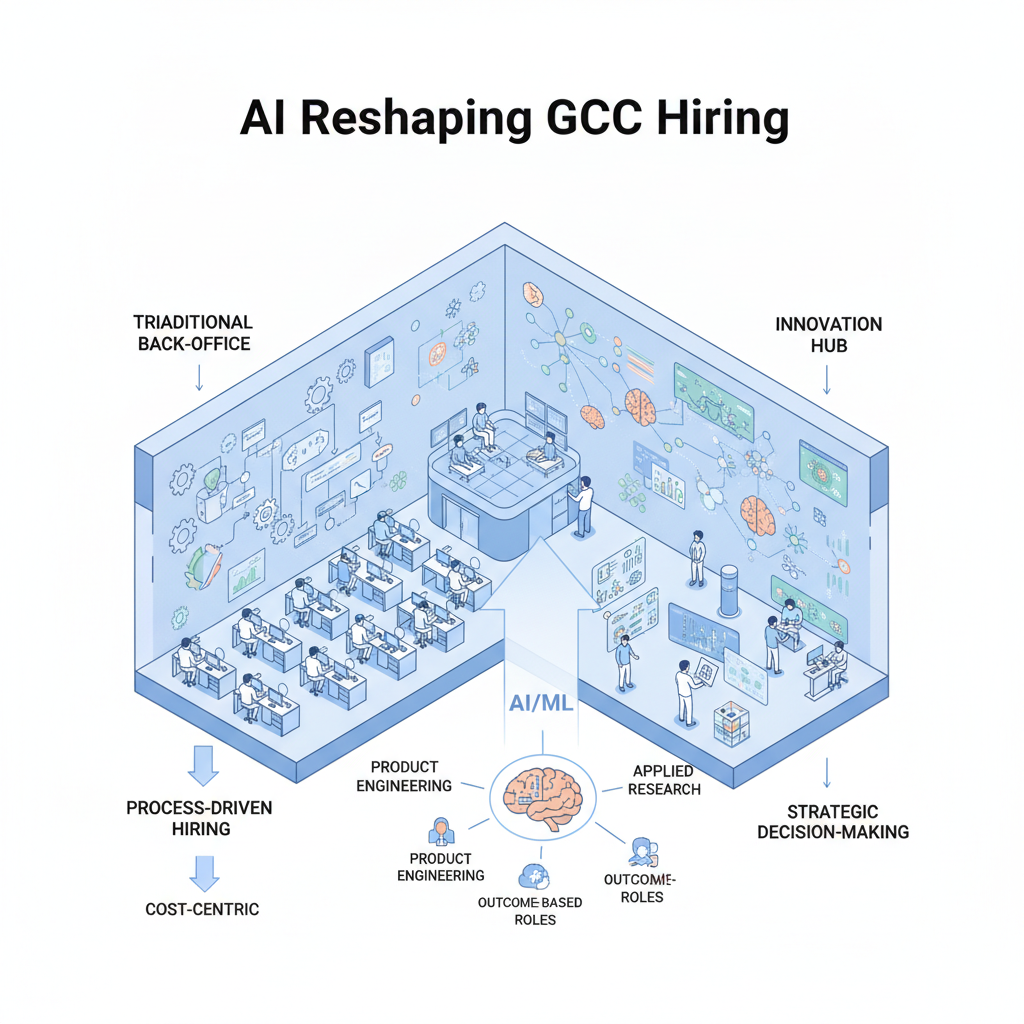 Outcome-based rolesProduct engineeringApplied researchStrategic decision-making
Subject Relevance — Where This Topic Fits
- GS Paper III — Indian Economy and issues relating to Planning, Mobilization of Resources, Growth, Development and Employment | GS Paper III — Effects of Liberalization on the Economy, Changes in Industrial Policy and their effects on Industrial Growth | GS Paper III — Science and Technology- Developments and their Applications and Effects in Everyday Life
- Prelims: Global Capability Centres (GCCs), AI-driven hiring, Product engineering in GCCs, Applied research in India, Zinnov-Nasscom GCC Landscape Report, AI hiring in India, Operational efficiency vs innovation in GCCs
- Essay: The transformation of India’s role in the global knowledge economy: From cost arbitrage to innovation leadership, Artificial Intelligence and the future of work: Reskilling, upskilling, and the changing contours of employability
Quick Revision: Global Capability Centres in India are transitioning from cost-centric back-office units to AI-driven innovation hubs, with recruitment now prioritizing outcome-based hiring and specialized technical expertise in artificial intelligence and machine learning.
Why is this in the news?
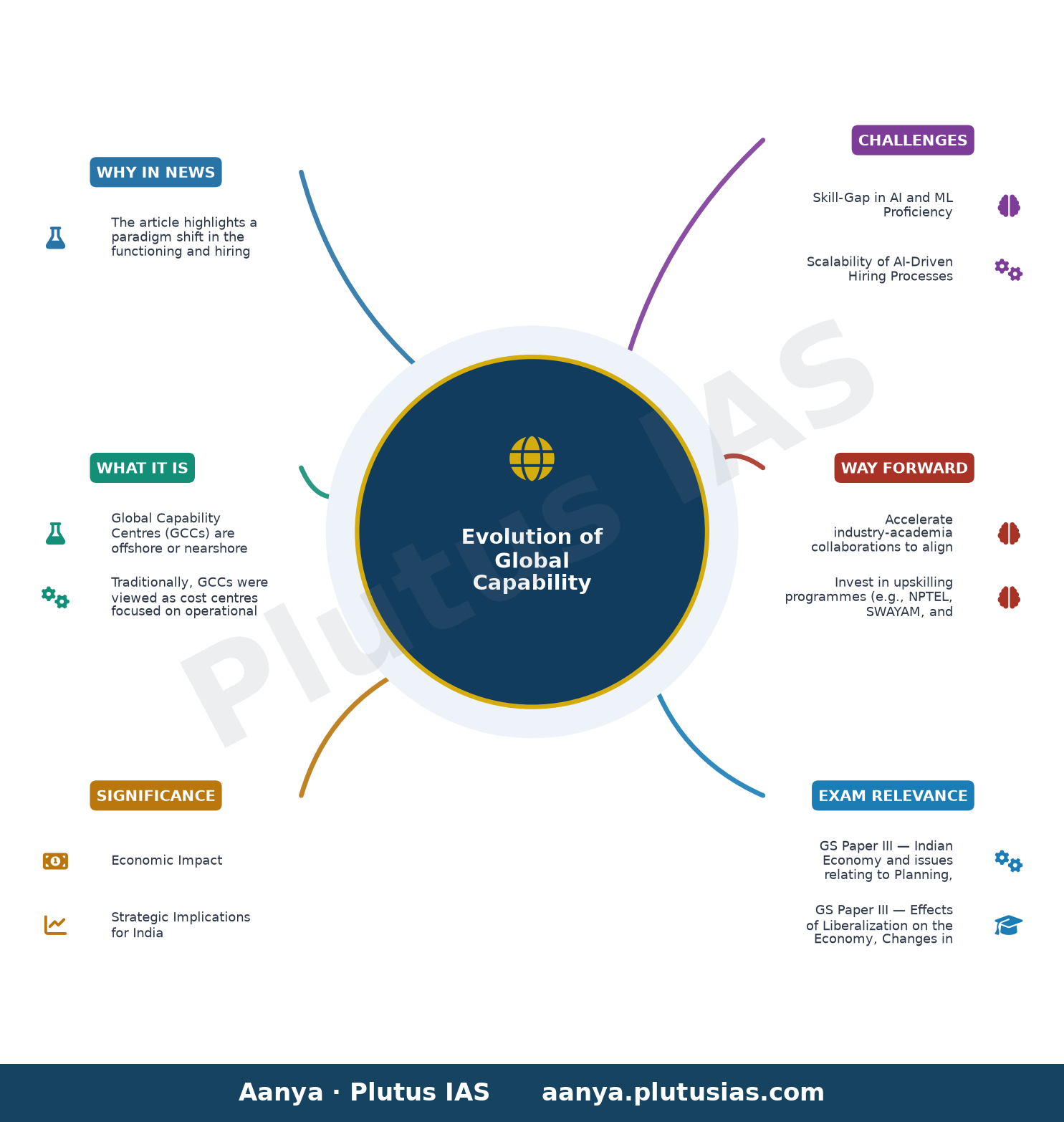
The article highlights a paradigm shift in the functioning and hiring priorities of Global Capability Centres (GCCs) in India, driven by the integration of Artificial Intelligence (AI) and machine learning. This transformation underscores the evolving role of GCCs from cost-centric back-office units to innovation hubs that contribute to product engineering, applied research, and strategic decision-making. The shift in recruitment practices—from process-driven hiring to a focus on AI fluency and outcome-based roles—reflects broader trends in the global knowledge economy and the increasing demand for AI-skilled professionals in India.
Background
- Global Capability Centres (GCCs) were historically established in India primarily as cost-effective extensions of multinational corporations, focusing on operational efficiency and back-office functions such as IT services, finance, and customer support.
- Over the past decade, GCCs in India have evolved into strategic hubs, with many now engaged in high-value activities such as product engineering, applied research, and business decision-making that were traditionally centralized in parent companies abroad.
- The integration of AI and machine learning into business processes has accelerated this transformation, with GCCs increasingly tasked with developing AI-driven solutions, automating workflows, and driving innovation.
- According to the Zinnov-Nasscom GCC Landscape Report for 2026, India’s GCC workforce has grown to 2.36 million professionals, making it one of the world’s top markets for AI hiring.
- The demand for AI-skilled professionals has outpaced the supply, leading to a fundamental reorientation of hiring practices within GCCs, with a focus on outcome-based recruitment and specialized technical expertise.
What are Global Capability Centres (GCCs) and their evolving role in the AI-driven economy?
- Global Capability Centres (GCCs) are offshore or nearshore units of multinational corporations (MNCs) established in India to perform high-value functions such as product engineering, applied research, IT services, finance, and strategic decision-making.
- Traditionally, GCCs were viewed as cost centres focused on operational efficiency, often handling routine tasks such as software development, customer support, and back-office operations.
- In recent years, GCCs have transitioned into innovation hubs, with many now responsible for end-to-end product development, research and development (R&D), and business strategy formulation, thereby contributing directly to the parent company’s competitive advantage.
- The integration of AI and machine learning has been a key driver of this transformation, enabling GCCs to automate processes, derive insights from data, and develop intelligent solutions that enhance business outcomes.
- AI-driven hiring within GCCs now prioritizes candidates with demonstrated expertise in AI, machine learning, and data science, as well as the ability to apply these technologies to real-world business problems.
- Recruitment processes have shifted from keyword-based resume screening to outcome-focused evaluations, including coding tests, case studies, simulation exercises, and assessments of applied work such as completed projects or certifications.
- The role of engineers and technical professionals within GCCs has expanded beyond traditional software development to include responsibilities such as designing AI models, optimizing business processes through automation, and driving data-driven decision-making.
- This evolution reflects a broader trend in the global economy, where the demand for AI-skilled professionals is outstripping supply, necessitating a reorientation of educational and professional development strategies to meet industry needs.
Key Features
| Feature | Significance |
|---|---|
| Shift from cost centres to innovation hubs | GCCs now prioritise product engineering, applied research, and autonomous decision-making over operational efficiency, redefining their strategic role within multinational corporations. |
| AI and ML as central hiring criteria | Approximately 80% of new GCCs in 2026 explicitly list AI/ML as their primary focus, marking a departure from traditional back-office functions. |
| Outcome-driven recruitment | Hiring now favours candidates who demonstrate tangible contributions (e.g., process fixes, product launches) over those merely listing job duties. |
| Automated screening mechanisms | Coding tests, case studies, and simulation exercises have replaced resume-based keyword matching, enabling scalable yet rigorous candidate evaluation. |
| Hybrid technical-AI skill requirements | Candidates must combine core technical expertise with applied AI/ML knowledge, such as automating workflows or deploying models to solve business problems. |
Why it Matters
Economic Impact
- India’s GCC workforce has expanded to 2.36 million professionals, positioning the country as a global leader in AI-driven employment and innovation.
- The transition from cost arbitrage to value creation enhances India’s GDP contribution through higher-value services and intellectual property generation.
- Increased foreign direct investment (FDI) in R&D-intensive sectors, as multinational corporations (MNCs) relocate strategic functions to India-based GCCs.
Strategic Implications for India
- Strengthens India’s position in the global AI ecosystem, aligning with the vision of becoming a ‘Global AI Hub’ as outlined in the National AI Strategy.
- Accelerates the ‘Make in India’ and ‘Digital India’ initiatives by embedding AI capabilities within domestic industries.
- Reduces reliance on traditional outsourcing models, fostering self-sufficiency in high-end technological domains.
Labour Market Transformation
- Creates demand for a new cadre of ‘AI-fluent’ professionals, including data scientists, machine learning engineers, and AI product managers.
- Drives upskilling and reskilling initiatives, with certifications and project-based portfolios becoming critical for employability.
- Shifts the hiring paradigm from ‘process execution’ to ‘innovation and problem-solving’, altering career trajectories for technical graduates.
Corporate Governance and Decision-Making
- Delegates strategic decision-making authority to India-based teams, reducing hierarchical bottlenecks in multinational corporations.
- Enhances agility in product development and market adaptation, as local teams can rapidly iterate based on AI-driven insights.
Challenges
1. Skill-Gap in AI and ML Proficiency
- A significant portion of India’s technical workforce lacks hands-on experience in deploying AI/ML solutions, despite theoretical knowledge.
- Recruiters report difficulty in distinguishing between candidates with superficial AI literacy and those with applied expertise.
UPSC Link: GS3: Science & Technology – Skill Development
2. Scalability of AI-Driven Hiring Processes
- Automated screening tools, while efficient, may inadvertently exclude high-potential candidates due to algorithmic biases or overly rigid criteria.
- The sheer volume of applications (thousands per role) strains recruitment teams, necessitating advanced AI tools for candidate shortlisting.
UPSC Link: GS2: Governance – Digital Governance
3. Ethical and Regulatory Concerns in AI Deployment
- GCCs must navigate data privacy laws (e.g., DPDP Act, 2023) and ethical AI frameworks while handling sensitive business and customer data.
- Risk of algorithmic bias in AI-driven hiring tools, which could lead to discriminatory outcomes if not rigorously audited.
UPSC Link: GS4: Ethics – AI Governance
4. Retention of High-Skilled Talent
- Competition from global tech firms and startups for AI talent may lead to brain drain, particularly in metropolitan hubs.
- GCCs must offer competitive compensation, career growth, and autonomy to retain professionals capable of driving innovation.
UPSC Link: GS3: Employment – Labour Reforms
5. Infrastructure and Resource Constraints
- High-performance computing (HPC) and cloud infrastructure requirements for AI/ML projects pose financial and logistical challenges for smaller GCCs.
- Limited access to cutting-edge AI research and datasets in certain sectors may hinder product development.
UPSC Link: GS3: Infrastructure – Digital Infrastructure
Challenges — UPSC Perspective
| Issue | Concern |
|---|---|
| Skill Deficit in AI/ML | Gap between academic training and industry-relevant AI expertise, leading to suboptimal hiring outcomes. |
| Algorithmic Bias in Hiring | Risk of automated screening tools perpetuating or amplifying existing biases in recruitment. |
| Data Privacy Compliance | Complexity of adhering to India’s data protection laws while processing sensitive business data. |
| Talent Retention Challenges | High attrition rates among AI-skilled professionals due to competitive job markets. |
| Infrastructure Costs | Financial barriers to acquiring advanced computing resources for AI/ML projects. |
| Ethical AI Deployment | Need for robust frameworks to ensure transparency and fairness in AI-driven decision-making. |
Way Forward
- Accelerate industry-academia collaborations to align technical curricula with AI/ML industry demands, including internships and capstone projects.
- Invest in upskilling programmes (e.g., NPTEL, SWAYAM, and corporate-led initiatives) to bridge the AI proficiency gap among professionals.
- Develop standardized AI certification frameworks to validate applied skills, aiding recruiters in identifying competent candidates.
- Enhance recruitment infrastructure by adopting AI-driven tools for unbiased candidate shortlisting, coupled with human oversight for quality control.
- Strengthen data governance policies within GCCs to ensure compliance with India’s data protection regulations while enabling AI innovation.
- Promote public-private partnerships to subsidize high-performance computing resources for startups and mid-sized GCCs.
- Encourage GCCs to adopt ethical AI guidelines, including bias audits and explainability frameworks, to mitigate risks in deployment.
- Focus on creating a conducive ecosystem for AI startups within GCCs, fostering intrapreneurship and spin-off ventures.
UPSC Value Addition
Keywords for Mains Answer-Writing
Global Capability Centres (GCCs) · Artificial Intelligence (AI) in recruitment · Product engineering and applied research · Skill transformation in GCC workforce · AI-driven hiring processes · Technical fluency in AI/ML · Zinnov-Nasscom GCC Landscape Report 2026 · Operational efficiency to innovation hubs · AI hiring volume and scale · Project-based hiring criteria
Constitutional & Policy Linkages
- Article 19(1)(g): Right to practise any profession, or to carry on any occupation, trade or business — relevant to GCCs’ operational autonomy in innovation-driven roles.
Concept Flow
Global MNCs expand GCCs in India → Shift from cost centres to innovation hubs → Demand for AI/ML expertise in product engineering and R&D increases → Traditional hiring (resume-based, process-driven) becomes obsolete → Outcome-driven recruitment and applied AI skills become prerequisites → Automated screening tools (coding tests, case studies) replace keyword matching → Scalability challenges emerge in candidate evaluation → AI deployment in hiring introduces ethical and regulatory concerns (e.g., bias, data privacy) → Need for robust governance frameworks arises → Retention of AI-skilled talent becomes critical → Competition from global firms and startups intensifies → Infrastructure and resource constraints limit smaller GCCs → Public-private partnerships and upskilling initiatives gain urgency → India’s role in the global AI ecosystem strengthens → Strategic alignment with national AI and digital governance policies
Prelims Practice Questions
Q1. Consider the following statements regarding Global Capability Centres (GCCs) in India:
1. GCCs have evolved from cost centres to centres of innovation over the past decade.
2. Roughly 80% of GCCs established in 2026 list AI and machine learning as their central purpose.
3. The Zinnov-Nasscom GCC Landscape Report 2026 estimates India’s GCC workforce at 2.36 million professionals.
How many of the above statements are correct?
- Only one
- Only two
- All
- None
Answer: All — Statements 1 and 3 are correct. Statement 2 is incorrect as the report refers to GCCs opened ‘this year’ (2026), not necessarily established in 2026.
Q2. Assertion (A): The hiring criteria in Global Capability Centres (GCCs) have shifted from process-driven roles to building and decision-making roles.
Reason (R): AI and machine learning have enabled automation of routine tasks, necessitating a workforce skilled in product engineering and applied research.
Options:
A. Both A and R are true, and R is the correct explanation of A.
B. Both A and R are true, but R is not the correct explanation of A.
C. A is true, but R is false.
D. A is false, but R is true.
- A
- B
- C
- D
Answer: A — Both A and R are true, and R correctly explains A. The shift in hiring priorities is directly linked to the adoption of AI and ML technologies.
Mains Practice Question
✍ Critically analyse the transformation of Global Capability Centres (GCCs) in India from cost-efficient extensions of parent enterprises to hubs of innovation, with particular reference to the role of Artificial Intelligence (AI) in reshaping hiring priorities. (15 Marks)
Approach: MODEL-ANSWER SKELETON:
1. **Introduction**: Define GCCs and their evolution from cost centres to innovation hubs (cite the shift from operational efficiency to product engineering and applied research).
2. **AI as a Catalyst**: Explain how AI/ML adoption has driven this transformation, citing the Zinnov-Nasscom GCC Landscape Report 2026 and the 80% focus on AI/ML in new GCCs.
3. **Hiring Priorities**: Discuss the shift from process-driven hiring to roles requiring AI fluency, decision-making, and project-based outcomes (e.g., candidates with completed projects or certifications).
4. **Challenges**: Highlight the constraints in scaling AI hiring, such as the volume of applications (2.36 million professionals) and the need for applied technical skills.
5. **Balanced View**: Acknowledge the continued importance of core technical grounding while emphasising the necessity of AI/ML fluency.
6. **Conclusion**: Summarise the strategic imperative for India’s GCC workforce to align with global innovation demands and the broader implications for India’s technical education ecosystem.
Source: The Hindu
Generated by AanyaAi for educational purpose.

- Jal Arpan: 1850+ Gram Panchayats Join Hands for Rural Water Supply - October 3, 2026
- भारत ने किया 5.56 किमी मुक्त अंतरिक्ष क्वांटम की वितरण लिंक का सफल परीक्षण - October 3, 2026
- Great Indian Bustard Reintroduction: 10-Year Effort Bears Fruit in Rajasthan - October 3, 2026

No Comments