


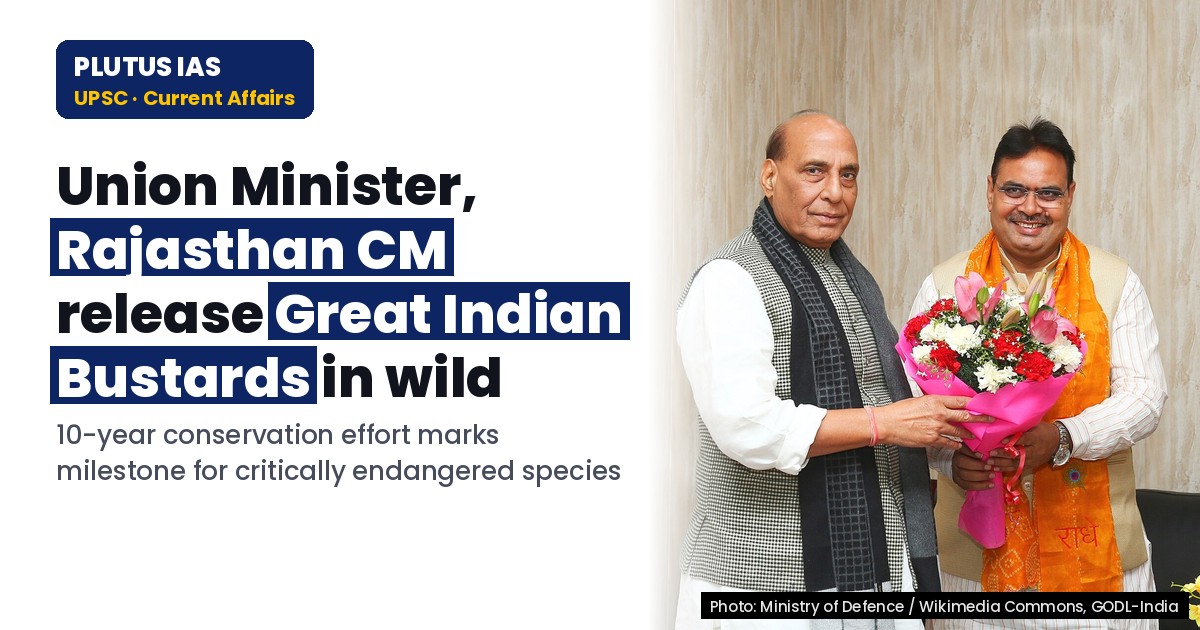
03 Oct Great Indian Bustard Reintroduction: 10-Year Effort Bears Fruit in Rajasthan
✎ The Great Indian Bustard is a Critically Endangered species protected under the Wildlife Protection Act, 1972, and its conservation involves habitat restoration, captive breeding, and community engagement, with the Desert…
Subject Relevance — Where This Topic Fits
- GS Paper III — Environment and Biodiversity | GS Paper III — Conservation, Environmental Pollution and Degradation
- Prelims: Great Indian Bustard (GIB), Critically Endangered species, Captive breeding, Wildlife Protection Act 1972, Desert National Park, Rajasthan, Species Recovery Programme, IUCN Red List, Power line mortality, Habitat fragmentation
- Essay: Conservation of India’s endangered species: Balancing development and ecological integrity, The role of scientific intervention in wildlife preservation: A case study of the Great Indian Bustard
Quick Revision: The Great Indian Bustard is a Critically Endangered species protected under the Wildlife Protection Act, 1972, and its conservation involves habitat restoration, captive breeding, and community engagement, with the Desert National Park serving as a key site for reintroduction efforts.
Why is this in the news?
This marks the culmination of a decade-long conservation effort aimed at reversing the decline of this critically endangered species, which faces existential threats from habitat loss, power line collisions, and poaching.
Background
- The Great Indian Bustard (Ardeotis nigriceps) is a flagship species of the Indian grasslands and is classified as ‘Critically Endangered’ by the IUCN Red List due to its rapidly declining population.
- Historically, the species was distributed across 11 states in India, but its range has now shrunk to fewer than 150 individuals, primarily confined to Rajasthan and Gujarat.
- The primary threats to the GIB include habitat fragmentation due to agricultural expansion, industrial development, and renewable energy projects; mortality from collisions with power lines; and hunting pressures.
- The Wildlife Protection Act, 1972, provides the legal framework for the protection of endangered species in India, including the GIB, under Schedule I.
- The Desert National Park in Rajasthan is one of the last strongholds for the GIB, hosting a significant population of the species.
- India’s commitment to biodiversity conservation is reflected in international agreements such as the Convention on Biological Diversity (CBD) and the Convention on Migratory Species (CMS).
What is the Great Indian Bustard (GIB) Conservation Programme?
- The GIB Conservation Programme is a multi-pronged initiative launched by the Ministry of Environment, Forest and Climate Change (MoEFCC) in collaboration with state governments, research institutions, and conservation NGOs.
- The programme includes habitat restoration, community engagement, research and monitoring, and captive breeding as key components of its strategy.
- Captive breeding is employed as a last-resort measure to bolster the wild population, given the species’ critically endangered status and the high mortality rate in the wild.
- The Desert National Park in Jaisalmer is designated as a core area for the GIB, with ongoing efforts to mitigate threats such as power line collisions through underground cabling and bird diverters.
- The programme is guided by the ‘National Action Plan for Recovery of Great Indian Bustard’ (2018), which outlines short-term and long-term strategies for the species’ recovery.
- Research institutions such as the Wildlife Institute of India (WII) and the Bombay Natural History Society (BNHS) play a pivotal role in monitoring population trends, breeding biology, and habitat requirements.
- Community participation is integral to the programme, with local stakeholders involved in habitat protection, anti-poaching patrols, and awareness campaigns.
- The reintroduction of captive-bred individuals into the wild is a critical step in the recovery process, aimed at increasing genetic diversity and population resilience.
Key Features
| Feature | Significance |
|---|---|
| Captive breeding programme | A long-term conservation strategy to prevent the extinction of the Great Indian Bustard (GIB) by maintaining a genetically viable population outside its natural habitat. |
| Desert National Park, Jaisalmer | A critical habitat for the GIB, designated as a protected area under the Wildlife Protection Act, 1972, and part of the Thar Desert ecosystem. |
| Union Environment Ministry and Rajasthan CM coordination | Demonstrates inter-governmental collaboration between the central and state authorities for wildlife conservation, aligning with the constitutional directive of protecting forests and wildlife (Article 48A). |
| Release protocol and monitoring framework | Involves pre-release health assessments, satellite tagging, and post-release tracking to evaluate survival rates and ecological adaptation. |
Why it Matters
Ecological
- Represents a critical intervention to reverse the population decline of the Great Indian Bustard, classified as ‘Critically Endangered’ by the IUCN, with fewer than 150 individuals remaining in India.
- Aims to restore ecological balance in the Thar Desert ecosystem, where the GIB plays a keystone role as a seed disperser and indicator species for habitat health.
- Supports India’s commitments under international conventions such as the Convention on Biological Diversity (CBD) and the Convention on Migratory Species (CMS).
Scientific and Technological
- Showcases advancements in ex-situ conservation techniques, including captive breeding, veterinary care, and behavioural conditioning for reintroduction.
- Emphasises the use of modern monitoring tools such as GPS tracking and remote sensing to study movement patterns and habitat use post-release.
- Contributes to the broader field of wildlife genetics and reproductive biology, particularly for species facing extreme habitat fragmentation.
Policy and Governance
- Highlights the role of statutory bodies such as the National Board for Wildlife (NBWL) and State Wildlife Boards in approving and overseeing conservation actions.
- Demonstrates the operationalisation of the Wildlife Protection Act, 1972, and the Wildlife (Protection) Amendment Act, 2022, which strengthened provisions for species recovery programmes.
- Illustrates the integration of conservation goals with sustainable development objectives, particularly in arid and semi-arid regions where livelihoods depend on natural resources.
Challenges
1. Habitat Fragmentation and Infrastructure Development
- The Thar Desert faces increasing pressure from linear infrastructure projects such as power lines, roads, and wind farms, which pose collision risks and habitat loss for the GIB.
- Urbanisation and agricultural expansion in peripheral areas reduce the available foraging and nesting grounds for the species.
- Requires stringent enforcement of the Wildlife (Protection) Act and the Environment Impact Assessment (EIA) Notification, 2006, to mitigate anthropogenic threats.
UPSC Link: GS III: Environmental Pollution & Degradation
2. Genetic Bottleneck and Low Population Viability
- The critically low population size of the GIB increases the risk of inbreeding depression and reduced genetic diversity, compromising long-term survival.
- Captive breeding programmes must carefully manage genetic lines to avoid unintended consequences such as loss of adaptive traits.
- Requires collaboration with international conservation networks to introduce genetic material if necessary, while ensuring biosecurity protocols.
UPSC Link: GS III: Biodiversity & Conservation
3. Human-Wildlife Conflict and Local Stakeholder Engagement
- Local communities, particularly pastoralists, may perceive the GIB as a competitor for resources, leading to conflicts over grazing lands and water sources.
- Effective conservation necessitates participatory approaches, including awareness campaigns, alternative livelihood programmes, and compensation mechanisms for crop damage.
- Requires alignment with the Forest Rights Act, 2006, to ensure that conservation efforts do not infringe upon the rights of forest-dwelling communities.
UPSC Link: GS II: Governance, Transparency & Accountability
4. Climate Change and Desertification
- The Thar Desert is experiencing altered precipitation patterns and rising temperatures, which may affect the availability of food resources and nesting sites for the GIB.
- Desertification poses a dual threat by reducing habitat quality and increasing the frequency of extreme weather events such as droughts.
- Requires integration of climate adaptation strategies into conservation planning, including the identification of climate-resilient habitats for reintroduction.
UPSC Link: GS III: Environmental Conservation
5. Post-Release Survival and Ecological Adaptation
- Reintroduced individuals may face high mortality rates due to predation, disease, or inability to adapt to wild conditions, necessitating robust monitoring and adaptive management.
- The success of the programme depends on the availability of suitable habitat with minimal anthropogenic disturbances, which may be limited in fragmented landscapes.
- Requires long-term funding and institutional support to sustain monitoring efforts and address emerging challenges.
UPSC Link: GS III: Environmental Conservation
Challenges — UPSC Perspective
| Issue | Concern |
|---|---|
| Power line collisions | High mortality due to electrocution and collision with overhead wires, particularly in the absence of bird-friendly infrastructure. |
| Habitat degradation | Loss of grasslands due to agricultural expansion, mining, and renewable energy projects, reducing foraging and nesting grounds. |
| Genetic diversity | Low population size leading to inbreeding depression and reduced adaptive potential. |
| Stakeholder resistance | Perceived conflicts with local communities over resource use, necessitating inclusive conservation strategies. |
| Climate variability | Altered precipitation and temperature regimes affecting food availability and habitat suitability. |
| Monitoring gaps | Limited resources for long-term tracking and evaluation of reintroduced individuals post-release. |
Way Forward
- Strengthen inter-ministerial coordination to integrate conservation goals with infrastructure development policies, ensuring compliance with the Wildlife (Protection) Act and EIA Notification.
- Expand habitat restoration programmes in the Thar Desert, focusing on grassland regeneration and reducing anthropogenic pressures through sustainable land-use planning.
- Enhance genetic management of the captive population through collaboration with international conservation agencies and adoption of advanced reproductive technologies.
- Implement community-based conservation initiatives, including awareness campaigns, capacity-building for local stakeholders, and compensation mechanisms for human-wildlife conflict.
- Develop a national-level monitoring framework for reintroduced GIBs, utilising satellite telemetry, camera traps, and citizen science to track survival and ecological adaptation.
- Integrate climate adaptation strategies into conservation planning, including the identification of climate-resilient habitats and the development of early warning systems for extreme weather events.
- Secure long-term funding for the programme through partnerships with corporate entities, international donors, and government schemes such as the Compensatory Afforestation Fund Management and Planning Authority (CAMPA).
- Promote research on the ecological role of the GIB, including its impact on seed dispersal, vegetation dynamics, and ecosystem services, to inform broader conservation strategies.
UPSC Value Addition
Keywords for Mains Answer-Writing
Great Indian Bustard (GIB) · Captive breeding programme · Desert National Park · IUCN Red List · Wildlife (Protection) Act, 1972 · Species Recovery Programme · Wildlife Institute of India (WII) · Convention on Biological Diversity (CBD) · Endangered species conservation · Habitat fragmentation · Power transmission lines · Wind energy projects · Biodiversity governance · National Wildlife Action Plan (2017-2031) · In-situ vs Ex-situ conservation · Union Environment Ministry · Rajasthan Forest Department · Avian collision mitigation · Bird-friendly infrastructure · Threatened species recovery framework
Constitutional & Policy Linkages
- [‘Article 48A’, ‘Directive Principle: Protection of forests and wildlife’]
- [‘Article 51A(g)’, ‘Fundamental Duty: To protect and improve the natural environment’]
Concept Flow
Decline in Great Indian Bustard population due to habitat loss and anthropogenic pressures → Designation of Desert National Park as a protected area under the Wildlife Protection Act, 1972 → Initiation of a captive breeding programme to maintain a genetically viable population → Coordination between Union Environment Ministry and Rajasthan state government for reintroduction → Pre-release health assessments, satellite tagging, and habitat suitability evaluations → Release of captive-bred individuals into the wild with post-release monitoring and adaptive management → Evaluation of survival rates, ecological adaptation, and long-term viability of the reintroduced population
Prelims Practice Questions
Q1. Consider the following statements regarding the Great Indian Bustard (GIB):
1. It is listed as Critically Endangered under the IUCN Red List.
2. The Desert National Park in Rajasthan is one of its primary habitats.
3. The Wildlife (Protection) Act, 1972 provides absolute protection to the species without any exceptions.
4. The species is primarily threatened by habitat fragmentation due to renewable energy projects.
How many of the above statements are correct?
- Only one
- Only two
- Only three
- All four
Answer: Only three — Statements 1, 2, and 4 are correct. The GIB is listed as Critically Endangered, the Desert National Park is a key habitat, and habitat fragmentation due to renewable energy projects is a major threat. Statement 3 is incorrect as the Act allows for exemptions under specific conditions.
Q2. Assertion (A): The captive breeding programme for the Great Indian Bustard is a part of the Species Recovery Programme under the National Wildlife Action Plan (2017-2031).
Reason (R): The programme aims to augment wild populations through ex-situ conservation measures, including artificial insemination and chick rearing.
In the context of the above two statements, which one of the following is correct?
- Both A and R are true, and R is the correct explanation of A.
- Both A and R are true, but R is NOT the correct explanation of A.
- A is true, but R is false.
- A is false, but R is true.
Answer: Both A and R are true, but R is NOT the correct explanation of A. — Both the assertion and reason are correct. The Species Recovery Programme under the National Wildlife Action Plan (2017-2031) includes captive breeding as a key strategy for the conservation of the Great Indian Bustard. The reason correctly explains the assertion.
Q3. Match the following pairs related to the conservation of the Great Indian Bustard:
Column I (Threat) Column II (Mitigation Measure)
A. Habitat fragmentation 1. Underground power transmission lines
B. Avian collisions 2. Bird-friendly wind turbine designs
C. Predation 3. Establishment of protected areas
D. Low genetic diversity 4. Captive breeding programmes
Select the correct match:
- A-3, B-2, C-1, D-4
- A-1, B-2, C-3, D-4
- A-2, B-1, C-4, D-3
- A-3, B-1, C-2, D-4
Answer: A-1, B-2, C-3, D-4 — The correct matches are: Habitat fragmentation (A) is mitigated by establishing protected areas (3), avian collisions (B) by bird-friendly wind turbine designs (2), predation (C) by underground power transmission lines (1), and low genetic diversity (D) by captive breeding programmes (4).
Mains Practice Question
✍ The Government of India has initiated a decade-long programme to release captive-bred Great Indian Bustards (GIB) into the wild at the Desert National Park, Rajasthan. Critically examine the significance of this initiative in the broader context of India’s biodiversity governance framework. (15 Marks)
Approach: MODEL-ANSWER SKELETON:
1. **Context and Significance of the GIB Conservation Programme**
– Brief on the Great Indian Bustard: Critically Endangered species (IUCN), key threats (habitat loss, power lines, renewable energy projects, predation).
– Role of the Desert National Park as a critical habitat.
2. **India’s Biodiversity Governance Framework**
– Constitutional provisions: Article 48A (DPSP), Article 51A(g) (Fundamental Duty).
– Statutory framework: Wildlife (Protection) Act, 1972 (Schedule I species, absolute protection), Forest Rights Act, 2006 (tribal rights vs. conservation), Biological Diversity Act, 2002.
– Policy frameworks: National Wildlife Action Plan (2017-2031), Species Recovery Programme, National Biodiversity Targets aligned with CBD.
3. **In-situ vs. Ex-situ Conservation**
– In-situ conservation: Protected areas, habitat restoration, community-based conservation.
– Ex-situ conservation: Captive breeding, artificial insemination, chick rearing (e.g., Wildlife Institute of India’s efforts).
– Critique: Challenges in transitioning from ex-situ to in-situ (survival rates, genetic diversity, behavioural adaptation).
4. **Inter-sectoral Coordination and Challenges**
– Role of Union Environment Ministry, Rajasthan Forest Department, WII, and local communities.
– Conflicts with renewable energy projects (wind/solar) and power transmission lines (avian collisions).
– Mitigation measures: Underground power lines, bird-friendly infrastructure, compensatory afforestation.
5. **Global and Comparative Perspectives**
– Alignment with international commitments: CBD (Aichi Targets, Kunming-Montreal Global Biodiversity Framework), CMS (Convention on Migratory Species).
– Lessons from global programmes (e.g., California Condor recovery in the USA).
6. **Way Forward and Critical Evaluation**
– Need for long-term monitoring and adaptive management.
– Strengthening community participation and livelihood alternatives.
– Policy gaps: Lack of a dedicated species-specific recovery plan under the WLPA; need for inter-state coordination (GIB habitats span Rajasthan, Gujarat, Maharashtra, Karnataka).
7. **Conclusion**
– Balancing conservation with developmental imperatives.
– Reiterate the importance of multi-stakeholder governance in achieving sustainable outcomes.
Source: PIB (Press Information Bureau)
Rajasthan PCS (RPSC / RAS) — State PCS Practice
Prelims: Which of the following initiatives was recently launched by the Union Environment Minister and the Chief Minister of Rajasthan to mark the culmination of 10 years of conservation efforts?
- A. Release of captive-bred Great Indian Bustards in Rajasthan
- B. Establishment of a new wildlife sanctuary in the Thar Desert
- C. Introduction of eco-tourism projects in the Aravalli hills
- D. Launch of a state-wide afforestation drive under the ‘Van Mitra’ scheme
Answer: A. Release of captive-bred Great Indian Bustards in Rajasthan — The initiative marks the release of captive-bred Great Indian Bustards, a critically endangered species, in Rajasthan after a decade of conservation efforts.
Mains: Discuss the significance of the release of captive-bred Great Indian Bustards in Rajasthan for biodiversity conservation and the socio-economic impact on local communities. Highlight the role of state and central government initiatives in this endeavor.
Generated by AanyaAi for educational purpose.
Related guides on our sites
- Best geography optional coaching
- Best geography optional coaching
- Best geography optional teacher
- Best geography optional teacher

- Karnataka Launches Praja Seva Legal Aid Centre for Court Case Resolution - October 3, 2026
- महाराष्ट्र में मानसून की असामयिक वापसी: 21 जिलों में बारिश की कमी - October 3, 2026
- Odisha launches new tourism portal to attract global investors - October 3, 2026

No Comments