


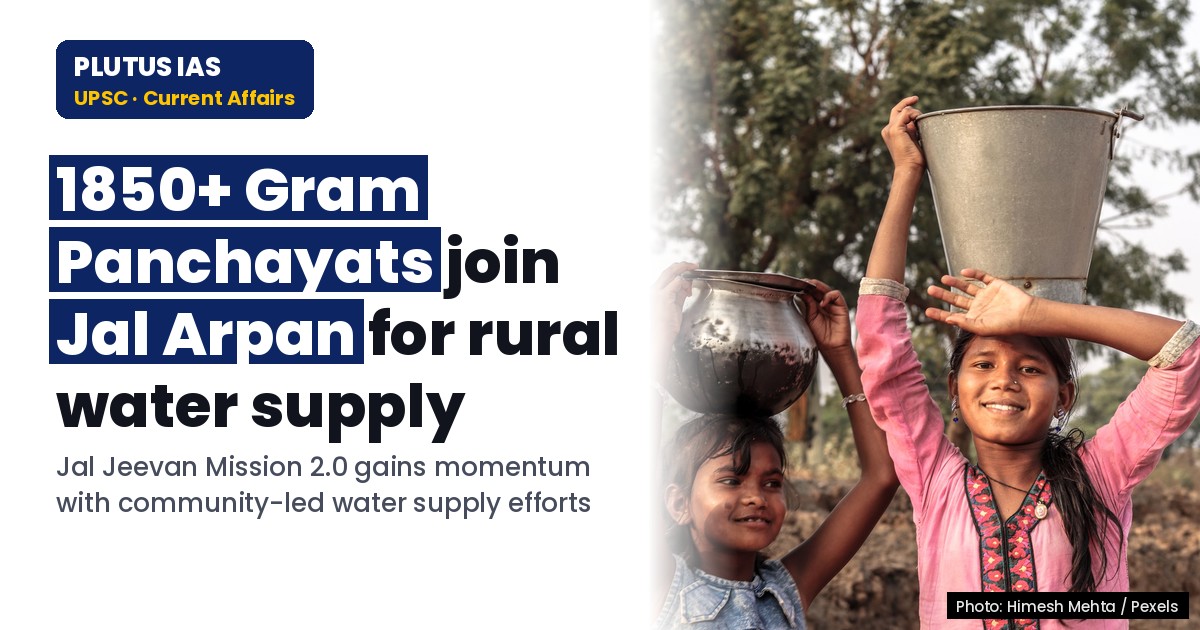
03 Oct Jal Arpan: 1850+ Gram Panchayats Join Hands for Rural Water Supply
✎ The initiative institutionalises Gram Sabha participation in rural water governance by aligning statutory decentralisation with community-led water security, ensuring sustainable, locally owned water supply systems.
Subject Relevance — Where This Topic Fits
- GS Paper II — Governance, Constitution, Polity, Social Justice and International Relations (Decentralisation, Local Self-Governance) | GS Paper III — Environment, Disaster Management, Water Resources
- Prelims: Gram Sabha, Jal Jeevan Mission 2.0, Special Gram Sabha, Community Water Governance, Panchayati Raj Institutions, Water Supply Systems, Gandhi Jayanti
- Essay: The Role of Local Institutions in Sustainable Development, Community Participation in Public Service Delivery
Quick Revision: The initiative institutionalises Gram Sabha participation in rural water governance by aligning statutory decentralisation with community-led water security, ensuring sustainable, locally owned water supply systems.
Why is this in the news?
This initiative aims to strengthen community ownership of rural water supply systems through participatory governance and institutional mechanisms. The event underscores the convergence of constitutional decentralisation principles with contemporary water security objectives, reflecting a governance model that integrates local participation with national policy imperatives.
Background
- The 73rd Constitutional Amendment Act, 1992, established Panchayati Raj Institutions (PRIs) as the third tier of governance, empowering Gram Sabhas as deliberative bodies for local decision-making.
- Jal Jeevan Mission (JJM), launched in August 2019, seeks to provide Functional Household Tap Connection (FHTC) to every rural household by 2024.
- The mission prioritises community-based water resource management, mandating the formation of Village Water and Sanitation Committees (VWSCs) and the integration of local knowledge in water governance.
- Gram Sabhas, as statutory bodies under the Panchayati Raj Act, are empowered to approve plans, monitor implementation, and ensure transparency in rural development schemes.
- Gandhi Jayanti is designated as a symbolic occasion for launching national campaigns that align with Mahatma Gandhi’s philosophy of self-reliance and community-centric development.
What is the initiative?
- The programme leverages the Special Gram Sabha, a statutory meeting convened on Gandhi Jayanti, to foster collective ownership and accountability among rural communities for water resource management.
- Key activities include: (a) identification of local water sources, (b) assessment of water quality and quantity, (c) formulation of Village Action Plans (VAPs), and (d) establishment of Village Water and Sanitation Committees (VWSCs).
- Gram Sabhas are tasked with approving VAPs, ensuring that water supply systems are tailored to local needs and socio-economic conditions, thereby enhancing sustainability.
- The programme integrates traditional water conservation practices with modern engineering solutions, promoting a balance between technological intervention and indigenous knowledge.
- Monitoring and evaluation are decentralised, with Gram Sabhas empowered to conduct periodic reviews and submit feedback to higher tiers of governance, including the District Water and Sanitation Mission (DWSM).
- The initiative also serves as a platform for inter-generational knowledge transfer, engaging youth and women in water governance to ensure long-term community resilience.
Key Features
| Feature | Significance |
|---|---|
| Jal Arpan Observance | A mass community engagement initiative under Jal Jeevan Mission 2.0 to foster collective responsibility for rural water supply systems. |
| Special Gram Sabha on Gandhi Jayanti | Leverages a national holiday to ensure maximum participation of rural stakeholders in water governance. |
| More than 1850 Gram Panchayats | Demonstrates scale and penetration of the initiative across diverse rural geographies. |
| Community Ownership of Water Supply Systems | Shifts the paradigm from government-led provision to participatory management of critical infrastructure. |
Why it Matters
Governance & Decentralisation
- Reinforces the constitutional mandate of Panchayati Raj Institutions (Article 243G) by devolving water management to local bodies.
- Aligns with the Sustainable Development Goal 6 (Clean Water and Sanitation) through grassroots participation.
- Enhances transparency and accountability in rural water governance by involving beneficiaries directly.
Water Security & Rural Development
- Strengthens Jal Jeevan Mission 2.0’s objective of providing functional household tap connections in rural areas by 2024.
- Reduces dependency on external agencies for maintenance, ensuring long-term sustainability of water infrastructure.
- Promotes water conservation practices through community-led monitoring and management.
Social & Behavioural Change
- Encourages behavioural shifts from passive beneficiaries to active stewards of rural water resources.
- Fosters social cohesion by uniting communities around a shared developmental goal.
- Empowers women, who are primary water collectors in rural households, to participate in decision-making.
Challenges
1. Sustainability of Community Ownership
- Risk of waning community interest post-observance without continuous capacity-building and incentives.
- Need for institutional mechanisms to ensure Gram Panchayats have the technical and financial capacity for long-term management.
UPSC Link: GS-II: Decentralisation
2. Technical & Infrastructure Gaps
- Uneven quality of water supply infrastructure across Gram Panchayats may hinder uniform community engagement.
- Limited access to advanced monitoring tools (e.g., IoT-based sensors) for real-time water quality tracking.
UPSC Link: GS-III: Infrastructure
3. Climate Vulnerability & Water Scarcity
- Increasing frequency of droughts and erratic rainfall patterns may strain community-managed systems.
- Need for climate-resilient water storage and distribution strategies tailored to local hydro-geological conditions.
UPSC Link: GS-III: Disaster Management
4. Institutional Coordination
- Coordination between Gram Panchayats, state agencies, and technical experts remains a persistent challenge.
- Delays in fund disbursement or administrative bottlenecks may demotivate local stakeholders.
UPSC Link: GS-II: Centre-State Relations
Challenges — UPSC Perspective
| Issue | Concern |
|---|---|
| Capacity Building | Inadequate training for Gram Panchayat members on water management and conflict resolution. |
| Funding Sustainability | Over-reliance on central/state funds without local revenue generation mechanisms. |
| Monitoring & Evaluation | Absence of robust data systems to track water quality and usage patterns. |
| Gender Inclusion | Underrepresentation of women in decision-making roles despite their primary role in water collection. |
| Technology Adoption | Low penetration of digital tools for water management in remote Gram Panchayats. |
Way Forward
- Institutionalise Jal Arpan as an annual event with structured follow-up actions, including capacity-building workshops.
- Develop a tiered technical support system for Gram Panchayats, linking them with local engineering colleges and NGOs.
- Integrate climate-resilient design principles into rural water supply infrastructure under Jal Jeevan Mission 2.0.
- Establish a participatory monitoring framework with community-led water quality testing and reporting mechanisms.
- Promote women-led water user groups to ensure gender-inclusive governance and address intra-community disparities.
- Leverage digital platforms (e.g., mobile apps) for real-time water usage tracking and grievance redressal.
- Strengthen inter-departmental coordination between Jal Shakti, Panchayati Raj, and Rural Development ministries.
UPSC Value Addition
Keywords for Mains Answer-Writing
Jal Jeevan Mission 2.0 · Community participation in water governance · Gram Sabha and water resource management · Rural water supply systems · Decentralised governance of natural resources · Panchayati Raj Institutions (PRIs) · Sustainable Development Goal 6 (SDG 6) · Water conservation and community ownership · Institutional mechanisms for water security · Convergence of MGNREGS and JJM
Constitutional & Policy Linkages
- Article 243G: Functions of Panchayats (water supply and sanitation).
- Article 40: Organisation of Village Panchayats (decentralisation principle).
- Article 21: Right to Clean Water (interpreted as part of Right to Life).
Concept Flow
Gram Sabha convened on Gandhi Jayanti → Community awareness on water conservation and ownership → Formation of water user groups → Identification of local water supply challenges → Development of action plans → Implementation of solutions → Continuous monitoring and feedback → Institutionalisation of community-led management.
Prelims Practice Questions
Q1. Consider the following statements regarding Jal Jeevan Mission 2.0:
1. It aims to provide tap water supply to every rural household by 2024.
2. Jal Arpan is a community-driven initiative to strengthen ownership of rural water supply systems.
3. The mission mandates 100% Gram Panchayat participation in water governance.
4. It includes convergence with MGNREGS for water conservation activities.
How many of the above statements are correct?
- Only one
- Only two
- Only three
- All four
Answer: All four — Statements 1, 2, and 4 are correct. Statement 3 is incorrect as the mission does not mandate 100% Gram Panchayat participation but encourages it through community engagement.
Q2. Assertion (A): The Jal Jeevan Mission 2.0 emphasizes community ownership of water supply systems through Gram Sabha participation.
Reason (R): Gram Sabhas are constitutionally mandated under Article 243B of the Constitution of India to manage local natural resources.
Options:
A. Both A and R are true, and R is the correct explanation of A.
B. Both A and R are true, but R is NOT the correct explanation of A.
C. A is true, but R is false.
D. A is false, but R is true.
Answer: ? — Both A and R are true. The Jal Jeevan Mission 2.0 promotes Gram Sabha participation for community ownership, and Gram Sabhas are constitutionally mandated under Article 243B for local governance, including natural resource management.
Mains Practice Question
✍ Critically examine the role of Gram Sabhas in ensuring community ownership and sustainable management of rural water supply systems under Jal Jeevan Mission 2.0. Also discuss the institutional mechanisms that facilitate this process. (15 Marks)
Approach: MODEL-ANSWER SKELETON:
1. **Introduction (2 marks)**: Define Jal Jeevan Mission 2.0 and its objectives (e.g., universal piped water supply, community ownership). Mention the constitutional basis of Gram Sabhas under the 73rd Amendment Act, 1992 (Article 243B) and their role in decentralised governance.
2. **Role of Gram Sabhas (5 marks)**:
– **Community Ownership**: Explain how Gram Sabhas foster ownership through participatory planning, monitoring, and maintenance of water supply systems (e.g., Jal Arpan initiative).
– **Decision-Making**: Discuss their role in approving water supply schemes, identifying local water sources, and resolving conflicts (e.g., water allocation disputes).
– **Convergence with MGNREGS**: Highlight how Gram Sabhas leverage MGNREGS for water conservation activities (e.g., rainwater harvesting, check dams).
– **Transparency and Accountability**: Emphasise their function in auditing water usage and ensuring leakage reduction.
3. **Institutional Mechanisms (5 marks)**:
– **Legal Framework**: Reference the National Rural Drinking Water Programme (NRDWP) guidelines and Jal Jeevan Mission 2.0 operational guidelines that mandate Gram Sabha involvement.
– **Capacity Building**: Discuss training programs for Gram Sabha members on water quality testing, O&M of systems, and financial management (e.g., Village Water and Sanitation Committees).
– **Technology Integration**: Mention the use of ICT tools (e.g., mobile apps for reporting issues) to enhance Gram Sabha effectiveness.
– **Funding and Convergence**: Explain how funds are channelised through Gram Panchayats and converged with other schemes (e.g., Swachh Bharat Mission, MGNREGS).
4. **Challenges and Way Forward (3 marks)**:
– **Challenges**: Highlight issues like low participation, lack of awareness, elite capture, and inadequate technical capacity.
– **Solutions**: Suggest measures such as awareness campaigns, capacity-building workshops, and incentivising Gram Sabha participation (e.g., performance-linked grants).
– **Conclusion**: Summarise the critical role of Gram Sabhas in achieving SDG 6 (clean water and sanitation) and ensuring long-term sustainability of water systems.
Source: PIB (Press Information Bureau)
Generated by AanyaAi for educational purpose.
Related guides on our sites
- Anthropology VS PSIR
- Best PSIR optional coaching
- Best PSIR optional coaching online
- Best PSIR optional teacher

- Jal Arpan: 1850+ Gram Panchayats Join Hands for Rural Water Supply - October 3, 2026
- भारत ने किया 5.56 किमी मुक्त अंतरिक्ष क्वांटम की वितरण लिंक का सफल परीक्षण - October 3, 2026
- Great Indian Bustard Reintroduction: 10-Year Effort Bears Fruit in Rajasthan - October 3, 2026

No Comments