


04 Aug GI Tag: Boosting India’s Cultural Heritage & Rural Economy in UPSC 2026
✎ Geographical Indications (GI) are a legal tool under WTO’s TRIPS Agreement to protect products with unique geographical origins, ensuring authenticity, cultural preservation, and economic empowerment for local artisans and…
Subject Relevance — Where This Topic Fits
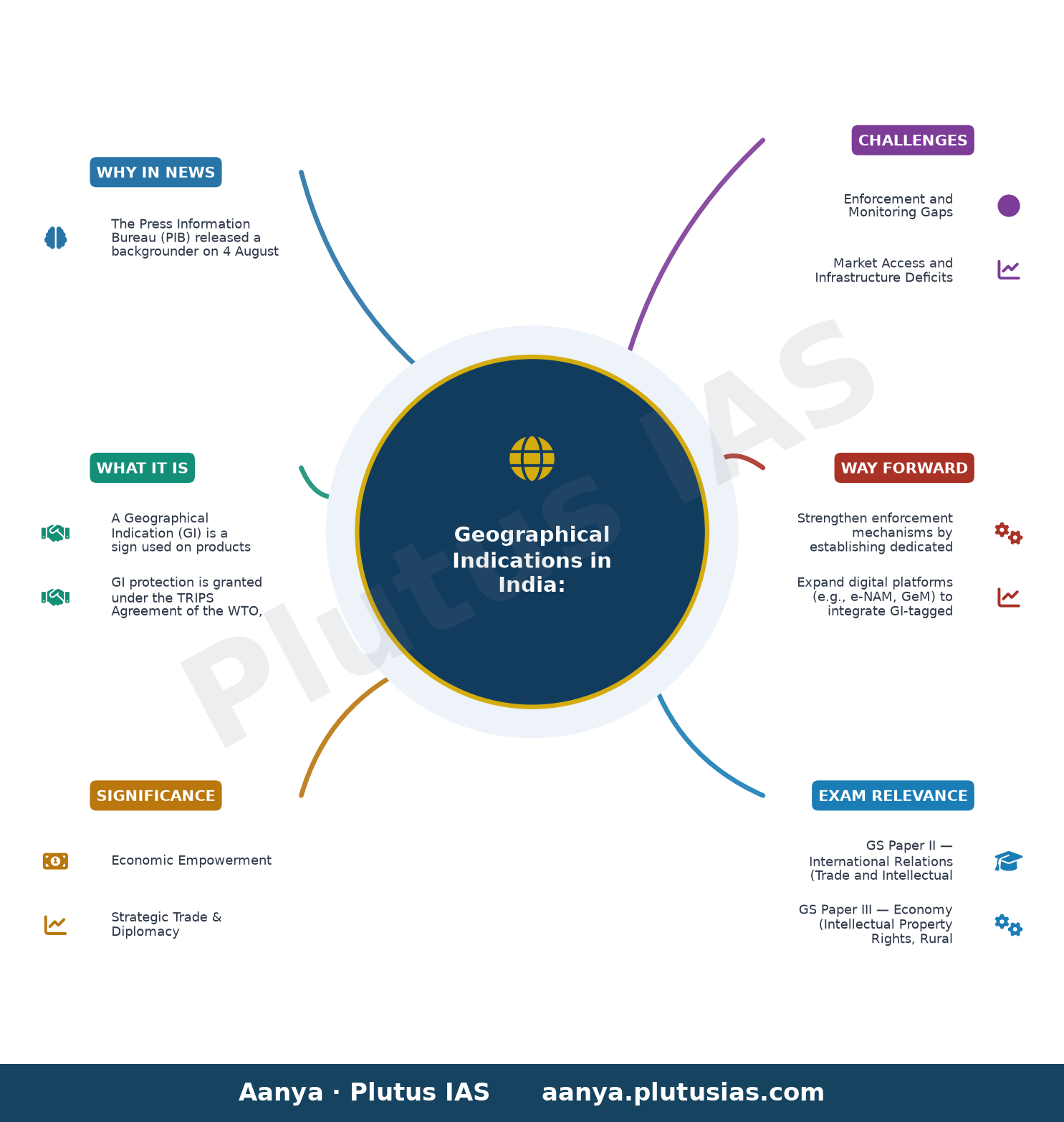
- GS Paper II — International Relations (Trade and Intellectual Property Rights) | GS Paper III — Economy (Intellectual Property Rights, Rural Development, and Export Promotion)
- Prelims: Geographical Indication (GI), TRIPS Agreement, WTO, Traditional Knowledge, Artisan Welfare, Rural Livelihoods, Export Promotion, IPR Enforcement, Cultural Heritage, Handloom Sector
- Essay: The Role of Intellectual Property in Preserving Cultural Heritage and Promoting Sustainable Development, Balancing Economic Growth with Cultural Preservation: The Case of Geographical Indications in India
Quick Revision: Geographical Indications (GI) are a legal tool under WTO’s TRIPS Agreement to protect products with unique geographical origins, ensuring authenticity, cultural preservation, and economic empowerment for local artisans and producers.
Why is this in the news?
The Press Information Bureau (PIB) released a backgrounder on 4 August 2026 highlighting the expanding role of Geographical Indications (GI) in India as a mechanism to protect traditional heritage, enhance economic opportunities for local communities, and strengthen market access for authentic products. The report underscores the growing recognition of GI-tagged products such as Banarasi sarees and Muzzafarnagar jaggery in global markets, demonstrating their potential to drive rural development, cultural preservation, and export-led growth.
Background
- The Geographical Indications (Registration and Protection) Act, 1999, was enacted in India to comply with the TRIPS Agreement under the WTO, providing legal protection to products originating from a specific geographical region.
- India’s GI registry, administered by the Controller General of Patents, Designs, and Trade Marks (CGPDTM), has registered over 400 products as of 2026, spanning agricultural, handicraft, and textile sectors.
- The GI ecosystem in India is supported by government initiatives such as the ‘One District, One Product’ (ODOP) scheme, which aims to promote indigenous and traditional products for economic upliftment.
- The integration of GI products with tourism, such as through ‘GI Craft Villages’ and ‘GI Tourism Circuits,’ has been encouraged to enhance local economies and cultural preservation.
- The demand for authentic, handcrafted products has surged globally, driven by consumer preference for sustainability, cultural authenticity, and ethical sourcing.
- India’s GI-tagged products have gained traction in international markets, with notable exports including Darjeeling tea, Basmati rice, and Channapatna toys.
What is a Geographical Indication (GI)?
- A Geographical Indication (GI) is a sign used on products that have a specific geographical origin and possess qualities or a reputation that are essentially attributable to that origin.
- GI protection is granted under the TRIPS Agreement of the WTO, which mandates member countries to provide legal protection for GI-tagged products to prevent misuse and misrepresentation.
- In India, GI registration is governed by the Geographical Indications of Goods (Registration and Protection) Act, 1999, and administered by the CGPDTM under the Ministry of Commerce and Industry.
- GI tags serve as a certification of authenticity, ensuring that products are produced, processed, or prepared in a designated geographical area using traditional methods or materials.
- The primary objectives of GI protection include preserving traditional knowledge, preventing unfair competition, and enhancing the economic value of indigenous products.
- GI tags are not limited to agricultural products; they also cover handicrafts, textiles, manufactured goods, and food items, provided they meet the criteria of origin and uniqueness.
- The registration process involves an application to the GI registry, followed by examination, opposition (if any), and publication in the GI Journal before final registration.
- GI tags contribute to rural development by empowering local communities, increasing incomes, and fostering sustainable livelihoods through enhanced market access and premium pricing.
- Examples of GI-tagged products in India include Banarasi sarees (Uttar Pradesh), Basmati rice (Punjab, Haryana, Uttar Pradesh), Darjeeling tea (West Bengal), and Channapatna toys (Karnataka).
Key Features
| Feature | Significance |
|---|---|
| Legal Protection | Prevents misuse, counterfeiting, and unauthorized commercialization of traditional products by establishing exclusive rights tied to geographical origin. |
| Market Differentiation | Enables authentic products to command premium pricing by certifying origin, craftsmanship, and cultural heritage. |
| Consumer Trust | Provides verifiable assurance of authenticity, quality, and ethical production, enhancing market credibility. |
| Rural Livelihoods | Directly links artisans, weavers, and farmers to higher income streams through increased market access and brand value. |
| Cultural Preservation | Safeguards indigenous knowledge systems, traditional techniques, and regional art forms from erosion or dilution. |
Why it Matters
Economic Empowerment
- Increases income of rural artisans and producers by 20-30% through premium pricing and expanded market reach.
- Facilitates export-led growth by transforming local specialties into globally recognized brands (e.g., Muzzafarnagar jaggery exports to Bangladesh).
- Strengthens bargaining power of producer groups by reducing dependency on intermediaries and enabling direct market linkages.
Strategic Trade & Diplomacy
- Enhances India’s soft power by positioning GI-tagged products as symbols of cultural authenticity and craftsmanship in international markets.
- Serves as a non-tariff barrier to protect domestic industries from unfair competition through counterfeit goods.
- Supports India’s export promotion initiatives under the ‘One District, One Product’ framework.
Sustainability & Inclusivity
- Promotes sustainable livelihoods by integrating traditional knowledge with modern market demands, ensuring intergenerational transfer of skills.
- Encourages eco-friendly production practices embedded in indigenous craftsmanship (e.g., handloom textiles, natural dyes).
- Fosters inclusive growth by prioritizing marginalized communities, including women artisans and tribal groups.
Cultural & Heritage Safeguarding
- Acts as a legal shield against cultural appropriation and dilution of traditional practices (e.g., Banarasi sarees, Channapatna toys).
- Documents and standardizes indigenous knowledge systems, ensuring their preservation for future generations.
- Reinforces regional identity and pride by linking products to their geographical and historical roots.
Challenges
1. Enforcement and Monitoring Gaps
- Inadequate institutional capacity to detect and penalize counterfeit products, especially in unorganized sectors.
- Limited awareness among producers and consumers about the legal recourse available under GI registration.
- Cross-border smuggling and replication of GI-tagged products in neighboring countries with weaker enforcement.
UPSC Link: GS-III: IPR & Traditional Knowledge
2. Market Access and Infrastructure Deficits
- High transaction costs for small producers to access premium markets due to lack of aggregation platforms and logistics support.
- Dependence on intermediaries and middlemen, who often exploit the lack of direct market linkages.
- Insufficient digital infrastructure for e-commerce integration of GI-tagged products, particularly in rural areas.
UPSC Link: GS-III: Rural Development & MSMEs
3. Quality Standardization and Skill Gaps
- Inconsistent adherence to traditional production standards due to generational skill gaps and lack of formal training.
- Difficulty in scaling up production without compromising authenticity, leading to supply constraints.
- Limited R&D investment to modernize traditional techniques while preserving cultural integrity.
UPSC Link: GS-III: Skill Development & Craft Clusters
4. Policy and Governance Bottlenecks
- Fragmented implementation across states, with varying levels of support for GI registration and post-registration benefits.
- Delays in processing GI applications due to bureaucratic hurdles and lack of streamlined coordination.
- Overlap with other IPR mechanisms (e.g., trademarks), leading to confusion and legal ambiguities.
UPSC Link: GS-II: Centre-State Relations
5. Climate Change and Resource Constraints
- Depletion of raw materials critical to traditional crafts (e.g., natural dyes, specific wood types) due to environmental degradation.
- Increased production costs from erratic weather patterns affecting agricultural inputs (e.g., sugarcane for jaggery).
- Competition for land and water resources between traditional crafts and commercial agriculture.
UPSC Link: GS-III: Environment & Climate Change
Challenges — UPSC Perspective
| Issue | Concern |
|---|---|
| Counterfeiting | Rise of imitation products in domestic and international markets, diluting brand value of authentic GI-tagged goods. |
| Awareness Deficit | Limited understanding among producers and consumers about the benefits and legal protections of GI registration. |
| Supply Chain Gaps | Inadequate infrastructure for aggregation, storage, and transportation of GI-tagged products from rural hubs. |
| Skill Erosion | Gradual loss of traditional knowledge due to lack of documentation, training, and intergenerational transfer. |
| Policy Fragmentation | Inconsistent implementation of GI policies across states, leading to uneven benefits and enforcement. |
| Export Barriers | Non-tariff barriers in foreign markets (e.g., sanitary and phytosanitary standards) for agricultural GI products. |
Government Initiatives — Must-Memorise for Prelims
- Geographical Indications (Registration and Protection) Act, 1999
- One District, One Product (ODOP) Initiative
Way Forward
- Strengthen enforcement mechanisms by establishing dedicated GI cells in state governments with real-time monitoring and penalties for violations.
- Expand digital platforms (e.g., e-NAM, GeM) to integrate GI-tagged products, enabling direct market linkages and reducing intermediaries.
- Launch targeted skill development programs in collaboration with local NGOs and craft clusters to preserve traditional techniques.
- Enhance R&D support for traditional crafts through institutions like NID, NIFT, and CSIR to modernize production without compromising authenticity.
- Promote GI-tagged products in international fairs (e.g., IITF, Vibrant Gujarat) and bilateral trade agreements to boost export potential.
- Introduce financial incentives (e.g., subsidized credit, insurance) for producers of GI-tagged goods to mitigate climate and market risks.
- Conduct nationwide awareness campaigns to educate producers and consumers about the legal and economic benefits of GI registration.
- Foster public-private partnerships to develop rural infrastructure (e.g., cold storage, logistics hubs) for perishable GI products.
UPSC Value Addition
Keywords for Mains Answer-Writing
Geographical Indications (GI) Tag · Intellectual Property Rights (IPR) · Traditional knowledge preservation · Rural livelihood enhancement · Cultural heritage protection · Premium market access · Artisan welfare · Export promotion · Sustainable development · Brand authenticity · Banarasi Sarees · Channapatna toys · Muzaffarnagar jaggery
Concept Flow
Traditional craftsmanship and indigenous knowledge → Identification of unique geographical origin → Application for GI registration under Geographical Indications (Registration and Protection) Act, 1999 → GI registration → Legal protection against misuse and counterfeiting → Certification of authenticity and quality → Certification → Enhanced consumer trust and market differentiation → Premium pricing and increased demand → Increased demand → Higher income for artisans and producers → Strengthening of rural livelihoods → Higher income → Reinvestment in skill preservation and innovation → Sustainable development of traditional crafts → Sustainable development → Preservation of cultural heritage and regional identity → Long-term economic and social benefits
Prelims Practice Questions
Q1. Consider the following statements regarding Geographical Indications (GI) in India:
1. A GI tag certifies that a product originates from a specific geographical region and possesses unique qualities or reputation attributable to that region.
2. The registration of a GI is valid for a period of 10 years and can be renewed indefinitely.
3. The GI tag is governed by the Geographical Indications of Goods (Registration and Protection) Act, 1999.
4. The first GI tag in India was awarded to the Darjeeling tea in 2000.
How many of the above statements are correct?
- Only one
- Only two
- Only three
- All
Answer: All — Statements 1, 2, and 3 are correct. Statement 4 is incorrect as the first GI tag in India was awarded to Darjeeling tea in 2004, not 2000.
Q2. Assertion (A): The Geographical Indications (GI) tag helps in preventing unauthorized commercial use of traditional knowledge and cultural heritage.
Reason (R): The GI tag provides legal protection under the TRIPS Agreement, which mandates member countries to protect GI-tagged products.
Options:
A. Both A and R are true, and R is the correct explanation of A.
B. Both A and R are true, but R is not the correct explanation of A.
C. A is true, but R is false.
D. A is false, but R is true.
Answer: ? — Both A and R are true, and R correctly explains A. The TRIPS Agreement requires member countries to protect GI-tagged products, thereby preventing unauthorized commercial use.
Q3. Match the following GI-tagged products with their respective states:
Column I (GI-tagged product) | Column II (State)
1. Banarasi Sarees | A. Karnataka
2. Channapatna toys | B. Uttar Pradesh
3. Muzaffarnagar jaggery | C. West Bengal
4. Darjeeling tea | D. Uttar Pradesh
Options:
A. 1-D, 2-A, 3-B, 4-C
B. 1-B, 2-A, 3-D, 4-C
C. 1-A, 2-B, 3-C, 4-D
D. 1-C, 2-D, 3-A, 4-B
- A
- B
- C
- D
Answer: C — 1. Banarasi Sarees are associated with Varanasi, Uttar Pradesh (1-B). 2. Channapatna toys originate from Karnataka (2-A). 3. Muzaffarnagar jaggery is from Uttar Pradesh (3-D). 4. Darjeeling tea is from West Bengal (4-C).
Mains Practice Question
✍ The Geographical Indications (GI) tag has emerged as a potent instrument for preserving India’s cultural heritage while simultaneously enhancing rural livelihoods and fostering export-led growth. Critically examine the role of GI tags in achieving these objectives. Substantiate your arguments with reference to recent judicial interpretations and empirical evidence. (15 Marks)
Approach: MODEL-ANSWER SKELETON:
1. **Introduction (2 marks)**: Define GI tags (Article 22 of TRIPS Agreement, Geographical Indications of Goods (Registration and Protection) Act, 1999) and their dual role in heritage preservation and economic empowerment.
2. **Preservation of Cultural Heritage (3 marks)**:
– Mechanism: GI tags protect traditional knowledge, artisanal skills, and indigenous practices by linking them to geographical origin.
– Examples: Banarasi sarees (Varanasi), Channapatna toys (Karnataka), Darjeeling tea (West Bengal).
– Judicial interpretation: Cite *Basmati Rice case* (2020) where Delhi High Court upheld GI protection for traditional basmati varieties, preventing misappropriation.
3. **Economic Empowerment and Rural Livelihoods (4 marks)**:
– Income augmentation: Cite PIB data (2026) that GI-tagged products can increase artisans’ income by 20-30% (e.g., Muzaffarnagar jaggery exports to Bangladesh).
– Market access: GI tags enable premium pricing in domestic and international markets (e.g., Banarasi sarees fetching higher prices in EU markets).
– Export promotion: GI-tagged products like Darjeeling tea and Basmati rice contribute significantly to India’s agricultural exports (APEDA reports).
4. **Challenges and Criticisms (3 marks)**:
– Awareness gaps: Limited understanding among artisans and consumers about GI benefits.
– Implementation hurdles: Delayed registrations, lack of post-registration support (e.g., Channapatna toy makers’ struggles with market penetration).
– Legal ambiguities: Conflicts over GI claims (e.g., disputes between India and Pakistan over Basmati rice).
5. **Way Forward (3 marks)**:
– Strengthening institutional mechanisms: Enhancing Geographical Indications Registry’s capacity, providing financial assistance (e.g., GI tagging schemes under the Ministry of Textiles).
– Awareness campaigns: Collaborating with NGOs and SHGs to educate artisans.
– Policy integration: Linking GI tags with rural development schemes (e.g., MGNREGA for skill enhancement) and export promotion policies.
6. **Conclusion (2 marks)**: Reiterate the transformative potential of GI tags in balancing heritage preservation with economic growth, while acknowledging the need for systemic improvements.
Source: PIB (Press Information Bureau)
Generated by AanyaAi for educational purpose.

- KWML’s Feasibility Reports for Water Metro in 18 Cities: UPSC & PCS Insights - October 3, 2026
- ओडिशा में वन्यजीव अनुसंधान अनुदान कार्यक्रम शुरू, सिमिलिपाल में 300 कैमरे और बढ़ेंगे - October 3, 2026
- India Summons Pakistan High Commission Official Over Violation - October 3, 2026

No Comments