


04 Aug Supreme Court Extends 10 km Mining Buffer to All Wetland Reserves
✎ The Supreme Court’s August 4, 2026 ruling mandates that the 10 km mining buffer zone around wetland conservation reserves—first imposed in Uttarakhand—applies uniformly to all such reserves nationwide, ensuring ecological parity…
Subject Relevance — Where This Topic Fits
- GS Paper II — Judiciary and Constitutional Framework | GS Paper III — Environment and Biodiversity | GS Paper III — Forest and Wildlife Conservation
- Prelims: Ramsar Convention, Wetland Conservation Reserve, National Board of Wildlife, MoEF&CC, Asan Wetland, 10 km buffer zone, Himalayan terrain, February 14, 2024 order
- Essay: Balancing economic development and environmental conservation: A judicial perspective, The role of the judiciary in safeguarding India’s ecological heritage
Quick Revision: The Supreme Court’s August 4, 2026 ruling mandates that the 10 km mining buffer zone around wetland conservation reserves—first imposed in Uttarakhand—applies uniformly to all such reserves nationwide, ensuring ecological parity and adherence to the Ramsar Convention.
Why is this in the news?
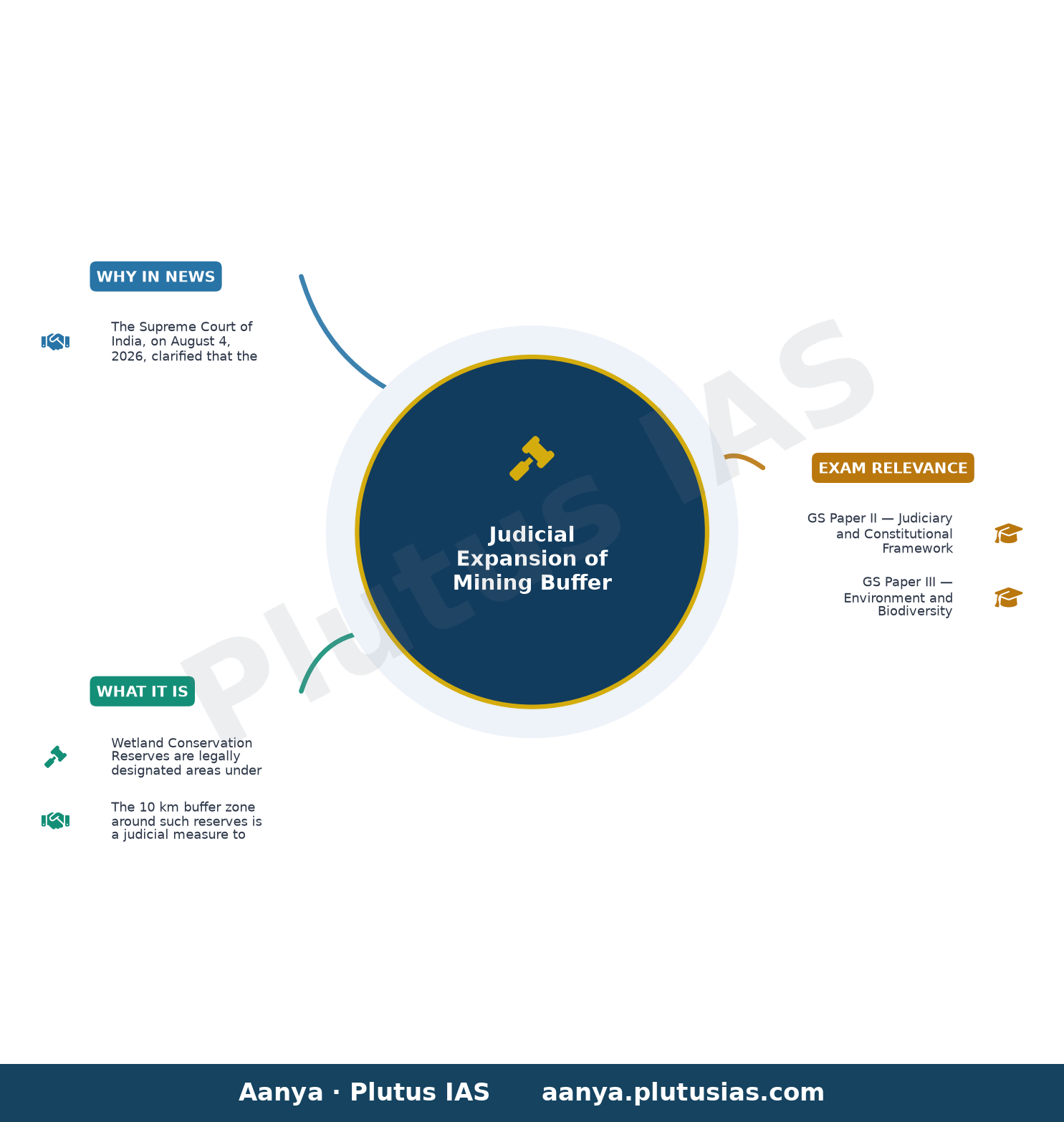
The Supreme Court of India, on August 4, 2026, clarified that the 10 km radius buffer zone prohibiting mining activities around the Asan Wetland Conservation Reserve in Uttarakhand—a Ramsar site—would apply uniformly to all wetland conservation reserves across the country. This ruling, delivered while hearing a plea by Himachal Pradesh challenging the applicability of the buffer zone, underscores the judiciary’s commitment to environmental parity and the protection of wetlands, often referred to as the ‘kidneys of the Earth’. The decision reinforces the principle that ecologically sensitive areas must be governed by consistent legal safeguards, irrespective of state boundaries.
Background
- The Asan Wetland Conservation Reserve in Uttarakhand was designated as a Ramsar site in October 2020, recognizing its international importance for wetland conservation.
- Himachal Pradesh filed an application arguing that the buffer zone restriction should not apply to its territory, citing territorial and terrain-specific differences.
- The Supreme Court’s observation highlighted the interconnectedness of the Himalayan ecosystem, which spans multiple states, necessitating uniform conservation measures.
- The court directed the National Board of Wildlife or the Ministry of Environment, Forests and Climate Change (MoEF&CC) to determine whether the Asan Wetland falls within Himachal Pradesh’s jurisdiction.
- This ruling aligns with India’s obligations under the Ramsar Convention, which mandates the protection of wetlands of international importance.
What are Wetland Conservation Reserves and the 10 km Buffer Zone?
- Wetland Conservation Reserves are legally designated areas under the Wildlife (Protection) Act, 1972, aimed at protecting wetlands of ecological significance, including Ramsar sites.
- The 10 km buffer zone around such reserves is a judicial measure to prevent anthropogenic activities, such as mining, that could degrade the wetland’s ecological functions and biodiversity.
- The buffer zone concept is rooted in the precautionary principle, which prioritizes environmental protection over developmental activities in ecologically fragile areas.
- Wetlands, often termed the ‘kidneys of the Earth,’ play a critical role in water purification, flood mitigation, carbon sequestration, and supporting biodiversity.
- The Ramsar Convention, to which India is a signatory, provides a framework for the identification, designation, and protection of wetlands of international importance.
- The Supreme Court’s ruling ensures parity in environmental governance, preventing state-specific exemptions that could undermine conservation efforts.
- This judicial approach reinforces the need for inter-state cooperation in managing transboundary ecological resources, particularly in the Himalayan region.
UPSC Value Addition
Keywords for Mains Answer-Writing
Supreme Court of India · Wetland conservation reserves · Ramsar sites · Mining bans · National Board of Wildlife · Ministry of Environment, Forest and Climate Change · Environmental jurisprudence · Inter-State environmental parity · Wetland (Conservation and Management) Rules, 2017 · Ecological balance · Himalayan terrain · Asan Wetland Conservation Reserve · Buffer zones for ecological protection · Environmental impact assessment · Inter-State coordination in environmental governance
Prelims Practice Questions
Q1. Consider the following statements regarding the Supreme Court’s recent directive on mining bans around wetland conservation reserves:
1. The directive imposes a 10 km radius mining ban around all wetland conservation reserves in India.
2. The ban applies uniformly across all States, including Himachal Pradesh and Uttarakhand.
3. The ban is applicable only to Ramsar sites and not to other notified wetland conservation reserves.
How many of the above statements are correct?
- Only one
- Only two
- All
- None
Answer: Only two — Statement 1 is correct as the directive applies to all wetland conservation reserves. Statement 2 is incorrect because the ban is not uniformly applicable; it depends on the location and notification status of the reserve. Statement 3 is incorrect as the ban applies to all notified wetland conservation reserves, not just Ramsar sites.
Q2. Assertion (A): The Supreme Court of India has recently extended a 10 km radius mining ban around the Asan Wetland Conservation Reserve to all wetland conservation reserves across India.
Reason (R): The directive is based on the principle of ecological parity and aims to prevent environmental degradation across State boundaries.
Options:
A. Both A and R are true, and R is the correct explanation of A.
B. Both A and R are true, but R is NOT the correct explanation of A.
C. A is true, but R is false.
D. A is false, but R is true.
Answer: ? — Assertion (A) is true as the Supreme Court has extended the mining ban to all wetland conservation reserves. Reason (R) is also true and correctly explains the rationale behind the directive, which is to ensure ecological parity and prevent environmental harm across State boundaries.
Q3. Match the following environmental governance bodies with their respective functions:
Column I
1. National Board of Wildlife
2. Ministry of Environment, Forest and Climate Change
3. State Wetland Authority
4. Ramsar Convention Secretariat
Column II
A. Implements the Wetland (Conservation and Management) Rules, 2017
B. Oversees the protection and conservation of wildlife and its habitat
C. Designates Ramsar sites and monitors their ecological health
D. Grants environmental clearances for projects with inter-State implications
- 1-B, 2-D, 3-A, 4-C
- 1-A, 2-B, 3-D, 4-C
- 1-D, 2-A, 3-B, 4-C
- 1-B, 2-A, 3-D, 4-C
Answer: 1-B, 2-D, 3-A, 4-C — 1-B: The National Board of Wildlife oversees wildlife conservation. 2-D: The Ministry of Environment, Forest and Climate Change grants environmental clearances. 3-A: State Wetland Authorities implement the Wetland Rules. 4-C: The Ramsar Convention Secretariat designates and monitors Ramsar sites.
Mains Practice Question
✍ The Supreme Court of India has recently extended the 10 km radius mining ban around the Asan Wetland Conservation Reserve to all wetland conservation reserves in India, citing the need for ecological parity. Critically examine the legal and ecological implications of this directive. Also, analyse how this judgment reinforces the principle of inter-State coordination in environmental governance. (15 Marks)
Approach: MODEL-ANSWER SKELETON:
1. **Legal Framework and Directive**:
– Cite the Supreme Court’s order dated February 14, 2024, and the recent clarification on August 4, 2026.
– Reference the Wetland (Conservation and Management) Rules, 2017, and the role of the National Board of Wildlife (NBWL) and the Ministry of Environment, Forest and Climate Change (MoEF&CC).
– Highlight the constitutional basis under Article 21 (Right to Life) and Article 48A (Protection of the environment).
2. **Ecological Implications**:
– Explain the ecological significance of wetlands as ‘kidneys of the earth’ and their role in biodiversity conservation, water purification, and climate regulation.
– Discuss the impact of mining activities on wetlands, including habitat destruction, water pollution, and soil degradation.
– Emphasise the need for buffer zones to mitigate cumulative ecological impacts, especially in fragile Himalayan ecosystems.
3. **Inter-State Coordination**:
– Analyse the principle of ecological parity and its legal basis in ensuring uniformity in environmental protection across States.
– Discuss the challenges posed by inter-State environmental governance, including differing State priorities, administrative capacities, and legal frameworks.
– Reference the Supreme Court’s observation on the Himalayan terrain and the need for a unified approach.
4. **Critique and Counterarguments**:
– Present counterarguments: State autonomy in environmental governance, economic implications for mining-dependent regions, and the feasibility of uniform buffer zones.
– Discuss the role of expert committees in determining site-specific exceptions (e.g., Himachal Pradesh’s plea).
5. **Conclusion**:
– Weigh the balance between ecological protection and developmental imperatives.
– Suggest measures for effective implementation, such as strengthening State Wetland Authorities, enhancing public participation, and leveraging technology for monitoring.
Source: The Hindu
Generated by AanyaAi for educational purpose.

- बिहार सरकार का बड़ा फैसला: कारोबार शुरू करने में होगी आसानी, जानिए कैसे मिलेगा फायदा - September 23, 2026
- Bihar Launches Single Window Portal for 62 Business Services: UPSC & PCS Guide - September 23, 2026
- ग्रीनलैंड समझौता: अमेरिका को मिले अतिरिक्त रक्षा क्षेत्र, जानिए पूरा मामला - September 23, 2026

No Comments