


06 Aug Namami Gange: 70 Sewerage Projects & 4,263 MLD Capacity by 2025
✎ The Namami Gange Mission is a holistic, multi-pronged initiative integrating sewage infrastructure augmentation, biodiversity conservation, and community engagement to rejuvenate the Ganga River system while ensuring ecological…
Subject Relevance — Where This Topic Fits
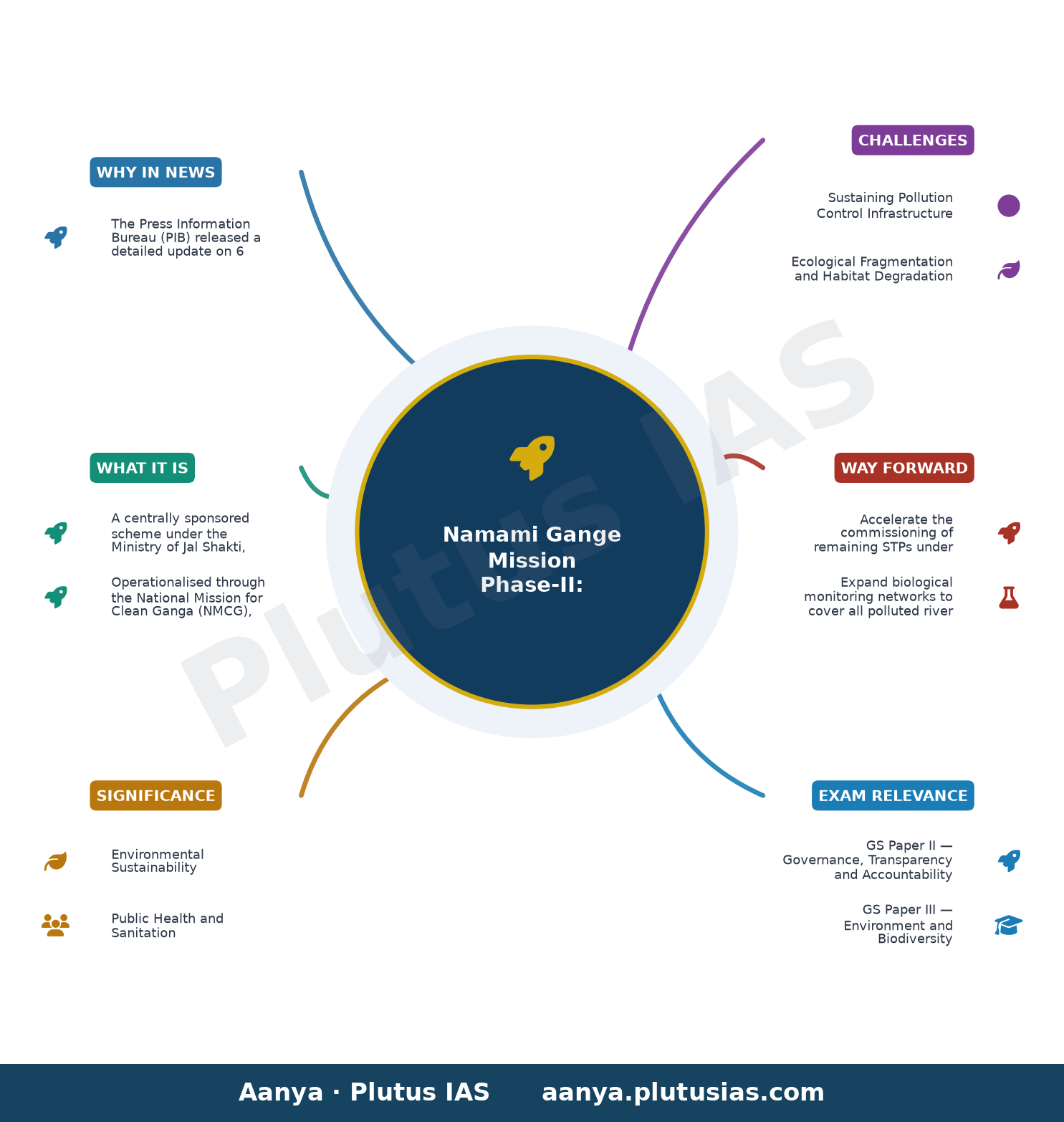
- GS Paper II — Governance, Transparency and Accountability (Mission Mode Projects) | GS Paper III — Environment and Biodiversity Conservation, Water Resources Management, Pollution Control
- Prelims: Namami Gange Programme, National Mission for Clean Ganga (NMCG), Sewage Treatment Plants (STPs), Biological Water Quality (BWQ), Gangetic Dolphin, Red-Crowned Roofed Turtle, River Ranching, Wetland (Conservation and Management) Rules 2017, Benthic Macroinvertebrates, National Gharial Conservation Action Plan
- Essay: Conservation of riverine ecosystems as a national priority, Balancing developmental imperatives with ecological sustainability: The Ganga paradigm
Quick Revision: The Namami Gange Mission is a holistic, multi-pronged initiative integrating sewage infrastructure augmentation, biodiversity conservation, and community engagement to rejuvenate the Ganga River system while ensuring ecological sustainability and public participation.
Why is this in the news?
The Press Information Bureau (PIB) released a detailed update on 6 August 2026 regarding the progress of the Namami Gange Mission Phase-II (NGM-II), highlighting the commissioning of 25 new sewage treatment plants (STPs) and the creation of 4,263 MLD sewage treatment capacity by June 2026 under the Namami Gange Programme. The release also underscores significant strides in biodiversity conservation, including the rescue and rehabilitation of 6,800 aquatic species, the establishment of national conservation action plans, and the enhancement of ecological monitoring across the Ganga basin.
Background
- The Namami Gange Programme, launched in 2014, is an integrated, multi-sectoral, pan-India flagship initiative under the Ministry of Jal Shakti, aimed at rejuvenating the Ganga River and its tributaries through a combination of infrastructure development, pollution abatement, and ecological restoration.
- Phase-II (NGM-II) of the programme, operational since 2021, focuses on scaling up sewage infrastructure, biodiversity conservation, and community engagement to achieve the vision of a ‘Clean and Aviral Ganga’.
- The Central Pollution Control Board (CPCB) monitors Polluted River Stretches (PRS) in the Ganga basin biennially to assess pollution trends and prioritise interventions.
- Biological Water Quality (BWQ) assessments, conducted at 50 sites along the Ganga and its tributaries and 26 sites along the Yamuna and its tributaries during 2024-25, indicate that water quality ranges from ‘Good’ to ‘Moderate’, reflecting ecological resilience.
- The programme integrates scientific research, habitat restoration, and species conservation, positioning biodiversity conservation as a core component of river rejuvenation.
- The establishment of the National River Research Centre at the Wildlife Institute of India, Dehradun, and the deployment of India’s first Dolphin Rescue Ambulance, alongside four Aquatic Animal Rescue and Rehabilitation Centres, exemplify the mission’s commitment to aquatic fauna conservation.
What is the Namami Gange Mission?
- A centrally sponsored scheme under the Ministry of Jal Shakti, launched in June 2014, with a budgetary outlay of ₹20,000 crore (Phase-I) and an additional ₹15,000 crore (Phase-II) to rejuvenate the Ganga River and its tributaries.
- Operationalised through the National Mission for Clean Ganga (NMCG), which functions as the implementing arm, coordinating with state governments, local bodies, and specialised agencies.
- The mission adopts a ‘River Basin Approach’ integrating Sewage Management, Industrial Effluent Control, River Front Development, Bio-Diversity Conservation, and Public Awareness.
- Key thrust areas include: (a) Creation of 100% sewage treatment capacity in identified cities along the Ganga; (b) Phased elimination of untreated sewage discharge; (c) Restoration of aquatic biodiversity; and (d) Community-led conservation initiatives.
- The programme is aligned with the National Ganga River Basin Authority (NGRBA) and the Clean Ganga Fund, leveraging public-private partnerships and CSR contributions for resource mobilisation.
- Scientific monitoring mechanisms, including real-time water quality sensors, satellite-based pollution tracking, and biological assessments, ensure evidence-based decision-making.
- The mission also promotes ‘Aviral Dhara’ (continuous flow) through riverfront development, de-silting, and flow augmentation measures to restore the ecological integrity of the river system.
- Community participation is institutionalised through the ‘Ganga Prahari’ cadre, comprising over 5,500 volunteers across 113 districts, who conduct awareness drives, monitor pollution, and support conservation activities.
Key Features
| Feature | Significance |
|---|---|
| Sewerage Infrastructure Projects under NGM-II (2025) | Execution of 70 sewage infrastructure projects, including 25 operational Sewage Treatment Plants (STPs), enhancing sewage treatment capacity by 4,263 MLD as of June 2026. |
| Pollution Reduction in Ganga Mainstream (2018-2025) | Decline in polluted river stretches from 4 to 0 in Uttarakhand, partial improvement in Uttar Pradesh and Bihar, and enhanced water quality in West Bengal, indicating systemic pollution control measures. |
| Biological Water Quality Monitoring (2024-25) | Assessment of 50 sites along Ganga and 26 along Yamuna revealed ‘good’ to ‘moderate’ biological water quality, reflecting ecological resilience and sustainable aquatic life. |
| Biodiversity Conservation Initiatives | Inclusion of habitat restoration, species conservation, wetland revival, and afforestation under NGM, with documented presence of 3,037 gharials and 215 fish species in Ganga basin. |
| Community and Institutional Engagement | Deployment of 5,500+ ‘Ganga Praharis’ across 113 districts, establishment of Ganga Biodiversity Parks in Uttar Pradesh, and collaboration with state forest departments for ecological restoration. |
Why it Matters
Environmental Sustainability
- Systematic reduction in pollution levels in Ganga mainstream, demonstrating measurable progress in river rejuvenation under NGM-II.
- Restoration of aquatic biodiversity, including critically endangered species like the Red-Crowned Roofed Turtle, through conservation breeding and habitat rehabilitation.
- Integration of wetland conservation and afforestation, aligning with Ramsar Convention principles and India’s Nationally Determined Contributions (NDCs) under the Paris Agreement.
Public Health and Sanitation
- Expansion of sewage treatment capacity (4,263 MLD) directly mitigates faecal coliform and other waterborne pathogen loads, reducing waterborne disease prevalence in riparian communities.
- Biological monitoring of river stretches ensures compliance with water quality standards, safeguarding human health in downstream regions.
Institutional and Scientific Capacity Building
- Establishment of the National River Research Centre at Wildlife Institute of India, Dehradun, and four aquatic animal rescue centres, enhancing India’s freshwater biodiversity research infrastructure.
- Collaboration with ICAR-CIFRI for river ranching of indigenous fish species, promoting sustainable fisheries and livelihoods in Ganga basin states.
Legal and Policy Framework
- Implementation of Wetland (Conservation and Management) Rules, 2017, through scientific identification and prioritization of ecologically critical wetlands in Ganga basin states.
- Alignment with the National Mission for Clean Ganga (NMCG) objectives, integrating conservation, restoration, and community participation under a unified governance framework.
Challenges
1. Sustaining Pollution Control Infrastructure
- Operational efficiency of 25 new STPs must be maintained to prevent secondary pollution from sludge disposal and energy-intensive treatment processes.
- Monitoring and enforcement gaps in non-point source pollution (agricultural runoff, urban stormwater) remain unaddressed, risking long-term water quality degradation.
UPSC Link: GS-III: Environmental Pollution
2. Ecological Fragmentation and Habitat Degradation
- Continued encroachment on floodplains and wetlands for agriculture and urbanization threatens biodiversity hotspots and flood regulation services.
- Invasive alien species (IAS) proliferation, such as water hyacinth, competes with native flora, disrupting aquatic food webs and reducing habitat complexity.
UPSC Link: GS-III: Conservation
3. Community Participation and Behavioral Change
- Limited awareness among local communities about sustainable waste management practices leads to persistent dumping of solid waste and plastic into river systems.
- Economic incentives for river-dependent livelihoods (e.g., fishing) often conflict with conservation goals, requiring integrated policy interventions.
UPSC Link: GS-II: Governance
4. Climate Change Impacts on River Systems
- Increased frequency of extreme weather events (floods, droughts) alters river flow regimes, affecting sediment transport, nutrient cycling, and aquatic habitat suitability.
- Rising temperatures and altered precipitation patterns may exacerbate eutrophication in stagnant water bodies, undermining biodiversity restoration efforts.
UPSC Link: GS-III: Climate Change
5. Inter-State Coordination and Governance
- Asymmetries in institutional capacities and resource allocation among Ganga basin states hinder uniform implementation of conservation measures.
- Lack of a unified regulatory framework for transboundary river stretches complicates enforcement and monitoring across state boundaries.
UPSC Link: GS-II: Federalism
Challenges — UPSC Perspective
| Issue | Concern |
|---|---|
| Non-Point Source Pollution | Agricultural runoff, urban stormwater, and plastic waste contribute to persistent pollution despite point-source controls. |
| Habitat Fragmentation | Urbanization and agricultural expansion reduce floodplain connectivity, isolating aquatic species populations. |
| Invasive Alien Species | Water hyacinth and other IAS disrupt native ecosystems, increasing maintenance costs for STPs and wetlands. |
| Climate Variability | Extreme weather events alter river flow, affecting sediment dynamics and aquatic habitat suitability. |
| Institutional Fragmentation | Divergent state-level priorities and capacities impede cohesive implementation of conservation strategies. |
Government Initiatives — Must-Memorise for Prelims
- Namami Gange Programme (NGM-II)
Way Forward
- Accelerate the commissioning of remaining STPs under NGM-II to achieve the 2026 target of 5,000 MLD sewage treatment capacity.
- Expand biological monitoring networks to cover all polluted river stretches, integrating citizen science for real-time data collection.
- Strengthen inter-state coordination through the establishment of a Ganga Basin Authority with statutory powers for enforcement.
- Implement incentivized waste management programs in riparian communities to reduce non-point source pollution.
- Develop climate-resilient habitat restoration plans, incorporating floodplain zoning and wetland buffer creation.
- Enhance institutional capacity by scaling up the National River Research Centre and expanding aquatic animal rescue networks.
- Promote river ranching of indigenous fish species in collaboration with ICAR-CIFRI to restore fisheries and livelihoods.
- Integrate NGM with state-level biodiversity action plans to align conservation efforts with local ecological priorities.
UPSC Value Addition
Keywords for Mains Answer-Writing
Namami Gange Programme · Ganga Rejuvenation · Sewerage Treatment Plants (STPs) · Polluted River Segments (PRS) · Biodiversity Conservation · River Dolphin Conservation · Wetland Restoration · National Mission for Clean Ganga (NMCG) · Ganga Action Plan · E-flows in Rivers · Benthic Macro-invertebrates · River Ranching · Ganga Biodiversity Parks · Environmental Flows (E-flows)
Constitutional & Policy Linkages
- [‘Article 48A’, ‘Directive Principle: Protection of environment and wildlife’]
- [‘Article 51A(g)’, ‘Fundamental Duty: Compassion towards living creatures’]
Concept Flow
Urban and industrial wastewater discharge → River pollution → Decline in aquatic biodiversity and water quality → Implementation of NGM-II with STPs and monitoring → Partial reduction in polluted stretches → Sustained ecological restoration through habitat rehabilitation and community engagement → Long-term river rejuvenation and biodiversity recovery.
Prelims Practice Questions
Q1. Consider the following statements regarding the Namami Gange Programme: 1. It aims to create 4,263 MLD sewage treatment capacity by June 2026. 2. It includes the restoration of wetlands and biodiversity parks. 3. The programme has documented 215 fish species in the Ganga river basin. How many of the above statements are correct?
- Only one
- Only two
- All three
- None
Answer: All three — Statements 1 and 2 are correct as per the press release. Statement 3 is also correct as the programme has documented 215 fish species in the Ganga river basin.
Q2. Assertion (A): The National Mission for Clean Ganga (NMCG) has established rescue and rehabilitation centres for aquatic species like the Ganga dolphin and turtles. Reason (R): The NMCG prioritises biodiversity conservation as a key component of river rejuvenation under the Namami Gange Programme.
- Both A and R are true, and R is the correct explanation of A.
- Both A and R are true, but R is not the correct explanation of A.
- A is true, but R is false.
- A is false, but R is true.
Answer: Both A and R are true, and R is the correct explanation of A. — Both the assertion and reason are true. The NMCG has indeed established rescue and rehabilitation centres for aquatic species, and biodiversity conservation is a key component of the programme.
Q3. Match the following river segments with their respective states as reported in the CPCB’s 2025 assessment of Polluted River Segments (PRS) in the Ganga basin:
Column I:
1. Haridwar to Sultanpur
2. Bijnor to Tareghat
3. Buxar to Bhagalpur
4. Triveni to Diamond Harbour
Column II:
A. Uttarakhand
B. Uttar Pradesh
C. Bihar
D. West Bengal
- 1-A, 2-B, 3-C, 4-D
- 1-A, 2-C, 3-B, 4-D
- 1-B, 2-A, 3-C, 4-D
- 1-A, 2-B, 3-D, 4-C
Answer: 1-A, 2-B, 3-C, 4-D — The correct matches are: 1. Haridwar to Sultanpur (Uttarakhand), 2. Bijnor to Tareghat (Uttar Pradesh), 3. Buxar to Bhagalpur (Bihar), 4. Triveni to Diamond Harbour (West Bengal).
Mains Practice Question
✍ The Namami Gange Programme represents a paradigm shift from the earlier Ganga Action Plan by integrating sewage treatment infrastructure with biodiversity conservation and ecological restoration. Critically examine this assertion with reference to the programme’s achievements, challenges, and the ecological principles underpinning its design. (15 Marks)
Approach: MODEL-ANSWER SKELETON:
1. **Introduction** (2 Marks): Define the Namami Gange Programme and contrast it with the Ganga Action Plan (GAP). Highlight the shift towards a holistic, ecosystem-based approach.
2. **Achievements** (4 Marks):
– Sewerage infrastructure: 4,263 MLD sewage treatment capacity created by June 2026.
– Biodiversity conservation: 3,037 gharials recorded; 6,800 aquatic animals rescued; 215 fish species documented; establishment of rescue and rehabilitation centres.
– Wetland and habitat restoration: 33,024 hectares afforested; 7 Ganga Biodiversity Parks in Uttar Pradesh.
3. **Ecological Principles** (3 Marks):
– Integration of sewage treatment with ecological flows (E-flows) to maintain river health.
– Use of benthic macro-invertebrates as bioindicators of water quality.
– Restoration of wetlands to enhance natural filtration and biodiversity.
4. **Challenges** (3 Marks):
– Partial improvement in polluted segments (e.g., Bijnor to Tareghat in Uttar Pradesh).
– Limited success in some states (e.g., Bihar’s Buxar to Bhagalpur segment).
– Need for sustained community participation and long-term monitoring.
5. **Critical Evaluation** (3 Marks):
– Assess whether the programme has achieved a true paradigm shift or remains infrastructure-heavy.
– Discuss the balance between engineering solutions (STPs) and ecological restoration.
– Highlight the role of institutions like the National Mission for Clean Ganga (NMCG) and the National Gharial Conservation Action Plan.
Source: PIB (Press Information Bureau)
Generated by AanyaAi for educational purpose.

- महाराष्ट्र में त्योहार जुलूसों पर बॉम्बे हाईकोर्ट का बड़ा फैसला: पटाखे, लेजर और संगीत पर रोक - September 24, 2026
- Bombay HC Bans Firecrackers, Music in Maharashtra Processions: Key UPSC Analysis - September 24, 2026
- तमिलनाडु में महिला कर्मचारियों के लिए सवैतनिक माहवारी अवकाश नीति पर HC का आदेश - September 24, 2026

No Comments