


06 Aug FCRA Bill 2026: Amit Shah’s August 12 Lok Sabha Clause Assurance Explained
✎ The Foreign Contribution (Regulation) Amendment Bill, 2026, introduces 'cessation' of FCRA certificates and 'interim management' provisions to ensure continuity and accountability in institutions funded by foreign contributions…
Subject Relevance — Where This Topic Fits
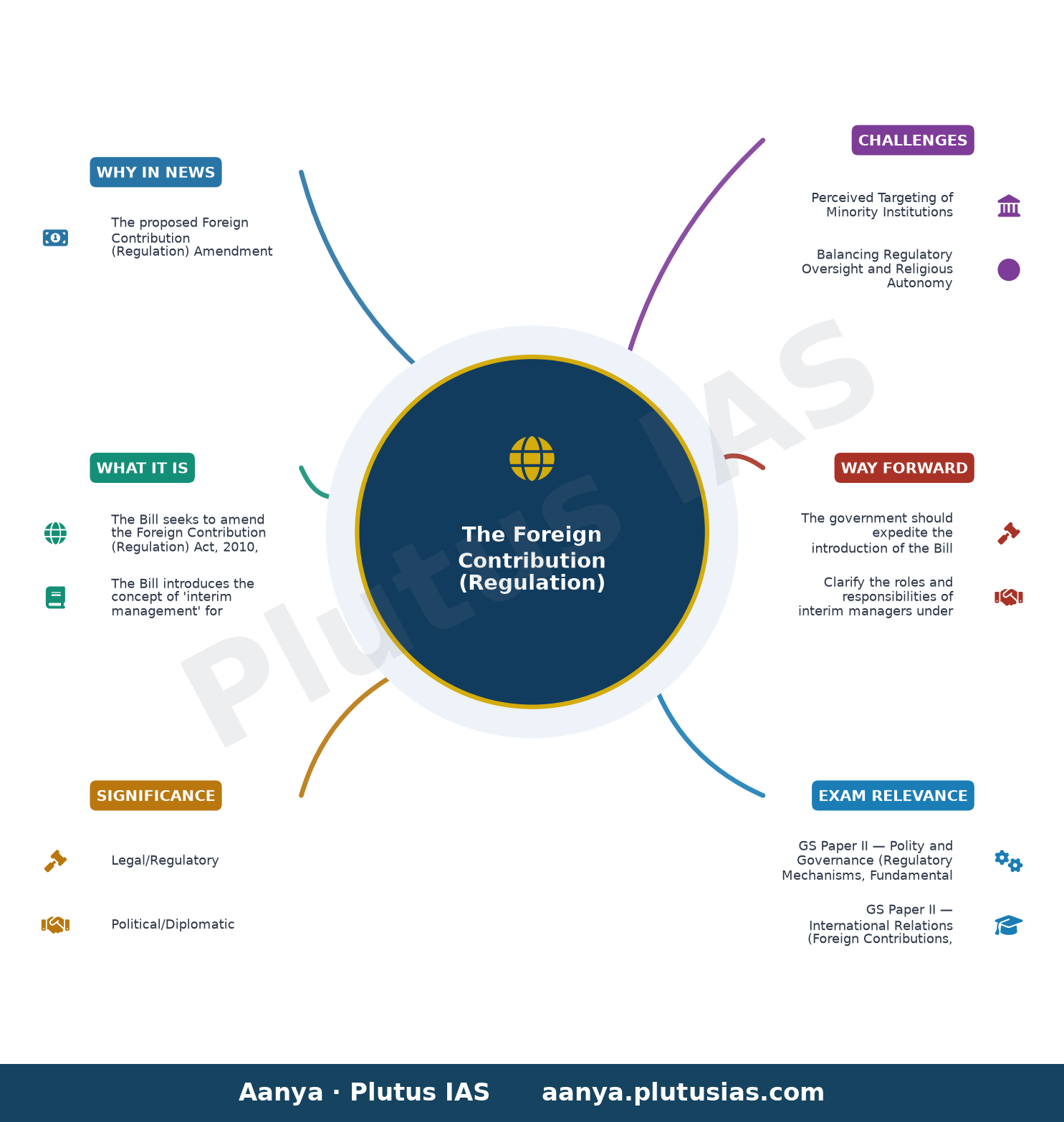
- GS Paper II — Polity and Governance (Regulatory Mechanisms, Fundamental Rights) | GS Paper II — International Relations (Foreign Contributions, NGOs, and Sovereignty) | GS Paper III — Economic and Social Development (NGO Sector, Civil Society Organisations)
- Prelims: Foreign Contribution (Regulation) Act, 2010, FCRA Amendment Bill, 2026, Section 14B (cessation of FCRA certificate), Section 16A (interim management provisions), Lok Sabha proceedings, August 2026, Amit Shah, Union Home Minister, Lalduhoma, Chief Minister of Mizoram, Catholic Bishops’ Conference of India (CBCI), retrospective legislation, interim management of institutions
- Essay: The role of civil society organisations in India’s democratic framework, Balancing national security and the autonomy of non-governmental organisations in India
Quick Revision: The Foreign Contribution (Regulation) Amendment Bill, 2026, introduces ‘cessation’ of FCRA certificates and ‘interim management’ provisions to ensure continuity and accountability in institutions funded by foreign contributions, while explicitly ruling out retrospective application.
Why is this in the news?
The proposed Foreign Contribution (Regulation) Amendment Bill, 2026, has gained prominence following a meeting between Union Home Minister Amit Shah and Mizoram Chief Minister Lalduhoma, during which assurances were given regarding the non-retrospective nature of the legislation. The Bill, expected to be tabled in the Lok Sabha on August 12, 2026, introduces provisions for the ‘cessation’ of FCRA certificates and interim management of institutions, raising concerns among Christian organisations and minority communities. The political sensitivity of the Bill stems from its potential impact on institutions funded by foreign contributions, particularly in states like Kerala and Mizoram.
Background
- The Foreign Contribution (Regulation) Act (FCRA), 2010, regulates the receipt and utilisation of foreign contributions by individuals, associations, and companies in India, ensuring transparency and accountability.
- The FCRA was amended in 2020 to introduce stricter provisions, including mandatory opening of FCRA accounts in the State Bank of India, Delhi, and restrictions on sub-granting of foreign funds.
- The 2026 Amendment Bill seeks to further refine the regulatory framework, particularly addressing gaps in the management of institutions during disruptions in FCRA registration.
- Concerns have been raised by Christian organisations, which manage a significant number of educational, healthcare, and social service institutions funded by foreign contributions.
- The Bill has become a focal point of political discourse, with the BJP aiming to address minority community concerns while maintaining regulatory oversight.
- The proposed legislation aligns with the government’s broader objective of ensuring national security and preventing foreign interference in domestic institutions.
What is the Foreign Contribution (Regulation) Amendment Bill, 2026?
- The Bill seeks to amend the Foreign Contribution (Regulation) Act, 2010, to introduce provisions for the ‘cessation’ of FCRA certificates, which deems a certificate to have ceased if an organisation fails to apply for renewal, its renewal is refused, or it expires without renewal.
- The Bill introduces the concept of ‘interim management’ for institutions whose FCRA registration is suspended or revoked, ensuring continuity in the management of assets and properties created through foreign contributions.
- The Bill aims to prevent misuse of foreign funds by ensuring that institutions adhere to the practices of the religion or community to which they belong, particularly for religious institutions.
- The government has clarified that the Bill is not retrospective, addressing concerns raised by minority communities and civil society organisations.
- The proposed legislation emphasises the need for parliamentary debate and discussion before passage, reflecting the government’s intent to ensure transparency and stakeholder consultation.
- The Bill is part of a broader effort to balance national security concerns with the autonomy of non-governmental organisations (NGOs) and civil society institutions.
- The amendments are expected to streamline the regulatory framework, reducing ambiguities in the management of institutions funded by foreign contributions.
- The Bill has been framed in response to reports of mismanagement and misuse of foreign funds, particularly in institutions operating in sensitive sectors like education and healthcare.
Key Features
| Feature | Significance |
|---|---|
| Insertion of Section 14B (cessation of FCRA certificate) | Introduces automatic cessation of FCRA registration if renewal is not applied for, refused, or expired, ensuring regulatory oversight over foreign contributions. |
| Insertion of Section 16A (interim management) | Provides for temporary management of institutions during discontinuity in FCRA registration, preventing misuse of assets created from foreign funds. |
| Exclusion of retrospective provisions | Ensures the Bill does not apply to past transactions, addressing concerns of religious and minority institutions regarding prior foreign contributions. |
| Parliamentary debate prior to passage | Aims to foster legislative scrutiny and consensus, reducing political disruptions during the Bill’s consideration. |
| Assurance on religious autonomy | Clarifies that management of religious institutions will adhere to their respective religious practices, mitigating fears of state interference. |
Why it Matters
Legal/Regulatory
- The Bill seeks to tighten the regulatory framework governing foreign contributions, addressing gaps in the management of institutions funded by such contributions.
- Provisions for interim management and cessation of FCRA certificates aim to prevent mismanagement or misuse of assets created from foreign funds.
- The exclusion of retrospective clauses aligns with constitutional principles of legal certainty and non-retroactivity.
Political/Diplomatic
- The Bill has become a sensitive issue for the BJP, particularly in states with significant Christian populations, such as Kerala and Mizoram, where institutions rely heavily on foreign contributions.
- The government’s cautious approach, including assurances to minority communities, reflects efforts to balance regulatory oversight with electoral considerations.
- The Bill’s timing and handling may influence perceptions of the BJP’s commitment to minority rights, particularly ahead of state elections.
Institutional/Administrative
- The Bill introduces mechanisms to ensure continuity in the management of institutions during periods of regulatory discontinuity, safeguarding public assets.
- The emphasis on parliamentary debate underscores the government’s intent to address concerns through democratic processes rather than executive fiat.
Challenges
1. Perceived Targeting of Minority Institutions
- Christian organisations, particularly in the Northeast and Kerala, have expressed concerns that the Bill disproportionately targets their institutions, which rely heavily on foreign contributions.
- The political sensitivity of the issue risks alienating minority communities, despite assurances from the government.
- The Bill’s framing as a regulatory measure may be overshadowed by perceptions of it being a tool to control minority-run institutions.
UPSC Link: GS2: Fundamental Rights (Article 25-28)
2. Balancing Regulatory Oversight and Religious Autonomy
- The Bill’s provisions for interim management and cessation of FCRA certificates must be carefully drafted to avoid encroaching on the autonomy of religious institutions.
- Ensuring that management practices align with religious tenets while maintaining regulatory compliance poses a significant administrative challenge.
- The government’s assurances on religious autonomy must be translated into clear, unambiguous legal provisions to prevent misinterpretation.
UPSC Link: GS2: Fundamental Rights (Article 25)
3. Parliamentary Scrutiny and Political Disruptions
- The government’s desire for a thorough parliamentary debate may face challenges due to opposition disruptions or lack of consensus on the Bill’s provisions.
- The timing of the Bill’s introduction in the Lok Sabha (August 12) coincides with a politically sensitive period, increasing the risk of disruptions.
- Ensuring constructive debate while preventing the Bill from becoming a political football will require careful negotiation and outreach.
UPSC Link: GS2: Parliament and State Legislatures
4. Operationalisation of Interim Management Mechanisms
- The effectiveness of the interim management provisions will depend on the clarity and efficiency of the mechanisms established for their implementation.
- Delays or ambiguities in the process could lead to mismanagement or disputes over the control of institutions and their assets.
- The government must ensure that interim managers are appointed promptly and that their roles are clearly defined to avoid conflicts.
UPSC Link: GS2: Centre-State Relations
Challenges — UPSC Perspective
| Issue | Concern |
|---|---|
| Perceived targeting of Christian institutions | Risk of alienating minority communities and undermining electoral outreach efforts. |
| Ambiguity in interim management provisions | Potential for disputes over control of institutions and their assets during regulatory discontinuity. |
| Political disruptions during parliamentary debate | Risk of the Bill being stalled or diluted due to opposition tactics or lack of consensus. |
| Balancing regulatory oversight and religious autonomy | Challenge of ensuring compliance with FCRA while respecting constitutional guarantees of religious freedom. |
| Operational inefficiencies in implementation | Risk of delays or ambiguities in appointing interim managers, leading to mismanagement. |
Way Forward
- The government should expedite the introduction of the Bill in the Lok Sabha on August 12, ensuring that all procedural requirements are met to facilitate a smooth debate.
- Clarify the roles and responsibilities of interim managers under Section 16A to prevent disputes and ensure continuity in the management of institutions.
- Engage in proactive outreach with minority communities, particularly Christian organisations, to address concerns and build consensus on the Bill’s provisions.
- Ensure that the Bill’s provisions are drafted with precision to avoid retrospective application, aligning with constitutional principles of legal certainty.
- Establish a transparent and efficient mechanism for the renewal of FCRA certificates to prevent automatic cessation due to procedural lapses.
- Conduct a pilot phase or simulation of the interim management process to identify potential challenges and refine the operational framework.
- Collaborate with state governments, particularly in Mizoram and Kerala, to address local concerns and ensure smooth implementation of the Bill’s provisions.
UPSC Value Addition
Keywords for Mains Answer-Writing
Foreign Contribution Regulation Act (FCRA) · FCRA Amendment Bill 2026 · Retrospective legislation · Continuity of institutional management · Regulation of foreign funding · Non-governmental organisations (NGOs) · Religious organisations and FCRA · Legislative process in Parliament · Constitutional validity of FCRA · Freedom of association · National security and foreign funding · Transparency in foreign contributions
Constitutional & Policy Linkages
- Article 25: Freedom of conscience and free profession, practice, and propagation of religion.
- Article 26: Freedom to manage religious affairs subject to public order, morality, and health.
Concept Flow
Rising reliance on foreign contributions by religious and minority institutions → Concerns over misuse and mismanagement → Government proposes FCRA Amendment Bill 2026 → Introduction of Section 14B (cessation) and Section 16A (interim management) → Perceived targeting of minority institutions → Assurances on non-retrospective clauses and religious autonomy → Political sensitivity in states like Mizoram and Kerala → Parliamentary debate on August 12 → Potential challenges in implementation and public perception.
Prelims Practice Questions
Q1. Consider the following statements regarding the Foreign Contribution (Regulation) Act (FCRA) in India:
1. The FCRA primarily regulates the acceptance and utilisation of foreign contributions by individuals, associations, or companies in India.
2. The Ministry of Home Affairs is the nodal ministry for the implementation of the FCRA.
3. Foreign contributions can be received by any organisation without prior registration or permission under the FCRA, provided they are used for specified social purposes.
- Only one
- Only two
- Only three
- None
Answer: Only two — Statement 1 is correct: The FCRA’s main objective is to regulate foreign contributions. Statement 2 is correct: The Ministry of Home Affairs is indeed the nodal ministry. Statement 3 is incorrect: Organisations generally require prior registration or permission under FCRA to receive foreign contributions, with specific exceptions, and strict compliance is mandated.
Q2. Which of the following provisions is NOT typically associated with the Foreign Contribution (Regulation) Act (FCRA)?
- Prohibition on acceptance of foreign contribution by certain persons.
- Mandatory registration or prior permission for receiving foreign contributions.
- Requirement for foreign contributions to be received only through designated bank accounts.
- Exemption of political parties from any form of regulation concerning foreign funding.
Answer: Exemption of political parties from any form of regulation concerning foreign funding. — The FCRA imposes regulations on political parties regarding foreign funding, making the statement about their exemption incorrect. The other options are core provisions of the FCRA.
Mains Practice Question
✍ The Foreign Contribution (Regulation) Act (FCRA) aims to regulate the acceptance and utilisation of foreign contributions. Critically examine the balance between facilitating legitimate foreign funding for developmental activities and addressing concerns related to national security and public order. Discuss with reference to recent amendments and judicial pronouncements. (15 Marks)
Approach: MODEL-ANSWER SKELETON:
1. Introduction: Briefly define FCRA and its primary objective of regulating foreign contributions.
2. Objectives of FCRA: Explain the dual purpose – facilitating legitimate funding for NGOs/associations and safeguarding national interest/security.
3. Key Provisions of FCRA (pre-amendment): Mention aspects like registration/prior permission, designated bank accounts, utilisation restrictions, and reporting requirements.
4. Recent Amendments (e.g., FCRA Amendment Act, 2020, and proposed 2026 Bill): Discuss changes such as:
a. Prohibition on transfer of foreign contribution.
b. Reduction in administrative expenses limit.
c. Mandatory Aadhaar for key functionaries.
d. Enhanced powers of suspension/cancellation of registration.
e. Proposed provisions like ‘cessation’ of certificate and interim management.
5. Arguments for stricter regulation (National Security/Public Order):
a. Preventing funding of activities detrimental to national interest.
b. Ensuring transparency and accountability of foreign funds.
c. Curbing money laundering and terror financing.
d. Maintaining sovereignty and preventing undue foreign influence.
6. Concerns regarding stricter regulation (Impact on Civil Society/Developmental Activities):
a. Potential for stifling legitimate NGO operations and developmental work.
b. Bureaucratic hurdles and compliance burden.
c. Impact on human rights organisations and advocacy groups.
d. Allegations of political targeting or curtailment of dissent.
e. Issues related to retrospective application of laws (as highlighted in the news).
7. Judicial Pronouncements: Refer to relevant Supreme Court/High Court judgments that have upheld or questioned aspects of FCRA, balancing rights with state interests (e.g., upholding the need for regulation while stressing proportionality).
8. Conclusion: Offer a balanced perspective, suggesting the need for a robust regulatory framework that ensures transparency and national security without unduly impeding the vital work of civil society organisations, emphasising clear guidelines and fair implementation.
Source: The Indian Express
Generated by AanyaAi for educational purpose.

- विकलांग सैन्य कैडेटों को पेंशन देने से रोक रही सरकार की नीति: केंद्र ने सुप्रीम कोर्ट में बताया - September 23, 2026
- Centre Tells SC: Policy Blocks Disability Pension for Outboarded Cadets - September 23, 2026
- यूपीएससी तैयारी: स्कूलों में स्वच्छता सुविधाओं की कमी, 5 करोड़ बच्चे प्रभावित - September 23, 2026

No Comments