


23 Sep Centre Tells SC: Policy Blocks Disability Pension for Outboarded Cadets
✎ Disability pensions for military cadets boarded out on medical grounds are not currently covered under existing pension policies, creating a policy gap that intersects with disability rights and military governance.
Subject Relevance — Where This Topic Fits
- GS Paper II — Functions and Responsibilities of the Union and the States, Issues and Challenges Pertaining to the Federal Structure | GS Paper III — Welfare Schemes for Vulnerable Sections of the Population by the Centre and States and the Performance of these Schemes | GS Paper IV — Ethical Governance and Challenges in Public Policy Implementation
- Prelims: Disability Pension, Boarding Out, Armed Forces Medical Services, Rights of Persons with Disabilities Act, 2016, Union Government’s Policy on Military Cadets, Supreme Court of India, Resettlement and Rehabilitation of Ex-Servicemen
- Essay: The Intersection of Military Service and Social Security: Balancing Duty and Welfare, Policy Gaps in Governance: Addressing the Needs of Vulnerable Groups
Quick Revision: Disability pensions for military cadets boarded out on medical grounds are not currently covered under existing pension policies, creating a policy gap that intersects with disability rights and military governance.
Why is this in the news?
The Supreme Court is currently examining a case wherein the Union Government has informed the Court that policy constraints prevent the grant of disability pensions to military cadets who were boarded out on medical grounds. This issue highlights the intersection of military governance, disability rights, and social security, raising questions about the adequacy of existing provisions for disabled military personnel and the role of judicial intervention in policy implementation.
Background
- The Armed Forces in India operate under a structured medical evaluation system to determine the fitness of personnel, including cadets undergoing training.
- The term ‘boarded out’ refers to the discharge of military personnel on medical grounds, including disability, prior to completion of service.
- Existing pension policies for military personnel primarily cover those who are in service or have completed service, with limited provisions for those boarded out during training.
- The Rights of Persons with Disabilities Act, 2016, mandates inclusive policies for persons with disabilities, including those in the armed forces, but its applicability to cadets boarded out during training remains ambiguous.
- The Union Government has cited administrative and financial constraints as reasons for not extending disability pensions to such cadets, while proposing skill development initiatives for their resettlement.
- The Supreme Court’s suo motu consideration of this matter underscores the judiciary’s role in ensuring the protection of rights of vulnerable groups within the military framework.
What is the Policy Governing Disability Pensions for Military Cadets Boarded Out on Medical Grounds?
- The term ‘disability pension’ in the context of the armed forces refers to a monthly pension granted to personnel who are invalided out of service due to a disability attributable to or aggravated by military service.
- Military cadets undergoing training are not classified as ‘serving personnel’ under existing pension policies, which typically require completion of a minimum period of service for pension eligibility.
- The policy of ‘boarding out’ is a medical discharge mechanism wherein cadets found unfit for further training or service due to disability are discharged prior to completion of their training or service tenure.
- Existing provisions under the Pension Regulations for the Army, Navy, and Air Force do not explicitly cover cadets boarded out during training, creating a policy vacuum for this cohort.
- The Rights of Persons with Disabilities Act, 2016, while providing a broad framework for disability rights, does not specifically address the entitlements of military cadets boarded out on medical grounds, leading to interpretational challenges.
- The Union Government’s stance reflects a policy dichotomy between the need for social security for disabled individuals and the administrative and financial feasibility of extending such benefits to a non-serving cohort.
- Skill development initiatives proposed by the government aim to provide alternative pathways for resettlement, aligning with the broader objective of inclusive rehabilitation for persons with disabilities.
- Judicial scrutiny in this matter may necessitate a re-evaluation of existing policies to ensure alignment with constitutional principles of equity and non-discrimination.
Key Features
| Feature | Significance |
|---|---|
| Disability pension policy for military cadets | Defines eligibility criteria for disability pension under the Armed Forces regulations, ensuring financial support for cadets medically boarded out due to disability. |
| Boarding-out mechanism for disabled cadets | Process of discharging cadets from military training or service on medical grounds, often due to disability incurred during training or service. |
| Skill development and resettlement support | Government initiative to provide vocational training and professional courses to disabled cadets for their reintegration into civilian life. |
| Supreme Court intervention | Judicial oversight to examine the legality and fairness of the Centre’s policy regarding disability pension for boarded-out cadets. |
| Policy constraints cited by the Centre | Legal or administrative limitations preventing the extension of disability pension to cadets boarded out during training, despite medical disability. |
Why it Matters
Governance and Institutional Framework
- Highlights the intersection of military administrative policies with constitutional guarantees of equality and social justice under Articles 14 and 21.
- Exposes gaps in the implementation of welfare schemes for military personnel, particularly those with disabilities incurred during training.
- Demonstrates the role of the judiciary in ensuring accountability and equity in governance, especially in matters concerning defence personnel.
Social Security and Inclusion
- Raises questions about the adequacy of social security measures for disabled military cadets, who are often young and in the early stages of their careers.
- Underscores the need for inclusive policies that address the unique challenges faced by disabled defence personnel, including those boarded out during training.
- Emphasises the importance of resettlement support mechanisms to facilitate the transition of disabled cadets into civilian employment.
Legal and Policy Dimensions
- Illustrates the complexities of policy interpretation and implementation, particularly where statutory provisions are silent or ambiguous.
- Shows the dynamic between executive policy and judicial review, where the judiciary may intervene to ensure fairness and constitutional compliance.
- Highlights the need for periodic review and updating of military welfare policies to align with evolving social and legal standards.
Challenges
1. Policy Ambiguity in Disability Pension Eligibility
- The Centre’s reliance on ‘policy constraints’ suggests a lack of clarity in the existing legal framework regarding disability pension for cadets boarded out during training.
- This ambiguity may lead to inconsistent application of welfare measures, denying eligible cadets their rightful entitlements.
- The issue underscores the need for a comprehensive review of military disability pension policies to ensure they cover all categories of disabled personnel.
UPSC Link: GS-II: Welfare schemes for vulnerable sections
2. Judicial Scrutiny of Executive Policies
- The Supreme Court’s suo motu intervention reflects growing judicial activism in matters of governance and welfare, particularly for defence personnel.
- This scrutiny may pressure the executive to clarify or amend policies to ensure compliance with constitutional principles.
- However, excessive judicial intervention could also lead to policy paralysis if not balanced with executive autonomy.
UPSC Link: GS-II: Judiciary and governance
3. Resettlement and Skill Development Gaps
- While skill development is proposed as an alternative, the adequacy and accessibility of such programmes for disabled cadets remain uncertain.
- There is a risk that resettlement support may not fully address the long-term economic and social challenges faced by disabled cadets.
- The effectiveness of these programmes depends on their design, implementation, and monitoring by relevant authorities.
UPSC Link: GS-II: Skill development and employment
4. Constitutional Guarantees vs. Administrative Policies
- The case tests the balance between administrative discretion and constitutional rights, particularly the right to equality and social justice.
- It raises questions about whether military administrative policies are in consonance with broader constitutional obligations towards disabled individuals.
- The judiciary may need to clarify the extent to which constitutional principles apply to military personnel, especially in matters of disability.
UPSC Link: GS-II: Fundamental Rights and Directive Principles
5. Data and Awareness Deficits
- There may be a lack of comprehensive data on the number of cadets boarded out due to disability and their subsequent welfare outcomes.
- Insufficient awareness among affected cadets about their entitlements and the processes for availing them could exacerbate the issue.
- Addressing this challenge requires systematic data collection and dissemination of information to ensure no eligible cadet is left behind.
UPSC Link: GS-II: Transparency and accountability in governance
Challenges — UPSC Perspective
| Issue | Concern |
|---|---|
| Eligibility criteria for disability pension | Ambiguity in whether cadets boarded out during training qualify for disability pension under existing military regulations. |
| Judicial intervention in executive policies | Risk of policy paralysis due to excessive judicial scrutiny, or conversely, pressure to reform outdated policies. |
| Adequacy of resettlement support | Uncertainty about the effectiveness of skill development programmes in addressing the long-term needs of disabled cadets. |
| Constitutional compliance of military policies | Question of whether military administrative policies align with constitutional guarantees of equality and social justice. |
| Data and awareness gaps | Lack of systematic data on disabled cadets and insufficient awareness about entitlements and processes. |
| Inter-agency coordination | Need for coordination between military authorities, welfare agencies, and judicial bodies to address the issue holistically. |
Government Initiatives — Must-Memorise for Prelims
- Skill Development Programmes for Defence Personnel (as proposed by the Centre)
Way Forward
- Conduct a comprehensive review of military disability pension policies to clarify eligibility criteria for cadets boarded out during training, ensuring alignment with constitutional principles.
- Strengthen resettlement support mechanisms by expanding access to vocational training, career counselling, and employment opportunities tailored to the needs of disabled cadets.
- Establish a dedicated grievance redressal mechanism within the military to address disputes related to disability pension and welfare entitlements.
- Enhance data collection and monitoring systems to track the number of cadets boarded out due to disability, their welfare outcomes, and the effectiveness of resettlement programmes.
- Promote awareness campaigns within military institutions to educate cadets about their rights, entitlements, and the processes for availing disability pension and resettlement support.
- Encourage inter-agency collaboration between the military, Ministry of Defence, Ministry of Skill Development, and judicial bodies to ensure a holistic and coordinated approach to addressing the issue.
- Explore the possibility of amending existing military regulations or enacting new legislation to explicitly cover cadets boarded out during training under the disability pension scheme.
- Conduct periodic audits of resettlement programmes to assess their impact and make necessary adjustments to improve outcomes for disabled cadets.
UPSC Value Addition
Keywords for Mains Answer-Writing
Disability Pension for Armed Forces · Boarded Out Cadets · Armed Forces Personnel (Medical Facilities) Regulations, 1954 · Disability Pension Scheme · Supreme Court of India · Resettlement and Rehabilitation of Ex-Servicemen · Central Government Policy on Disability Pensions · Constitutional Provisions for Armed Forces Welfare · Medical Boarding Out Procedures · Skill Development for Ex-Servicemen · Armed Forces (Pension) Regulations, 1961 · Judicial Review of Government Policies
Constitutional & Policy Linkages
- Article 14: Right to Equality (ensuring non-discriminatory application of welfare policies)
- Article 21: Right to Life and Personal Liberty (including the right to livelihood and dignity)
Concept Flow
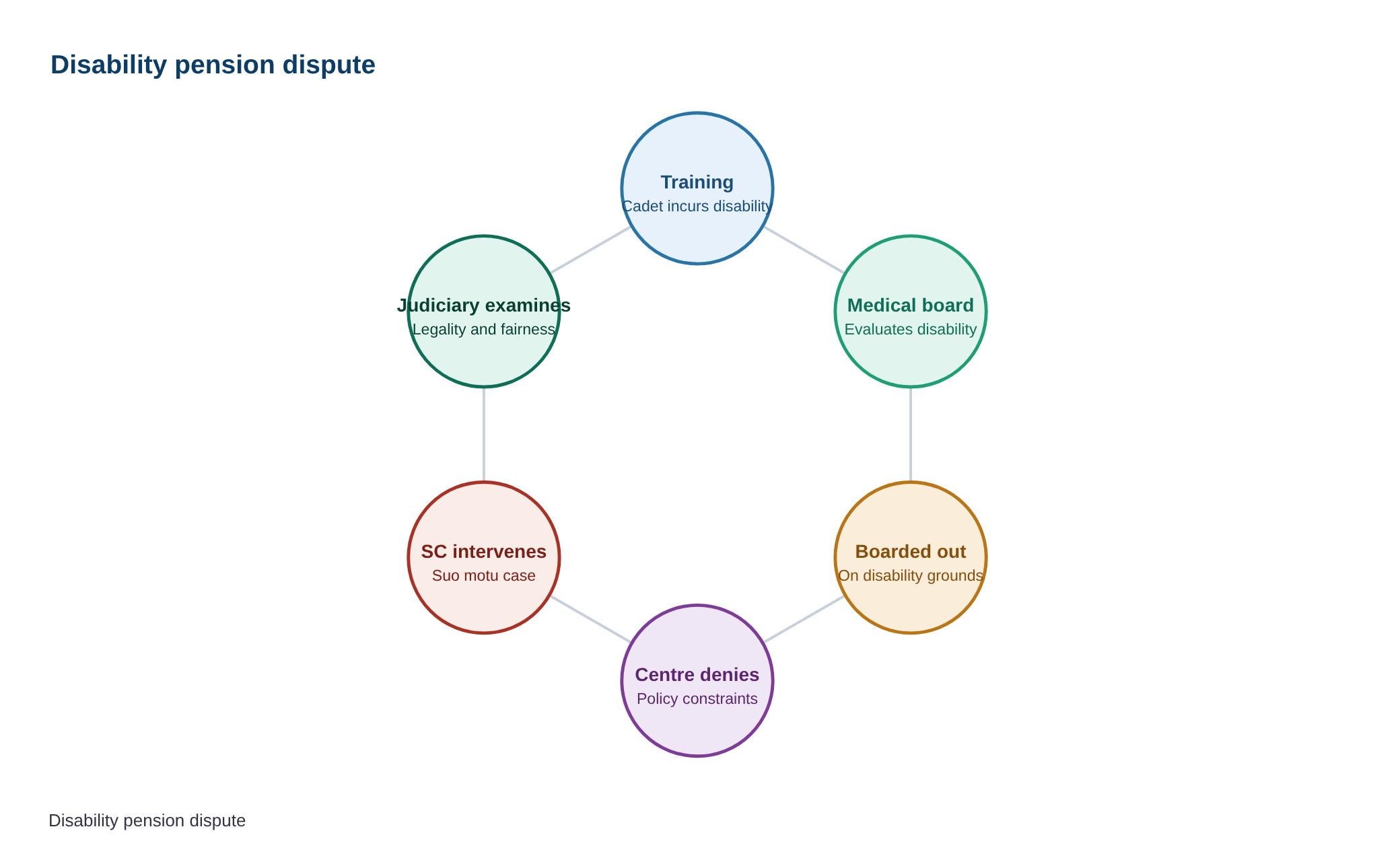
Military training or service → Cadet incurs disability → Medical board evaluates disability → Cadet boarded out on disability grounds → Centre cites ‘policy constraints’ to deny disability pension → Supreme Court intervenes suo motu → Judiciary examines legality and fairness of policy → Centre proposes skill development as alternative support → Issue escalates to constitutional question of equality and social justice.
Prelims Practice Questions
Q1. Consider the following statements regarding the disability pension for military personnel in India:
1. Disability pension is granted under the Armed Forces (Pension) Regulations, 1961.
2. The term ‘boarded out’ refers to military personnel discharged on medical grounds.
3. The Central Government has the authority to grant disability pensions to all boarded-out cadets without any policy constraints.
How many of the above statements are correct?
- Only one
- Only two
- All three
- None
Answer: Only two — Statement 1 is correct as disability pension is indeed governed by the Armed Forces (Pension) Regulations, 1961. Statement 2 is correct; ‘boarded out’ refers to discharge on medical grounds. Statement 3 is incorrect because the Central Government has cited policy constraints in granting disability pensions to boarded-out cadets, as stated in the Supreme Court submission.
Q2. Assertion (A): The Armed Forces Personnel (Medical Facilities) Regulations, 1954, provide the legal framework for medical boarding-out procedures.
Reason (R): The Supreme Court of India has the jurisdiction to review the policy constraints imposed by the Central Government on disability pensions.
Select the correct option from the following:
- Both A and R are true, and R is the correct explanation of A
- Both A and R are true, but R is not the correct explanation of A
- A is true, but R is false
- A is false, but R is true
Answer: A is true, but R is false — Assertion (A) is true as the Armed Forces Personnel (Medical Facilities) Regulations, 1954, govern medical boarding-out procedures. Reason (R) is also true, but the Supreme Court’s jurisdiction to review policy constraints does not directly explain the legal framework for medical boarding-out procedures.
Q3. Match the following columns with reference to disability pensions and military personnel policies:
Column I
A. Armed Forces (Pension) Regulations, 1961
B. Armed Forces Personnel (Medical Facilities) Regulations, 1954
C. Boarded Out Cadets
D. Disability Pension
Column II
1. Governs medical boarding-out procedures
2. Governs pension entitlements for disabled personnel
3. Refers to personnel discharged on medical grounds
4. Provides for resettlement and skill development
Select the correct match:
- A-2, B-1, C-3, D-4
- A-1, B-2, C-3, D-4
- A-2, B-1, C-4, D-3
- A-4, B-3, C-2, D-1
Answer: A-2, B-1, C-3, D-4 — A-2: The Armed Forces (Pension) Regulations, 1961 governs pension entitlements. B-1: The Armed Forces Personnel (Medical Facilities) Regulations, 1954 governs medical boarding-out procedures. C-3: ‘Boarded out’ refers to personnel discharged on medical grounds. D-4: Disability pension is not directly linked to resettlement and skill development in the regulations but is a separate entitlement.
Mains Practice Question
✍ The Supreme Court of India recently observed that the Central Government has cited ‘policy constraints’ in denying disability pensions to military cadets boarded out on disability grounds, while offering skill training for resettlement. Critically examine the legal and policy framework governing disability pensions for military personnel, with reference to the Armed Forces (Pension) Regulations, 1961 and the Armed Forces Personnel (Medical Facilities) Regulations, 1954. Also, analyse the implications of such policy constraints on the welfare of ex-servicemen. (15 Marks)
Approach: MODEL-ANSWER SKELETON:
1. **Legal Framework**:
– Disability pension for military personnel is governed by the **Armed Forces (Pension) Regulations, 1961**, which define eligibility criteria, rates, and conditions for grant of disability pension.
– Medical boarding-out procedures are governed by the **Armed Forces Personnel (Medical Facilities) Regulations, 1954**, which outline the process for discharge on medical grounds.
– Reference: **Section 3 of the 1961 Regulations** (eligibility for disability pension) and **Regulation 12 of the 1954 Regulations** (medical boarding-out procedures).
2. **Policy Constraints and Judicial Review**:
– The Central Government’s submission to the Supreme Court highlights ‘policy constraints’ in granting disability pensions to boarded-out cadets, implying that such personnel may not meet the eligibility criteria under the 1961 Regulations.
– The Supreme Court’s role in reviewing such policy constraints stems from **Article 32 of the Constitution**, which empowers it to enforce fundamental rights and review executive actions.
– Reference: **Supreme Court judgments in *Union of India v. Major General Shri Kant Sharma* (2015) and *Ex-Servicemen Contributory Health Scheme (ECHS) case (2021)****, which underscore the judiciary’s scrutiny of executive policies affecting ex-servicemen.
3. **Welfare Implications**:
– Denial of disability pension to boarded-out cadets may lead to financial hardship, as disability pensions are designed to compensate for loss of earning capacity due to service-related disabilities.
– The offer of skill training for resettlement, while beneficial, does not substitute for the financial security provided by disability pensions.
– Reference: **Recommendations of the **Koshyari Committee (2019)** on welfare of ex-servicemen**, which emphasised the need for comprehensive support systems.
4. **Balancing Policy and Equity**:
– The policy constraints may stem from concerns over misuse or misclassification of disabilities, but they must be balanced against the constitutional obligation to ensure fair treatment of ex-servicemen under **Article 38 (Directive Principles of State Policy)** and **Article 21 (Right to Life and Dignity)**.
– Reference: **Supreme Court’s observations in *Navtej Singh Johar v. Union of India (2018)***, which highlight the judiciary’s role in ensuring equity in state policies.
5. **Conclusion**:
– The Central Government’s policy must align with the legal framework to ensure that disability pensions are granted where justified, while addressing concerns of misuse through robust medical and administrative processes.
– The judiciary’s intervention ensures that policy constraints do not infringe upon the rights of ex-servicemen, reinforcing the principle of **natural justice** and **procedural fairness**.
Source: Hindustan Times
Generated by AanyaAi for educational purpose.
Related guides on our sites
- Best PSIR optional coaching for upsc
- Best PSIR optional teacher for upsc
- Best teacher of PSIR optional for upsc
- Best PSIR optional coaching in delhi for UPSC

- AI आधारित ‘HEADS’ से भारत में अवसाद जांच में क्रांति: जानिए कैसे होगा मदद - September 23, 2026
- HEADS AI Project to Tackle India’s Mental Healthcare Crisis: Key Facts for UPSC - September 23, 2026
- प्रतापगढ़ में फॉरेस्ट रेंजर की मौत: सुप्रीम कोर्ट ने अवैध खनन पर तुरंत कार्रवाई का दिया आदेश - September 23, 2026

No Comments