


06 Aug Why UPSC Aspirants Must Master Skills AI Can’t Replace in 2026
✎ UPSC aspirants must internalise that the core objective of education in the AI era is not to compete with machines but to cultivate uniquely human competencies that machines cannot emulate.
Subject Relevance — Where This Topic Fits
- GS Paper II — Governance, Constitution, Polity, Social Justice and International Relations (Education Policy, Digital Governance) | GS Paper III — Technology, Economic Development, Biodiversity, Environment, Security and Disaster Management (Impact of AI on Labour Markets, Skill Development)
- Prelims: NEP 2020, National Curriculum Framework (NCF) 2023, AI literacy, critical thinking, socio-emotional learning (SEL), experiential learning, Bloom’s Taxonomy, UNESCO Education 2030, Prelims 2024: Questions on AI in education, skill gaps, and human-centric development
- Essay: The erosion of human agency in the digital age: A critique of algorithmic dependency in education, Reimagining pedagogy: The enduring value of human cognition in an AI-dominated world
Quick Revision: UPSC aspirants must internalise that the core objective of education in the AI era is not to compete with machines but to cultivate uniquely human competencies that machines cannot emulate.
Why is this in the news?
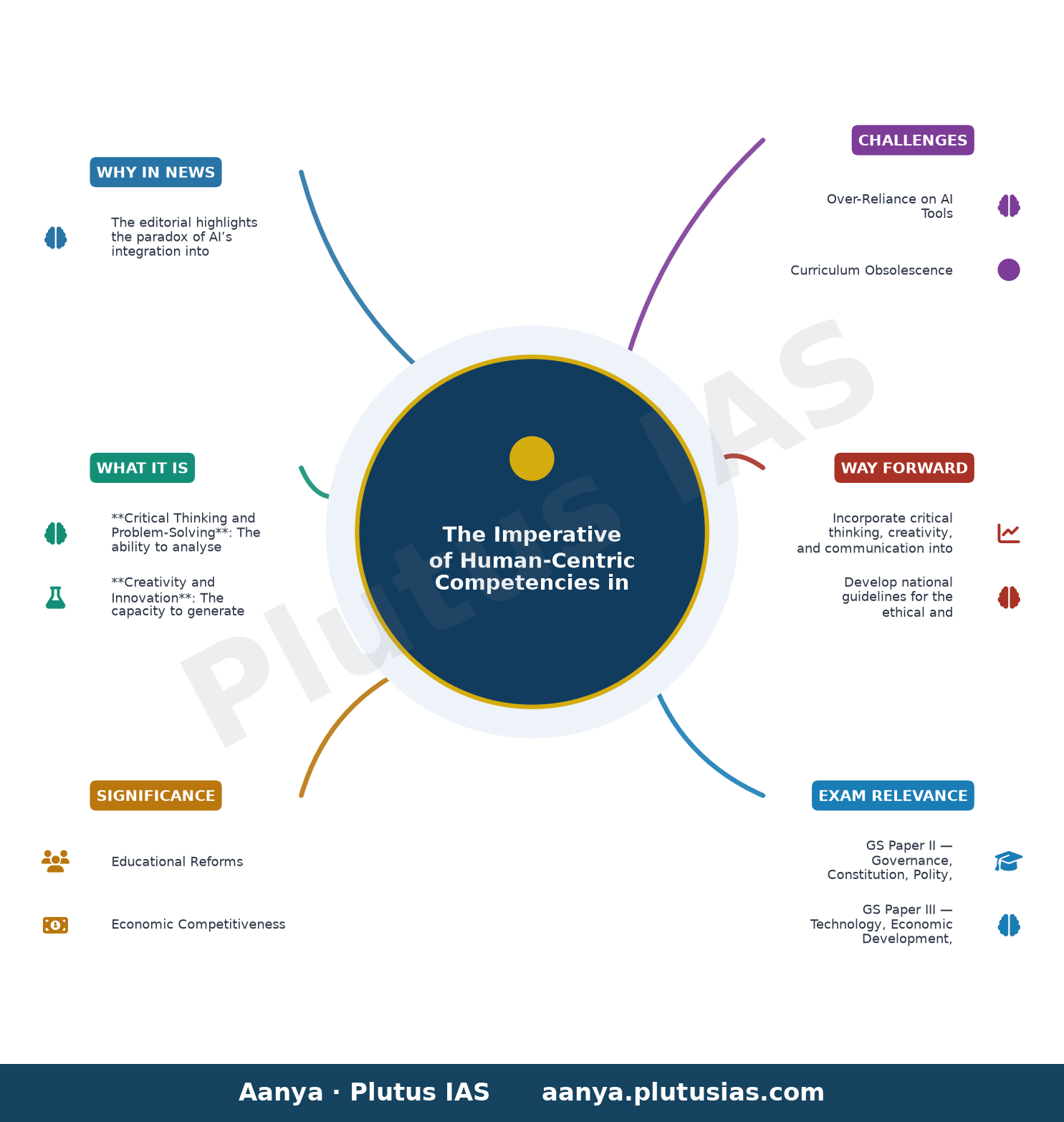
The editorial highlights the paradox of AI’s integration into education—while it enhances efficiency, it risks diminishing the development of foundational human skills such as critical thinking, creativity, and empathy. This dilemma is particularly salient for India’s education system, which must balance technological adoption with the preservation of human-centric competencies to prepare students for an unpredictable future. The piece underscores the urgency of reorienting pedagogical strategies to ensure AI serves as a tool rather than a substitute for cognitive and emotional growth.
Background
- The National Education Policy (NEP) 2020 advocates for a holistic, multidisciplinary approach to education, emphasising experiential learning and the development of higher-order thinking skills over rote memorisation.
- The National Curriculum Framework (NCF) 2023, aligned with NEP 2020, introduces competency-based learning, with a focus on socio-emotional learning (SEL) and critical thinking as core outcomes.
- Global initiatives, such as UNESCO’s *Education 2030* framework, stress the need for education systems to cultivate adaptability, creativity, and ethical reasoning in learners to thrive in an AI-driven world.
- The proliferation of AI tools in classrooms—from language learning assistants to automated grading systems—has accelerated the debate on their role in shaping student cognition and independence.
What are human-centric competencies in the context of AI-augmented education?
- **Critical Thinking and Problem-Solving**: The ability to analyse information, evaluate arguments, and derive reasoned conclusions without relying solely on algorithmic outputs. This aligns with Bloom’s Taxonomy’s higher-order cognitive skills (analysing, evaluating, creating).
- **Creativity and Innovation**: The capacity to generate original ideas, approaches, or solutions, which AI cannot replicate due to its dependency on existing data patterns. This is increasingly vital in fields like design, entrepreneurship, and scientific research.
- **Emotional Intelligence (EQ) and Empathy**: Skills that enable individuals to understand, manage, and respond to emotions—both their own and others’—in social and professional contexts. AI lacks the nuanced emotional processing required for leadership, teamwork, and conflict resolution.
- **Communication and Collaboration**: Proficiency in articulating ideas clearly, actively listening, and working effectively in diverse teams. These skills are foundational for negotiation, diplomacy, and cross-cultural interactions.
- **Ethical Reasoning and Digital Citizenship**: The ability to navigate ethical dilemmas in the digital space, such as data privacy, misinformation, and algorithmic bias. This includes understanding the societal implications of AI and advocating for responsible technology use.
- **Adaptability and Resilience**: The mental flexibility to learn new skills, pivot in response to change, and persist in the face of setbacks. In an AI-driven economy, jobs will evolve rapidly, necessitating continuous upskilling.
- **Judgement and Decision-Making**: The capacity to make nuanced decisions under uncertainty, weighing multiple factors (e.g., ethical, social, economic) that AI cannot contextualise without human input.
- **Metacognition**: Awareness and regulation of one’s own thought processes, enabling learners to monitor their understanding, identify gaps, and strategise their learning—skills that AI tools cannot inherently foster.
Key Features
| Feature | Significance |
|---|---|
| Critical Thinking | Enables students to analyse, evaluate, and synthesise information independently, fostering intellectual autonomy in an AI-driven educational landscape. |
| Creativity | Encourages innovation and original problem-solving, areas where AI can only assist but not originate solutions. |
| Communication Skills | Develops the capacity for clear articulation, active listening, and persuasive discourse—essential for leadership and collaboration. |
| Emotional Intelligence | Cultivates empathy, self-awareness, and interpersonal relationships, which AI lacks the capacity to replicate. |
| Adaptability | Prepares students to navigate uncertainty and rapid technological change, ensuring resilience in evolving professional environments. |
Why it Matters
Educational Reforms
- AI integration necessitates a paradigm shift from rote learning to competency-based education, aligning with the National Education Policy (NEP) 2020’s emphasis on holistic development.
- Schools must redefine curricula to prioritise human-centric skills, reducing over-reliance on algorithmic solutions for academic tasks.
- Teacher training programmes must evolve to equip educators with strategies for fostering critical skills in an AI-augmented classroom.
Economic Competitiveness
- Nations that cultivate human-centric skills gain a comparative advantage in a global economy where AI handles routine tasks, ensuring long-term productivity and innovation.
- India’s demographic dividend can be leveraged effectively if the workforce is trained in skills resistant to automation, such as emotional intelligence and complex problem-solving.
- Higher education institutions must align skill development with industry demands, particularly in sectors like healthcare, education, and creative industries where human judgement is irreplaceable.
Social Cohesion
- Developing empathy and communication skills fosters social trust and reduces polarisation in an era of digital echo chambers and AI-generated misinformation.
- Interpersonal skills are critical for conflict resolution and community-building, countering the atomisation tendencies of algorithmic social interactions.
- Inclusive education models must ensure that marginalised groups are not further disadvantaged by AI-driven educational disparities.
Challenges
1. Over-Reliance on AI Tools
- Students may develop a dependency on AI for tasks like essay writing or problem-solving, undermining their ability to think independently.
- Educational institutions face pressure to adopt AI tools due to perceived efficiency gains, often without adequate safeguards for skill development.
- The digital divide exacerbates disparities, as students with access to advanced AI tools may outperform those without, widening educational inequities.
UPSC Link: GS2: Education, GS3: Technology and Society
2. Curriculum Obsolescence
- Traditional curricula may lag in addressing the skills required for an AI-augmented workforce, leaving students ill-prepared for future job markets.
- Educational boards struggle to update syllabi at the pace of technological change, creating gaps between academic content and real-world demands.
- Assessment systems remain rooted in memorisation and standardised testing, failing to measure competencies like creativity and emotional intelligence.
UPSC Link: GS2: Education Policy
3. Teacher Preparedness
- Many educators lack training in integrating AI tools responsibly while prioritising human-centric skill development.
- Resistance to adopting new pedagogical methods may stem from inadequate institutional support or fear of obsolescence.
- The role of teachers must evolve from content deliverers to facilitators of experiential and inquiry-based learning.
UPSC Link: GS1: Human Resource Development
4. Ethical and Psychological Concerns
- Excessive exposure to AI-generated content may erode students’ capacity for original thought and critical reflection.
- Concerns about data privacy and algorithmic bias in educational AI tools raise ethical dilemmas for policymakers and educators.
- The psychological impact of AI-driven personalisation in learning environments may reduce opportunities for serendipitous discovery and social interaction.
UPSC Link: GS4: Ethics and Integrity
5. Policy and Governance Gaps
- Lack of national guidelines on the ethical use of AI in education leaves schools to navigate uncharted territory without standardised frameworks.
- Inconsistent implementation of policies across states and institutions creates disparities in access to quality AI-integrated education.
- The absence of robust monitoring mechanisms for AI tool efficacy in skill development hinders evidence-based policy formulation.
UPSC Link: GS2: Governance and Accountability
Challenges — UPSC Perspective
| Issue | Concern |
|---|---|
| AI Dependency | Risk of students losing foundational cognitive skills due to over-reliance on AI for problem-solving and content creation. |
| Curriculum Lag | Traditional syllabi fail to incorporate the dynamic skill sets required for an AI-driven future, leaving gaps in student preparedness. |
| Teacher Training Deficit | Educators lack the pedagogical tools and institutional support to balance AI integration with human-centric skill development. |
| Ethical Dilemmas | AI tools in education raise concerns about data privacy, algorithmic bias, and the erosion of independent thought. |
| Policy Vacuum | Absence of national frameworks for AI use in education leads to inconsistent practices and inequitable access. |
| Digital Divide | Disparities in access to AI tools exacerbate educational inequities, favouring privileged students. |
Way Forward
- Incorporate critical thinking, creativity, and communication into school curricula through project-based and experiential learning modules.
- Develop national guidelines for the ethical and pedagogically sound integration of AI tools in classrooms, with age-specific restrictions.
- Launch teacher training programmes focused on AI literacy and human-centric pedagogical strategies, in collaboration with institutions like NCERT and DIETs.
- Establish a multi-stakeholder task force comprising educators, technologists, and policymakers to monitor AI tool efficacy and address ethical concerns.
- Promote public-private partnerships to ensure equitable access to AI tools, particularly in government schools and rural areas.
- Revise assessment frameworks to include evaluations of creativity, emotional intelligence, and problem-solving, beyond rote memorisation.
- Encourage universities and vocational institutions to align skill development programmes with sectors where human judgement is irreplaceable, such as healthcare and creative industries.
- Foster community engagement through parent-teacher collaborations to reinforce the importance of human-centric skills in an AI-driven world.
UPSC Value Addition
Keywords for Mains Answer-Writing
Artificial Intelligence in education · Human-centric education paradigm · Critical thinking and creativity · AI literacy in school curriculum · Soft skills for future workforce · Ethical use of AI tools · Pedagogical shift in management education · Age-appropriate AI integration · Human-AI complementarity · 21st-century learning competencies
Concept Flow
AI integration in education → Potential erosion of foundational cognitive skills → Need for human-centric skill development → Revision of curricula and pedagogical methods → Teacher training and institutional support → Ethical and policy frameworks → Equitable access and monitoring → Sustainable skill development for future workforce
Prelims Practice Questions
Q1. Consider the following statements about the role of Artificial Intelligence (AI) in education:
1. AI can analyse data, generate presentations, and assist with coding.
2. AI can replace human judgement, empathy, leadership, and the ability to build trust.
3. Primary school students should avoid using generative AI tools to develop foundational skills.
4. Norway has mandated the use of AI tools for all school students starting from 2026.
How many of the above statements are correct?
- Only one
- Only two
- Only three
- All
Answer: Only three — Statements 1 and 3 are correct. Statement 2 is incorrect because AI cannot replace human judgement, empathy, leadership, or trust-building. Statement 4 is incorrect as Norway has not mandated AI use for all students; it has restricted primary school students from using generative AI.
Q2. Assertion (A): The integration of AI in education should prioritise complementing rather than substituting human thinking.
Reason (R): AI lacks the capacity for critical thinking, creativity, and human-centric skills like empathy and leadership.
Options:
A. Both A and R are true, and R is the correct explanation of A.
B. Both A and R are true, but R is not the correct explanation of A.
C. A is true, but R is false.
D. A is false, but R is true.
Answer: ? — Both A and R are true, and R correctly explains why AI should complement rather than substitute human thinking in education.
Mains Practice Question
✍ “The future of education lies not in teaching students to compete with machines, but in equipping them with skills that machines cannot replicate.” Critically examine this proposition with reference to the role of Artificial Intelligence (AI) in contemporary education systems. Also, outline the policy measures India should adopt to foster human-centric learning in the AI era. (15 Marks)
Approach: MODEL-ANSWER SKELETON:
1. Introduction: Define AI in education and its dual role as a tool and a disruptor.
2. Skills AI cannot replace: Critical thinking (reference John Dewey’s experiential learning), creativity (Ken Robinson’s advocacy), communication, empathy, and leadership.
3. AI’s complementary role: Data analysis, personalised learning (e.g., adaptive learning platforms), and administrative efficiency.
4. Challenges: Over-reliance on AI, erosion of foundational skills, and ethical concerns (bias, privacy).
5. Policy measures for India:
a. National Education Policy (NEP) 2020: Emphasis on 21st-century skills and AI literacy.
b. Curriculum reforms: Integrate critical thinking and creativity in school syllabi (e.g., NCERT’s ‘Experiential Learning’ modules).
c. Teacher training: Capacity-building for educators to leverage AI tools responsibly (e.g., DIKSHA platform).
d. Age-wise AI integration: Restrict generative AI for primary students (as in Norway’s model) and phased introduction for older students.
e. Ethical frameworks: Develop guidelines for AI use in assessments and data privacy (e.g., UNESCO’s AI in Education guidelines).
6. Conclusion: Balance between AI adoption and human-centric learning, with a call for proactive policy intervention.
Source: Hindustan Times
Generated by AanyaAi for educational purpose.

- KWML’s Feasibility Reports for Water Metro in 18 Cities: UPSC & PCS Insights - October 3, 2026
- ओडिशा में वन्यजीव अनुसंधान अनुदान कार्यक्रम शुरू, सिमिलिपाल में 300 कैमरे और बढ़ेंगे - October 3, 2026
- India Summons Pakistan High Commission Official Over Violation - October 3, 2026

No Comments