


07 Aug Lok Sabha Passes Tax Amendment Bill: Key Changes for UPI & Offshore Funds Explained
✎ The amendment to the Payment and Settlement Systems Act, 2007, removes the zero-MDR framework for UPI transactions, potentially introducing merchant charges, while also exempting FPIs from income tax on G-Sec investments to…
Subject Relevance — Where This Topic Fits
- GS Paper III — Indian Economy and issues relating to planning, mobilization of resources, growth, development and employment
- Prelims: Merchant Discount Rate (MDR), Payment and Settlement Systems Act 2007, UPI, NEFT, RTGS, Foreign Portfolio Investors (FPI), Zero-MDR framework, Taxation and Other Laws (Amendment) Bill 2026
- Essay: The evolution of digital payments in India: Balancing innovation, financial inclusion, and economic efficiency
Quick Revision: The amendment to the Payment and Settlement Systems Act, 2007, removes the zero-MDR framework for UPI transactions, potentially introducing merchant charges, while also exempting FPIs from income tax on G-Sec investments to attract foreign capital.
Why is this in the news?
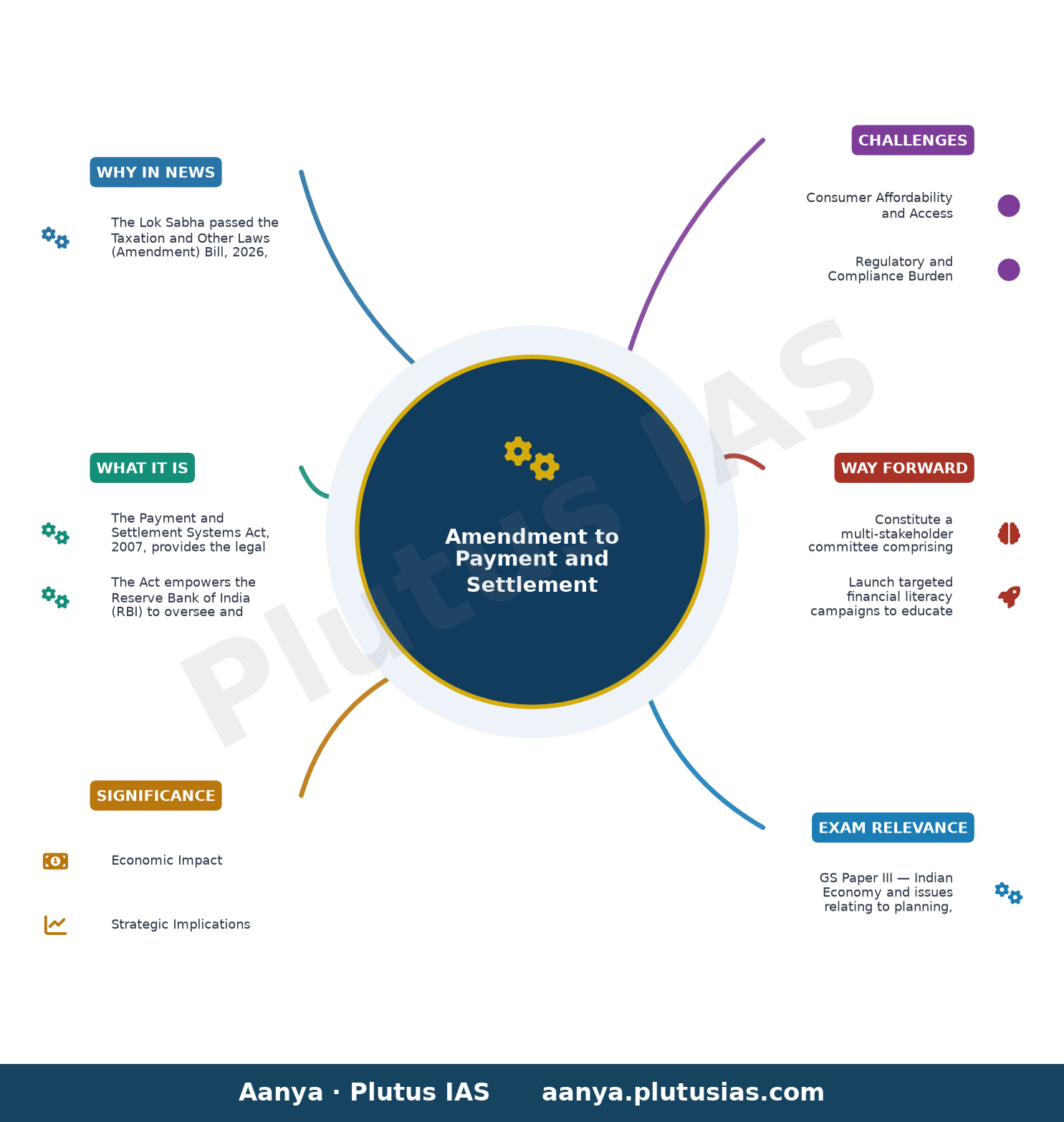
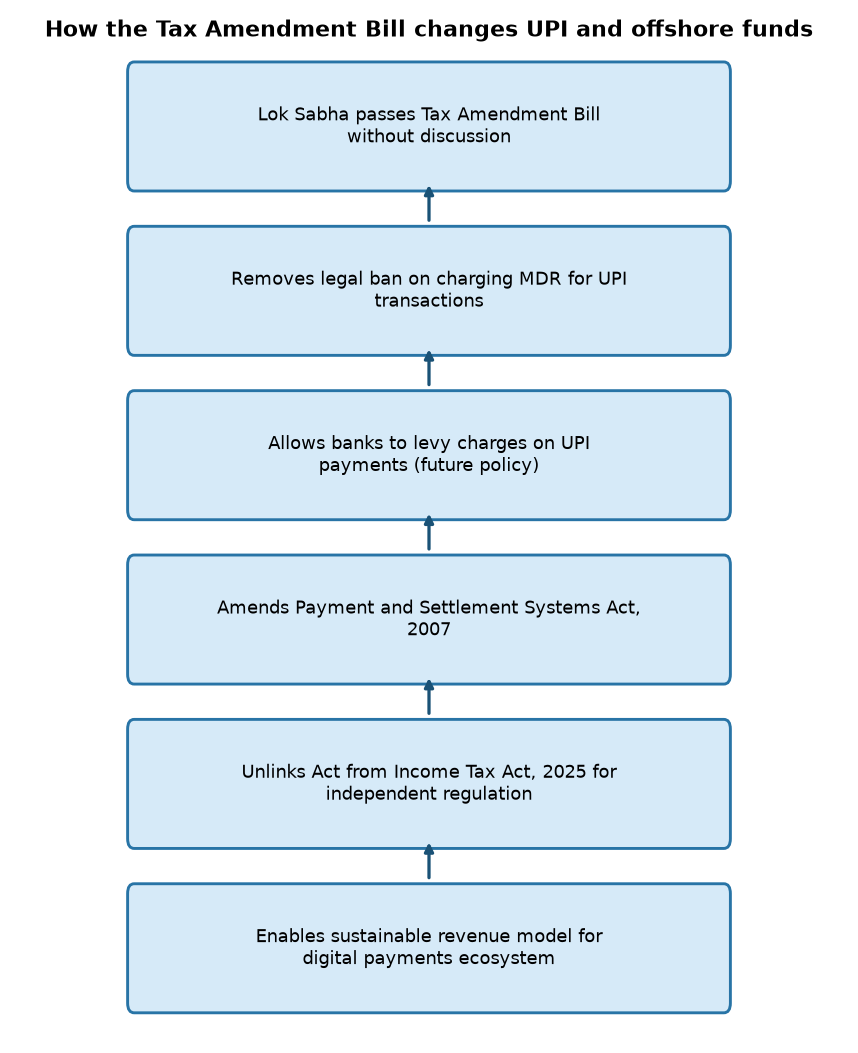
The Lok Sabha passed the Taxation and Other Laws (Amendment) Bill, 2026, which seeks to amend the Payment and Settlement Systems Act, 2007, to permit banks and payment service providers to levy Merchant Discount Rate (MDR) on UPI transactions. This legislative change, passed without discussion amid opposition protests, marks a potential shift from the zero-MDR framework that has hitherto incentivised digital payments. The Bill also introduces tax exemptions for Foreign Portfolio Investors (FPIs) investing in Government Securities (G-Secs), aiming to enhance India’s attractiveness as an investment destination.
Background
- The Payment and Settlement Systems Act, 2007, was enacted to regulate payment systems in India and ensure the stability and efficiency of financial transactions.
- The zero-MDR framework for UPI transactions was introduced to promote digital payments and financial inclusion, exempting users and merchants from transaction charges.
- Real-time payments through RTGS and NEFT are subject to service charges, whereas UPI transactions have remained free for consumers, fostering widespread adoption.
- The Taxation and Other Laws (Amendment) Bill, 2026, replaces an ordinance issued on June 5, 2026, which provided income tax exemptions to FPIs on interest income and capital gains from G-Sec investments.
- The Bill was passed via voice vote in the Lok Sabha amid protests by the Opposition, reflecting political contention over the proposed changes.
What is the Payment and Settlement Systems Act, 2007, and its proposed amendments?
- The Payment and Settlement Systems Act, 2007, provides the legal framework for regulating payment systems in India, including digital payment modes such as UPI, NEFT, and RTGS.
- The Act empowers the Reserve Bank of India (RBI) to oversee and regulate payment systems to ensure their safety, efficiency, and stability.
- The zero-MDR framework for UPI transactions was a policy measure introduced to incentivise digital payments and reduce the cost burden on merchants and consumers.
- The proposed amendment removes the legal provision preventing banks and payment service providers from charging MDR on UPI transactions, potentially introducing fees for merchants.
- The amendment also seeks to create a sustainable revenue model for banks and payment service providers, ensuring the long-term viability of the digital payments ecosystem.
- The Bill introduces tax exemptions for FPIs investing in G-Secs, aiming to attract foreign capital and boost liquidity in the government securities market.
- The proposed changes are part of broader efforts to balance financial inclusion, economic efficiency, and the attractiveness of India as a global investment destination.
Key Features
| Feature | Significance |
|---|---|
| Removal of zero-MDR provision for UPI transactions | Enables banks and payment service providers to levy Merchant Discount Rate (MDR) on UPI transactions, potentially introducing costs for merchants and altering the digital payments ecosystem. |
| Amendment to Payment and Settlement Systems Act, 2007 | Provides legal authority to the government to modify or impose charges on electronic payment modes, including UPI, RTGS, and NEFT, ensuring regulatory flexibility. |
| Income Tax Act, 2025 amendments | Introduces exemptions for interest income and capital gains of Foreign Portfolio Investors (FPIs) from investments in Government Securities (G-Secs), aimed at attracting global capital. |
| Unlinking Payment and Settlement Systems Act from Income Tax Act | Decouples the regulatory framework for digital payments from tax provisions, allowing independent policy adjustments for each domain. |
| Sustainability of digital payments ecosystem | Aims to create a revenue model for banks and payment service providers to ensure the long-term viability and growth of digital payment infrastructure in India. |
Why it Matters
Economic Impact
- Shift from zero-cost UPI transactions may introduce transaction fees, affecting consumer behavior and merchant pricing strategies.
- Potential revenue generation for banks and fintech firms through MDR, enhancing financial sustainability of digital payment systems.
- Attractiveness for global investors via tax exemptions for FPIs in G-Secs, aligning with India’s goal of capital inflows for infrastructure and manufacturing.
- Enhanced regulatory control over electronic payment systems, enabling calibrated policy responses to market dynamics.
Strategic Implications
- Alignment with India’s vision of a cashless economy by balancing zero-cost convenience with sustainable digital payment infrastructure.
- Strengthening India’s position as a global financial hub by offering predictable and investor-friendly tax regimes for foreign capital.
- Facilitating deeper integration of digital payments in e-commerce, government welfare schemes, and financial inclusion initiatives.
Fiscal Policy
- Revenue-neutral or revenue-positive adjustments to digital payment systems may reduce fiscal burden on exchequer while promoting digital adoption.
- Tax exemptions for FPIs in G-Secs may stimulate secondary market liquidity and reduce borrowing costs for the government.
- Potential for cross-subsidization of digital payment infrastructure through MDR, reducing reliance on public funding.
Technological and Financial Inclusion
- Regulatory flexibility in digital payments can spur innovation in fintech, UPI-linked services, and cross-border transactions.
- Balanced pricing of UPI transactions may ensure equitable access while sustaining ecosystem growth for rural and underserved regions.
Challenges
1. Consumer Affordability and Access
- Introduction of MDR may deter small merchants and low-income consumers from adopting UPI, reversing gains in financial inclusion.
- Risk of price inflation in goods/services if merchants pass on UPI transaction costs to consumers, affecting purchasing power.
- Potential digital divide if urban and digitally literate populations adapt better than rural or marginalized groups.
UPSC Link: GS3: Digital Economy
2. Regulatory and Compliance Burden
- Complexity in determining fair and transparent MDR rates to avoid cartelization or predatory pricing by payment service providers.
- Need for robust grievance redressal mechanisms to address disputes arising from transaction charges.
- Ensuring compliance with anti-money laundering (AML) and know-your-customer (KYC) norms amid evolving digital payment structures.
UPSC Link: GS3: Financial Regulation
3. Macroeconomic Stability
- Over-reliance on MDR for revenue may lead to volatility in digital payment ecosystem if consumer adoption declines.
- Risk of capital flight if tax exemptions for FPIs are perceived as unsustainable or discriminatory against domestic investors.
- Potential strain on fiscal deficit if revenue from MDR falls short of expectations, requiring alternative funding sources.
UPSC Link: GS3: Fiscal Policy
4. Global Competitiveness
- Balancing investor-friendly policies with domestic economic priorities to avoid perceptions of regulatory arbitrage.
- Ensuring that tax exemptions for FPIs do not erode domestic tax base or create inequities in capital market participation.
- Maintaining India’s attractiveness as a destination for foreign direct investment (FDI) amid global economic uncertainties.
UPSC Link: GS3: FDI and External Sector
5. Technological and Security Risks
- Increased transaction volumes may expose digital payment systems to cyber threats, necessitating stronger cybersecurity frameworks.
- Interoperability challenges between legacy payment systems (RTGS/NEFT) and newer modes (UPI) could disrupt seamless transactions.
- Need for continuous innovation to prevent obsolescence of digital payment infrastructure amid rapid technological advancements.
UPSC Link: GS3: Cybersecurity
Challenges — UPSC Perspective
| Issue | Concern |
|---|---|
| Consumer adoption | Risk of reduced UPI usage due to introduced charges, impacting financial inclusion. |
| Merchant pricing | Potential pass-through of MDR costs to consumers, leading to inflationary pressures. |
| Regulatory arbitrage | Possibility of payment service providers exploiting loopholes in MDR pricing. |
| Fiscal sustainability | Uncertainty in revenue generation from MDR to sustain digital payment ecosystem. |
| Global investor sentiment | Perception of tax exemptions as unsustainable, deterring long-term capital inflows. |
| Cybersecurity threats | Increased vulnerability of digital payment systems to fraud and data breaches. |
Way Forward
- Constitute a multi-stakeholder committee comprising RBI, banks, fintech firms, and consumer representatives to determine fair and transparent MDR rates for UPI transactions.
- Launch targeted financial literacy campaigns to educate merchants and consumers on the implications of MDR and alternative payment modes.
- Strengthen cybersecurity protocols for digital payment systems, including real-time fraud detection and customer awareness initiatives.
- Monitor macroeconomic indicators such as inflation, consumer spending, and digital payment adoption rates to assess the impact of MDR introduction.
- Review tax exemptions for FPIs in G-Secs periodically to ensure alignment with fiscal sustainability and global investment trends.
- Enhance interoperability between UPI, RTGS, and NEFT to ensure seamless transactions and reduce operational inefficiencies.
- Introduce graded MDR structures based on transaction value or merchant category to minimize regressive impacts on small businesses.
- Establish a grievance redressal mechanism for disputes related to transaction charges, ensuring timely resolution and consumer protection.
UPSC Value Addition
Keywords for Mains Answer-Writing
Payment and Settlement Systems Act, 2007 · Merchant Discount Rate (MDR) · Unified Payments Interface (UPI) · Taxation and Other Laws (Amendment) Bill, 2026 · digital payments ecosystem · offshore funds taxation · Income Tax Act, 2025 · Financial sector reforms · monetary policy instruments · financial inclusion · sustainable revenue model for banks · G-Secs (Government Securities) · Foreign Portfolio Investors (FPIs) · Parliamentary legislative process · zero-MDR framework
Concept Flow
Government introduces amendments to Payment and Settlement Systems Act, 2007 to remove zero-MDR provision for UPI transactions. → Banks and payment service providers gain legal authority to levy MDR on UPI transactions, altering cost structure for merchants. → Potential introduction of transaction fees may reduce consumer adoption of UPI, impacting financial inclusion and digital economy growth. → Concurrently, tax exemptions for FPIs in G-Secs aim to attract global capital, aligning with India’s economic liberalization goals. → Regulatory flexibility in digital payments and tax policies seeks to balance sustainability of digital infrastructure with investor attractiveness. → Macroeconomic stability and consumer welfare outcomes depend on calibrated implementation of MDR and tax policies. → Long-term impact on India’s digital economy, fiscal health, and global competitiveness hinges on effective policy execution and monitoring.
Prelims Practice Questions
Q1. Consider the following statements regarding the Payment and Settlement Systems Act, 2007:
1. The Act was amended by the Taxation and Other Laws (Amendment) Bill, 2026 to allow banks to charge Merchant Discount Rate (MDR) on UPI transactions.
2. The Act originally prohibited banks from levying charges on notified electronic payment modes such as UPI.
3. The Act empowers the Reserve Bank of India (RBI) to regulate all payment systems in India.
How many of the above statements are correct?
- Only one
- Only two
- All
- None
Answer: All — Statements 1 and 2 are correct as the amendment removes the prohibition on charging MDR for UPI transactions. Statement 3 is incorrect because while the Act empowers the RBI to regulate payment systems, it is not the sole authority; the Act also involves the central government.
Q2. Assertion (A): The Taxation and Other Laws (Amendment) Bill, 2026 seeks to unlink the Payment and Settlement Systems Act, 2007 from the Income Tax Act, 2025.
Reason (R): The unlinking allows the government to modify the zero-MDR framework for UPI transactions without requiring legislative amendments to the Income Tax Act.
- Both A and R are true, and R is the correct explanation of A
- Both A and R are true, but R is not the correct explanation of A
- A is true but R is false
- A is false but R is true
Answer: Both A and R are true, and R is the correct explanation of A — Both the Assertion and Reason are true, and the Reason correctly explains the Assertion. The unlinking provides the government with the flexibility to modify the zero-MDR framework independently of the Income Tax Act.
Q3. Match the following columns related to the Taxation and Other Laws (Amendment) Bill, 2026:
Column I (Provisions)
A. Removal of zero-MDR framework for UPI transactions
B. Exemption of interest income and capital gains for FPIs in G-Secs
C. Amendment to the Finance Act, 2026
D. Payment and Settlement Systems Act, 2007
Column II (Amended Acts)
1. Income Tax Act, 2025
2. Payment and Settlement Systems Act, 2007
3. Finance Act, 2026
4. Payment and Settlement Systems Act, 2007 and Income Tax Act, 2025
- A-2, B-1, C-3, D-4; A-1, B-2, C-3, D-4; A-2, B-1, C-4, D-3; A-4, B-2, C-1, D-3
- answer_string_list_indexed_pairs_0
- explain_pairs_exact_match
- format
- match
- pairs_to_match_exact_strings_in_order
Answer: A-2, B-1, C-3, D-4; A-1, B-2, C-3, D-4; A-2, B-1, C-4, D-3; A-4, B-2, C-1, D-3 —
Q4. Which of the following is NOT a stated objective of the Taxation and Other Laws (Amendment) Bill, 2026?
- To create a sustainable revenue model for banks and payment service providers
- To make India a more attractive destination for global capital and manufacturing
- To introduce charges for all digital payment modes including NEFT and RTGS
- To exempt interest income and capital gains for FPIs from investments in G-Secs
Answer: To introduce charges for all digital payment modes including NEFT and RTGS — The Bill does not aim to introduce charges for NEFT and RTGS transactions, which already involve service charges. The other options are explicitly stated objectives of the Bill.
Mains Practice Question
✍ Critically examine the implications of the removal of the zero-MDR framework for UPI transactions in the context of India’s digital payments ecosystem and financial inclusion agenda. Also, analyse the potential impact on merchants, consumers, and the broader economy. (15 Marks)
Approach: MODEL-ANSWER SKELETON:
1. **Introduction (2 Marks)**
– Briefly define UPI and the zero-MDR framework under the Payment and Settlement Systems Act, 2007.
– Contextualise the recent amendment via the Taxation and Other Laws (Amendment) Bill, 2026.
2. **Rationale for Removal of Zero-MDR (3 Marks)**
– Government’s stated objectives: sustainability of revenue model for banks and payment service providers, ensuring continuity of digital payments ecosystem.
– Comparison with existing charges on NEFT/RTGS and global practices (e.g., debit/credit card MDR).
– Link to the broader financial sector reforms and the need for a balanced ecosystem.
3. **Impact on Stakeholders (5 Marks)**
– **Merchants**: Potential increase in transaction costs, impact on pricing strategies, and consumer behaviour.
– **Consumers**: Likelihood of indirect costs (e.g., higher prices) or potential benefits from improved service quality.
– **Banks and Payment Service Providers**: Revenue generation, investment in infrastructure, and innovation.
– **Government and RBI**: Regulatory oversight, consumer protection, and alignment with digital public infrastructure goals.
4. **Broader Economic and Social Implications (3 Marks)**
– Effect on financial inclusion: risk of reduced UPI usage among small merchants or low-income users.
– Impact on MSMEs and informal sector: potential burden on small businesses.
– Macroeconomic considerations: digital payment adoption, tax compliance, and formalisation of the economy.
5. **Critical Analysis and Way Forward (2 Marks)**
– Evaluate the trade-offs between sustainability of the digital payments ecosystem and affordability for users.
– Discuss the need for a calibrated approach: phased introduction of MDR, exemptions for small transactions, or tiered pricing.
– Reference global best practices (e.g., Brazil’s MDR regulation, EU’s PSD2) and lessons for India.
**Balanced View Required**: Present both positive (revenue sustainability, innovation) and negative (financial exclusion, consumer burden) perspectives with reasoned arguments.
Source: Mint
Generated by AanyaAi for educational purpose.

- गृह मंत्री ने मध्य प्रदेश में गौपालक सम्मेलन का किया उद्घाटन, नए अपराध कानूनों पर प्रदर्शनी का किया शुभारंभ - October 3, 2026
- Jal Arpan: 1850+ Gram Panchayats Join Hands for Rural Water Supply - October 3, 2026
- भारत ने किया 5.56 किमी मुक्त अंतरिक्ष क्वांटम की वितरण लिंक का सफल परीक्षण - October 3, 2026

No Comments