


07 Aug Taxation and Other Laws (Amendment) Bill 2026 Passed in Lok Sabha: Key Provisions Explained
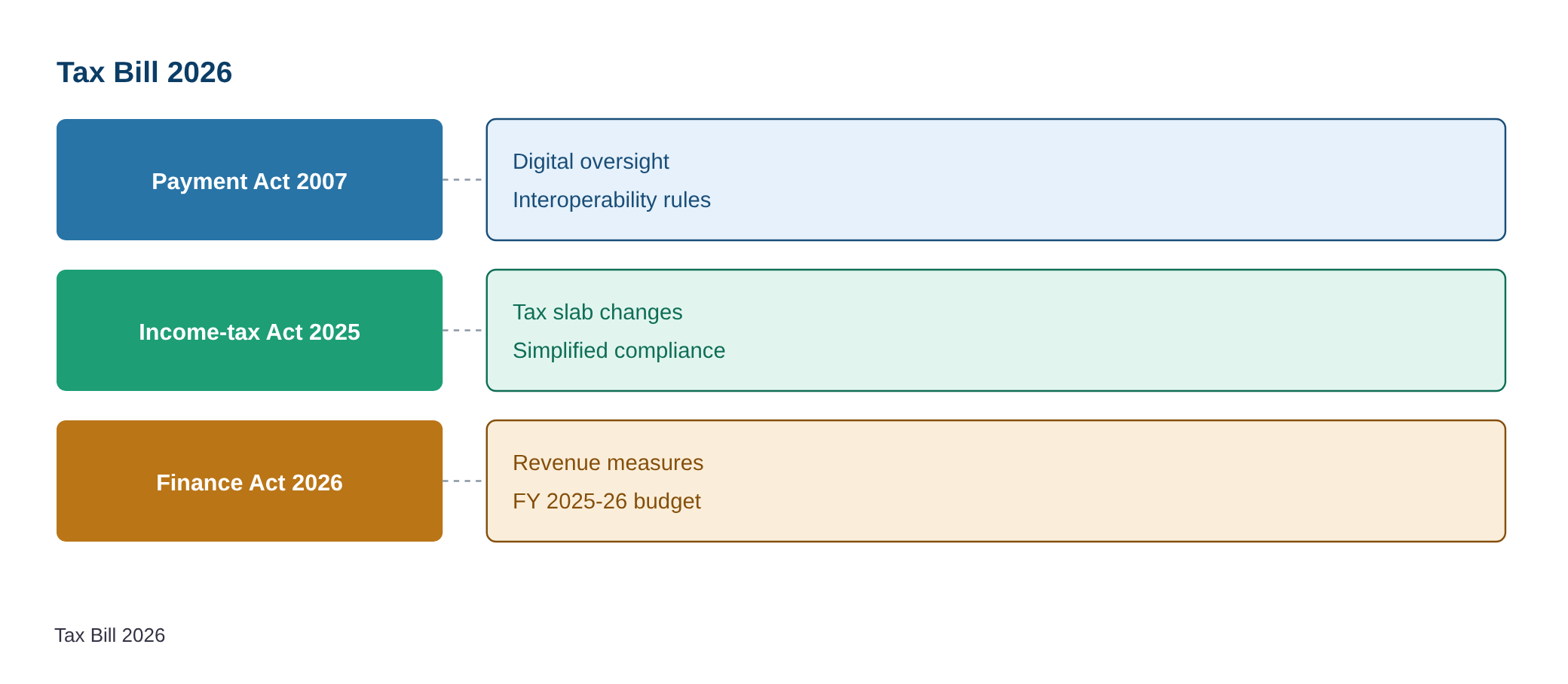
✎ The Taxation and Other Laws (Amendment) Bill, 2026, integrates amendments to the Payment and Settlement Systems Act, 2007, the Income-tax Act, 2025, and the Finance Act, 2026, to modernise India’s fiscal and digital payment…
Subject Relevance — Where This Topic Fits
- GS Paper III — Indian Economy: Fiscal Policy, Taxation Reforms, and Public Finance | GS Paper II — Parliament and State Legislatures — Structure, Functioning, Conduct of Business, and Powers
- Prelims: Taxation and Other Laws (Amendment) Bill, 2026, Payment and Settlement Systems Act, 2007, Income-tax Act, 2025, Finance Act, 2026, Appropriation (No.3) Bill, 2026, Consolidated Fund of India, Parliamentary procedures in financial legislation
- Essay: The role of fiscal legislation in balancing economic growth and equity: A critique of recent amendments, Parliamentary democracy in India: Challenges of legislative efficiency and accountability
Quick Revision: The Taxation and Other Laws (Amendment) Bill, 2026, integrates amendments to the Payment and Settlement Systems Act, 2007, the Income-tax Act, 2025, and the Finance Act, 2026, to modernise India’s fiscal and digital payment frameworks, while raising questions about legislative scrutiny and parliamentary debate.
Why is this in the news?
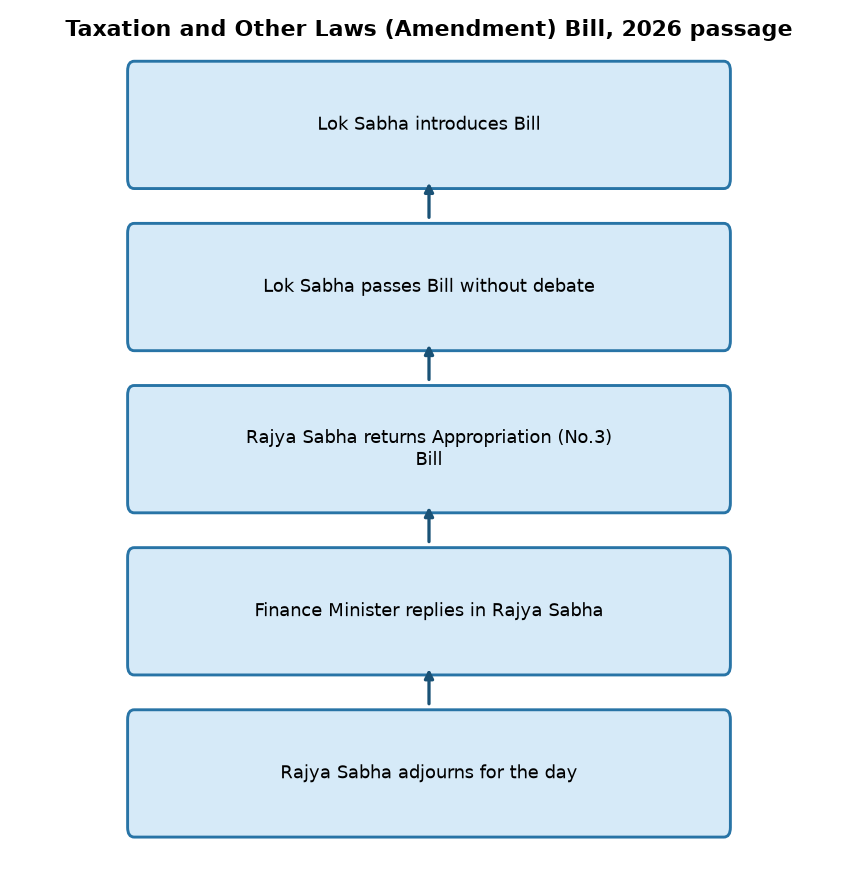
The Lok Sabha passed the Taxation and Other Laws (Amendment) Bill, 2026, on August 6, 2026, without debate, marking a significant legislative development during the Monsoon Session of Parliament. The Bill introduces amendments to critical fiscal and regulatory statutes, including the Payment and Settlement Systems Act, 2007, the Income-tax Act, 2025, and the Finance Act, 2026. Its passage underscores the government’s agenda for fiscal consolidation and digital financial integration, while also raising questions about legislative scrutiny and parliamentary debate.
Background
- The Taxation and Other Laws (Amendment) Bill, 2026, is part of the Union Government’s broader fiscal strategy to modernise India’s tax and financial regulatory frameworks in alignment with the Digital India vision.
- The Bill seeks to amend the Payment and Settlement Systems Act, 2007, to enhance the regulatory oversight of digital payment systems, including provisions for interoperability, consumer protection, and grievance redressal mechanisms.
- The Income-tax Act, 2025, is proposed to be amended to introduce changes in tax slabs, deductions, and compliance procedures, reflecting the government’s intent to simplify the tax regime while expanding the tax base.
- The Finance Act, 2026, is being amended to incorporate fiscal measures for the financial year 2025-26, including provisions for tax administration and revenue mobilisation.
- The passage of the Bill without debate in the Lok Sabha highlights the challenges of legislative scrutiny in a contentious parliamentary session, where opposition demands for discussions on issues such as police action against protestors and the Indo-Bangladesh Farakka Treaty renewal were not addressed.
- The Appropriation (No.3) Bill, 2026, was also passed, authorising the expenditure of additional funds from the Consolidated Fund of India for the financial year 2025-26, ensuring continuity in government operations.
What is the Taxation and Other Laws (Amendment) Bill, 2026?
- The Bill is a legislative instrument introduced to amend three key statutes: the Payment and Settlement Systems Act, 2007; the Income-tax Act, 2025; and the Finance Act, 2026, thereby integrating fiscal, tax, and digital payment reforms into a single legislative framework.
- The Payment and Settlement Systems Act, 2007, governs the regulation of payment systems in India, including digital wallets, UPI, and card networks. The proposed amendments aim to strengthen consumer protection, enhance regulatory oversight, and promote interoperability among payment systems to foster a seamless digital financial ecosystem.
- The Income-tax Act, 2025, is the primary legislation governing direct taxation in India. The Bill seeks to introduce amendments to tax slabs, deductions, and compliance procedures, with the objective of simplifying the tax regime, reducing litigation, and expanding the tax base through measures such as rationalising exemptions and enhancing transparency in tax administration.
- The Finance Act, 2026, is an annual legislation that provides the legal framework for the Union Government’s fiscal policies, including tax proposals and expenditure authorisations. The Bill’s amendments to the Finance Act are expected to align with the broader fiscal strategy for the financial year 2025-26, ensuring consistency in tax administration and revenue mobilisation.
- The Bill’s passage without debate in the Lok Sabha raises concerns about the adequacy of parliamentary scrutiny, particularly in the context of significant fiscal and regulatory changes that impact citizens and businesses alike.
- The Bill’s provisions are aligned with the government’s Digital India initiative, which seeks to promote a cashless economy, enhance financial inclusion, and streamline tax compliance through digital platforms.
- The amendments to the Payment and Settlement Systems Act are likely to impact fintech companies, banks, and digital payment service providers, necessitating compliance with new regulatory standards and consumer protection norms.
- The Bill also reflects the government’s commitment to fiscal consolidation, as it seeks to rationalise tax exemptions and improve tax administration efficiency, thereby contributing to the reduction of the fiscal deficit.
Key Features
| Feature | Significance |
|---|---|
| Amendment to Payment and Settlement Systems Act, 2007 | Enhances regulatory oversight of digital payment ecosystems, including cryptocurrencies and cross-border transactions, aligning with India’s push for a formalised digital economy and financial inclusion. |
| Income-tax Act, 2025 amendments | Introduces procedural simplifications, dispute resolution mechanisms, and potential tax incentives for startups and MSMEs to stimulate economic growth and ease compliance burdens. |
| Finance Act, 2026 adjustments | Facilitates budgetary allocations for critical sectors such as infrastructure, healthcare, and education, ensuring fiscal continuity and resource optimisation for the financial year 2025-26. |
| Appropriation (No.3) Bill, 2026 | Authorises supplementary expenditure from the Consolidated Fund of India, enabling the government to meet unforeseen financial obligations without disrupting ongoing developmental projects. |
| Parliamentary procedure in Lok Sabha | Demonstrates the government’s ability to secure legislative passage of fiscal bills through majority support, underscoring the importance of legislative discipline in budgetary processes. |
Why it Matters
Fiscal Governance
- Ensures uninterrupted funding for government operations, particularly in sectors critical to public welfare and economic recovery.
- Reflects the government’s commitment to fiscal prudence by adhering to constitutional provisions on appropriation and expenditure.
- Highlights the role of parliamentary oversight in scrutinising supplementary demands for grants, thereby maintaining democratic accountability.
Digital Economy
- Strengthens the regulatory framework for digital payments, addressing risks such as money laundering, fraud, and systemic stability in fintech ecosystems.
- Aligns with the Reserve Bank of India’s (RBI) vision for a cash-lite economy, fostering innovation while mitigating financial crime.
- Supports the growth of India’s digital public infrastructure (DPI), including UPI and Aadhaar-enabled services, which are pivotal for financial inclusion.
Taxation Reforms
- Aims to reduce litigation and improve ease of doing business by streamlining tax administration and dispute resolution mechanisms.
- May introduce targeted tax incentives to boost investment in sunrise sectors such as renewable energy, semiconductors, and electric vehicles.
- Ensures continuity in tax policies, providing certainty to businesses and investors amid evolving global tax regimes.
Parliamentary Dynamics
- Illustrates the challenges of legislative consensus in a multi-party democracy, particularly on fiscal matters requiring majority support.
- Underscores the role of the Speaker and Chairpersons in managing legislative business, including the use of guillotine motions to expedite proceedings.
- Highlights opposition demands for accountability on issues such as police action during protests, reflecting broader societal concerns about governance and civil liberties.
Challenges
1. Fiscal Federalism
- Potential disputes between the Centre and states over revenue-sharing mechanisms, particularly in the context of GST compensation and supplementary demands.
- Risk of fiscal imbalances if supplementary appropriations are not tightly monitored, leading to inflationary pressures or debt accumulation.
- Need for transparent and predictable fiscal transfers to states to maintain cooperative federalism.
UPSC Link: GS-II: Cooperative Federalism
2. Digital Payment Regulation
- Balancing innovation with consumer protection in a rapidly evolving fintech landscape, including the regulation of cryptocurrencies and cross-border transactions.
- Addressing cybersecurity threats and data privacy concerns in digital payment systems, which are critical for maintaining public trust.
- Ensuring interoperability and accessibility of digital payment platforms across diverse socio-economic groups.
UPSC Link: GS-III: Digital Economy
3. Taxation Policy Uncertainty
- Risk of retrospective taxation and litigation, which can deter foreign and domestic investment by creating an unpredictable tax environment.
- Need for alignment with global tax norms, such as the OECD’s Base Erosion and Profit Shifting (BEPS) framework, to prevent tax arbitrage.
- Ensuring that tax amendments do not disproportionately burden MSMEs or informal sectors, which are vital for employment generation.
UPSC Link: GS-III: Taxation
4. Parliamentary Scrutiny Gaps
- Limited debate on fiscal bills due to time constraints, which may undermine the quality of legislative scrutiny and public accountability.
- Opposition’s demand for statements on contentious issues, such as police action during protests, highlights the need for robust mechanisms for parliamentary oversight.
- Risk of legislative logjams in future sessions if procedural disputes are not resolved through dialogue and consensus-building.
UPSC Link: GS-II: Parliament and State Legislatures
Challenges — UPSC Perspective
| Issue | Concern |
|---|---|
| Supplementary Appropriations | Risk of fiscal slippage if supplementary demands exceed budgetary allocations, leading to inflation or debt accumulation. |
| Digital Payment Fraud | Increased vulnerability to cybercrimes, money laundering, and identity theft in an expanding digital payment ecosystem. |
| Tax Litigation | Prolonged disputes over tax amendments, particularly on retrospective taxation, creating uncertainty for investors. |
| Legislative Efficiency | Potential erosion of parliamentary debate quality due to time constraints and procedural bottlenecks. |
| Federal Tensions | Disputes over revenue-sharing mechanisms between Centre and states, particularly in GST compensation and supplementary demands. |
Way Forward
- Conduct a comprehensive review of supplementary appropriations to ensure fiscal discipline and prevent over-expenditure in non-essential sectors.
- Strengthen the regulatory framework for digital payments by expediting the implementation of the Digital Personal Data Protection Act, 2023, and RBI guidelines on fintech.
- Introduce a pre-budget consultation mechanism with stakeholders, including industry associations, tax experts, and civil society, to reduce policy uncertainty.
- Enhance parliamentary scrutiny of fiscal bills by allocating dedicated time for debates and inviting subject-matter experts to brief committees.
- Promote inter-state coordination on fiscal matters to address disputes over revenue-sharing and ensure equitable resource allocation.
- Accelerate the resolution of pending tax disputes through dedicated benches in Income Tax Appellate Tribunals (ITAT) and Fast Track Courts.
- Invest in digital literacy programmes to ensure inclusive access to digital payment systems, particularly in rural and semi-urban areas.
- Establish a multi-stakeholder task force to monitor the implementation of tax amendments and address grievances from businesses and taxpayers.
UPSC Value Addition
Keywords for Mains Answer-Writing
Taxation and Other Laws (Amendment) Bill 2026 · Payment and Settlement Systems Act 2007 · Income-tax Act 2025 · Finance Act 2026 · Appropriation (No.3) Bill 2026 · Parliament Monsoon Session 2026 · Consolidated Fund of India · Union Budget · Parliamentary accountability · Fiscal federalism · Constitutional provisions on taxation · Legislative procedure in Parliament
Concept Flow
Parliamentary approval of supplementary demands → Authorisation of expenditure from Consolidated Fund of India → Implementation of fiscal policies → Impact on economic growth and public welfare → Amendments to Payment and Settlement Systems Act → Enhanced regulatory oversight → Strengthening digital payment ecosystems → Promotion of financial inclusion → Taxation reforms in Income-tax Act → Simplification of compliance → Reduction in tax litigation → Attraction of investment → Opposition’s demand for accountability → Parliamentary scrutiny of governance issues → Reflection of democratic accountability → Public trust in institutions → Fiscal federalism challenges → Centre-state disputes over revenue-sharing → Risk of fiscal imbalances → Need for cooperative federalism → Digital payment regulation → Cybersecurity and data privacy concerns → Consumer protection measures → Trust in fintech innovation
Prelims Practice Questions
Q1. Consider the following statements regarding the Taxation and Other Laws (Amendment) Bill, 2026:
1. It seeks to amend the Payment and Settlement Systems Act, 2007.
2. It amends the Income-tax Act, 2025.
3. It authorises the payment and appropriation of sums from the Consolidated Fund of India for the financial year 2025-26.
How many of the above statements are correct?
- Only one
- Only two
- All three
- None
Answer: All three — Statements 1 and 2 are correct as per the Bill’s stated objectives. Statement 3 is incorrect as the Appropriation (No.3) Bill, 2026, not the Taxation Bill, authorises such payments.
Q2. Assertion (A): The Appropriation (No.3) Bill, 2026, authorises the payment and appropriation of sums from the Consolidated Fund of India.
Reason (R): The Consolidated Fund of India is a constitutional fund established under Article 266 of the Constitution of India.
- A. Both A and R are true, and R is the correct explanation of A
- B. Both A and R are true, but R is not the correct explanation of A
- C. A is true but R is false
- D. A is false but R is true
Answer: B. Both A and R are true, but R is not the correct explanation of A — The Appropriation Bill authorises expenditure from the Consolidated Fund, and Article 266(1) establishes the Consolidated Fund of India, making both statements true with R correctly explaining A.
Q3. Match the following legislative instruments with their primary purpose:
Column I (Instrument) — Column II (Purpose)
A. Taxation and Other Laws (Amendment) Bill, 2026 — 1. Authorises expenditure from the Consolidated Fund
B. Appropriation (No.3) Bill, 2026 — 2. Amends taxation and payment systems laws
C. Finance Act, 2026 — 3. Provides legal framework for the Union Budget
D. Payment and Settlement Systems Act, 2007 — 4. Regulates electronic payment systems
- A-2, B-1, C-3, D-4
- A-1, B-2, C-3, D-4
- A-3, B-1, C-2, D-4
- A-4, B-3, C-1, D-2
Answer: A-2, B-1, C-3, D-4 — A matches with 2 (amends taxation and payment systems laws), B with 1 (authorises expenditure), C with 3 (provides legal framework for the Union Budget), and D with 4 (regulates electronic payment systems).
Mains Practice Question
✍ The Taxation and Other Laws (Amendment) Bill, 2026, seeks to amend multiple fiscal statutes while the Appropriation (No.3) Bill, 2026, authorises expenditure from the Consolidated Fund of India. Critically examine the significance of these legislative measures in the context of parliamentary accountability and fiscal federalism. Also, analyse the constitutional safeguards that ensure legislative scrutiny of such financial bills. (15 Marks)
Approach: MODEL-ANSWER SKELETON:
1. **Introduction (2 marks)**: Define the Taxation and Other Laws (Amendment) Bill, 2026, and the Appropriation (No.3) Bill, 2026, highlighting their objectives and the context of the Parliament Monsoon Session 2026.
2. **Parliamentary Accountability (4 marks)**:
– Role of Parliament in financial legislation: Article 112 (Annual Financial Statement), Article 113-116 (Appropriation and Finance Bills), and Article 266 (Consolidated Fund).
– Significance of legislative scrutiny: Debate, discussion, and amendments in Lok Sabha and Rajya Sabha.
– Recent trends: Limited debate on the Taxation Bill and adjournments in Rajya Sabha.
– Constitutional provisions: Article 105 (powers and privileges of Parliament) and Article 123 (ordinance-making power).
3. **Fiscal Federalism (4 marks)**:
– Definition and constitutional framework: Article 279A (GST Council), Article 280 (Finance Commission), and Article 293 (loans by states).
– Role of states in fiscal matters: State legislatures’ role in approving state budgets and the impact of central amendments on state finances.
– Centre-state financial relations: Distribution of taxes under Article 270 and Article 274.
– Case study: Impact of amendments to the Income-tax Act on state revenue-sharing.
4. **Constitutional Safeguards (3 marks)**:
– Article 109 (Money Bills): Differentiate between Money Bills and Financial Bills.
– Role of the President: Article 111 (assent to bills) and Article 74 (Council of Ministers).
– Judicial review: Landmark judgments such as *S.R. Bommai v. Union of India* (1994) on financial emergency and *Kesavananda Bharati v. State of Kerala* (1973) on basic structure.
5. **Conclusion (2 marks)**:
– Balance between executive efficiency and parliamentary accountability.
– Need for robust debate and transparency in fiscal legislation.
– Recommendations: Strengthening parliamentary committees (e.g., Public Accounts Committee, Estimates Committee) and state consultations in fiscal amendments.
Source: The Hindu
Generated by AanyaAi for educational purpose.

- कुल्लू: NHPC की पार्वती-2 परियोजना के खिलाफ एफआईआर, 12 सदस्यीय जांच समिति गठित - September 21, 2026
- NHPC Tunnel Leak in Kullu: FIR Filed, 5-Day Probe Deadline for Project Failures - September 21, 2026
- भारत ने जी20 ऊर्जा सहमति में किया शामिल, जानिए प्रमुख समझौते - September 21, 2026

No Comments