


21 Sep NHPC Tunnel Leak in Kullu: FIR Filed, 5-Day Probe Deadline for Project Failures
✎ Tunnel leakage in hydroelectric projects is a critical safety concern governed by environmental and disaster management laws, requiring strict adherence to SOPs and regulatory oversight to prevent downstream damage and ensure…
Subject Relevance — Where This Topic Fits
- GS Paper II — Governance, Transparency and Accountability | GS Paper III — Infrastructure, Environmental Impact and Disaster Management
- Prelims: NHPC, Parvati Hydroelectric Project, Tunnel leakage, Environmental Impact Assessment (EIA), National Green Tribunal (NGT), Disaster Management Act, 2005, Standard Operating Procedures (SOPs) for hydroelectric projects, Hydroelectric Power Plant safety protocols
- Essay: Environmental governance and sustainable infrastructure development, Role of regulatory institutions in ensuring public safety and accountability in large-scale projects
Quick Revision: Tunnel leakage in hydroelectric projects is a critical safety concern governed by environmental and disaster management laws, requiring strict adherence to SOPs and regulatory oversight to prevent downstream damage and ensure public safety.
Why is this in the news?
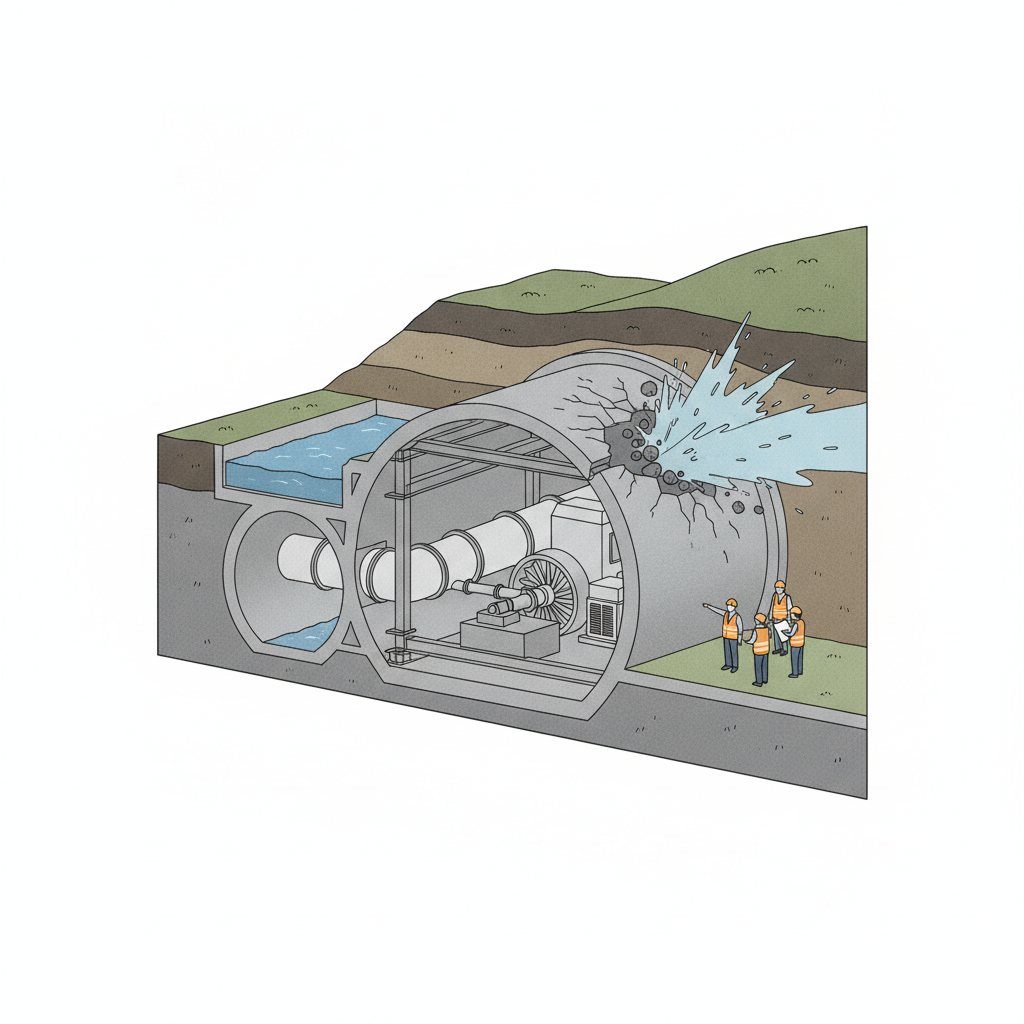
The registration of an FIR against the management of NHPC’s Parvati Hydroelectric Project-II in Kullu district, Himachal Pradesh, following a tunnel leakage incident that caused significant water and debris outflow, has brought attention to the legal, technical, and administrative dimensions of hydroelectric project safety. The formation of a multi-departmental committee to investigate the incident within five days underscores the urgency of addressing potential lapses in compliance with safety protocols and environmental safeguards.
Background
- Hydroelectric projects in India are governed by the Electricity Act, 2003, and the Environment (Protection) Act, 1986, requiring Environmental Impact Assessments (EIAs) and compliance with safety standards.
- The Parvati Hydroelectric Project-II, operated by NHPC, is a run-of-the-river scheme with significant environmental and socio-economic implications in the Himalayan region.
- Tunnel leakage in hydroelectric projects can result from geological instability, poor construction practices, or inadequate maintenance, posing risks to downstream communities and ecosystems.
- The incident highlights recurring concerns about the implementation of safety protocols in large infrastructure projects, particularly in ecologically sensitive zones.
What is Tunnel Leakage in Hydroelectric Projects and Its Implications?
- Tunnel leakage refers to the unintended seepage of water from tunnels constructed for hydroelectric projects, which can occur due to structural weaknesses, geological faults, or operational failures.
- Such leakage can lead to sudden water and debris outflows, causing damage to downstream infrastructure, agricultural land, and human settlements.
- Hydroelectric projects in the Himalayas are particularly vulnerable to such incidents due to the region’s complex geology and high seismic activity.
- Regulatory frameworks, including the Environment (Protection) Act, 1986, and the Disaster Management Act, 2005, mandate strict adherence to safety and environmental norms to mitigate such risks.
- The Standard Operating Procedures (SOPs) for hydroelectric projects typically include regular inspections, maintenance schedules, and emergency response protocols to prevent and address leakage incidents.
- The role of project management in ensuring compliance with these SOPs is critical, as lapses can result in legal liability, financial penalties, and reputational damage.
- Investigative committees, such as the one formed in this case, are tasked with identifying the root causes of leakage, assessing damages, and recommending corrective measures to prevent recurrence.
Key Features
| Feature | Significance |
|---|---|
| FIR Registration | Institutionalizes accountability for alleged negligence in tunnel construction, reinforcing the rule of law in public infrastructure projects. |
| Multi-departmental Committee | Ensures a holistic investigation by integrating technical, administrative, and environmental expertise to assess damage and prevent recurrence. |
| Five-day Deadline for Report | Demonstrates administrative urgency in addressing public safety concerns and mitigating further environmental or economic loss. |
| Joint Inspection by SDM | Facilitates real-time assessment of damage to property, agriculture, and infrastructure, enabling evidence-based decision-making. |
| Technical and SOP Compliance Audit | Highlights the importance of adherence to engineering standards and operational protocols in hydroelectric projects to prevent structural failures. |
Why it Matters
Environmental Impact
- Sudden water and debris discharge from tunnels can disrupt local ecosystems, contaminate water bodies, and degrade soil quality in agricultural zones.
- Risk of landslides or soil erosion in hilly terrains like Kullu, exacerbating long-term ecological degradation.
- Potential contamination of drinking water sources if the leakage introduces silt or chemical residues from construction materials.
Economic Implications
- Damage to private property, farmlands, and public infrastructure (roads, bridges) imposes financial burdens on affected communities and the exchequer.
- Disruption to agricultural productivity in a region where horticulture (e.g., apple orchards) is a primary livelihood source.
- Delays in project execution or additional costs for remediation may impact the financial viability of hydroelectric ventures.
Governance and Accountability
- The registration of an FIR underscores the state’s commitment to investigating alleged lapses in project management, irrespective of the implementing agency.
- The committee’s composition reflects inter-departmental coordination, a critical aspect of disaster management and infrastructure oversight.
- Timely reporting mechanisms enhance public trust in administrative responsiveness to citizen grievances.
Public Safety and Infrastructure Resilience
- Tunnel failures in hydropower projects pose risks to downstream settlements due to sudden water surges or structural collapses.
- Adherence to engineering standards (e.g., drainage systems, pressure relief valves) is essential to mitigate such incidents.
- Long-term monitoring of similar projects in ecologically sensitive zones (e.g., Himalayan regions) is imperative to prevent recurrence.
Challenges
1. Technical Failures in Hydropower Infrastructure
- Inadequate design or construction standards may lead to tunnel collapses, water leakage, or debris discharge, endangering lives and property.
- Lack of real-time monitoring systems to detect early signs of structural stress or water ingress in tunnels.
- Over-reliance on manual inspections without leveraging modern geotechnical or hydrodynamic assessment tools.
UPSC Link: GS-III: Infrastructure – Energy
2. Regulatory and Compliance Gaps
- Ambiguities in the division of responsibilities between project developers (e.g., NHPC), state agencies, and regulatory bodies (e.g., CWC, CEA).
- Inconsistent enforcement of environmental and safety norms due to overlapping jurisdictions or resource constraints.
- Delays in post-incident investigations and remediation due to bureaucratic procedural hurdles.
UPSC Link: GS-II: Statutory Bodies
3. Ecological Vulnerability in Himalayan Regions
- Fragile Himalayan ecosystems are highly susceptible to disruptions from large-scale infrastructure projects, including hydropower dams.
- Risk of exacerbating climate-induced hazards (e.g., glacial lake outbursts, landslides) due to anthropogenic interventions.
- Need for stringent environmental impact assessments (EIAs) and disaster risk reduction (DRR) strategies tailored to mountainous terrains.
UPSC Link: GS-III: Environment & Disaster Management
4. Community Displacement and Livelihood Loss
- Unplanned water releases or structural failures may force evacuations, displacing local populations and disrupting livelihoods.
- Compensation mechanisms for affected communities often face delays or inadequacies, leading to social unrest.
- Lack of participatory governance in project planning and implementation, reducing community trust in authorities.
UPSC Link: GS-II: Governance – Welfare Schemes
5. Data and Transparency Deficits
- Insufficient public access to project-related data (e.g., geological surveys, safety audits) hinders independent verification of claims.
- Absence of standardized reporting formats for incidents in hydropower projects, complicating cross-project comparisons.
- Need for a centralized database to track incidents, investigations, and remediation efforts across states.
UPSC Link: GS-II: Transparency & Accountability
Challenges — UPSC Perspective
| Issue | Concern |
|---|---|
| Structural Integrity of Tunnels | Risk of collapse or leakage due to poor construction, inadequate drainage, or geological instability. |
| Regulatory Oversight | Fragmented responsibilities among central/state agencies may lead to oversight lapses or delayed interventions. |
| Environmental Degradation | Sudden water releases can alter river flows, degrade soil quality, and harm biodiversity in fragile ecosystems. |
| Public Displacement | Inadequate compensation or rehabilitation for affected communities may trigger social and legal disputes. |
| Data Scarcity | Lack of real-time monitoring and standardized incident reporting impedes evidence-based policymaking. |
| Climate Vulnerability | Himalayan regions face heightened risks from extreme weather events, compounding infrastructure vulnerabilities. |
Way Forward
- Constitute a state-level technical audit board to periodically review the structural integrity of hydropower tunnels and dams, with mandatory third-party certifications.
- Develop a standardized incident reporting protocol for hydropower projects, including real-time data sharing with regulatory bodies and affected communities.
- Strengthen inter-departmental coordination by formalizing roles for agencies like the Central Water Commission (CWC), State Disaster Management Authorities (SDMAs), and environmental regulators.
- Implement mandatory environmental and social impact assessments (ESIAs) for all new hydropower projects, with provisions for public hearings and grievance redressal.
- Introduce a national-level compensation fund for infrastructure-induced disasters, ensuring timely disbursement to affected individuals and communities.
- Promote the use of advanced monitoring technologies (e.g., IoT sensors, satellite imagery) to detect early signs of structural stress or water leakage in tunnels.
- Conduct regular capacity-building programs for project developers and regulatory staff on best practices in hydropower safety and environmental compliance.
- Establish a whistleblower protection mechanism for employees or contractors reporting lapses in project safety or compliance.
UPSC Value Addition
Keywords for Mains Answer-Writing
Tunnel safety regulations · Environmental impact assessment · Disaster management in hydropower projects · Standard Operating Procedures (SOPs) for infrastructure projects · Public accountability in government projects · National Hydroelectric Power Corporation (NHPC) compliance · Hydropower project governance · Committee-based investigations in infrastructure failures · Environmental degradation due to tunneling · Sustainable development and infrastructure safety · Role of District Administration in disaster response · Technical audits of hydropower projects · Public grievance redressal mechanisms · Hydropower project standards in India · Environmental laws and hydropower projects in India
Constitutional & Policy Linkages
- Article 21 (Right to Life and Personal Liberty) — Ensures protection of life and livelihood from infrastructure-related hazards.
Concept Flow
Construction of hydropower tunnel (Parvati-II Project) → Alleged structural deficiency or operational lapse → Sudden water and debris leakage → Damage to property, agriculture, and infrastructure → FIR registration against project management → Multi-departmental committee formation → Joint inspection and damage assessment → Technical and SOP compliance audit → Recommendations for preventive measures → Implementation of corrective actions.
Prelims Practice Questions
Q1. Consider the following statements regarding the National Hydroelectric Power Corporation (NHPC) Limited:
1. NHPC is a central public sector enterprise under the Ministry of Power, Government of India.
2. NHPC is responsible for the development of hydroelectric projects in India.
3. NHPC operates under the administrative control of the Ministry of Environment, Forest and Climate Change.
How many of the above statements are correct?
- Only one
- Only two
- All
- None
Answer: Only two — Statement 1 is correct as NHPC is a CPSE under the Ministry of Power. Statement 2 is correct as NHPC’s primary mandate is hydroelectric project development. Statement 3 is incorrect as NHPC operates under the Ministry of Power, not the Ministry of Environment.
Q2. Assertion (A): The Environmental Impact Assessment (EIA) Notification, 2006 mandates that all hydropower projects above 25 MW capacity require prior environmental clearance.
Reason (R): The EIA Notification, 2006 was issued under the provisions of the Environment (Protection) Act, 1986.
Options:
A. Both A and R are true, and R is the correct explanation of A.
B. Both A and R are true, but R is not the correct explanation of A.
C. A is true, but R is false.
D. A is false, but R is true.
Answer: ? — Assertion (A) is correct as the EIA Notification, 2006 requires environmental clearance for hydropower projects above 25 MW. Reason (R) is also correct as the EIA Notification, 2006 was issued under the Environment (Protection) Act, 1986. R correctly explains A.
Q3. Match the following hydropower projects with their respective states:
Column I (Project) | Column II (State)
1. Tehri Hydroelectric Project | A. Himachal Pradesh
2. Sardar Sarovar Project | B. Uttarakhand
3. Parvati Hydroelectric Project | C. Gujarat
4. Nathpa Jhakri Project | D. Himachal Pradesh
- 1-B, 2-C, 3-A, 4-D
- 1-B, 2-C, 3-D, 4-A
- 1-A, 2-C, 3-B, 4-D
- 1-D, 2-B, 3-A, 4-C
Answer: 1-B, 2-C, 3-D, 4-A — Tehri Hydroelectric Project is in Uttarakhand (1-B). Sardar Sarovar Project is in Gujarat (2-C). Parvati Hydroelectric Project is in Himachal Pradesh (3-D). Nathpa Jhakri Project is in Himachal Pradesh (4-A).
Mains Practice Question
✍ The recent tunnel leakage incident in the Parvati Hydroelectric Project-II in Kullu district has raised concerns about the adequacy of safety protocols in hydropower projects. Critically examine the institutional and regulatory mechanisms governing hydropower projects in India, with particular reference to environmental safeguards, technical audits, and public accountability. Also, discuss the role of district administration in disaster management and mitigation of such incidents. (15 Marks)
Approach: MODEL-ANSWER SKELETON:
1. Introduction (2 marks):
– Briefly describe the Parvati Hydroelectric Project-II and the tunnel leakage incident.
– State the importance of hydropower projects in India’s energy mix and associated risks.
2. Regulatory and Institutional Framework (5 marks):
– Environmental Impact Assessment (EIA) Notification, 2006: Mandate for environmental clearance, public consultation, and compliance.
– Role of the Ministry of Environment, Forest and Climate Change (MoEFCC) and State Environment Impact Assessment Authorities (SEIAAs).
– Technical Standards and Guidelines: Central Water Commission (CWC) guidelines for dam safety, Bureau of Indian Standards (BIS) codes for tunneling.
– Institutional Oversight: Role of the Central Electricity Authority (CEA), Central Water Commission (CWC), and State Disaster Management Authorities (SDMAs).
– Public Accountability: Right to Information (RTI) Act, 2005, and grievance redressal mechanisms.
3. Technical Audits and Safety Protocols (4 marks):
– Standard Operating Procedures (SOPs) for tunneling, including pre-construction surveys, geotechnical investigations, and real-time monitoring.
– Role of independent technical audits and third-party inspections.
– Incident reporting and investigation mechanisms (e.g., formation of committees as seen in the Kullu incident).
– Lessons from past incidents (e.g., Uttarakhand tunnel collapse, 2022).
4. Role of District Administration (3 marks):
– Disaster management planning and preparedness under the Disaster Management Act, 2005.
– Formation of district-level disaster management committees and their functions.
– Coordination with project authorities, local communities, and line departments (e.g., Public Works Department, Forest Department).
– Post-disaster response, relief, and rehabilitation measures.
5. Way Forward and Conclusion (1 mark):
– Strengthening regulatory oversight and compliance enforcement.
– Enhancing public participation in environmental decision-making.
– Integrating climate change considerations into project design and operation.
– Ensuring accountability and transparency in project implementation.
Source: amarujala.com
Generated by AanyaAi for educational purpose.
Related guides on our sites
- Current affairs for upsc 2026
- Best PSIR optional coaching for upsc
- Best PSIR optional teacher for upsc
- Best teacher of PSIR optional for upsc

- कुल्लू: NHPC की पार्वती-2 परियोजना के खिलाफ एफआईआर, 12 सदस्यीय जांच समिति गठित - September 21, 2026
- NHPC Tunnel Leak in Kullu: FIR Filed, 5-Day Probe Deadline for Project Failures - September 21, 2026
- भारत ने जी20 ऊर्जा सहमति में किया शामिल, जानिए प्रमुख समझौते - September 21, 2026

No Comments