


07 Aug Congress Issues Whip for FCRA Bill: Key Polity Updates for UPSC/State PCS
✎ FCRA regulates foreign contributions in India; amendments in 2020 and 2026 aim to enhance transparency but risk curtailing civil society autonomy.
Subject Relevance — Where This Topic Fits
- GS Paper II — Polity and Governance (Parliamentary Procedures, Whips, Anti-Defection Law) | GS Paper III — Economy (Foreign Contributions, Regulatory Frameworks)
- Prelims: Foreign Contribution (Regulation) Act, 2010, Parliamentary Whip, Anti-Defection Law (Tenth Schedule), FCRA Amendment Bill 2026, Delimitation Commission, INDIA Bloc, Rajya Sabha, Lok Sabha
- Essay: The interplay between legislative discipline and democratic dissent: A study of parliamentary whips in India, Regulating foreign contributions: Balancing transparency, national security, and civil society autonomy
Quick Revision: FCRA regulates foreign contributions in India; amendments in 2020 and 2026 aim to enhance transparency but risk curtailing civil society autonomy.
Why is this in the news?
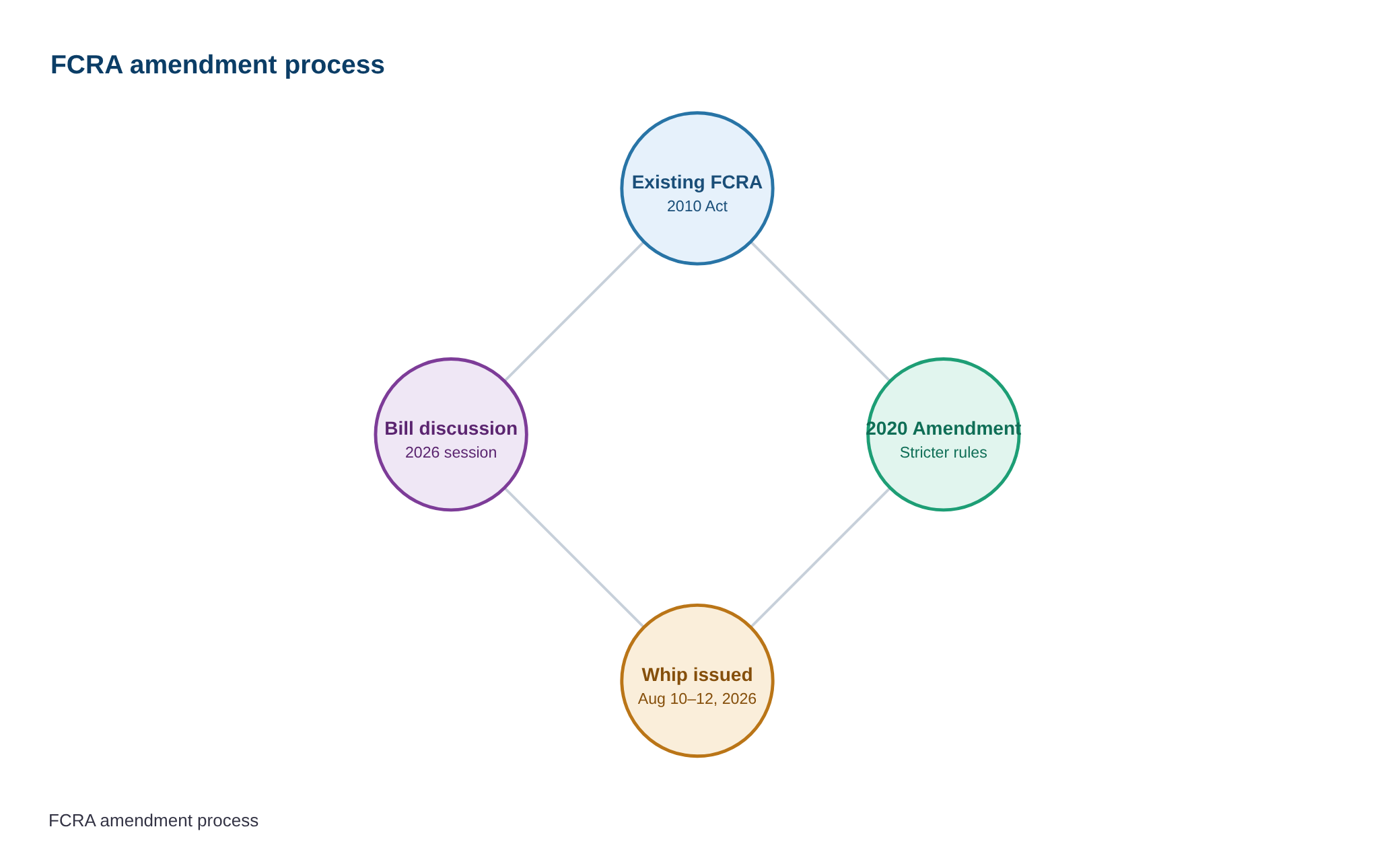
The Congress party has issued a three-day whip to its Members of Parliament (MPs) in both the Rajya Sabha and Lok Sabha, directing their presence for the discussion on the Foreign Contribution (Regulation) Amendment Bill, 2026, scheduled for August 10–12, 2026. This legislative move assumes significance against the backdrop of broader debates on foreign funding regulations, parliamentary discipline, and the functioning of the INDIA opposition bloc in the Monsoon Session of Parliament.
Background
- The Foreign Contribution (Regulation) Act (FCRA), 2010, regulates the acceptance and utilisation of foreign contributions by individuals, associations, and companies in India.
- The FCRA was amended in 2020 to introduce stricter provisions, including capping administrative expenses at 20% and mandatory opening of FCRA accounts in the State Bank of India, New Delhi.
- The proposed FCRA (Amendment) Bill, 2026, is expected to further tighten regulations, though its exact provisions remain undisclosed in public domain as of August 2026.
- Parliamentary whips are formal directives issued by political parties to ensure discipline among their MPs during legislative proceedings.
- The Monsoon Session of Parliament (August 2026) is a critical legislative window, coinciding with discussions on other significant Bills, including a potential Constitution Amendment Bill on delimitation.
What is the Foreign Contribution (Regulation) Amendment Bill, 2026?
- The FCRA (Amendment) Bill, 2026, is a legislative proposal aimed at amending the Foreign Contribution (Regulation) Act, 2010, to further regulate foreign funding in India.
- The Bill is expected to introduce stricter compliance mechanisms, including enhanced scrutiny of foreign contributions, possibly expanding the definition of ‘foreign source’ or tightening reporting requirements.
- The proposed amendments may address loopholes identified in the 2020 amendments, such as the misuse of foreign funds for political purposes or non-compliance by NGOs.
- The Bill is likely to align with the government’s broader agenda of ensuring transparency and accountability in foreign funding, while critics argue it could stifle civil society and non-governmental organisations (NGOs).
- The FCRA regime is administered by the Ministry of Home Affairs (MHA), which has the authority to suspend or cancel FCRA registrations for non-compliance.
- The Bill’s discussion in Parliament follows a pattern of legislative scrutiny where opposition parties often raise concerns about overreach and potential misuse of regulatory powers.
- The FCRA framework is distinct from the Foreign Exchange Management Act (FEMA), 1999, which governs foreign exchange transactions, though both aim to regulate financial inflows from abroad.
- The Bill’s passage could impact thousands of NGOs, associations, and individuals relying on foreign funding for welfare, research, and advocacy activities.
UPSC Value Addition
Keywords for Mains Answer-Writing
Foreign Contribution (Regulation) Act, 2010 · FCRA Amendment Bill 2026 · Parliamentary whip · Monsoon Session 2026 · Constitution Amendment Bill on delimitation · INDIA bloc · Parliamentary procedures · Role of opposition in legislative scrutiny · Regulation of foreign funds · Constitutional amendments · Parliamentary democracy · Party discipline in Parliament · Executive-legislature relations · Bill passage process · Constitutional provisions on Parliament
Prelims Practice Questions
Q1. Consider the following statements regarding the Foreign Contribution (Regulation) Act (FCRA), 2010:
1. The Act regulates the acceptance and utilisation of foreign contributions by individuals, associations, and companies.
2. The Act mandates that foreign contributions must be received only through designated banks.
3. The Act prohibits the transfer of foreign contributions to any other person or organisation.
4. The Act allows the central government to suspend the registration of an organisation for up to 10 years.
How many of the above statements are correct?
- Only one
- Only two
- Only three
- All four
Answer: All four — Statements 1, 2, and 3 are correct as per the FCRA, 2010. Statement 4 is incorrect; the central government can suspend registration for up to 3 years, not 10 years.
Q2. Assertion (A): The issuance of a whip by a political party in Parliament is a constitutional provision.
Reason (R): The Constitution of India, under Article 105, grants freedom of speech to members of Parliament but does not explicitly provide for party whips.
In the context of the above statements, which of the following is correct?
- Both A and R are true, and R is the correct explanation of A
- Both A and R are true, but R is not the correct explanation of A
- A is true, but R is false
- A is false, but R is true
Answer: A is true, but R is false — Assertion (A) is true; whips are issued under party discipline. Reason (R) is true but does not explain the assertion, as whips are not explicitly mentioned in Article 105 but are a convention.
Q3. Match the following parliamentary terms with their correct descriptions:
Column I (Term)
A. Whip
B. Delimitation
C. Money Bill
D. Censure Motion
Column II (Description)
1. A motion expressing strong disapproval of the government’s actions
2. A directive issued by a political party to its members to vote in a particular manner
3. The process of redrawing the boundaries of electoral constituencies based on census data
4. A financial bill certified by the Speaker of the Lok Sabha as containing only provisions related to taxation or government expenditure
Select the correct match:
- A-2, B-3, C-4, D-1
- A-1, B-2, C-3, D-4
- A-3, B-1, C-2, D-4
- A-4, B-3, C-1, D-2
Answer: A-2, B-3, C-4, D-1 — The correct matches are: A-2 (Whip), B-3 (Delimitation), C-4 (Money Bill), and D-1 (Censure Motion).
Mains Practice Question
✍ Critically examine the implications of the proposed FCRA Amendment Bill, 2026, on the regulatory framework governing foreign contributions in India. Also, analyse the role of opposition parties in scrutinising such legislative proposals in Parliament. (15 Marks)
Approach: MODEL-ANSWER SKELETON:
1. **Introduction (2 Marks)**:
– Brief context: FCRA, 2010 regulates foreign contributions; recent amendments proposed in Monsoon Session 2026.
– Mention the issuance of a whip by Congress to ensure party discipline during discussions.
2. **Key Provisions of FCRA Amendment Bill, 2026 (4 Marks)**:
– Highlight probable amendments (e.g., stricter compliance, limits on administrative expenses, Aadhaar linkage for office bearers).
– Reference to the need for transparency and accountability in foreign funding.
3. **Implications of the Amendment (5 Marks)**:
– **Positive Implications**: Enhanced transparency, reduced misuse of foreign funds, alignment with global standards.
– **Negative Implications**: Potential stifling of legitimate civil society activities, over-centralisation of power, impact on grassroots organisations.
– **Constitutional Concerns**: Balance between Article 19(1)(c) (freedom to form associations) and regulatory objectives.
4. **Role of Opposition in Scrutiny (4 Marks)**:
– Opposition’s role in parliamentary democracy: ensuring checks and balances, raising critical questions.
– Mechanisms: debates, calling attention motions, committee scrutiny.
– Recent example: Congress issuing a whip to ensure presence of MPs during discussions.
– Challenges: Executive dominance, party discipline, and the need for constructive opposition.
5. **Conclusion (2 Marks)**:
– Balanced view: Need for regulation vs. protection of democratic freedoms.
– Suggest measures for inclusive scrutiny (e.g., wider consultations, multi-party consensus).
Source: Times of India
Generated by AanyaAi for educational purpose.

- KWML’s Feasibility Reports for Water Metro in 18 Cities: UPSC & PCS Insights - October 3, 2026
- ओडिशा में वन्यजीव अनुसंधान अनुदान कार्यक्रम शुरू, सिमिलिपाल में 300 कैमरे और बढ़ेंगे - October 3, 2026
- India Summons Pakistan High Commission Official Over Violation - October 3, 2026

No Comments