


07 Aug Congress Whips MPs for FCRA Bill: Key Polity Updates for UPSC 2026
✎ The FCRA Amendment Bill seeks to amend the FCRA, 2010, by introducing stricter regulations on foreign funding, including restrictions on fund transfers, enhanced reporting requirements, and a tightened definition of ‘foreign…
Subject Relevance — Where This Topic Fits
- GS Paper II — Polity and Governance (Parliamentary Procedures, Amendments to Statutory Provisions) | GS Paper III — Economy (Regulation of Foreign Funding and Its Impact on NGOs and Civil Society)
- Prelims: Foreign Contribution (Regulation) Act, 2010, FCRA Amendment Bill, 2025, Parliamentary whip, Delimitation (Amendment) Bill, Article 338A (National Commission for Scheduled Castes), Article 338B (National Commission for Scheduled Tribes)
- Essay: The role of Parliament in balancing national security and democratic freedoms, Regulation of foreign funding: A necessary safeguard or a tool of suppression?
Quick Revision: The FCRA Amendment Bill seeks to amend the FCRA, 2010, by introducing stricter regulations on foreign funding, including restrictions on fund transfers, enhanced reporting requirements, and a tightened definition of ‘foreign source’.
Why is this in the news?
The Congress party has issued a parliamentary whip to its MPs ahead of the discussion on the FCRA Amendment Bill in the Monsoon Session of Parliament (August 10–12, 2026). The Bill seeks to amend the Foreign Contribution (Regulation) Act, 2010, and has sparked significant political debate, particularly regarding its potential impact on civil society organisations, non-governmental organisations (NGOs), and the broader democratic space in India. The timing coincides with broader parliamentary discussions, including the potential reintroduction of the Constitution (Amendment) Bill on delimitation, adding to the legislative complexity of the session.
Background
- The Foreign Contribution (Regulation) Act, 2010 (FCRA), regulates the acceptance and utilisation of foreign contributions or foreign hospitality by individuals, associations, or companies in India. It was enacted to ensure that such contributions do not compromise India’s sovereignty, security, or public interest.
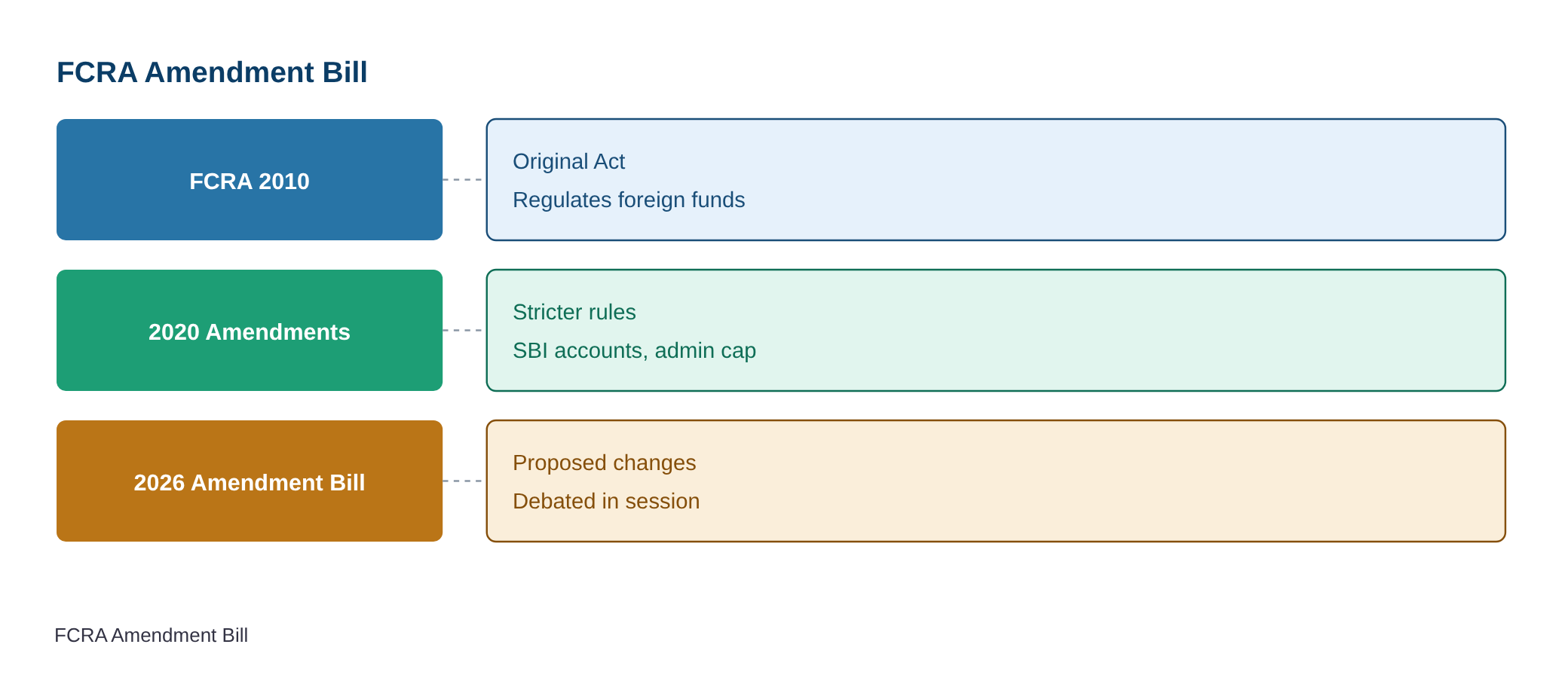
- The FCRA was amended in 2020 to introduce stricter provisions, including a cap on administrative expenses, mandatory opening of FCRA accounts in the State Bank of India (SBI), and restrictions on sub-granting foreign funds. These amendments were challenged in the Supreme Court but were largely upheld.
- Parliamentary whips are directives issued by political parties to ensure the presence and voting alignment of their members on critical issues. The Congress party’s whip reflects its strategic positioning ahead of the Bill’s discussion, signalling a united front on the issue.
- The Monsoon Session of Parliament (August 10–12, 2026) is also expected to deliberate on the Constitution (Amendment) Bill on delimitation, which aims to redraw Lok Sabha and Assembly constituencies based on the 2021 Census data. This adds to the legislative agenda and political discourse.
- The FCRA has been a subject of debate in the context of India’s international obligations under the Universal Declaration of Human Rights and the International Covenant on Civil and Political Rights, which protect the right to freedom of association and expression.
What is the FCRA Amendment Bill?
- The FCRA Amendment Bill seeks to amend the Foreign Contribution (Regulation) Act, 2010, to introduce stricter regulations on the acceptance and utilisation of foreign contributions in India.
- Key proposed amendments include: (a) Restrictions on the transfer of foreign funds between NGOs; (b) Enhanced reporting requirements for NGOs receiving foreign contributions; (c) Tightening the definition of ‘foreign source’ to include entities controlled by foreign nationals or entities; (d) Mandatory disclosure of foreign contributions in annual reports; and (e) Provisions for the suspension or cancellation of FCRA registration for non-compliance.
- The Bill aims to address concerns related to national security, sovereignty, and the misuse of foreign funds, particularly in the context of cross-border terrorism and organised crime.
- Critics argue that the Bill could disproportionately impact NGOs working on human rights, environmental issues, and social justice, by restricting their access to foreign funding. They contend that such restrictions may undermine democratic freedoms and civil society participation.
- The FCRA, 2010, was enacted to regulate foreign contributions and ensure transparency in their utilisation. The 2020 amendments introduced significant changes, including the requirement for NGOs to open FCRA accounts in the State Bank of India (SBI) and a cap on administrative expenses (50% of total foreign contributions).
- The Bill is part of a broader trend of regulatory tightening in India, including the Unlawful Activities (Prevention) Act (UAPA) and the Information Technology (Intermediary Guidelines and Digital Media Ethics Code) Rules, 2021, which have raised concerns about the shrinking space for dissent and civil society.
- The FCRA has been subject to judicial scrutiny, with the Supreme Court upholding the 2020 amendments in a 2023 judgment. The Court emphasised the need to balance regulatory oversight with the right to freedom of association and expression.
- The Bill’s discussion in Parliament reflects the ongoing debate between the government’s emphasis on national security and the concerns of civil society organisations about regulatory overreach and its impact on democratic freedoms.
Key Features
| Feature | Significance |
|---|---|
| Issue of a whip by political party | Ensures party discipline and uniform voting behavior among MPs, particularly on contentious legislative matters such as the FCRA Amendment Bill. |
| FCRA Amendment Bill | Proposes changes to the Foreign Contribution (Regulation) Act, 2010, which regulates foreign funding of NGOs and other entities in India. |
| Parliamentary Monsoon Session | A key legislative calendar for discussing and passing Bills, including those related to governance, economy, and social sectors. |
| INDIA bloc coordination | Demonstrates inter-party alignment on legislative strategy, particularly among opposition parties opposing the FCRA Amendment Bill. |
| Presence of MPs in both Houses | Critical for quorum and effective legislative functioning, especially during discussions on contentious Bills. |
Why it Matters
Legislative Process
- The issuance of a whip underscores the importance of the FCRA Amendment Bill in the parliamentary agenda, reflecting its potential impact on civil society and foreign funding dynamics.
- The Bill’s discussion during the Monsoon Session highlights the government’s intent to expedite legislative reforms, even amid opposition scrutiny.
- The absence of explicit mention in the tentative business schedule suggests either strategic ambiguity or last-minute scheduling, a common feature in parliamentary proceedings.
Political Dynamics
- The Congress party’s whip reflects its role as a principal opposition force, mobilizing allies to present a united front against the Bill.
- Coordination within the INDIA bloc indicates a broader opposition strategy to challenge government legislative priorities.
- The whip’s timing—just before the Bill’s discussion—signals high political stakes and potential electoral implications of foreign funding regulations.
Legal and Governance Implications
- The FCRA Amendment Bill, if passed, could alter the regulatory landscape for NGOs, impacting their operational autonomy and funding sources.
- Changes to FCRA may influence India’s engagement with international donors, civil society, and global transparency standards.
- The Bill’s progression through Parliament will be scrutinized for its alignment with constitutional principles of freedom of association and expression.
Economic and Social Impact
- Foreign contributions play a critical role in funding social sector initiatives, including healthcare, education, and environmental projects.
- Stricter FCRA regulations could reduce funding flows to NGOs, potentially affecting grassroots development and advocacy work.
- The Bill’s impact on civil society organizations may ripple into public discourse on governance, accountability, and civic participation.
Challenges
1. Regulatory Overreach vs. Autonomy
- Balancing national security concerns with the autonomy of civil society organizations remains a persistent challenge in FCRA regulations.
- Overly restrictive amendments could stifle legitimate foreign funding for developmental and humanitarian causes.
- The Bill’s provisions may face judicial review, raising questions about executive overreach in regulatory frameworks.
UPSC Link: GS-II: Role of NGOs in governance
2. Parliamentary Disruption
- Opposition-led disruptions during the Monsoon Session could delay legislative business, including the FCRA Bill.
- The issuance of a whip may exacerbate tensions, leading to walkouts or adjournments, further complicating parliamentary proceedings.
- Ensuring constructive debate while maintaining legislative efficiency is a recurring challenge in India’s parliamentary democracy.
UPSC Link: GS-II: Parliamentary functioning
3. Political Polarization
- The FCRA Bill has become a flashpoint for political polarization, with opposition parties framing it as an attack on democratic freedoms.
- The Bill’s passage could deepen mistrust between the government and civil society, as well as opposition parties.
- Managing political narratives around the Bill while ensuring evidence-based policymaking is a critical challenge.
UPSC Link: GS-II: Political parties and pressure groups
4. Implementation and Enforcement
- Stringent FCRA regulations may face implementation hurdles, including bureaucratic delays and legal ambiguities.
- Ensuring compliance without undermining the operational capacity of NGOs poses a significant governance challenge.
- Monitoring and evaluating the Bill’s impact post-enactment will require robust institutional mechanisms.
UPSC Link: GS-II: Administrative reforms
5. International Relations
- Stricter FCRA regulations could strain India’s diplomatic relations with countries and organizations that fund NGOs in India.
- The Bill may invite criticism from international human rights bodies and donor agencies, impacting India’s global image.
- Balancing sovereignty with international norms on transparency and civil society engagement is a complex diplomatic challenge.
UPSC Link: GS-II: Foreign policy and NGOs
Challenges — UPSC Perspective
| Issue | Concern |
|---|---|
| Over-regulation of NGOs | Risk of stifling legitimate foreign funding for developmental work. |
| Political weaponization of FCRA | Potential misuse to target dissenting civil society organizations. |
| Parliamentary logjam | Opposition-led disruptions may delay or derail the Bill’s passage. |
| Judicial scrutiny | Provisions may face legal challenges, leading to delays or modifications. |
| International backlash | Stricter regulations could alienate global partners and donor agencies. |
| Implementation gaps | Bureaucratic delays and ambiguities may hinder effective enforcement. |
Way Forward
- Parliament must ensure structured and evidence-based discussions on the FCRA Amendment Bill, avoiding political grandstanding.
- The government should release detailed impact assessments of the Bill’s provisions to address concerns about overreach.
- Opposition parties should propose constructive amendments rather than blanket opposition, fostering a bipartisan approach.
- Civil society organizations should engage proactively with policymakers to highlight potential unintended consequences.
- The Bill’s passage should be accompanied by clear guidelines for implementation to minimize bureaucratic hurdles.
- Parliamentary committees should conduct post-legislative scrutiny to evaluate the Bill’s impact on civil society and foreign funding.
- India should balance regulatory reforms with its commitments to international transparency and human rights norms.
- Media and civil society must play a vigilant role in monitoring the Bill’s implementation and its societal impact.
UPSC Value Addition
Keywords for Mains Answer-Writing
Foreign Contribution (Regulation) Amendment Bill, 2026 · FCRA provisions and amendments · Parliamentary whip and party discipline · Monsoon Session of Parliament 2026 · Constitution (One Hundred and Twenty-Eighth Amendment) Bill on delimitation · Role of the Speaker and Chairman in Parliament · Anti-defection law (Tenth Schedule) · India bloc and opposition coordination · Parliamentary procedures and legislative business · Constitutional amendments and parliamentary procedures
Constitutional & Policy Linkages
- [‘Article 19(1)(c): Freedom of association’, ‘FCRA regulations must not infringe upon this fundamental right.’]
- [‘Article 21: Right to livelihood’, ‘Overly restrictive FCRA could indirectly affect livelihoods of NGO workers.’]
Concept Flow
Government introduces FCRA Amendment Bill in Parliament → Opposition parties, led by Congress, issue whip to MPs to oppose the Bill → Parliamentary Monsoon Session convenes; Bill is scheduled for discussion → Opposition mobilizes allies within INDIA bloc to present a united front → Parliamentary proceedings face potential disruptions due to whip enforcement → Bill’s passage hinges on political consensus and legislative efficiency → Post-passage, implementation and judicial review determine long-term impact
Prelims Practice Questions
Q1. Consider the following statements regarding the Foreign Contribution (Regulation) Act (FCRA), 2010:
1. The Act regulates the acceptance and utilisation of foreign contributions by individuals, associations, and companies.
2. The Act mandates that foreign contributions must be received only through designated banks.
3. The Act prohibits the transfer of foreign contributions to any other person or organisation.
4. The Act allows foreign contributions to be used for speculative business activities.
How many of the above statements are correct?
- Only one
- Only two
- Only three
- All four
Answer: Only three — Statements 1, 2, and 3 are correct as per the FCRA, 2010. Statement 4 is incorrect because the Act prohibits the use of foreign contributions for speculative business activities.
Q2. Assertion (A): The issuance of a whip by a political party in Parliament is a constitutional provision.
Reason (R): The Tenth Schedule of the Constitution empowers the Speaker/Chairman to disqualify members for defying a whip.
Options:
A. Both A and R are true, and R is the correct explanation of A.
B. Both A and R are true, but R is not the correct explanation of A.
C. A is true, but R is false.
D. A is false, but R is true.
Answer: ? — Both the Assertion (A) and Reason (R) are true. The issuance of a whip is a parliamentary practice recognised under the anti-defection law (Tenth Schedule), and the Speaker/Chairman can disqualify members for defying a whip.
Q3. Match the following parliamentary terms with their correct descriptions:
Column I
1. Whip
2. Adjournment Motion
3. Calling Attention Notice
4. Motion of No-Confidence
Column II
A. A procedure to draw the attention of the House to a matter of urgent public importance.
B. A notice given by a member to call the attention of a minister to a matter of public importance.
C. A direction issued by a political party to its members to ensure their presence and voting in Parliament.
D. A motion expressing want of confidence in the Council of Ministers.
Options:
A. 1-C, 2-A, 3-B, 4-D
B. 1-B, 2-C, 3-D, 4-A
C. 1-D, 2-A, 3-C, 4-B
D. 1-A, 2-B, 3-D, 4-C
- A
- B
- C
- D
Answer: A — The correct match is: 1-C (Whip), 2-A (Adjournment Motion), 3-B (Calling Attention Notice), 4-D (Motion of No-Confidence).
Mains Practice Question
✍ The Monsoon Session of Parliament, 2026, has witnessed the issuance of a whip by the Congress party to its members ahead of the discussion on the Foreign Contribution (Regulation) Amendment Bill, 2026. Critically examine the significance of parliamentary whips in the context of legislative debates and party discipline in India. Also, analyse the implications of the proposed amendments to the FCRA, 2010, on civil society organisations and foreign funding in India. (15 Marks)
Approach: MODEL-ANSWER SKELETON:
1. **Introduction (2 Marks)**
– Define parliamentary whips and their constitutional/parliamentary basis (Tenth Schedule, anti-defection law).
– Contextualise the Monsoon Session 2026 and the FCRA Amendment Bill.
2. **Role and Significance of Whips (4 Marks)**
– Ensure party discipline and cohesion in Parliament.
– Facilitate the government’s legislative agenda or opposition’s strategic positioning.
– Balance between party loyalty and individual conscience (Article 105/194 protections).
– Recent examples of whip enforcement (e.g., 2023 data on defection cases).
3. **FCRA, 2010: Key Provisions and Amendments (4 Marks)**
– Core objectives: regulate foreign contributions, prevent misuse, and ensure transparency.
– Key provisions: registration, utilisation, designated banks, and prohibitions (e.g., speculative activities).
– Proposed amendments in 2026: potential changes to registration, utilisation norms, or restrictions on foreign funding.
– Impact on civil society organisations (CSOs), NGOs, and grassroots initiatives.
4. **Implications of FCRA Amendments (3 Marks)**
– On civil society: financial sustainability, operational autonomy, and advocacy roles.
– On foreign funding: transparency vs. over-regulation debates.
– Comparative perspective: global models (e.g., USA’s Foreign Agents Registration Act).
5. **Conclusion (2 Marks)**
– Balancing legislative efficiency (whips) with democratic accountability.
– Need for a balanced approach to FCRA to ensure transparency without stifling legitimate civil society activity.
Source: Times of India
Generated by AanyaAi for educational purpose.

- UPSC Alert: India-Bangladesh Methanol Cargo Flagged Off from Dibrugarh - October 5, 2026
- स्टॉक मार्केट में गिरावट, महंगाई ने बढ़ाया संकट: जानिए कारण और प्रभाव - October 5, 2026
- Rediscovered plant ‘Haplothismia exannulata’ inspires Wildlife Week in Kerala - October 5, 2026

No Comments