


07 Aug Nomura Report: AI Creating 83,100 Jobs in India, Outpacing Layoffs
✎ AI is reshaping India’s labour market by creating more jobs than it displaces, particularly in IT services, while accentuating the need for upskilling to bridge the two-tier divide between entry-level and experienced…
Subject Relevance — Where This Topic Fits
- GS Paper III — Technology, Economic Development, Bio-diversity, Environment, Security and Disaster Management (Role of AI in employment and economic transformation) | GS Paper II — International Relations (India’s role as a global labour market barometer)
- Prelims: Artificial Intelligence (AI), Nomura Holdings Inc., Job displacement, Attrition, Business Process Outsourcing (BPO), Chatbots, IT services, Labour market fragmentation, Productivity gains, Nandan Nilekani
- Essay: The Dual Impact of Artificial Intelligence: Innovation vs. Inequality, India’s Demographic Dividend in the Age of Automation
Quick Revision: AI is reshaping India’s labour market by creating more jobs than it displaces, particularly in IT services, while accentuating the need for upskilling to bridge the two-tier divide between entry-level and experienced professionals.
Why is this in the news?
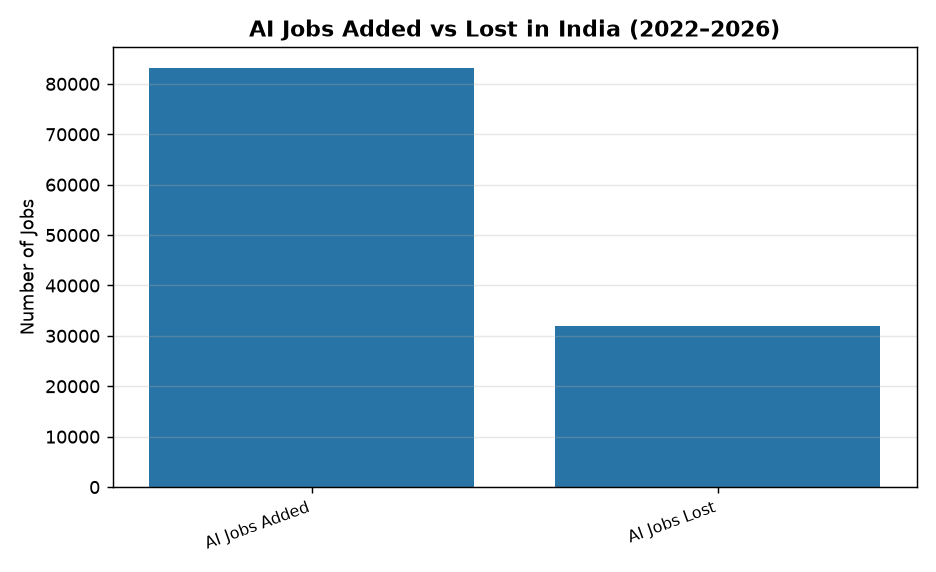
A recent report by Nomura Holdings Inc. reveals that India has witnessed a net positive impact on employment due to Artificial Intelligence (AI), with 83,100 AI-related jobs added against 31,921 losses during the period from 2022 to August 2026. This finding challenges the prevailing narrative of AI-induced job displacement and underscores India’s evolving role as a critical case study in the global AI-employment nexus. The report, which examined 69 AI-related developments across Asia, highlights India’s significance as ‘ground zero’ for evaluating AI’s impact on labour markets, given its vast workforce and outsourcing ecosystem.
Background
- India’s labour market has historically been shaped by its role as a global back office for multinational corporations, particularly in IT-enabled services and Business Process Outsourcing (BPO).
- The integration of AI technologies, such as generative AI and automation tools, has accelerated in recent years, transforming traditional job roles and creating new skill demands.
- Global concerns persist regarding AI’s potential to disrupt employment, with studies often highlighting job losses in sectors like financial services, customer support, and routine administrative roles.
- The Nomura report counters this narrative by demonstrating that, in India, AI-driven recruitment has outpaced job losses, particularly in IT services and allied sectors.
- The report’s findings are corroborated by broader trends in Asia, where economies like China and the Philippines also exhibit a similar pattern of AI-induced job creation exceeding displacement.
- India’s demographic dividend, characterised by a young and tech-savvy workforce, positions it uniquely to leverage AI for economic growth while mitigating displacement risks.
What is Artificial Intelligence (AI) and its Role in Employment?
- Artificial Intelligence (AI) refers to the simulation of human intelligence in machines, enabling them to perform tasks such as reasoning, learning, problem-solving, and decision-making autonomously.
- In the context of employment, AI technologies include machine learning, natural language processing (NLP), robotic process automation (RPA), and generative AI tools like chatbots and virtual assistants.
- AI’s impact on employment is dual in nature: it displaces routine and repetitive jobs while simultaneously creating new roles that require higher-order skills such as AI engineering, data science, and business process redesign.
- The Nomura report highlights that AI-driven hiring in India is predominantly concentrated in IT services, where firms explicitly cite AI demand as a catalyst for recruitment, particularly for entry-level and mid-level professionals.
- Conversely, job losses due to AI are largely confined to support functions, such as customer service and back-office operations, where automation tools like chatbots replace human roles.
- The report underscores the emergence of a two-tier labour market in India and other Asian economies, where demand for entry-level workers is weakening, while employers are increasingly seeking experienced professionals.
- AI’s role in employment is not merely about job creation or destruction but about transforming the nature of work, necessitating reskilling and upskilling initiatives to align the workforce with evolving market demands.
- The broader economic impact of AI includes productivity gains, cost optimisation for firms, and the potential to enhance India’s competitiveness in global markets.
Key Features
| Feature | Significance |
|---|---|
| AI-driven job creation in India | India added 83,100 AI-related jobs against 31,921 losses, indicating net positive employment impact from AI adoption. |
| Two-tier labour market | Demand for entry-level roles declines while experienced professionals with AI/business acumen are increasingly sought. |
| Sectoral displacement | Job losses concentrated in financial services (60% of 60,654 losses), while tech sector dominates AI-related hiring (90% of 130,758 hires). |
| Geographical spread | AI impact visible across Asia, including India, China, and the Philippines, where BPO contributes significantly to employment. |
| Distributional inequality | Displaced workers rarely transition to AI engineering roles, exacerbating labour market segmentation and inequality. |
Why it Matters
Economic Implications
- Net positive employment effect from AI adoption challenges the narrative of mass job displacement, particularly in India’s labour-intensive sectors.
- AI-driven productivity gains may enhance India’s global competitiveness, especially in IT and BPO services, where automation complements human capital.
- Uneven impact across sectors and skill levels risks widening income disparities, necessitating targeted policy interventions.
- India’s role as a global back office is evolving, with AI reshaping traditional outsourcing models and creating new high-skilled roles.
Strategic Workforce Development
- Accelerated demand for AI-literate professionals underscores the need for upskilling and reskilling initiatives in higher education and vocational training.
- Experience-based hiring trends highlight the importance of industry-academia collaboration to align curricula with emerging AI-driven job requirements.
- Public-private partnerships in skill development can mitigate the risk of structural unemployment in sectors vulnerable to AI-driven displacement.
Global Comparative Analysis
- India’s experience serves as a case study for other developing economies, demonstrating that AI adoption can coexist with job creation in specific contexts.
- Contrasts with narratives from developed economies, where AI-driven job losses are more pronounced, suggesting regional variations in AI’s employment impact.
Challenges
1. Structural Unemployment
- Displaced workers, particularly in financial services and support roles, face barriers to transitioning into AI-centric or high-skilled occupations.
- Limited mobility across sectors and skill levels exacerbates long-term unemployment risks for low-skilled workers.
UPSC Link: GS Paper 3: Employment & Skill Development
2. Skill Mismatch in Labour Market
- Rapid AI adoption outpaces the availability of skilled professionals, creating a gap between demand and supply in the labour market.
- Entry-level job market contraction reduces opportunities for fresh graduates, necessitating policy measures to bridge the skill divide.
UPSC Link: GS Paper 3: Skill Development & Education
3. Regional Disparities in AI Impact
- Urban centres and tech hubs benefit disproportionately from AI-driven job creation, while rural and semi-urban areas face limited opportunities.
- Concentration of AI-related employment in metropolitan regions risks deepening regional economic imbalances.
UPSC Link: GS Paper 3: Regional Development
4. Ethical and Social Concerns
- AI-driven automation may disproportionately affect marginalised communities, exacerbating social inequalities.
- Lack of transparency in AI deployment decisions raises concerns about accountability and worker rights.
UPSC Link: GS Paper 4: Ethics & Governance
5. Policy and Regulatory Gaps
- Absence of comprehensive AI governance frameworks in India limits the ability to address job displacement and ethical concerns effectively.
- Need for adaptive labour laws to regulate AI-driven hiring, firing, and upskilling policies.
UPSC Link: GS Paper 2: Governance & Policies
Challenges — UPSC Perspective
| Issue | Concern |
|---|---|
| Job displacement in financial services | High attrition due to AI-driven automation, particularly in back-office and support functions. |
| Skill mismatch | Gap between AI-driven job requirements and existing workforce skills, limiting employability. |
| Regional inequality | Concentration of AI-related jobs in urban centres, marginalising rural and semi-urban labour markets. |
| Ethical concerns | Potential for AI to exacerbate social inequalities and reduce transparency in employment decisions. |
| Policy vacuum | Lack of regulatory frameworks to address AI’s impact on employment, upskilling, and worker rights. |
| Entry-level job contraction | Reduced opportunities for fresh graduates due to AI-driven hiring trends favouring experienced professionals. |
Way Forward
- Strengthen industry-academia linkages to align higher education curricula with AI-driven job market demands, focusing on experiential learning and internships.
- Expand public-private partnerships for upskilling and reskilling programmes, targeting displaced workers in financial services and support roles.
- Implement targeted employment generation schemes in rural and semi-urban areas to counter regional disparities in AI-driven job creation.
- Develop AI governance frameworks that address ethical concerns, transparency, and accountability in automated hiring and firing processes.
- Enhance labour market data collection and analysis to better track AI’s impact on employment, enabling evidence-based policy interventions.
- Promote entrepreneurship and innovation in AI-driven sectors to create new job opportunities beyond traditional employment models.
- Introduce adaptive labour laws that balance flexibility for businesses with protections for workers in the context of AI adoption.
- Encourage multinational corporations to invest in local upskilling initiatives, leveraging India’s role as a global back office.
UPSC Value Addition
Keywords for Mains Answer-Writing
Artificial Intelligence and Employment · AI-driven job creation in India · Nomura report on AI jobs · Two-tier labour market in India · AI impact on entry-level jobs · AI and IT services sector · AI adoption in business process outsourcing · AI and financial services job losses · AI revolution and employment trends · AI-induced labour market segmentation
Concept Flow
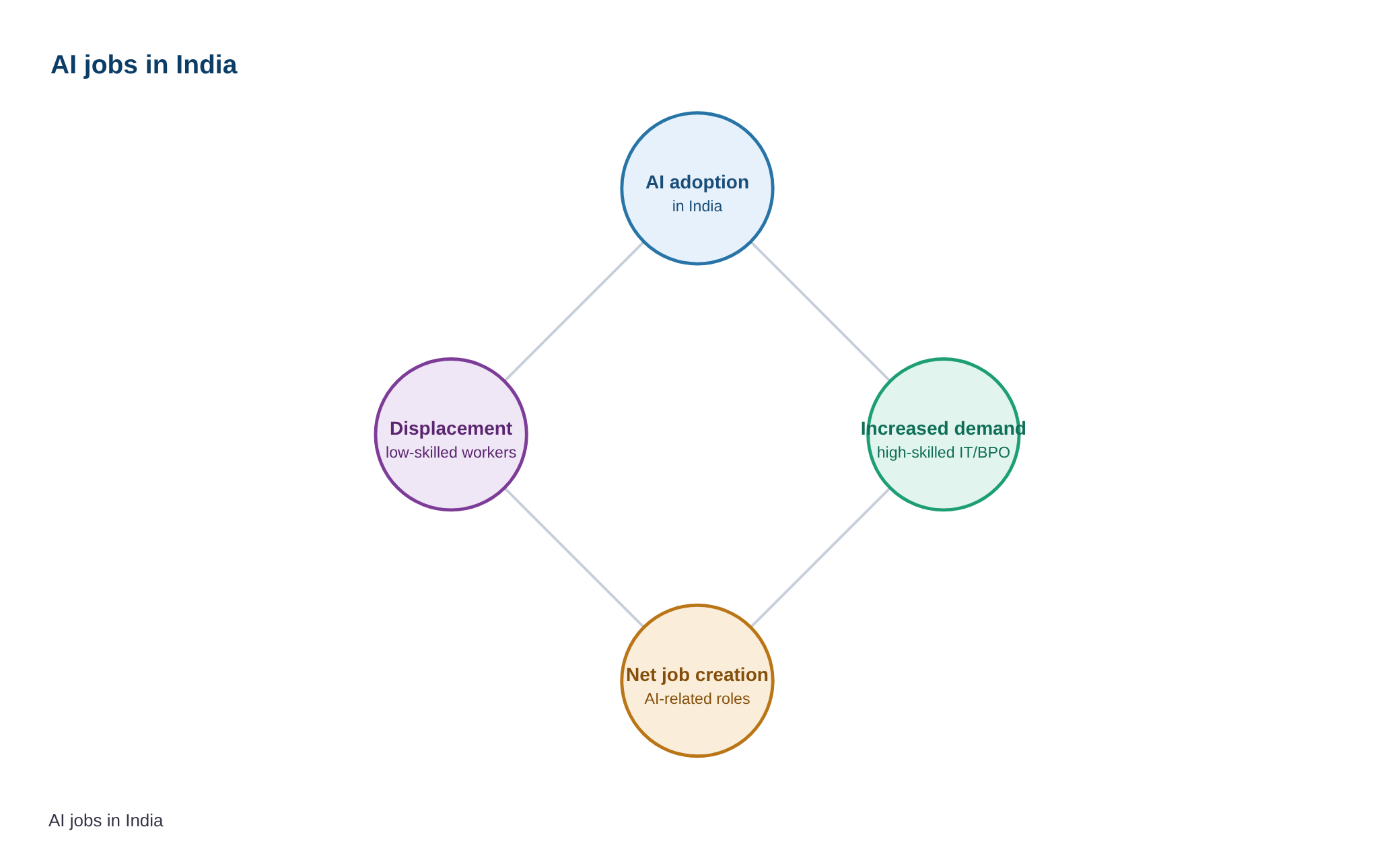
AI adoption in India → Increased demand for high-skilled professionals in IT and BPO sectors → Net job creation in AI-related roles → Displacement of low-skilled workers in financial services and support functions → Emergence of a two-tier labour market → Widening skill and regional disparities → Need for targeted policy interventions and upskilling initiatives → Long-term structural transformation of the labour market.
Prelims Practice Questions
Q1. Consider the following statements regarding the impact of Artificial Intelligence (AI) on employment in India as per the Nomura report:
1. India added 83,100 AI-related jobs during the study period, compared with 31,921 positions lost through layoffs and attrition.
2. The report indicates that most job losses due to AI are in the financial services sector, accounting for roughly 60% of total job cuts.
3. The study period for the report was from 2020 to 2025.
How many of the above statements are correct?
- Only one
- Only two
- All three
- None
Answer: Only two — Statement 1 is correct as per the report. Statement 2 is correct, with 60% of job losses in financial services. Statement 3 is incorrect; the study period was from 2022 to August 2026.
Q2. Assertion (A): The Nomura report suggests that AI is creating more jobs than it is displacing in India.
Reason (R): The report highlights that AI-driven recruitment in India exceeds job losses, with technology accounting for over 90% of AI-related hires.
In the context of the above statements, which of the following is correct?
- Both A and R are true, and R is the correct explanation of A
- Both A and R are true, but R is NOT the correct explanation of A
- A is true, but R is false
- A is false, but R is true
Answer: Both A and R are true, and R is the correct explanation of A — Both A and R are true, and R correctly explains A as the report quantifies AI-related job creation (130,758 hires) exceeding losses (60,654) with technology dominating the hires.
Q3. Match the following sectors with their respective AI-related employment impact as per the Nomura report:
Column I (Sector) Column II (AI Impact)
a. Financial Services 1. Most job losses due to AI adoption
b. IT Services 2. Majority of AI-related hires
c. Business Process Outsourcing 3. Mixed impact with some job creation
Select the correct match:
- a-1, b-2, c-3
- a-2, b-1, c-3
- a-3, b-2, c-1
- a-1, b-3, c-2
Answer: a-1, b-2, c-3 — Financial Services experienced most job losses (60% of total cuts). IT Services accounted for over 90% of AI-related hires. Business Process Outsourcing showed mixed impact with some job creation.
Mains Practice Question
✍ Critically examine the assertion that Artificial Intelligence (AI) is creating more jobs than it is displacing in India. Substantiate your response with empirical evidence from the Nomura report and analyse the structural shifts in the labour market. (15 Marks)
Approach: MODEL-ANSWER SKELETON:
1. **Empirical Evidence from Nomura Report**:
– AI-related job creation (83,100 jobs) exceeds job losses (31,921) in India.
– Technology sector accounts for over 90% of AI-related hires (130,758 hires across Asia).
– Financial services sector accounts for 60% of job losses (60,654 total losses).
2. **Structural Shifts in Labour Market**:
– **Two-tier labour market**: Decline in entry-level jobs (e.g., support teams replaced by chatbots) vs. increased demand for experienced professionals with AI expertise.
– **Sectoral divergence**: IT services and technology-driven roles benefit, while traditional support roles face displacement.
– **Regional impact**: India’s BPO sector (e.g., Philippines) shows mixed effects, with some job creation in AI-enabled services.
3. **Critical Examination**:
– **Distributional pain**: Displaced workers rarely transition to AI engineering roles; aggregates mask uneven impact.
– **Limitation of study**: Relies on news reports; labour markets remain fragmented; analysis indicates trends rather than absolute employment.
4. **Broader Implications**:
– AI as a job multiplier in the short term, but necessitates reskilling and upskilling for sustainable employment.
– Policy interventions: Focus on vocational training, AI literacy, and social safety nets for displaced workers.
5. **Conclusion**:
– AI is currently creating net employment in India, but the transition is uneven and requires proactive measures to mitigate displacement risks.
Source: Times of India
Generated by AanyaAi for educational purpose.

- Gujarat HC orders FIR in ITS officer’s 2023 custodial death - October 3, 2026
- डीआरआई ने मुंबई एयरपोर्ट पर सोने-हीरे की तस्करी गिरोह का किया पर्दाफाश, 8 गिरफ्तार - October 3, 2026
- Chhattisgarh CM Rural Bus Scheme: 850 Villages Connected in 1 Year - October 3, 2026

No Comments