


03 Oct Gujarat HC orders FIR in ITS officer’s 2023 custodial death
✎ Custodial deaths must be treated as potential criminal matters; judicial inquiries cannot substitute for statutory police investigations under the CrPC, and non-registration of an FIR in such cases is a violation of…
Subject Relevance — Where This Topic Fits
- GS Paper II — Fundamental Rights and DPSP | GS Paper III — Security, Cyber and Governance | GS Paper IV — Ethics and Human Interface
- Prelims: Custodial death, FIR under Section 154 CrPC, Judicial inquiry vs criminal investigation, Cognizable offence, DIG CID Crime supervision
- Essay: Judicial accountability in governance: Balancing rights and investigations, The role of the judiciary in protecting constitutional rights
Quick Revision: Custodial deaths must be treated as potential criminal matters; judicial inquiries cannot substitute for statutory police investigations under the CrPC, and non-registration of an FIR in such cases is a violation of constitutional and statutory rights.
Why is this in the news?
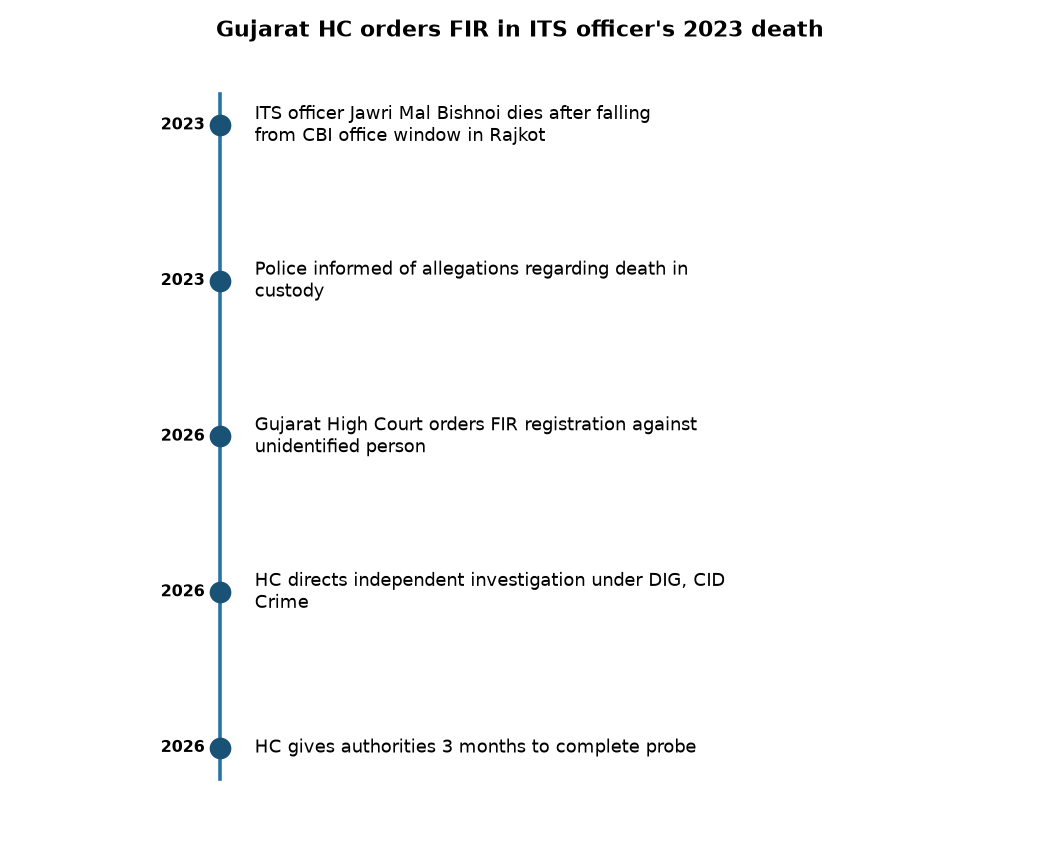
The Gujarat High Court has directed the registration of an FIR into the death of a senior Indian Trade Service officer, Jawri Mal Bishnoi, who died under suspicious circumstances in CBI custody in 2023. The court’s order underscores the legal imperative to treat custodial deaths as potential criminal matters, independent of judicial inquiries, and mandates an unbiased investigation under the supervision of a senior police officer.
Background
- Custodial deaths are governed by constitutional protections under Articles 21 and 22 of the Constitution, which guarantee the right to life and liberty and prohibit unlawful detention.
- The Code of Criminal Procedure (CrPC), 1973, mandates the registration of an FIR under Section 154 for cognizable offences, including those arising from custodial deaths.
- Judicial inquiries, such as those conducted under the Protection of Human Rights Act, 1993, are supplementary to criminal investigations and cannot substitute for statutory police inquiries.
- The case highlights the tension between administrative inquiries and criminal investigations, particularly when material on record suggests the commission of a cognizable offence.
- The Supreme Court, in cases like *Prakash Singh v. Union of India* (2006), has emphasized the need for independent and accountable police investigations to uphold public trust.
- The incident occurred during the custody of the Central Bureau of Investigation (CBI), a premier investigative agency under the Union Government, raising questions about institutional accountability.
What are the constitutional and legal safeguards against custodial deaths in India?
- **Constitutional Provisions**: Articles 21 (Right to Life and Personal Liberty) and 22 (Protection against Arrest and Detention) of the Constitution impose an obligation on the state to ensure that no person is subjected to torture or death in custody.
- The **Code of Criminal Procedure (CrPC), 1973**, requires the registration of an FIR under Section 154 for cognizable offences, including those arising from custodial deaths. Failure to register an FIR is a violation of statutory duty.
- A **judicial inquiry** (e.g., under the Protection of Human Rights Act, 1993) is an administrative process to examine systemic failures but does not absolve the police of their duty to investigate criminal liability under the CrPC.
- The **Supreme Court**, in landmark judgments like *DK Basu v. State of West Bengal* (1997) and *Nilabati Behera v. State of Orissa* (1993), has laid down guidelines to prevent custodial violence and ensure accountability.
- The **National Human Rights Commission (NHRC)** has issued directives for the protection of detainees, including mandatory reporting of custodial deaths and independent investigations.
- **Magisterial Inquiries** under Section 176 of the CrPC are conducted by a magistrate to determine the cause of death but do not replace criminal investigations.
- The **Police Act, 1861**, and state police manuals prescribe protocols for the treatment of detainees, including medical examinations and documentation of custody periods.
- The **CBI Manual of Instructions** governs the conduct of CBI officers during arrests and custody, including the prohibition of coercive methods and the requirement for proper documentation.
Key Features
| Feature | Significance |
|---|---|
| Registration of FIR after three years | Demonstrates the judiciary’s role in ensuring accountability for alleged custodial deaths, even after prolonged delays, by directing criminal investigation where material prima facie discloses cognizable offences. |
| Judicial scrutiny of police inaction | Highlights the constitutional duty of the judiciary to intervene when executive agencies fail to register FIRs despite prima facie evidence of cognizable offences, reinforcing the principle of ‘no one is above the law’. |
| Distinction between judicial inquiry and criminal investigation | Clarifies that a judicial inquiry into custodial death cannot substitute for a statutory police investigation, as the latter is mandatory where material discloses an offence. |
| Supervision of investigation by DIG, CID Crime | Ensures independence and impartiality in the probe by vesting oversight with a higher-ranking officer, reducing risks of institutional bias or procedural lapses. |
| Remedies for non-registration of FIR | Reaffirms the legal avenues available to aggrieved parties, including appeals to senior police officers or magistrates, while emphasizing the need for expedited action in custodial death cases. |
Why it Matters
Legal and Judicial
- Reinforces the constitutional principle that judicial inquiries cannot preempt statutory police investigations where material prima facie discloses a cognizable offence, as enshrined in Article 21 (Right to Life) and the Code of Criminal Procedure, 1973.
- Demonstrates the judiciary’s proactive role in upholding institutional accountability, particularly in cases involving custodial deaths, by directing FIR registration despite prior judicial or administrative inquiries.
Administrative and Procedural
- Exposes procedural gaps in the handling of custodial death cases, where initial inquiries treated the incident as accidental without registering an FIR, despite allegations of a cognizable offence.
- Highlights the need for standardized protocols in cases involving allegations against public servants, including the separation of administrative inquiries from criminal investigations to avoid conflict of interest.
Institutional Integrity
- Underscores the importance of independent oversight in high-profile cases involving allegations of corruption or misconduct by public officials, particularly when the incident occurs within the premises of a law enforcement agency.
- Raises questions about the adequacy of existing safeguards in custodial environments, including the monitoring of detainees and the transparency of investigative processes.
Challenges
1. Delays in Criminal Investigation
- Prolonged inaction by investigative agencies in registering FIRs despite prima facie evidence of cognizable offences, leading to erosion of public trust in law enforcement.
- The three-year delay in this case underscores the need for expeditious processing of allegations, particularly in custodial death scenarios where evidence may degrade or witnesses’ memories fade.
UPSC Link: Criminal Procedure Code, 1973 (Sections 154-156)
2. Conflict Between Administrative and Criminal Inquiries
- Risk of administrative inquiries being treated as substitutes for criminal investigations, potentially compromising the integrity of the latter due to perceived institutional bias.
- The Gujarat HC’s ruling clarifies that judicial inquiries cannot replace statutory police investigations, but this distinction is often blurred in practice, leading to procedural ambiguities.
UPSC Link: Code of Criminal Procedure, 1973 (Section 176)
3. Institutional Accountability in Custodial Deaths
- Ensuring that law enforcement agencies do not operate with impunity, particularly in cases where the incident occurs within their own premises, which may create perceptions of cover-up or lack of transparency.
- The need for robust internal oversight mechanisms to prevent procedural lapses or deliberate inaction in cases involving allegations against public servants.
UPSC Link: Protection of Human Rights Act, 1993 (Section 17)
4. Preservation of Evidence and Witness Integrity
- Challenges in maintaining the integrity of evidence in cases where a significant period elapses between the incident and the initiation of a formal investigation, particularly in custodial environments.
- The risk of tampering with or loss of evidence, including digital records (e.g., mobile phones, surveillance footage), which may be critical to establishing the sequence of events.
UPSC Link: Indian Evidence Act, 1872 (Sections 27, 65B)
5. Public Trust and Perception of Justice
- The erosion of public confidence in institutions when allegations of custodial deaths or misconduct by public servants are not promptly and transparently investigated.
- The need for proactive communication by investigative agencies to address public concerns and demonstrate commitment to due process.
UPSC Link: Constitution of India (Article 21)
Challenges — UPSC Perspective
| Issue | Concern |
|---|---|
| Delay in FIR registration | Undermines the credibility of investigative agencies and delays justice, particularly in custodial death cases where evidence is time-sensitive. |
| Overlap between judicial and criminal inquiries | Creates ambiguity in the investigative process, potentially leading to procedural lapses or perceived bias in the handling of the case. |
| Institutional bias in investigations | Raises concerns about the independence of probes when allegations involve officers from the same or allied agencies, necessitating external oversight. |
| Preservation of digital and physical evidence | Challenges in maintaining the integrity of evidence over prolonged periods, particularly in cases involving allegations against public servants. |
| Public perception of impunity | Erosion of trust in institutions when high-profile cases involving allegations of misconduct are not addressed promptly or transparently. |
Way Forward
- Strengthen protocols for the registration of FIRs in cases involving allegations of cognizable offences, with strict timelines to prevent delays and ensure expeditious action.
- Mandate the separation of administrative inquiries from criminal investigations in cases of custodial deaths or allegations against public servants to avoid conflicts of interest.
- Enhance transparency in investigative processes by providing periodic updates to the public and aggrieved parties, particularly in high-profile cases.
- Establish independent oversight mechanisms, such as a dedicated cell within the CBI or state police, to monitor the handling of allegations involving public servants.
- Conduct regular training for law enforcement personnel on the legal and procedural requirements for handling custodial deaths and allegations of misconduct, with a focus on due process.
- Ensure the preservation and secure handling of digital and physical evidence in cases involving allegations against public servants, including the timely seizure and analysis of electronic devices.
- Promote awareness among the public about their rights and the legal remedies available in cases of non-registration of FIRs or allegations of custodial misconduct.
UPSC Value Addition
Keywords for Mains Answer-Writing
Custodial death · FIR registration · Gujarat High Court · Judicial inquiry vs criminal investigation · Cognizable offence · Constitutional remedies against non-registration of FIR · Indian Trade Service (ITS) · Judicial scrutiny of police inaction · Supervision of investigation by DIG, CID Crime · Statutory investigation process · Protection of life and personal liberty under Article 21
Constitutional & Policy Linkages
- Article 21 (Right to Life and Personal Liberty) — Ensures that no person shall be deprived of life or personal liberty except according to procedure established by law, including the right to a fair and impartial investigation.
Concept Flow
Allegation of corruption against public servant (ITS officer) → CBI’s Anti-Corruption Bureau initiates investigation → Arrest and overnight custody → Alleged fall from fourth-floor window → Death declared accidental by police → Judicial inquiry conducted → Gujarat HC examines material on record and finds prima facie cognizable offence → Directs registration of FIR and independent investigation → Highlights distinction between judicial inquiry and criminal investigation.
Prelims Practice Questions
Q1. Consider the following statements regarding the registration of an FIR in India:
1. A person aggrieved by the non-registration of an FIR can approach a magistrate under Section 156(3) of the Code of Criminal Procedure, 1973.
2. The Gujarat High Court in the given case held that a judicial inquiry into a custodial death can substitute for a criminal investigation.
3. The Code of Criminal Procedure, 1973, mandates that a police officer must register an FIR upon receiving information about the commission of a cognizable offence.
How many of the above statements are correct?
- Only one
- Only two
- All three
- None
Answer: Only two — Statement 1 is correct as Section 156(3) CrPC empowers magistrates to direct the police to investigate cognizable offences. Statement 2 is incorrect; the Gujarat High Court explicitly held that a judicial inquiry cannot substitute a criminal investigation. Statement 3 is correct as Section 154(1) CrPC requires registration of an FIR for cognizable offences.
Q2. Assertion (A): The Gujarat High Court directed the registration of an FIR in the custodial death case of an ITS officer, holding that material on record disclosed a possible cognizable offence.
Reason (R): The court observed that the police had treated the incident as an accidental death despite allegations of a cognizable offence, and a judicial inquiry could not preclude a statutory investigation.
In the context of the above assertions and reasons, which of the following is correct?
- Both A and R are true, and R is the correct explanation of A.
- Both A and R are true, but R is not the correct explanation of A.
- A is true, but R is false.
- A is false, but R is true.
Answer: Both A and R are true, and R is the correct explanation of A. — Both the assertion and reason are factually accurate. The Gujarat High Court did direct the registration of an FIR in the custodial death case, and the reason correctly explains the court’s rationale that a judicial inquiry cannot substitute a statutory criminal investigation.
Q3. Match the following provisions of the Code of Criminal Procedure, 1973 with their respective functions:
Column I (Provision) | Column II (Function)
———————————————–|———————————————–
A. Section 154 | 1. Direction to police to investigate by magistrate
B. Section 156(3) | 2. Registration of FIR for cognizable offences
C. Section 176 | 3. Inquiry into cases of death in police custody
D. Section 190 | 4. Power of magistrate to take cognizance of offences
Select the correct match:
- A-2, B-1, C-3, D-4
- A-1, B-2, C-4, D-3
- A-4, B-3, C-2, D-1
- A-3, B-4, C-1, D-2
Answer: A-2, B-1, C-3, D-4 — Section 154 CrPC mandates registration of an FIR for cognizable offences (A-2). Section 156(3) empowers magistrates to direct police investigation (B-1). Section 176 CrPC pertains to inquiry into deaths in police custody (C-3). Section 190 CrPC grants magistrates the power to take cognizance of offences (D-4).
Mains Practice Question
✍ The Gujarat High Court has recently underscored the primacy of the statutory investigation process over judicial inquiries in cases involving alleged custodial deaths. Critically examine the constitutional and procedural safeguards against custodial violence in India, with particular reference to the role of the judiciary in ensuring accountability. Also, analyse the implications of the court’s directive that a judicial inquiry cannot substitute for a criminal investigation. (15 Marks)
Approach: MODEL-ANSWER SKELETON:
1. **Constitutional Safeguards**:
– Article 21 (Right to Life and Personal Liberty) and Article 20(3) (protection against self-incrimination) as interpreted by the Supreme Court in *Maneka Gandhi v. Union of India* (1978) and *D.K. Basu v. State of West Bengal* (1997).
– Directive Principles of State Policy (Article 38, 39(e), 39A) and their judicial enforceability.
2. **Statutory Framework**:
– Sections 154, 156(3), 176, and 190 of the Code of Criminal Procedure, 1973, governing FIR registration, magistrate’s powers, and inquiries into custodial deaths.
– The Protection of Human Rights Act, 1993, and the role of the National Human Rights Commission (NHRC) in monitoring custodial violence.
3. **Judicial Role and Precedents**:
– *D.K. Basu v. State of West Bengal* (1997): laid down guidelines for arrest, detention, and custodial torture.
– *Prakash Singh v. Union of India* (2006): reforms in police accountability and the seven directives for police reforms.
– *Arnesh Kumar v. State of Bihar* (2014): caution against arbitrary arrests and the need for compliance with Section 41A CrPC.
4. **Judicial Inquiry vs Criminal Investigation**:
– Distinction between *judicial inquiry* (conducted by a judicial officer) and *criminal investigation* (conducted by police under CrPC).
– The Gujarat High Court’s reasoning in the instant case: judicial inquiry cannot substitute statutory investigation (Section 154 CrPC) as it lacks the coercive powers of a criminal investigation.
– The court’s directive for independent investigation under DIG, CID Crime to ensure impartiality.
5. **Accountability Mechanisms**:
– Role of the magistracy under Section 156(3) CrPC to ensure FIR registration.
– NHRC’s powers under Section 12 of the Protection of Human Rights Act, 1993, to inquire into custodial deaths.
– The need for systemic reforms in police accountability and the implementation of the Prakash Singh directives.
6. **Implications of the Court’s Directive**:
– Strengthens the rule of law by ensuring that no custodial death is treated as an accidental death without a proper criminal investigation.
– Reinforces the principle that judicial inquiries are supplementary, not substitutive, to statutory investigations.
– Highlights the judiciary’s role as a watchdog against executive inaction and procedural lapses.
7. **Balancing Views**:
– Arguments for judicial inquiries: they are often faster and less adversarial, providing quick relief to victims’ families.
– Counter-arguments: judicial inquiries lack the coercive tools of a police investigation (e.g., arrests, searches) and may not uncover the full truth.
8. **Way Forward**:
– Strengthening the implementation of police reforms (Prakash Singh case).
– Enhancing transparency in custodial death investigations through mandatory video recording of arrests and interrogations.
– Greater sensitization of police personnel on human rights and custodial violence.
Source: The Indian Express
Gujarat PCS (GPSC) — State PCS Practice
Prelims: In 2023, the Gujarat High Court ordered an FIR in a case involving the death of an IAS officer. Which of the following was the primary reason cited by the High Court for this order?
- A. Allegations of administrative negligence leading to the officer’s death
- B. Suspicion of foul play in the officer’s death under suspicious circumstances
- C. Violation of the officer’s fundamental rights during service
- D. Failure of the state government to provide adequate security to the officer
Answer: B. Suspicion of foul play in the officer’s death under suspicious circumstances — The Gujarat High Court ordered an FIR based on suspicion of foul play in the death of the IAS officer, directing the state to investigate the matter thoroughly.
Mains: Critically analyze the legal and administrative implications of the Gujarat High Court’s order for an FIR in the case of the IAS officer’s death in 2023. Discuss how this judgment impacts the accountability of state officials and the protection of civil servants in Gujarat.
Generated by AanyaAi for educational purpose.
Related guides on our sites
- Anthropology VS PSIR
- Best PSIR optional coaching
- Best PSIR optional coaching online
- Best PSIR optional teacher

- Gujarat HC orders FIR in ITS officer’s 2023 custodial death - October 3, 2026
- डीआरआई ने मुंबई एयरपोर्ट पर सोने-हीरे की तस्करी गिरोह का किया पर्दाफाश, 8 गिरफ्तार - October 3, 2026
- Chhattisgarh CM Rural Bus Scheme: 850 Villages Connected in 1 Year - October 3, 2026

No Comments