


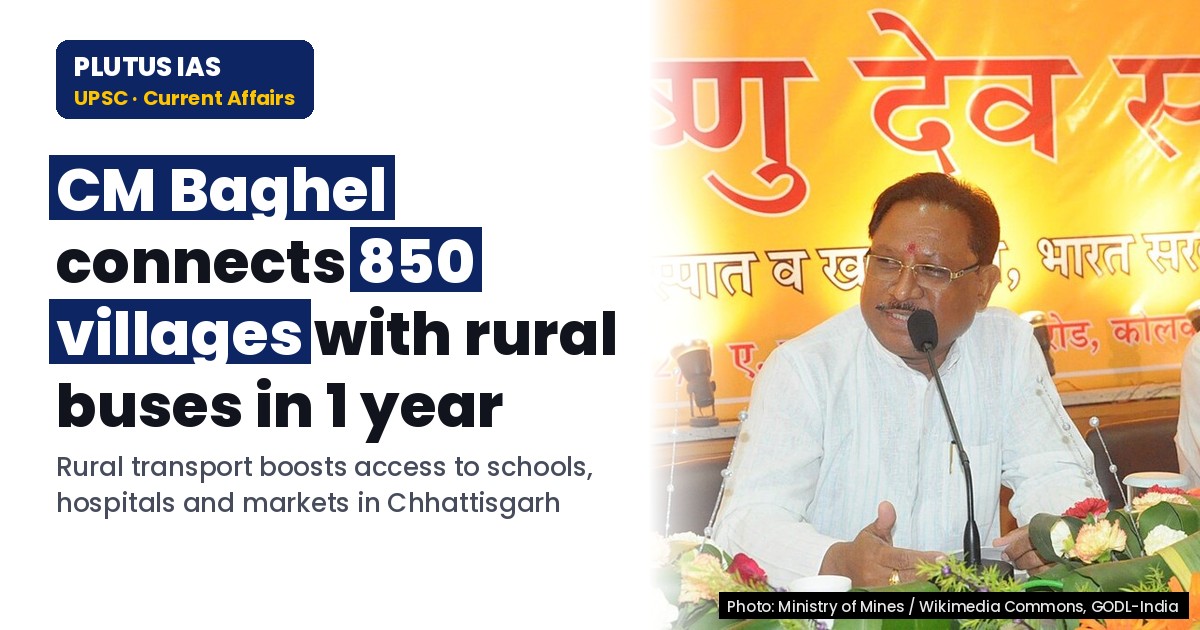
03 Oct Chhattisgarh CM Rural Bus Scheme: 850 Villages Connected in 1 Year
✎ The Chief Minister’s Rural Bus Scheme in Chhattisgarh demonstrates how state intervention in public transport can transform rural mobility, reduce socio-economic disparities, and ensure equitable access to essential services…
Subject Relevance — Where This Topic Fits
- GS Paper II — Governance, Administration and Public Policy | GS Paper III — Infrastructure: Transport and Rural Development
- Prelims: Public Transport Infrastructure, Rural Connectivity, Pradhan Mantri Gram Sadak Yojana (PMGSY), State Transport Undertakings (STUs), Social Impact Assessment of Transport Schemes
- Essay: Role of State in Ensuring Inclusive Growth, Sustainable Development and Rural-Urban Divide
Quick Revision: The Chief Minister’s Rural Bus Scheme in Chhattisgarh demonstrates how state intervention in public transport can transform rural mobility, reduce socio-economic disparities, and ensure equitable access to essential services through regulated, subsidised bus services in unserved and underserved regions.
Why is this in the news?
The Chief Minister’s Rural Bus Scheme in Chhattisgarh has completed one year, marking a significant milestone in enhancing regular public transport access to 850 previously unserved villages across 13 districts. The scheme’s operational success—covering 24 lakh km in 12 months—underscores its role in addressing rural mobility deficits, reducing dependency on informal transport, and fostering socio-economic inclusion in tribal and remote regions.
Background
- Chhattisgarh, with a significant tribal population (32.5% as per Census 2011), faces challenges in rural connectivity due to geographical barriers, low population density, and economic viability concerns for private operators.
- The state’s transport infrastructure is critical for accessing essential services such as healthcare, education, and markets, particularly in districts like Bastar and Surguja, which are part of the Scheduled Areas under the Fifth Schedule of the Constitution.
- Prior to this scheme, rural mobility relied heavily on informal transport like pickups and goods carriers, which lacked regulation, safety standards, and affordability, disproportionately affecting women, children, elderly, and persons with disabilities.
- The scheme aligns with the national framework for rural connectivity, complementing initiatives like the Pradhan Mantri Gram Sadak Yojana (PMGSY), which focuses on road connectivity but does not address public transport services.
- Public transport in India is governed by the Motor Vehicles Act, 1988, and state transport undertakings (STUs) play a pivotal role in ensuring regulated, affordable, and accessible mobility solutions.
- Chhattisgarh’s initiative reflects a broader trend among states to leverage public-private partnerships (PPPs) and state-led interventions to bridge rural transport gaps, as seen in similar schemes in Himachal Pradesh and Uttarakhand.
What is the Chief Minister’s Rural Bus Scheme?
- The scheme aims to provide regular, subsidised bus services to villages lacking formal public transport connectivity, particularly in tribal and remote areas.
- Operationalised through 107 buses across 106 routes in 13 districts, the scheme covers approximately 5,300 km of notified routes, with distances ranging from 14 to 105 km per route.
- The scheme prioritises routes in the Bastar and Surguja divisions, which include districts like Sukma, Dantewada, Bijapur, Narayanpur, Bastar, Kanker, Kondagaon, Surajpur, Jashpur, and Balrampur—regions with historically poor transport infrastructure.
- Financial viability is ensured through government subsidies, reducing the burden on private operators and enabling regular services in low-density, high-cost operational zones.
- Daily operations involve approximately 17,500 km of travel, with most routes operating two trips per day, thereby enhancing accessibility to district headquarters, block development offices, schools, and healthcare facilities.
- The scheme addresses gender-specific mobility challenges by providing a safer, regulated, and affordable alternative to informal transport, particularly for women and girls accessing education and healthcare.
- Monitoring and evaluation are conducted through field assessments and passenger feedback, with the scheme’s expansion planned in phases to include 4,368 additional villages in its second stage.
- The initiative exemplifies a state-led model of inclusive governance, where public transport is treated as a public good rather than a purely commercial enterprise.
Key Features
| Feature | Significance |
|---|---|
| Inception and Coverage | Launched on 4 October 2025, the scheme now operates 107 buses across 106 routes in 13 districts of Bastar and Surguja divisions, connecting 850 previously unserved villages. |
| Operational Scale | Buses cover approximately 24 lakh kilometres in one year, with daily operations exceeding 17,500 kilometres, ensuring consistent public transport access. |
| Route Characteristics | Routes range from 14 to 105 kilometres, with most routes operating two trips daily; total notified route length is about 5,300 kilometres. |
| District-wise Distribution | Bastar division: 51 routes with 50 buses; Surguja division: 55 routes with 57 buses, ensuring equitable regional coverage. |
| Target Beneficiaries | Primarily benefits rural populations, including women, children, elderly, and patients, by reducing reliance on informal transport modes. |
Why it Matters
Economic
- Reduces transport costs for rural households by providing subsidised and reliable bus services, thereby enhancing disposable income for essential services and goods.
- Stimulates local economies by improving access to markets, healthcare, and educational institutions, fostering trade and commerce in remote areas.
- Creates employment opportunities in bus operations, maintenance, and ancillary services, contributing to rural livelihoods.
Social
- Enhances mobility for marginalised groups, including women, children, and the elderly, by offering safe and scheduled transport options.
- Facilitates access to primary and secondary healthcare, reducing delays in medical emergencies and improving health outcomes.
- Supports educational continuity by enabling students to attend schools and colleges in nearby towns and district headquarters.
Infrastructure and Governance
- Demonstrates the role of state-led public transport initiatives in bridging gaps in rural connectivity, complementing national schemes like the Pradhan Mantri Gram Sadak Yojana (PMGSY).
- Highlights the importance of data-driven route planning and periodic assessments to optimise service delivery in geographically challenging terrains.
- Serves as a model for replicating similar schemes in other states with comparable socio-geographical challenges.
Environmental
- Encourages a shift from informal, often polluting, transport modes to formal, regulated bus services, potentially reducing vehicular emissions in rural areas.
- Promotes sustainable mobility by integrating public transport into rural development plans, aligning with national climate action goals.
Challenges
1. Geographical and Logistical Constraints
- Hilly and forested terrains in Bastar and Surguja divisions pose challenges in route design, road maintenance, and vehicle performance.
- Seasonal weather conditions, such as monsoons, disrupt operations and increase maintenance costs.
- Limited availability of trained drivers and mechanics in remote areas, affecting fleet reliability.
UPSC Link: Geography of India – Tribal Areas
2. Financial Sustainability
- High operational costs due to low passenger density on rural routes, necessitating continued government subsidies.
- Dependence on state budget allocations for viability, raising concerns about long-term funding security.
- Need for innovative financing models, such as public-private partnerships, to ensure economic viability.
UPSC Link: Public Finance – Subsidies
3. Social and Cultural Barriers
- Traditional reliance on informal transport modes may slow adoption of formal bus services among rural populations.
- Gender norms in some communities may limit women’s ability to utilise bus services independently, requiring awareness campaigns.
- Cultural preferences for local transport providers could pose challenges in mainstreaming the scheme.
UPSC Link: Social Issues – Gender and Mobility
4. Regulatory and Administrative Hurdles
- Coordinating with multiple stakeholders, including local authorities, transport departments, and bus operators, for seamless implementation.
- Ensuring compliance with road safety regulations and vehicle standards in remote and inaccessible areas.
- Addressing issues of fare regulation and subsidy disbursement to prevent misuse or inefficiencies.
UPSC Link: Governance – Public Service Delivery
Challenges — UPSC Perspective
| Issue | Concern |
|---|---|
| Route Accessibility | Geographical barriers limit route expansion and increase maintenance costs in tribal and forested areas. |
| Passenger Density | Low ridership on rural routes challenges financial viability despite high societal benefits. |
| Seasonal Disruptions | Monsoons and extreme weather conditions lead to frequent service disruptions and higher repair costs. |
| Human Resource Gaps | Shortage of trained drivers and mechanics in remote areas affects fleet reliability and safety. |
| Fare Affordability | Balancing subsidised fares with operational costs to ensure accessibility without overburdening the exchequer. |
| Stakeholder Coordination | Need for seamless collaboration between state agencies, local bodies, and transport operators for efficient implementation. |
Way Forward
- Expand route coverage to additional districts and villages, prioritising areas with the highest unmet demand for public transport.
- Introduce dynamic pricing models and flexible fare structures to balance affordability with financial sustainability.
- Enhance maintenance infrastructure by establishing regional service centres and training local mechanics.
- Launch targeted awareness campaigns to promote the scheme among women, students, and elderly populations.
- Explore public-private partnerships to leverage private sector expertise in route optimisation and fleet management.
- Integrate the scheme with other rural development initiatives, such as PMGSY and Ayushman Bharat, for holistic impact.
- Conduct periodic impact assessments to evaluate socio-economic benefits and identify areas for improvement.
- Strengthen data systems to monitor ridership, service reliability, and user feedback for evidence-based decision-making.
UPSC Value Addition
Keywords for Mains Answer-Writing
Public transport infrastructure in rural India · Chhattisgarh CM Rural Bus Scheme · Accessibility in tribal regions · Sustainable public transport policy · Inclusive development and mobility · Government intervention in transport sector · Rural connectivity and socio-economic impact · Public-private partnership in transport · Regional disparity in infrastructure · Constitutional provisions for local governance and service delivery
Constitutional & Policy Linkages
- Article 21 – Right to Life and Personal Liberty (mobility as a component of dignified living)
- Article 38 – Directive Principles of State Policy (promotion of welfare and reducing inequalities)
- Article 41 – Right to Work and Education (facilitating access to opportunities)
Concept Flow
Identification of rural transport gaps in Bastar and Surguja divisions → State-led intervention through the CM Rural Bus Scheme → Route planning and fleet deployment in unserved villages → Operationalisation of bus services with government subsidies → Increased mobility for rural populations, particularly marginalised groups → Economic and social spill-over effects (education, healthcare, trade) → Challenges in sustainability, governance, and infrastructure → Way forward: expansion, innovation, and integration with broader development goals
Prelims Practice Questions
Q1. Consider the following statements regarding the Chhattisgarh CM Rural Bus Scheme:
1. The scheme was launched in October 2025.
2. It operates 107 buses on 106 routes covering 13 districts.
3. The scheme aims to connect 4,368 villages in its second phase.
4. The scheme is funded entirely by private operators without government support.
How many of the above statements are correct?
- Only one
- Only two
- Only three
- All
Answer: Only three — Statements 1, 2, and 3 are correct. Statement 4 is incorrect as the scheme involves government financial support to make operations viable in remote areas.
Q2. Assertion (A): The Chhattisgarh CM Rural Bus Scheme is a state-led initiative to enhance rural connectivity.
Reason (R): The scheme provides financial assistance to private operators to run buses in remote tribal regions.
Options:
A. Both A and R are true, and R is the correct explanation of A.
B. Both A and R are true, but R is not the correct explanation of A.
C. A is true, but R is false.
D. A is false, but R is true.
Answer: ? — Both the assertion and reason are true. The scheme is indeed state-led (A) and provides financial assistance to private operators (R), making R the correct explanation of A.
Q3. Match the following columns regarding the Chhattisgarh CM Rural Bus Scheme:
Column I (District) | Column II (Number of buses operating)
——————- | ——————————–
A. Sukma | 1. 5
B. Bastar | 2. 7
C. Dantewada | 3. 9
D. Narayanpur | 4. 4
Options:
A. A-3, B-1, C-2, D-4
B. A-2, B-1, C-3, D-4
C. A-3, B-2, C-1, D-4
D. A-4, B-1, C-2, D-3
Answer: ? — The correct match is: A (Sukma) – 9 buses, B (Bastar) – 5 buses, C (Dantewada) – 7 buses, D (Narayanpur) – 4 buses.
Mains Practice Question
✍ The provision of regular public transport in remote tribal regions is not merely a logistical challenge but a constitutional imperative for inclusive development. Critically examine the significance of the Chhattisgarh CM Rural Bus Scheme in this context, with reference to Articles 38, 39, and 46 of the Constitution of India. Also, analyse the potential socio-economic impacts of such schemes on marginalised communities. (15 Marks)
Approach: MODEL-ANSWER SKELETON:
1. **Constitutional Framework**:
– Article 38 (Directive Principles of State Policy): State’s obligation to secure social order for the welfare of people, particularly marginalised groups.
– Article 39 (a): Equal access to means of livelihood; (b): Distribution of material resources for common good; (c): Prevention of concentration of wealth.
– Article 46: Promotion of educational and economic interests of Scheduled Tribes and weaker sections.
– **Link**: Regular bus services in remote areas align with these provisions by ensuring equitable access to education, healthcare, and livelihood opportunities.
2. **Significance of the Scheme**:
– **Accessibility**: Connects 850 villages previously devoid of regular transport, reducing reliance on unsafe or irregular private vehicles.
– **Socio-Economic Impact**:
– **Education**: Facilitates school attendance for children, particularly girls, in tribal regions.
– **Healthcare**: Enables timely access to medical facilities for patients and pregnant women.
– **Livelihood**: Supports daily wage workers, farmers, and traders in reaching markets and administrative centres.
– **Gender Equality**: Reduces the burden on women and girls who often bear the brunt of limited mobility.
– **Governance**: Strengthens local governance by improving connectivity to block and district headquarters, enhancing service delivery.
3. **Challenges and Limitations**:
– **Financial Viability**: Remote routes with low passenger density may remain unsustainable without continued government support.
– **Infrastructure**: Poor road conditions and terrain in tribal areas can limit the effectiveness of bus services.
– **Operational Efficiency**: Ensuring regularity, safety, and affordability in sparsely populated regions.
– **Environmental Concerns**: Potential increase in carbon emissions if not paired with sustainable transport alternatives.
4. **Comparative Perspective**:
– **Similar Schemes**: Odisha’s ‘Mo Bus’ scheme, Jharkhand’s rural transport initiatives.
– **Global Examples**: Brazil’s ‘Frota Azul’ programme for rural connectivity.
5. **Way Forward**:
– **Integration with Other Schemes**: Linking with PMGSY (Pradhan Mantri Gram Sadak Yojana) for road infrastructure.
– **Technology Adoption**: Use of GPS tracking, digital ticketing, and real-time updates to improve efficiency.
– **Community Participation**: Involving local tribal communities in route planning and service monitoring.
– **Sustainability**: Exploring electric buses or hybrid models to reduce environmental impact.
**Balanced View**: While the scheme marks a significant step toward inclusive development, its long-term success depends on addressing financial sustainability, infrastructure gaps, and environmental considerations.
Source: amarujala.com
Generated by AanyaAi for educational purpose.
Related guides on our sites
- Best PSIR optional coaching for upsc
- Best PSIR optional teacher for upsc
- Best teacher of PSIR optional for upsc
- Best PSIR optional coaching in delhi for UPSC

- KWML’s Feasibility Reports for Water Metro in 18 Cities: UPSC & PCS Insights - October 3, 2026
- ओडिशा में वन्यजीव अनुसंधान अनुदान कार्यक्रम शुरू, सिमिलिपाल में 300 कैमरे और बढ़ेंगे - October 3, 2026
- India Summons Pakistan High Commission Official Over Violation - October 3, 2026

No Comments