


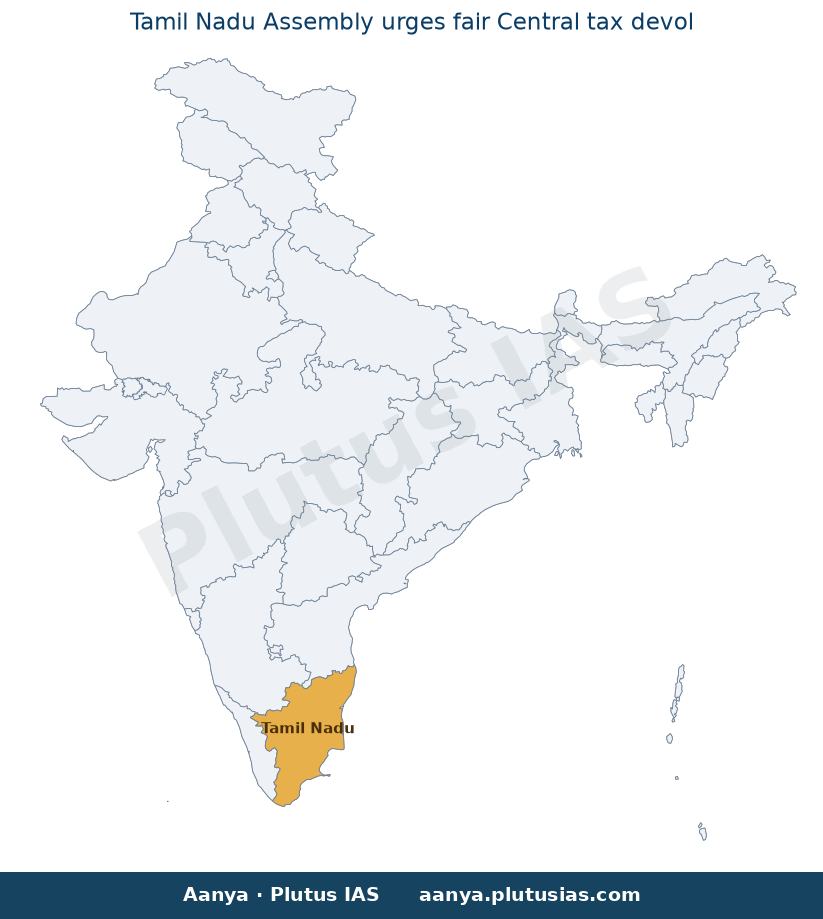
08 Aug Tamil Nadu Assembly Demands Fair Central Tax Devolution: Key UPSC Insights
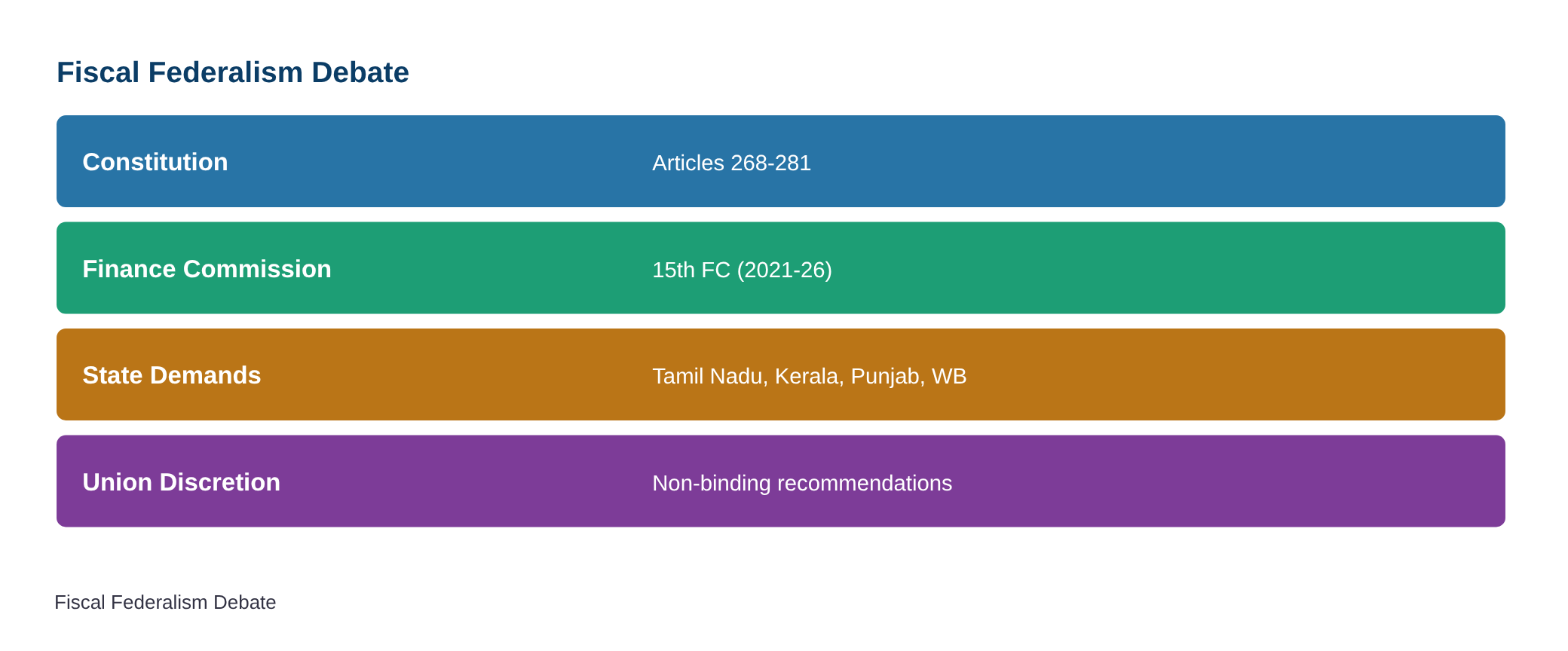
✎ The Finance Commission’s tax devolution formula must balance equity, efficiency, and need, while ensuring that States are not penalised for past achievements in population control or human development.
Subject Relevance — Where This Topic Fits
- GS Paper II — Functions and Responsibilities of the Union and the States, Issues and Challenges Pertaining to the Federal Structure, Devolution of Powers and Finances up to Local Levels and Challenges Therein | GS Paper III — Indian Economy and issues relating to Planning, Mobilisation of Resources, Growth, Development and Employment
- Prelims: Finance Commission, Article 280, Devolution of Taxes, Vertical and Horizontal Devolution, Fiscal Federalism, Terms of Reference of Finance Commission, Gadgil Formula, NITI Aayog, State Finance Commission, Revenue Deficit Grants
- Essay: Federalism in India: Balancing Unity and Diversity, Fiscal Federalism and Inclusive Development: The Case for Equitable Resource Distribution
Quick Revision: The Finance Commission’s tax devolution formula must balance equity, efficiency, and need, while ensuring that States are not penalised for past achievements in population control or human development.
Why is this in the news?
The Tamil Nadu Assembly’s unanimous adoption of a resolution on August 7, 2026, demanding a fair share of Central tax devolution underscores longstanding concerns over the adequacy and equity of the Finance Commission’s criteria. This development is significant as it reflects the broader debate on fiscal federalism in India, particularly the need for transparent, objective, and need-based criteria in tax devolution that do not penalise states for achievements in population control or human development.
Background
- The Constitution of India, under Article 280, mandates the establishment of a Finance Commission every five years to recommend the distribution of Union tax revenues between the Centre and the States, as well as among the States themselves.
- The Finance Commission’s terms of reference (ToR) have historically included criteria such as population, income distance, area, and fiscal discipline, but the weightage assigned to these factors has been a subject of contention among states.
- Tamil Nadu, like several other states, has argued that the current methodology disproportionately disadvantages states that have made significant progress in population stabilisation and human development, as these achievements are not adequately reflected in the devolution formula.
- The Finance Commission’s recommendations are not binding on the Union government, which retains the discretion to accept, reject, or modify them, leading to potential conflicts over fiscal federalism.
- States such as Kerala, Punjab, and West Bengal have also raised concerns over the adequacy of devolution, citing the need for a more equitable and transparent framework.
- The 15th Finance Commission (2021-26) introduced changes such as the use of the 2011 Census data and a higher weightage for demographic performance, which some states view as penalising their past efforts in population control.
What is Central Tax Devolution?
- Central tax devolution refers to the transfer of a share of the Union government’s tax revenue to the States, as mandated by the Constitution under Article 280.
- The Finance Commission, a constitutional body, recommends the principles governing this devolution, including the vertical share (Centre to States) and horizontal share (among States).
- The vertical share is determined by the Finance Commission’s assessment of the States’ financial needs and the Centre’s fiscal capacity, while the horizontal share is based on criteria such as population, income distance, area, and fiscal discipline.
- The Gadgil Formula (1969) and later modifications have been used to determine the horizontal distribution of taxes among States, though the exact criteria and weightages have evolved over time.
- The Finance Commission’s recommendations are advisory, and the Union government may accept, reject, or modify them, leading to potential disputes over fiscal federalism.
- The 15th Finance Commission (2021-26) introduced significant changes, including the use of 2011 Census data for population criteria and a higher weightage for demographic performance, which has been criticised by some states for not adequately compensating for past achievements.
- States like Tamil Nadu argue that the current methodology does not adequately recognise their fiscal efforts, governance performance, or developmental needs, particularly in areas such as population stabilisation and human development.
- The debate over tax devolution is closely linked to broader issues of fiscal federalism, including the autonomy of States in resource utilisation, the adequacy of revenue transfers, and the need for a more transparent and equitable framework.
Key Features
| Feature | Significance |
|---|---|
| Unanimous Assembly Resolution | Demonstrates cross-party consensus on fiscal federalism, enhancing the resolution’s political weight and legitimacy. |
| Call for Transparent Methodology | Highlights the demand for objective, rule-based criteria in tax devolution, reducing arbitrariness in Centre-State fiscal transfers. |
| Recognition of Fiscal Effort | Emphasises the inclusion of governance performance and developmental needs, aligning with constitutional principles of equity. |
| Protection Against Disadvantage | Seeks safeguards for States achieving population stabilisation and human development, addressing unintended consequences of devolution formulas. |
| Focus on Tamil Nadu’s Interests | Underscores the State’s proactive stance in defending its legitimate financial claims within the federal framework. |
Why it Matters
Constitutional and Legal
- Reaffirms the constitutional mandate of fiscal federalism under Article 268-281, which delineates the Centre’s taxing powers and States’ share in Union taxes.
- Aligns with the spirit of cooperative federalism enshrined in the 73rd and 74th Constitutional Amendments, promoting participatory governance.
- Invokes the principle of equity in Article 368(2)(b), which permits Parliament to amend the Constitution to ensure equitable distribution of resources.
Economic
- Highlights the fiscal asymmetry between States, where resource-rich or high-performing States (e.g., Tamil Nadu) may receive less than their contributions due to formulaic biases.
- Underscores the need for a devolution formula that balances efficiency (e.g., tax effort) with equity (e.g., developmental needs), preventing fiscal imbalances.
- Raises concerns about the impact of rigid devolution criteria on States’ ability to fund social welfare schemes, infrastructure, and human development initiatives.
Political and Administrative
- Signals Tamil Nadu’s assertive stance in Centre-State financial negotiations, reflecting sub-national aspirations within India’s federal structure.
- Demonstrates the role of State Assemblies in shaping fiscal policy discourse, reinforcing the democratic legitimacy of such demands.
- Potential to influence national discourse on revisiting the Finance Commission’s terms of reference, particularly in post-2026 assessments.
Social and Developmental
- Links fiscal devolution to human development outcomes, arguing that States with better governance and demographic transitions should not be penalised.
- Emphasises the need for inclusive growth, where fiscal transfers account for regional disparities in development indicators like literacy, health, and infrastructure.
Challenges
1. Formulaic Bias in Devolution
- Existing devolution formulas (e.g., 15th Finance Commission’s terms) may not adequately account for States’ fiscal effort or developmental achievements.
- Risk of penalising States for population stabilisation, which could disincentivise progressive demographic policies.
- Lack of a standardised methodology to measure ‘governance performance,’ leading to subjective assessments.
UPSC Link: 15th Finance Commission Report
2. Centre-State Fiscal Asymmetry
- Vertical imbalance persists due to the Centre’s preponderance in tax collection, necessitating a fairer redistribution mechanism.
- Horizontal imbalance arises from unequal fiscal capacities among States, exacerbating regional disparities.
- Tamil Nadu’s demand reflects broader concerns of southern States, which contribute more to the Union exchequer than they receive.
UPSC Link: Article 270-281 (Tax Distribution)
3. Political Economy of Fiscal Federalism
- Centre’s reluctance to cede fiscal autonomy may stem from strategic interests (e.g., maintaining control over welfare schemes).
- States with higher tax bases (e.g., Tamil Nadu) face pressure to subsidise less developed States, creating political friction.
- Risk of ad-hoc fiscal transfers (e.g., GST compensation) undermining the predictability of devolution.
UPSC Link: Cooperative vs. Competitive Federalism
4. Implementation and Compliance
- Ensuring Centre’s adherence to constitutional principles in devolution formulas remains a persistent challenge.
- Lack of a constitutional mechanism to enforce equitable devolution, relying instead on political negotiations.
- Potential for judicial intervention if Centre fails to address States’ grievances, as seen in past Supreme Court rulings (e.g., 2018 Kerala Floods case).
UPSC Link: Article 32 (Judicial Review)
Challenges — UPSC Perspective
| Issue | Concern |
|---|---|
| Devolution Formula | Lack of objective criteria to measure States’ fiscal effort, governance, and developmental needs. |
| Vertical Fiscal Imbalance | Disproportionate tax collection by the Centre vis-à-vis its expenditure responsibilities. |
| Horizontal Fiscal Imbalance | Unequal fiscal capacities among States, leading to disparities in service delivery. |
| Political Resistance | Centre’s reluctance to revise devolution formulas due to strategic or electoral considerations. |
| Judicial Constraints | Limited scope for courts to enforce equitable devolution without explicit constitutional violations. |
| Implementation Lag | Delay in translating demands into actionable changes in Finance Commission recommendations. |
Way Forward
- The Union government should constitute a high-powered committee to revisit the devolution formula, incorporating metrics for fiscal effort, governance, and human development.
- States should proactively document their contributions to the Union exchequer and developmental achievements to strengthen their claims in negotiations.
- Parliament should consider amending the Constitution to include a ‘fiscal federalism clause,’ ensuring equitable devolution as a fundamental principle.
- The Finance Commission should adopt a multi-year devolution framework to provide States with predictable fiscal transfers, reducing uncertainty.
- Civil society and academia should conduct independent studies to evaluate the impact of devolution formulas on States’ fiscal health and development outcomes.
- The Centre and States should establish a permanent inter-governmental council to address fiscal disputes and harmonise tax policies.
- Judicial activism should be encouraged to interpret constitutional provisions (e.g., Article 268-281) in favour of equitable fiscal federalism.
- States should leverage the GST Council to advocate for a more balanced distribution of GST revenues, addressing current imbalances.
UPSC Value Addition
Keywords for Mains Answer-Writing
Fiscal federalism in India · Devolution of Union taxes · Finance Commission of India · Article 280 of the Constitution · Terms of Reference of Finance Commissions · Horizontal distribution of resources · Criteria for tax devolution · Population stabilisation and human development · Equitable fiscal transfers · Cooperative federalism · Tamil Nadu’s fiscal demands · Union-State financial relations · Constitutional principles of fiscal equity
Constitutional & Policy Linkages
- Article 268-281 (Distribution of Taxes between Union and States)
- Article 270 (Taxes levied and collected by the Union but distributed between Union and States)
- Article 275 (Grants-in-aid from the Union to States)
- Article 280 (Finance Commission)
- Article 282 (Grants for public purposes)
Concept Flow
Tamil Nadu’s fiscal contribution → Centre’s tax collection (Article 270) → Devolution formula (Article 280) → State’s share of Union taxes → Tamil Nadu’s demand for equitable devolution → Unanimous Assembly resolution → Call for transparent methodology → Centre’s response (or lack thereof) → Potential judicial or political intervention.
Prelims Practice Questions
Q1. Consider the following statements regarding the Finance Commission of India:
1. It is a constitutional body established under Article 280.
2. It recommends the principles governing the grants-in-aid of the revenues of the States out of the Consolidated Fund of India.
3. The recommendations of the Finance Commission are binding on the Union Government.
4. The Finance Commission is appointed every five years.
How many of the above statements are correct?
- Only one
- Only two
- Only three
- All four
Answer: Only three — Statements 1, 2, and 4 are correct. Statement 3 is incorrect as the recommendations of the Finance Commission are advisory and not binding on the Union Government.
Q2. Assertion (A): The Finance Commission of India uses population as a primary criterion for horizontal devolution of Union taxes.
Reason (R): The Finance Commission is mandated by the Constitution to ensure equitable distribution of resources among States.
Options:
A. Both A and R are true, and R is the correct explanation of A.
B. Both A and R are true, but R is not the correct explanation of A.
C. A is true, but R is false.
D. A is false, but R is true.
- A
- B
- C
- D
Answer: A — Both A and R are true. The Finance Commission does use population as a primary criterion for horizontal devolution, and its mandate under Article 280 is to ensure equitable distribution of resources among States.
Q3. Which of the following is NOT a criterion used by the Finance Commission for the horizontal distribution of Union taxes to States?
- Population
- Area
- Fiscal capacity distance
- Per capita income
- Forest cover
Answer: Forest cover — Per capita income is not a direct criterion used by the Finance Commission for horizontal distribution. The primary criteria include population, area, fiscal capacity distance, and forest cover.
Mains Practice Question
✍ The Tamil Nadu Assembly’s unanimous resolution on ensuring a fair share of Central tax devolution underscores the persistent tensions in India’s fiscal federalism. Critically examine the constitutional and institutional mechanisms governing the devolution of Union taxes to States, with particular reference to the role of the Finance Commission. Also, assess how recent demands by States for a more equitable and transparent methodology align with the principles of cooperative federalism. (15 Marks)
Approach: MODEL-ANSWER SKELETON:
1. **Constitutional Framework**:
– Article 280: Establishment and functions of the Finance Commission.
– 14th, 15th, and 16th Finance Commissions: Key recommendations and shifts in criteria (e.g., population, fiscal capacity, demographic changes).
– Horizontal vs. vertical devolution: Principles and objectives.
2. **Criteria for Devolution**:
– Primary criteria: Population (1971 base), area, fiscal capacity distance, forest cover.
– Secondary criteria: Demographic changes, tax effort, and governance performance.
– Tamil Nadu’s concerns: Recognition of fiscal effort, governance performance, and developmental needs.
3. **Institutional Mechanisms**:
– Finance Commission’s Terms of Reference (ToR): Transparency, objectivity, and equity.
– Role of NITI Aayog and other bodies in advising on fiscal transfers.
– Limitations: Lack of binding nature of recommendations, delays in constitution of Commissions.
4. **Cooperative Federalism**:
– Definition and principles: Shared responsibility, mutual trust, and respect for autonomy.
– Recent tensions: States’ demands for greater autonomy in fiscal matters (e.g., GST compensation, tax devolution).
– Judicial interventions: Landmark judgments (e.g., S.R. Bommai case, Union of India v. State of Kerala) on fiscal federalism.
5. **Way Forward**:
– Reforms: Adoption of a transparent and objective methodology for devolution.
– Balancing equity and efficiency: Addressing concerns of States like Tamil Nadu while ensuring fiscal discipline.
– Role of Parliament: Ensuring that the Finance Commission’s recommendations are debated and implemented in a timely manner.
Balance of Views:
– Proponents of equity argue for greater weightage to developmental needs and governance performance.
– Critics caution against over-reliance on subjective criteria, which may undermine fiscal discipline.
Source: The Hindu
Generated by AanyaAi for educational purpose.

- NIRF रैंकिंग 2026: नए बदलाव और क्यों है ये महत्वपूर्ण? - September 23, 2026
- NIRF Rankings 2026: Key Changes & Their Impact on UPSC Aspirants - September 23, 2026
- मुस्लिम महिलाओं को विरासत में समान अधिकार: सुप्रीम कोर्ट ने केंद्र से पूछा जवाब - September 23, 2026

No Comments