


23 Sep NIRF Rankings 2026: Key Changes & Their Impact on UPSC Aspirants
✎ The NIRF evaluates higher education institutions across five parameters—Teaching, Learning and Resources (30%), Research and Professional Practices (30%), Graduation Outcomes (15%), Outreach and Inclusivity (10%), and Perception…
Subject Relevance — Where This Topic Fits
- GS Paper II — Governance, Administration and Challenges (Education Sector)
- Prelims: NIRF, NAAC, HEIs, TLP, RPP, OI, Perception-based rankings, UGC, Ministry of Education
- Essay: Quality in Higher Education: Balancing Rankings with Holistic Development
Quick Revision: The NIRF evaluates higher education institutions across five parameters—Teaching, Learning and Resources (30%), Research and Professional Practices (30%), Graduation Outcomes (15%), Outreach and Inclusivity (10%), and Perception (15%)—using a weighted scoring system to derive composite rankings.
Why is this in the news?
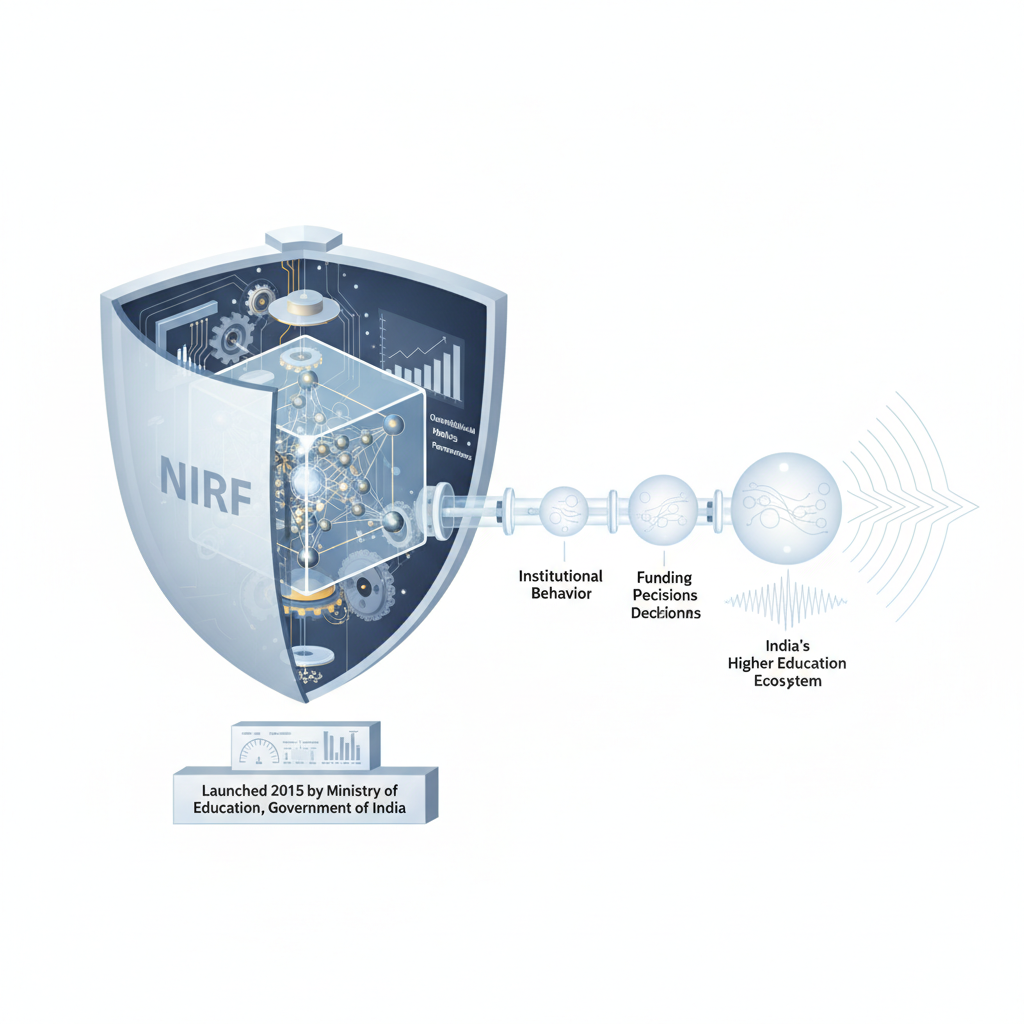
The National Institutional Ranking Framework (NIRF) has recently been highlighted for its methodology, parameters, and the ongoing debate surrounding its efficacy in measuring institutional quality. Critics argue that the current framework may inadvertently prioritise quantitative metrics over qualitative outcomes, potentially distorting institutional priorities and compromising academic integrity. This discussion is timely, as NIRF rankings significantly influence institutional behaviour, funding decisions, and student perceptions, thereby shaping the trajectory of India’s higher education ecosystem.
Background
- The National Institutional Ranking Framework (NIRF) was launched in 2015 by the Ministry of Education, Government of India, to provide a systematic and objective evaluation of higher education institutions (HEIs) across the country.
- NIRF ranks institutions annually across five broad parameters: Teaching, Learning and Resources (TLR), Research and Professional Practices (RPP), Graduation Outcomes (GO), Outreach and Inclusivity (OI), and Perception.
- The framework was introduced to address the lack of a unified, transparent, and comparable ranking system for HEIs in India, aligning with global best practices while addressing local contextual needs.
- NIRF rankings have gained prominence due to their utilisation in policy decisions, institutional funding allocations, and student admissions, thereby influencing institutional behaviour and strategic priorities.
- Criticisms of NIRF primarily revolve around its perceived overemphasis on quantitative metrics, which may lead to a focus on metrics-driven activities rather than holistic academic development.
- The debate on the efficacy of ranking frameworks in higher education has intensified globally, with calls for more nuanced, equity-focused, and quality-centric evaluation mechanisms.
What is the National Institutional Ranking Framework (NIRF)?
- The NIRF is a methodology developed by the Ministry of Education to rank higher education institutions (HEIs) in India on a comparative basis, ensuring transparency and objectivity in evaluation.
- It evaluates institutions across five key parameters: (1) Teaching, Learning and Resources (TLR), measuring faculty quality, student-teacher ratio, and infrastructure; (2) Research and Professional Practices (RPP), assessing research output, patents, and industry collaborations; (3) Graduation Outcomes (GO), evaluating placement rates, higher studies, and median salaries; (4) Outreach and Inclusivity (OI), gauging diversity, gender parity, and regional representation; and (5) Perception, based on surveys of stakeholders including employers and academicians.
- The framework employs a weighted scoring system, with each parameter assigned specific weightages (e.g., TLR: 30%, RPP: 30%, GO: 15%, OI: 10%, Perception: 15%), to derive a composite score for ranking institutions.
- NIRF rankings are published annually and cover disciplines such as Overall, Engineering, Management, Pharmacy, University, College, Medical, and Law, enabling cross-disciplinary comparisons.
- The framework is designed to be dynamic, with periodic revisions to incorporate feedback and address emerging challenges in higher education evaluation.
- NIRF rankings are intended to serve as a tool for institutional improvement, rather than a definitive measure of quality, encouraging HEIs to align their strategies with national education goals.
Key Features
| Feature | Significance |
|---|---|
| Teaching, Learning and Resources (TLR) | Measures institutional inputs such as faculty quality, student strength, and infrastructure availability, directly influencing the learning environment and academic rigour. |
| Research and Professional Practices (RPP) | Evaluates research output, professional engagement, and industry collaborations, fostering innovation and societal impact through knowledge dissemination. |
| Graduation Outcomes (GO) | Assesses placement rates, higher education progression, and skill development, reflecting the effectiveness of institutional pedagogy and career preparedness. |
| Outreach and Inclusivity (OI) | Tracks diversity in student admissions, geographical representation, and gender parity, ensuring equitable access to higher education across socio-economic segments. |
| Perception (PR) | Incorporates stakeholder feedback from employers, alumni, and peers, providing a qualitative dimension to institutional reputation and societal trust. |
Why it Matters
Governance and Policy
- NIRF serves as a national benchmarking tool, enabling evidence-based policy formulation for higher education institutions (HEIs) to align with global standards.
- Facilitates transparency and accountability in the allocation of public and private resources to HEIs based on performance metrics.
- Supports the implementation of the National Education Policy (NEP) 2020 by incentivizing institutions to adopt multidisciplinary approaches and research excellence.
Institutional Development
- Encourages HEIs to prioritise holistic development, including research integrity and ethical practices, beyond mere quantitative metrics.
- Promotes institutional differentiation by recognising strengths in specific domains (e.g., engineering, medicine, arts) through category-specific rankings.
- Drives internal reforms by identifying gaps in teaching quality, infrastructure, and inclusivity, fostering a culture of continuous improvement.
Economic and Social Impact
- Enhances the employability of graduates by aligning institutional outcomes with industry demands, thereby contributing to human capital development.
- Strengthens India’s position in global higher education rankings, attracting foreign students and collaborations, and boosting the education export sector.
- Supports the achievement of Sustainable Development Goal 4 (Quality Education) by identifying and addressing disparities in access and outcomes across regions and demographics.
Challenges
1. Quantitative Bias in Ranking Methodology
- Overemphasis on metrics such as publication count and citation indices may incentivise quantity over quality, compromising academic integrity.
- The ‘Perception’ parameter, while valuable, is susceptible to subjective biases and reputational inertia, potentially skewing rankings.
- Lack of standardised assessment for teaching quality and holistic student development, which are critical but difficult to quantify.
UPSC Link: GS2: Institutions and Bodies
2. Regional and Institutional Disparities
- Rural and state-funded institutions often lack the resources to compete with premier institutions, leading to skewed representation in top ranks.
- Institutions in Tier-2 and Tier-3 cities face challenges in attracting faculty, funding, and research collaborations, exacerbating inequities.
- The dominance of a few elite institutions (e.g., IITs, IIMs) in top positions may discourage diversity and innovation in the higher education ecosystem.
UPSC Link: GS1: Social Justice
3. Data Integrity and Transparency
- Inconsistencies in data reporting by institutions, including inflated metrics or selective disclosure, undermine the credibility of rankings.
- Delayed or incomplete data submission by HEIs can distort comparative analyses and reduce the timeliness of rankings.
- Lack of a robust grievance redressal mechanism for institutions to challenge rankings, raising concerns about procedural fairness.
UPSC Link: GS2: Transparency & Accountability
4. Alignment with NEP 2020 Objectives
- NIRF’s current framework does not fully incorporate NEP 2020’s emphasis on multidisciplinary education, flexibility, and experiential learning.
- The focus on research output may conflict with NEP’s push for foundational literacy and numeracy, particularly in undergraduate programmes.
- Inclusivity metrics require strengthening to reflect NEP’s goals of universal access, especially for marginalised communities and persons with disabilities.
UPSC Link: GS2: Education Policy
5. Impact on Institutional Culture
- Institutions may prioritise activities that improve rankings (e.g., publications, placements) over core academic values like critical thinking and ethical research.
- The pressure to rank higher can lead to commercialisation of education, compromising affordability and accessibility for economically weaker sections.
- Rankings may foster unhealthy competition, discouraging collaboration between institutions and stifling innovation.
UPSC Link: GS4: Ethics
Challenges — UPSC Perspective
| Issue | Concern |
|---|---|
| Over-reliance on research metrics | May disincentivise teaching excellence and holistic student development, leading to a skewed academic culture. |
| Regional imbalance in rankings | Perpetuates disparities between urban and rural institutions, limiting equitable growth in higher education. |
| Subjectivity in perception scores | Ranks may reflect reputation rather than actual performance, creating feedback loops that favour established institutions. |
| Data manipulation risks | Institutions may game the system by inflating metrics, undermining the integrity of the ranking process. |
| Misalignment with NEP 2020 | Current parameters do not fully capture the policy’s emphasis on multidisciplinary learning and inclusivity. |
| Lack of grievance redressal | Institutions have limited avenues to challenge rankings, raising concerns about procedural justice. |
Way Forward
- Revise NIRF parameters to incorporate a balanced weightage for teaching quality, research integrity, and inclusivity, ensuring alignment with NEP 2020 objectives.
- Introduce category-specific sub-rankings (e.g., state universities, private colleges, vocational institutions) to recognise diverse institutional strengths and reduce bias.
- Strengthen data validation mechanisms through third-party audits and mandatory disclosures to enhance transparency and credibility.
- Establish a dedicated grievance redressal portal for institutions to challenge rankings, accompanied by a transparent review process.
- Develop a national framework for ethical research assessment, discouraging predatory publishing and incentivising high-quality, impactful research.
- Promote regional collaborations and resource-sharing among institutions to reduce disparities and foster collective growth.
- Enhance inclusivity metrics by including disaggregated data on gender, disability, and socio-economic background in rankings.
- Conduct periodic reviews of NIRF methodology in consultation with academia, industry, and civil society to ensure relevance and rigour.
UPSC Value Addition
Keywords for Mains Answer-Writing
National Institutional Ranking Framework (NIRF) · Higher education quality assessment · Teaching, Learning and Resources (TLR) · Graduation Outcomes (GO) · Outreach and Inclusivity (OI) · Perception (PR) · Research and Professional Practices (RP) · Academic integrity in rankings · Equity in higher education · Holistic development of students · Institutional performance metrics · Quality vs quantity in education
Concept Flow
Institutional inputs (faculty, infrastructure, funding) → Teaching, Learning and Resources (TLR) → Academic rigour and student engagement → Graduation Outcomes (GO) → Employability and higher education progression → Research and Professional Practices (RPP) → Knowledge creation and societal impact → Outreach and Inclusivity (OI) → Equitable access and diversity → Perception (PR) → Reputation and stakeholder trust → NIRF rankings → Policy feedback and institutional reforms → Continuous improvement in higher education quality.
Prelims Practice Questions
Q1. Consider the following statements regarding the National Institutional Ranking Framework (NIRF):
1. NIRF ranks institutions based solely on research output.
2. The parameters include Teaching, Learning and Resources (TLR), Graduation Outcomes (GO), and Outreach and Inclusivity (OI).
3. Perception (PR) is one of the five broad parameters used by NIRF.
4. NIRF does not consider the quality of teaching as a parameter.
How many of the above statements are correct?
- Only one
- Only two
- Only three
- All
Answer: Only three — Statements 2 and 3 are correct. NIRF uses five broad parameters: Teaching, Learning and Resources (TLR), Research and Professional Practices (RP), Graduation Outcomes (GO), Outreach and Inclusivity (OI), and Perception (PR). Statement 1 is incorrect as research output is only one of the parameters, not the sole basis. Statement 4 is incorrect as quality of teaching is explicitly included under TLR.
Q2. Assertion (A): The National Institutional Ranking Framework (NIRF) emphasizes quantity over quality in higher education institutions.
Reason (R): Critics argue that NIRF’s ranking methodology prioritizes measurable outputs like research papers and graduation rates, which may compromise academic integrity.
Options:
A. Both A and R are true, and R is the correct explanation of A.
B. Both A and R are true, but R is not the correct explanation of A.
C. A is true, but R is false.
D. A is false, but R is true.
Answer: ? — Both Assertion (A) and Reason (R) are true. The NIRF framework does emphasize measurable outputs, which critics argue can lead to a focus on quantity over quality. However, the Reason (R) does not fully explain why this emphasis exists; it merely states the criticism. Thus, R is not the correct explanation of A.
Q3. Match the following parameters of the National Institutional Ranking Framework (NIRF) with their respective descriptions:
Column I (Parameter) | Column II (Description)
———————————————–|———————————————–
1. Teaching, Learning and Resources (TLR) | A. Focuses on the employability and higher studies of graduates
2. Research and Professional Practices (RP) | B. Measures the institution’s societal impact and inclusivity
3. Graduation Outcomes (GO) | C. Evaluates the quality of teaching, faculty, and infrastructure
4. Outreach and Inclusivity (OI) | D. Assesses research output, patents, and consultancy projects
5. Perception (PR) | E. Based on surveys of stakeholders and reputation in the academic community
- 1-C, 2-D, 3-A, 4-B, 5-E
- 1-A, 2-B, 3-C, 4-D, 5-E
- 1-E, 2-D, 3-A, 4-B, 5-C
- 1-C, 2-A, 3-D, 4-B, 5-E
Answer: 1-C, 2-D, 3-A, 4-B, 5-E — The correct match is: 1-C (TLR evaluates teaching quality and resources), 2-D (RP assesses research output and professional practices), 3-A (GO measures graduation outcomes like employability), 4-B (OI focuses on outreach and inclusivity), and 5-E (PR is based on perception surveys).
Mains Practice Question
✍ Critically examine the efficacy of the National Institutional Ranking Framework (NIRF) in promoting quality and equity in higher education in India. Also, discuss the potential reforms required to address the criticisms levelled against the current ranking methodology. (15 Marks)
Approach: MODEL-ANSWER SKELETON:
1. **Introduction (2 marks)**
– Define NIRF: National Institutional Ranking Framework, introduced in 2015 by the Ministry of Education.
– Purpose: To provide a transparent and objective ranking of higher education institutions in India.
– Five broad parameters: Teaching, Learning and Resources (TLR), Research and Professional Practices (RP), Graduation Outcomes (GO), Outreach and Inclusivity (OI), and Perception (PR).
2. **Efficacy of NIRF (5 marks)**
– **Strengths:**
– Promotes competition among institutions, incentivizing improvement in infrastructure, faculty quality, and research output.
– Provides students and parents with a comparative tool for decision-making.
– Encourages institutions to focus on measurable outcomes, aligning with global best practices.
– **Limitations:**
– Overemphasis on quantitative metrics (e.g., research papers, patents) may compromise academic integrity and holistic development.
– Perception (PR) parameter is subjective and may be influenced by reputation rather than actual quality.
– Criticisms of inequity: Institutions in Tier-1 cities may have inherent advantages over those in rural or underdeveloped regions.
– Does not adequately measure teaching quality, student satisfaction, or societal impact beyond inclusivity.
3. **Criticisms and Challenges (4 marks)**
– **Academic Integrity:** Focus on quantity (e.g., number of publications, patents) may lead to plagiarism, data manipulation, or superficial research.
– **Holistic Development:** NIRF does not explicitly assess soft skills, ethical values, or extracurricular achievements of students.
– **Equity Concerns:** Institutions serving marginalized communities (e.g., tribal areas, remote regions) may struggle to compete due to resource constraints.
– **Regional Disparities:** Lack of regional representation in rankings may discourage institutions in certain states from participating.
4. **Potential Reforms (4 marks)**
– **Diversify Metrics:** Introduce parameters like student satisfaction surveys, ethical research practices, and community engagement.
– **Weightage Adjustment:** Reduce reliance on RP and GO parameters, which are prone to manipulation; increase weightage for TLR and OI.
– **Regional Equity:** Introduce sub-rankings or separate categories for institutions in underrepresented regions to encourage participation.
– **Transparency:** Publish detailed methodology, including data sources and calculation methods, to enhance trust.
– **Longitudinal Studies:** Track institutional progress over time rather than static rankings to assess sustained improvement.
5. **Conclusion (2 marks)**
– NIRF has played a pivotal role in enhancing the quality and competitiveness of higher education institutions in India.
– However, its current methodology requires reform to address criticisms related to equity, academic integrity, and holistic development.
– A balanced approach, combining quantitative and qualitative metrics, is essential for NIRF to fulfill its intended purpose effectively.
Source: The Hindu
Generated by AanyaAi for educational purpose.
Related guides on our sites
- Current affairs for upsc 2026
- Best PSIR optional coaching for upsc
- Best economics optional coaching for upsc
- Best PSIR optional teacher for upsc

- NIRF रैंकिंग 2026: नए बदलाव और क्यों है ये महत्वपूर्ण? - September 23, 2026
- NIRF Rankings 2026: Key Changes & Their Impact on UPSC Aspirants - September 23, 2026
- मुस्लिम महिलाओं को विरासत में समान अधिकार: सुप्रीम कोर्ट ने केंद्र से पूछा जवाब - September 23, 2026

No Comments