


08 Aug Bescom Launches PM-E DRIVE Portal for Private EV Charging Operators
✎ The PM E-DRIVE Scheme, with a ₹10,900 crore outlay, enables private Charge Point Operators to deploy Category-C stations through Bescom’s PM-E DRIVE portal via a standardised, two-stage EoI process, with up to 800 Category-C…
Subject Relevance — Where This Topic Fits
- GS Paper III — Infrastructure: Energy, Transport and Digital Connectivity | GS Paper III — Government Budgeting and Financial Incentives for Sustainable Development | GS Paper III — Role of State Utilities in Renewable Energy Transition | GS Paper III — Electric Vehicles and Battery Swapping Policy Framework
- Prelims: PM E-DRIVE Scheme, Bescom, Charge Point Operators (CPOs), Category-C Public EV Charging Stations, Ministry of Heavy Industries (MHI), FAME-II Scheme, Electric Mobility Promotion in Karnataka, Public-Private Partnership (PPP) in Infrastructure
- Essay: The Role of Public-Private Partnerships in Accelerating India’s Clean Energy Transition, Sustainable Urban Mobility: Balancing Infrastructure Development and Environmental Imperatives
Quick Revision: The PM E-DRIVE Scheme, with a ₹10,900 crore outlay, enables private Charge Point Operators to deploy Category-C stations through Bescom’s PM-E DRIVE portal via a standardised, two-stage EoI process, with up to 800 Category-C charging station locations to be processed.
Why is this in the news?
The introduction of the PM-E DRIVE portal by Bangalore Electricity Supply Company Limited (Bescom) marks a significant step in operationalising the PM E-DRIVE Scheme, a centrally sponsored initiative aimed at expanding India’s public electric vehicle (EV) charging infrastructure. This development is critical as it formalises private sector participation under Category-C of the scheme, enabling private Charge Point Operators (CPOs) to deploy charging stations through a transparent, two-stage Expression of Interest (EoI) process. The initiative aligns with India’s broader decarbonisation goals and the National Electric Mobility Mission Plan (NEMMP) 2020, while addressing key bottlenecks in EV adoption such as charging accessibility and last-mile connectivity.
Background
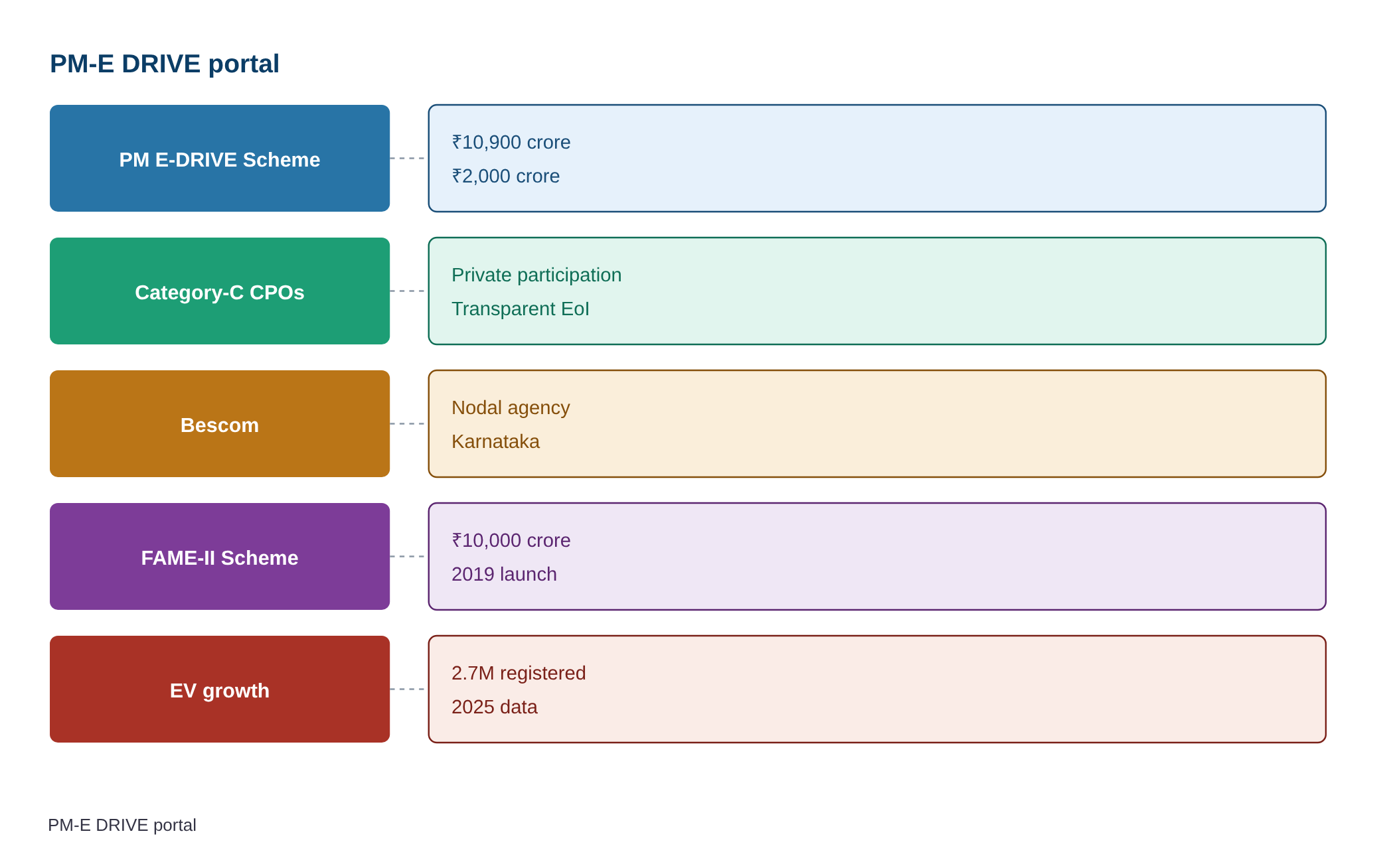
- The Government of India launched the Faster Adoption and Manufacturing of Electric Vehicles (FAME-II) Scheme in 2019 with a budgetary outlay of ₹10,000 crore to promote electric mobility through demand incentives, infrastructure development, and awareness campaigns.
- The PM E-DRIVE Scheme, launched by the Ministry of Heavy Industries (MHI), is a subsequent initiative aimed at accelerating the deployment of public EV charging infrastructure, with a total outlay of ₹10,900 crore and a dedicated allocation of ₹2,000 crore for public charging stations until March 2028.
- Bescom, the state-owned electricity distribution company in Karnataka, has been designated as the nodal agency for implementing the PM E-DRIVE Scheme in the state, underscoring the role of state utilities in India’s energy transition.
- The scheme categorises public charging stations into three types: Category-A (government-owned locations), Category-B (government-managed public locations), and Category-C (private participation), with the latter enabling private Charge Point Operators (CPOs) to establish and operate charging infrastructure.
- India’s EV ecosystem has witnessed rapid growth, with over 2.7 million EVs registered as of 2025, but public charging infrastructure remains a critical constraint, particularly in urban and highway corridors.
- The PM-E DRIVE portal introduces a standardised, digital-first approach to aggregating proposals from private operators, streamlining approvals, and ensuring compliance with scheme guidelines through a first-come, first-served mechanism.
What is the PM E-DRIVE Scheme and Bescom’s PM-E DRIVE Portal?
- The PM E-DRIVE Scheme is a centrally sponsored initiative by the Ministry of Heavy Industries (MHI) with a total outlay of ₹10,900 crore, with a dedicated ₹2,000 crore allocation for public charging infrastructure.
- The scheme categorises public EV charging stations into three types: Category-A (government-owned locations such as offices, hospitals, and residential complexes), Category-B (government-managed public locations like airports, metro stations, and bus stations), and Category-C (private participation under the PM-E DRIVE portal).
- Bescom’s PM-E DRIVE portal is a digital platform designed to facilitate private Charge Point Operators (CPOs) in submitting proposals for establishing Category-C public EV charging stations, ensuring transparency and efficiency in the approval process.
- The portal operates through a two-stage Expression of Interest (EoI) process: Stage 1 verifies the technical capability and operational experience of CPOs, while Stage 2 enables eligible operators to submit detailed proposals for charging station deployment.
- Approved proposals are aggregated by Bescom and submitted to the Ministry of Heavy Industries for final approval, with up to 800 Category-C locations to be processed on a first-come, first-served basis, subject to compliance with scheme guidelines.
- The scheme standardises charging station configurations for both urban and highway locations, simplifying implementation, subsidy assessment, and ensuring uniformity in charging infrastructure across diverse geographies.
- Private CPOs participating under Category-C are eligible for financial incentives, including capital subsidies and operational support, as outlined in the PM E-DRIVE Scheme’s guidelines, to encourage large-scale deployment of charging infrastructure.
- The initiative is aligned with India’s broader goals of reducing vehicular emissions, enhancing energy security, and achieving the target of 30% EV penetration in the automotive sector by 2030, as outlined in the National Electric Mobility Mission Plan (NEMMP) 2020.
Key Features
| Feature | Significance |
|---|---|
| PM E-DRIVE portal | Centralised digital platform for private Charge Point Operators (CPOs) to submit proposals for EV charging stations under Category-C, ensuring transparency and streamlined processing. |
| Two-stage Expression of Interest (EoI) process | Stage 1 verifies technical capability and operational experience of CPOs; Stage 2 enables eligible operators to submit proposals for specific locations, reducing administrative bottlenecks. |
| Category-C participation framework | Enables private sector participation in establishing public EV charging stations, accelerating infrastructure deployment beyond government-managed locations. |
| Standardised charging station configurations | Uniform specifications for urban and highway locations simplify implementation, subsidy assessment, and ensure interoperability of charging infrastructure. |
| ₹2,000 crore allocation for public EV charging stations | Dedicated financial outlay under the PM E-DRIVE scheme to expand charging network across India until March 2028, with Bescom as the State nodal agency for Karnataka. |
Why it Matters
Economic
- Stimulates private investment in EV charging infrastructure, creating employment opportunities in installation, maintenance, and operations of charging stations.
- Reduces long-term operational costs for EV users by increasing charging accessibility, thereby accelerating EV adoption and reducing fossil fuel dependency.
- Enhances Karnataka’s position as a leader in renewable energy integration, attracting investments in allied sectors such as battery manufacturing and grid modernisation.
Strategic
- Supports India’s decarbonisation goals under the National Electric Mobility Mission Plan (NEMMP) 2020 and the FAME-II scheme, aligning with global commitments to reduce carbon emissions.
- Strengthens energy security by reducing crude oil imports through increased EV adoption, particularly in urban and intercity mobility segments.
- Facilitates the transition to cleaner public transport systems by enabling faster deployment of charging infrastructure in high-traffic areas like bus stations and metro hubs.
Environmental
- Reduces greenhouse gas emissions and local air pollution by promoting electric mobility, particularly in densely populated urban areas like Bengaluru.
- Supports India’s Nationally Determined Contributions (NDCs) under the Paris Agreement by lowering the carbon footprint of the transport sector.
Governance
- Demonstrates a model of public-private partnership (PPP) in infrastructure development, with Bescom acting as a nodal agency to aggregate and process proposals for central approval.
- Introduces a standardised and transparent bidding process, minimising corruption risks and ensuring equitable distribution of subsidies to eligible operators.
Challenges
1. Private Sector Participation
- Limited awareness among private operators regarding technical and financial requirements for setting up charging stations, potentially slowing down adoption.
- High upfront capital costs for CPOs, despite subsidies, may deter smaller players from participating in the scheme.
UPSC Link: Economic Survey 2023-24: Infrastructure Financing
2. Grid Integration and Capacity
- Inadequate grid capacity in certain urban and rural areas may lead to power supply constraints, necessitating coordinated efforts with state electricity boards.
- Fluctuations in renewable energy supply (solar/wind) could impact charging station reliability without robust energy storage solutions.
UPSC Link: National Electricity Policy 2005
3. Land Acquisition and Regulatory Hurdles
- Delays in land acquisition for charging stations, particularly in congested urban areas, may hinder timely implementation.
- Complexity in obtaining permits and clearances from multiple agencies (municipal corporations, traffic authorities, etc.) could slow down project execution.
UPSC Link: Land Acquisition Act, 2013
4. Interoperability and Standardisation
- Lack of uniform charging standards across different manufacturers may lead to compatibility issues, reducing user convenience.
- Diverse charging speeds and connector types (CCS, CHAdeMO, Bharat DC-001) require harmonisation to ensure seamless EV adoption.
UPSC Link: Bureau of Indian Standards (BIS) for EV Charging
5. Subsidy Disbursement and Fiscal Sustainability
- Risk of subsidy misuse or delays in disbursement due to bureaucratic inefficiencies, undermining the scheme’s effectiveness.
- Long-term fiscal sustainability of the ₹2,000 crore outlay may be challenged by rising material costs and inflation.
UPSC Link: Fiscal Responsibility and Budget Management Act, 2003
Challenges — UPSC Perspective
| Issue | Concern |
|---|---|
| Capital Intensity | High initial investment for CPOs despite subsidies, limiting participation of small and medium enterprises. |
| Grid Stability | Potential overload on local grids during peak charging hours, necessitating smart grid solutions. |
| Regulatory Delays | Multi-layered approval processes for land use and permits, causing project delays. |
| Technical Fragmentation | Inconsistent charging standards across manufacturers, reducing user experience and adoption. |
| Subsidy Utilisation | Risk of underutilisation or misallocation of funds due to administrative bottlenecks. |
Government Initiatives — Must-Memorise for Prelims
- PM E-DRIVE Scheme (Promotion of Electric Mobility through Demand Incentives for EV Charging Infrastructure)
- Faster Adoption and Manufacturing of Hybrid and Electric Vehicles (FAME-II) Scheme
Way Forward
- Accelerate awareness campaigns among private operators to enhance participation in the PM E-DRIVE portal and EoI process.
- Strengthen grid infrastructure in coordination with state electricity boards to ensure reliable power supply for charging stations.
- Streamline land acquisition and regulatory approvals through single-window clearance mechanisms for charging station projects.
- Mandate uniform charging standards (e.g., Bharat DC-001) across all public charging stations to ensure interoperability.
- Establish a real-time monitoring dashboard to track subsidy disbursement, project progress, and user feedback for iterative improvements.
- Promote public-private partnerships (PPPs) for large-scale charging hubs in high-traffic areas like highways, airports, and bus depots.
- Integrate renewable energy sources (solar/wind) with charging stations to enhance sustainability and reduce grid dependency.
- Conduct periodic reviews of the scheme’s impact on EV adoption and adjust financial incentives based on market feedback.
UPSC Value Addition
Keywords for Mains Answer-Writing
PM E-DRIVE Scheme · BESCOM · EV charging infrastructure · Ministry of Heavy Industries · Public-Private Partnership in EV sector · Category-C charging stations · Expression of Interest (EoI) process · National Electric Mobility Mission Plan (NEMMP) 2020 · Faster Adoption and Manufacturing of Hybrid and Electric Vehicles (FAME) India Scheme · Sustainable Mobility · Decarbonisation of transport · First-Come-First-Served (FCFS) allocation · Standardised charging configurations · Subsidy assessment for EV infrastructure
Concept Flow
Government launches PM E-DRIVE Scheme with ₹10,900 crore outlay → ₹2,000 crore earmarked for public EV charging stations till March 2028. → Bescom, as State nodal agency, introduces PM E-DRIVE portal and Category-C framework for private Charge Point Operators (CPOs). → CPOs register on portal, undergo two-stage EoI process (technical verification and proposal submission). → Bescom aggregates proposals and submits to Ministry of Heavy Industries for approval on first-come, first-served basis. → Approved CPOs deploy standardised charging stations in urban and highway locations, supported by subsidies. → Increased charging infrastructure accelerates EV adoption, reducing fossil fuel dependency and carbon emissions. → Enhanced EV ecosystem contributes to India’s decarbonisation goals and energy security objectives.
Prelims Practice Questions
Q1. Consider the following statements regarding the PM E-DRIVE Scheme:
1. The scheme is implemented by the Ministry of Heavy Industries with a total outlay of ₹10,900 crore.
2. ₹2,000 crore has been earmarked for establishing public EV charging stations under the scheme.
3. The scheme allows private Charge Point Operators (CPOs) to participate under Category-C.
4. Category-B includes State and Central government offices, hospitals, and government residential complexes.
How many of the above statements are correct?
- Only one
- Only two
- Only three
- All
Answer: Only three — Statements 1, 2, and 3 are correct. Statement 4 is incorrect as Category-B includes government-owned or government-managed public locations such as railway stations and airports, not government offices or residential complexes (which fall under Category-A).
Q2. Assertion (A): The PM E-DRIVE Scheme prioritises the allocation of Category-C charging stations on a first-come-first-served basis.
Reason (R): The scheme aims to simplify subsidy assessment by standardising charging station configurations for both urban and highway locations.
Options:
A. Both A and R are true, and R is the correct explanation of A.
B. Both A and R are true, but R is not the correct explanation of A.
C. A is true, but R is false.
D. A is false, but R is true.
Answer: ? — Assertion (A) is true as the scheme processes up to 800 Category-C charging station locations on a first-come-first-served basis. Reason (R) is also true but does not directly explain the assertion, as standardisation of configurations is a separate provision for implementation efficiency.
Q3. Match the following categories of EV charging stations under the PM E-DRIVE Scheme with their respective participants:
Column I (Category) Column II (Participants)
A. Category-A 1. Private Charge Point Operators (CPOs)
B. Category-B 2. State and Central government offices
C. Category-C 3. Government-owned public locations such as railway stations and airports
Options:
A. A-2, B-3, C-1
B. A-1, B-2, C-3
C. A-3, B-1, C-2
D. A-2, B-1, C-3
Answer: ? — Category-A includes State and Central government offices (2). Category-B includes government-owned public locations such as railway stations and airports (3). Category-C allows participation by private Charge Point Operators (CPOs) (1).
Mains Practice Question
✍ The PM E-DRIVE Scheme represents a significant step towards accelerating the adoption of electric vehicles (EVs) in India by leveraging public-private partnerships. Critically examine the institutional framework, financial outlay, and implementation modalities of the scheme. Also, analyse its potential impact on India’s decarbonisation goals and the challenges in achieving universal EV charging accessibility. (15 Marks)
Approach: MODEL-ANSWER SKELETON:
1. **Institutional Framework and Scheme Design**:
– Role of Ministry of Heavy Industries as the nodal ministry.
– Bescom as the State nodal agency for Karnataka.
– Categorisation of charging stations (A, B, C) and their respective participants.
– Two-stage Expression of Interest (EoI) process for private CPOs.
2. **Financial Outlay and Subsidy Mechanism**:
– Total outlay of ₹10,900 crore and ₹2,000 crore earmarked for public EV charging stations.
– Standardisation of charging station configurations for urban and highway locations.
– First-Come-First-Served (FCFS) allocation for Category-C stations.
3. **Linkages with National EV Policies**:
– Alignment with the National Electric Mobility Mission Plan (NEMMP) 2020 and FAME India Scheme.
– Role in achieving India’s decarbonisation targets under the Paris Agreement.
4. **Potential Impact on Decarbonisation**:
– Reduction in vehicular emissions and dependence on fossil fuels.
– Promotion of sustainable mobility and reduction in urban air pollution.
5. **Challenges and Limitations**:
– Uneven geographical distribution of charging infrastructure.
– High initial capital costs for private CPOs despite subsidies.
– Need for grid stabilisation and renewable energy integration.
– Ensuring equitable access across rural and urban areas.
6. **Conclusion**:
– The scheme is a progressive step but requires robust monitoring and adaptive policy measures to address implementation gaps.
Source: The Hindu
Generated by AanyaAi for educational purpose.

- KWML’s Feasibility Reports for Water Metro in 18 Cities: UPSC & PCS Insights - October 3, 2026
- ओडिशा में वन्यजीव अनुसंधान अनुदान कार्यक्रम शुरू, सिमिलिपाल में 300 कैमरे और बढ़ेंगे - October 3, 2026
- India Summons Pakistan High Commission Official Over Violation - October 3, 2026

No Comments