


08 Aug New Motor Vehicle Aggregator Policy: Key Features for UPSC & State PCS 2026
✎ The Motor Vehicle Aggregator Policy integrates safety, transparency, and sustainability into app-based transport services through mandatory registration, digital monitoring, fare regulation, and driver welfare provisions.
Subject Relevance — Where This Topic Fits
- GS Paper II — Governance, Transparency and Accountability | GS Paper III — Infrastructure: Energy, Ports, Roads, Airports and Urban Development
- Prelims: Motor Vehicles (Amendment) Act, 2019, National Urban Transport Policy (NUTP), 2006, Aggregator Guidelines, 2020, Fitness Certificate (FC), Permit System under Motor Vehicles Act, Digital Monitoring of Transport Services, Grievance Redressal Mechanism, Battery Waste Management Rules, 2022
- Essay: The Role of Technology in Public Service Delivery: Balancing Innovation with Accountability, Sustainable Urban Mobility: A Pathway to Inclusive and Resilient Cities
Quick Revision: The Motor Vehicle Aggregator Policy integrates safety, transparency, and sustainability into app-based transport services through mandatory registration, digital monitoring, fare regulation, and driver welfare provisions.
Why is this in the news?
This policy emerges from extensive consultations with stakeholders and seeks to address critical gaps in passenger safety, driver welfare, fare transparency, and environmental sustainability within the aggregator ecosystem. The development underscores the government’s commitment to leveraging technology for equitable and secure urban mobility solutions.
Background
- The Motor Vehicles (Amendment) Act, 2019, introduced stringent provisions for aggregators, including mandatory registration, fare regulation, and grievance redressal mechanisms, to enhance accountability and safety in app-based transport services.
- Prior to this, the Ministry of Road Transport and Highways (MoRTH) issued the Aggregator Guidelines, 2020, which outlined basic operational and compliance requirements for aggregators but lacked comprehensive enforcement mechanisms.
- The exponential growth of app-based mobility services (e.g., ride-hailing, food delivery, and goods transport) has necessitated a robust regulatory framework to mitigate risks such as driver exploitation, passenger harassment, and environmental degradation.
- Urban transport policies in India, including the National Urban Transport Policy (NUTP), 2006, have long emphasized the integration of technology, sustainability, and equity in mobility solutions, aligning with the objectives of the new policy.
- The policy aligns with global best practices, such as the European Union’s Urban Mobility Framework, which prioritizes digitalization, safety, and decarbonization in transport services.
- Concerns over data privacy, monopolistic practices by aggregators, and the lack of standardized fare structures have further necessitated a unified policy framework to ensure fair competition and consumer protection.
What is the Motor Vehicle Aggregator Policy?
- The Motor Vehicle Aggregator Policy is a statutory framework designed to regulate app-based transport aggregators operating in India, ensuring compliance with safety, transparency, and sustainability norms.
- It mandates aggregators to register with state transport authorities, maintain digital records of drivers and vehicles, and implement real-time monitoring systems for passenger safety and fare transparency.
- The policy introduces a grievance redressal mechanism accessible to both passengers and drivers, with provisions for escalation to regulatory bodies in case of disputes or violations.
- It stipulates strict vehicle fitness requirements, including periodic inspections, valid permits, and mandatory insurance coverage, to mitigate risks associated with unsafe or unroadworthy vehicles.
- To address driver welfare, the policy proposes fair remuneration models, social security benefits, and mechanisms to prevent exploitation by aggregator platforms, including caps on commission rates.
- The policy emphasizes the promotion of electric and environmentally sustainable vehicles by incentivizing aggregators to transition their fleets to cleaner energy sources, in line with India’s climate commitments.
- Digital monitoring and data-sharing protocols between aggregators and government departments are mandated to enable evidence-based policy enforcement and reduce regulatory arbitrage.
- The policy also includes provisions for the protection of women passengers and drivers, such as panic buttons, real-time tracking, and stringent penalties for harassment or misconduct.
Key Features
| Feature | Significance |
|---|---|
| Passenger safety protocols | Mandates real-time tracking, emergency buttons, and strict background checks for drivers to mitigate risks of harassment and accidents. |
| Fare transparency mechanisms | Ensures dynamic pricing is regulated, prevents surge pricing abuse, and provides fare estimates upfront to passengers. |
| Driver welfare provisions | Includes minimum wage guarantees, insurance coverage, and grievance redressal systems to address platform-induced exploitation. |
| Vehicle fitness and permits | Requires periodic inspections, valid permits, and adherence to emission norms to enhance road safety and environmental compliance. |
| Data sharing framework | Facilitates real-time data exchange with government authorities for regulatory oversight, tax compliance, and law enforcement. |
Why it Matters
Regulatory and Governance
- Establishes a uniform regulatory framework for app-based transport aggregators, addressing the regulatory vacuum in the sector.
- Enhances state capacity to monitor and enforce compliance through digital tools and data-sharing mechanisms.
- Aligns with the principles of cooperative federalism by enabling states to tailor policies within a national framework.
Economic
- Promotes formalisation of the gig economy, reducing informality and improving tax compliance among aggregator platforms.
- Encourages investment in electric and sustainable vehicles by offering incentives or mandates within the policy.
- Balances consumer affordability with driver welfare, potentially reducing platform-driven wage suppression.
Social and Ethical
- Prioritises safety for women passengers through mandatory safety audits, driver verification, and panic-button systems.
- Addresses driver exploitation by enforcing minimum service standards, social security, and dispute resolution mechanisms.
- Promotes environmental sustainability by incentivising or mandating the use of electric vehicles in aggregator fleets.
Technological
- Leverages digital monitoring and real-time data analytics to enhance operational transparency and regulatory oversight.
- Integrates with existing government databases (e.g., VAHAN, SARATHI) for seamless vehicle and driver verification.
- Facilitates interoperability between aggregator platforms and government systems for unified compliance tracking.
Challenges
1. Regulatory Arbitrage and Compliance
- Aggregator platforms may resist stringent regulations citing competitive disadvantages or operational constraints.
- Ensuring uniform enforcement across states with varying administrative capacities and political priorities.
- Balancing innovation in app-based services with prescriptive regulatory requirements without stifling growth.
UPSC Link: GS3: Regulatory Bodies
2. Data Privacy and Security
- Aggregators collect vast amounts of passenger and driver data, raising concerns over misuse or breaches.
- Compliance with data localisation norms while ensuring seamless data sharing with government authorities.
- Risk of surveillance overreach if real-time tracking is mandated without robust safeguards.
UPSC Link: GS3: Cyber Security
3. Driver Welfare vs. Platform Viability
- Imposing higher compliance costs (e.g., insurance, wages) may reduce platform profitability, leading to service withdrawal.
- Gig workers lack traditional employment protections; enforcing welfare measures requires innovative policy design.
- Resistance from aggregator platforms to share financial burden of compliance with drivers or passengers.
UPSC Link: GS2: Labour Reforms
4. Technological and Infrastructure Gaps
- Rural and semi-urban areas may lack digital infrastructure (e.g., GPS, internet) for real-time monitoring.
- Aggregators may face challenges in retrofitting existing fleets with safety devices (e.g., panic buttons).
- Interoperability issues between state-level databases and aggregator platforms may delay compliance.
UPSC Link: GS3: Infrastructure
5. Public Acceptance and Behavioural Change
- Passengers accustomed to low fares may resist fare transparency or higher costs due to compliance.
- Drivers may resist stringent verification processes or safety protocols perceived as intrusive.
- Lack of awareness among stakeholders about new regulations may lead to non-compliance.
UPSC Link: GS4: Ethics
Challenges — UPSC Perspective
| Issue | Concern |
|---|---|
| Regulatory arbitrage | Platforms exploiting gaps between state and central regulations to avoid compliance. |
| Data localisation | Conflict between government data-sharing demands and aggregator global data policies. |
| Driver exploitation | Gig workers facing wage suppression, lack of social security, and unsafe working conditions. |
| Infrastructure deficits | Rural areas lacking digital connectivity for real-time monitoring and verification. |
| Public resistance | Passengers and drivers resisting changes due to perceived cost or inconvenience. |
Way Forward
- Finalise the committee’s recommendations and notify the Motor Vehicle Aggregator Policy under the Motor Vehicles Act, 1988.
- Develop a phased implementation roadmap with clear timelines for compliance, starting with high-density urban areas.
- Establish a dedicated grievance redressal portal for passengers and drivers, integrated with state transport departments.
- Conduct capacity-building programs for state transport authorities to ensure effective enforcement and monitoring.
- Incentivise aggregators to adopt electric vehicles through subsidies, tax breaks, or preferential permits.
- Launch public awareness campaigns to educate stakeholders on new regulations, rights, and grievance mechanisms.
- Pilot real-time monitoring systems in select cities to assess feasibility and address implementation challenges.
- Collaborate with aggregator platforms to co-design safety protocols and welfare measures tailored to local contexts.
UPSC Value Addition
Keywords for Mains Answer-Writing
Motor Vehicle Aggregator Policy 2026 · app-based transport services · passenger safety regulations · fare transparency mechanisms · driver welfare provisions · electric vehicle promotion · digital monitoring of aggregators · grievance redressal systems · permit and insurance compliance · sustainable mobility framework · women passenger safety · data sharing with government · regulatory mechanisms for aggregators · Ministry of Road Transport and Highways · sustainable transport policy · stakeholder consultations in policy-making
Constitutional & Policy Linkages
- [‘Article 14: Equality before law’, ‘Ensures non-discriminatory application of regulations across aggregators.’]
- [‘Article 21: Right to life’, ‘Safeguards passenger and driver safety through mandatory protocols.’]
- [‘Article 19(1)(g): Freedom of profession’, ‘Balances entrepreneurial freedom with regulatory oversight.’]
Concept Flow
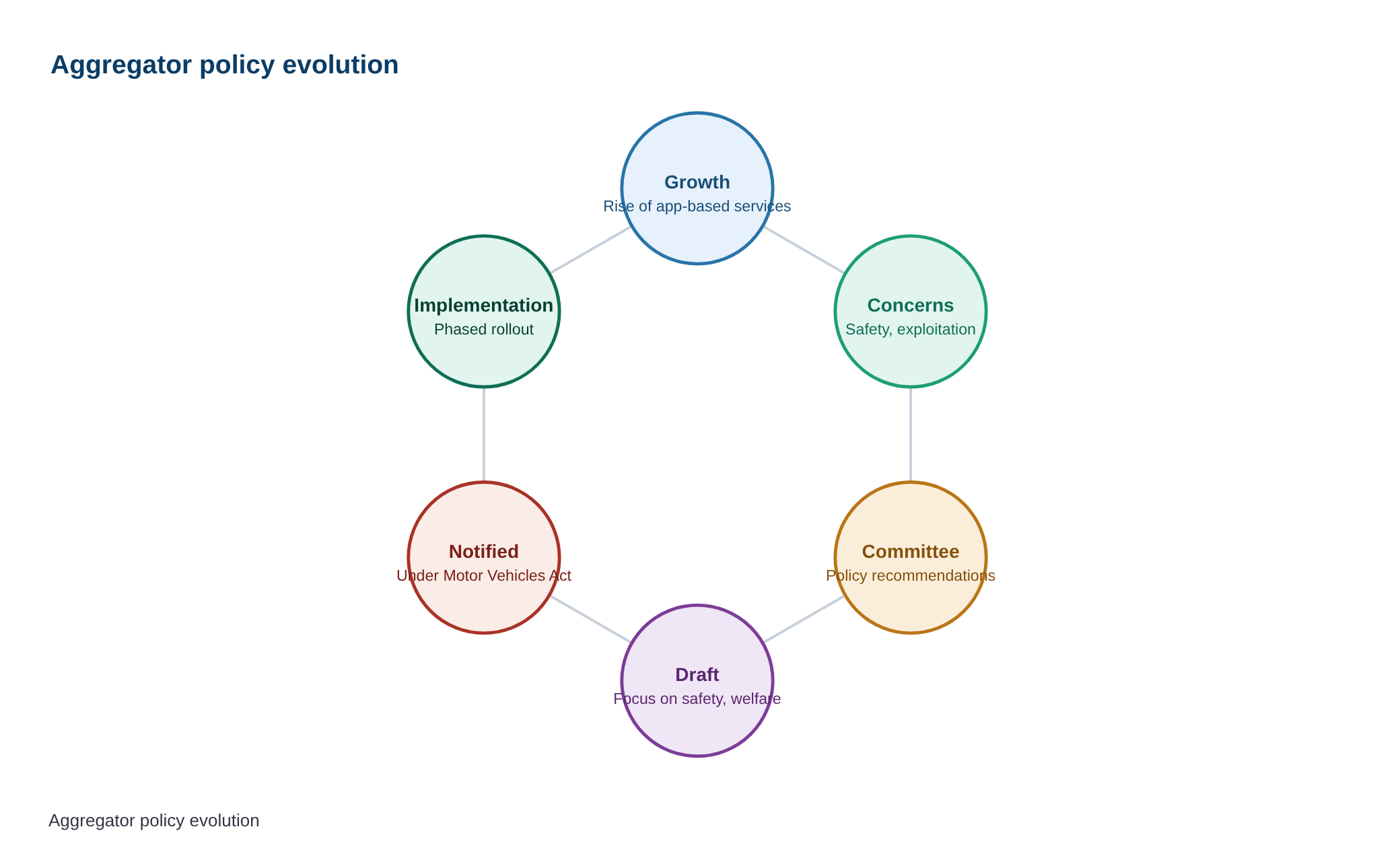
Rise of app-based transport aggregators → Regulatory vacuum and safety concerns → Committee constituted for policy recommendations → Draft policy focuses on passenger safety, driver welfare, and transparency → Policy notified under Motor Vehicles Act → Phased implementation with stakeholder consultations → Real-time monitoring and grievance redressal systems → Enhanced compliance and service quality.
Prelims Practice Questions
Q1. Consider the following statements regarding the proposed Motor Vehicle Aggregator Policy 2026 in India:
1. The policy mandates digital monitoring of aggregator platforms to ensure passenger safety.
2. It requires aggregators to share data with government departments for regulatory oversight.
3. The policy exclusively promotes the use of electric vehicles and prohibits the operation of internal combustion engine vehicles by aggregators.
How many of the above statements are correct?
- Only one
- Only two
- All three
- None
Answer: Only two — Statement 1 and 2 are correct as the policy emphasizes digital monitoring and data sharing with government. Statement 3 is incorrect because the policy promotes electric vehicles but does not prohibit internal combustion engine vehicles outright.
Q2. Assertion (A): The Motor Vehicle Aggregator Policy 2026 aims to enhance transparency in fare structures for app-based transport services.
Reason (R): The policy includes provisions for fare transparency mechanisms to protect passenger interests.
- Both A and R are true, and R is the correct explanation of A
- Both A and R are true, but R is NOT the correct explanation of A
- A is true but R is false
- A is false but R is true
Answer: Both A and R are true, and R is the correct explanation of A — Both the assertion and reason are correct, and the reason directly explains the assertion as fare transparency is a key objective of the policy.
Q3. Match the following provisions of the Motor Vehicle Aggregator Policy 2026 with their respective objectives:
Column I (Provision)
A. Digital monitoring of aggregators
B. Grievance redressal systems
C. Promotion of electric vehicles
D. Data sharing with government departments
Column II (Objective)
1. Enhance passenger safety and accountability
2. Ensure fare transparency and regulatory compliance
3. Facilitate sustainable mobility and environmental goals
4. Address passenger and driver complaints efficiently
- A-1, B-4, C-3, D-2; A-2, B-3, C-1, D-4; A-4, B-1, C-2, D-3; A-3, B-2, C-4, D-1
- answer_string_array_indexes_to_match_pairs_correctly
- explain_match_pairs_exact
- format_match
Answer: A-1, B-4, C-3, D-2; A-2, B-3, C-1, D-4; A-4, B-1, C-2, D-3; A-3, B-2, C-4, D-1 — Correct matching: A (Digital monitoring of aggregators) → 1 (Enhance passenger safety and accountability); B (Grievance redressal systems) → 4 (Address complaints efficiently); C (Promotion of electric vehicles) → 3 (Sustainable mobility); D (Data sharing with government) → 2 (Regulatory compliance).
Mains Practice Question
✍ The Motor Vehicle Aggregator Policy 2026 seeks to balance technological innovation with passenger safety and regulatory transparency in India’s app-based transport sector. Critically examine the policy’s provisions for passenger safety, fare transparency, and driver welfare. Also, discuss the challenges in its implementation and suggest measures to ensure its effective rollout. (15 Marks)
Approach: MODEL-ANSWER SKELETON:
1. **Introduction (2 marks)**: Briefly contextualize the rise of app-based transport aggregators in India, highlighting their role in urban mobility and the need for regulation. Mention the objectives of the Motor Vehicle Aggregator Policy 2026 as outlined by the Ministry of Road Transport and Highways.
2. **Passenger Safety Provisions (3 marks)**:
– Digital monitoring mechanisms (e.g., real-time tracking, panic buttons).
– Safety measures for women passengers (e.g., driver verification, emergency protocols).
– Vehicle fitness and insurance compliance.
– Reference to the Motor Vehicles (Amendment) Act, 2019, and its provisions on safety.
3. **Fare Transparency Mechanisms (3 marks)**:
– Mandatory fare calculation algorithms and upfront pricing.
– Regulatory oversight to prevent surge pricing abuse.
– Data sharing with government for audit and compliance.
– Comparison with global models (e.g., EU’s ride-hailing regulations).
4. **Driver Welfare Provisions (3 marks)**:
– Registration and regulatory mechanisms for drivers.
– Welfare schemes (e.g., insurance, social security).
– Grievance redressal systems for driver disputes.
– Ethical concerns: gig economy labor rights (reference to the Code on Social Security, 2020).
5. **Challenges in Implementation (2 marks)**:
– Resistance from aggregators due to compliance costs.
– Data privacy concerns in digital monitoring.
– Regional disparities in enforcement.
– Coordination between central and state governments.
6. **Measures for Effective Rollout (2 marks)**:
– Phased implementation with pilot projects.
– Capacity-building for state transport authorities.
– Public awareness campaigns.
– Incentives for aggregators to adopt electric vehicles (e.g., subsidies under FAME-II).
7. **Conclusion (2 marks)**: Summarize the policy’s potential to enhance safety, transparency, and sustainability while acknowledging implementation challenges. Emphasize the need for a balanced approach that fosters innovation without compromising public interest.
Source: The Hindu
Generated by AanyaAi for educational purpose.

- UPSC Alert: India-Bangladesh Methanol Cargo Flagged Off from Dibrugarh - October 5, 2026
- स्टॉक मार्केट में गिरावट, महंगाई ने बढ़ाया संकट: जानिए कारण और प्रभाव - October 5, 2026
- Rediscovered plant ‘Haplothismia exannulata’ inspires Wildlife Week in Kerala - October 5, 2026

No Comments