


08 Aug Bescom Launches PM-E DRIVE Portal for Private EV Charging Operators
✎ Bescom’s PM-E DRIVE portal enables private Charge Point Operators to establish public EV charging stations under Category-C of the PM E-DRIVE scheme by facilitating a two-stage Expression of Interest process and standardised…
Subject Relevance — Where This Topic Fits
- GS Paper III — Infrastructure: Energy, Ports, Roads, Airports and Railways; Investment Models; Government Policies and Interventions for Development in various sectors
- Prelims: FAME-II scheme, PM-E DRIVE portal, Bescom, Charge Point Operators (CPOs), Electric Vehicle (EV) charging infrastructure, Category-C locations, Ministry of Heavy Industries, public-private partnership in energy infrastructure, nodal agency, Expression of Interest (EoI) process
Quick Revision: Bescom’s PM-E DRIVE portal enables private Charge Point Operators to establish public EV charging stations under Category-C of the PM E-DRIVE scheme by facilitating a two-stage Expression of Interest process and standardised infrastructure configurations.
Why is this in the news?
The Bangalore Electricity Supply Company Limited (Bescom) has operationalised the PM-E DRIVE portal to facilitate private Charge Point Operators (CPOs) in establishing public EV charging stations under Category-C of the PM E-DRIVE scheme. This initiative, aligned with the Ministry of Heavy Industries’ FAME-II framework, marks a significant step toward decentralising EV charging infrastructure development and accelerating Karnataka’s transition to electric mobility by leveraging private sector participation.
Background
- The PM E-DRIVE scheme was launched by the Ministry of Heavy Industries with a total outlay of ₹10,900 crore.
- The PM E-DRIVE scheme has earmarked ₹2,000 crore for establishing public EV charging stations.
- Bescom, the state nodal agency for Karnataka, has been designated to implement Category-A and Category-B charging stations, while Category-C is reserved for private CPOs to foster market-driven expansion of charging networks.
- The scheme’s categorisation ensures that high-footfall government and public locations (e.g., hospitals, railway stations) are prioritised for government-led deployment, while private operators are encouraged to expand coverage in underserved areas.
- The introduction of the PM-E DRIVE portal by Bescom reflects a shift toward digital governance and transparent procurement processes, aligning with the broader objectives of ease of doing business and reducing bureaucratic delays in infrastructure projects.
What is the PM-E DRIVE scheme and Bescom’s role in its implementation?
- The PM E-DRIVE scheme was launched by the Ministry of Heavy Industries to accelerate the deployment of public EV charging stations across India.
- The scheme is structured into three categories: Category-A (government buildings and complexes), Category-B (public locations managed by government entities), and Category-C (private Charge Point Operators in non-government spaces).
- Bescom, as the state nodal agency for Karnataka, is responsible for implementing Category-A and Category-B charging stations, while Category-C is open to private CPOs for establishing charging infrastructure in private or commercial spaces.
- The scheme provides financial incentives and subsidies for the establishment of charging stations, with Bescom aggregating eligible proposals from private CPOs and submitting them to the Ministry of Heavy Industries for approval.
- The PM-E DRIVE portal serves as a digital platform for private CPOs to register, verify technical capabilities, and submit proposals for EV charging stations under Category-C, ensuring a streamlined and transparent process.
- Bescom has standardised charging station configurations for urban and highway locations to simplify implementation, subsidy assessment, and operational efficiency, ensuring uniformity in charging infrastructure across diverse geographies.
- The scheme operates on a first-come, first-served basis for up to 800 Category-C charging station locations in Karnataka, subject to compliance with technical, financial, and operational guidelines set by the Ministry of Heavy Industries.
- This initiative is part of India’s broader strategy to achieve 30% electric vehicle penetration by 2030, reduce carbon emissions, and enhance energy security through diversified and decentralised energy infrastructure.
Key Features
| Feature | Significance |
|---|---|
| PM E-DRIVE Portal | Centralised digital platform for private Charge Point Operators (CPOs) to apply for EV charging station approvals under Category-C of the PM E-DRIVE scheme. |
| Two-stage Expression of Interest (EoI) Process | Stage 1 verifies technical capability and operational experience of CPOs; Stage 2 allows eligible operators to submit proposals for specific charging station locations. |
| Category-C Participation | Enables private entities to establish public EV charging infrastructure, expanding the network beyond government-managed locations. |
| Standardised Charging Station Configurations | Predefined configurations for urban and highway locations simplify implementation, subsidy assessment, and operational uniformity. |
| First-Come, First-Served Basis | 800 Category-C charging station locations will be processed based on the order of eligible proposals, ensuring transparency and efficiency in allocation. |
Why it Matters
Economic
- Stimulates investment in EV charging infrastructure, attracting private capital into the green mobility sector.
- Creates employment opportunities in installation, maintenance, and operation of charging stations.
- Enhances energy sector diversification by integrating renewable energy sources with EV charging networks.
Strategic
- Supports India’s decarbonisation goals by accelerating EV adoption through accessible public charging infrastructure.
- Reduces dependence on fossil fuels in the transport sector, aligning with global climate commitments.
- Strengthens energy security by diversifying the energy mix for mobility through electrification.
Policy and Governance
- Demonstrates a model of public-private partnership (PPP) in implementing national EV charging infrastructure.
- Provides a scalable framework for state nodal agencies to coordinate with central ministries for scheme execution.
- Ensures standardisation and quality control in charging infrastructure through centralised guidelines.
Technological
- Promotes innovation in charging technology by encouraging private sector participation in R&D.
- Facilitates interoperability and standardisation of charging stations, enhancing user convenience.
- Supports the integration of smart grid technologies and demand-side management in charging networks.
Challenges
1. Private Sector Participation
- Ensuring adequate private investment in charging infrastructure, particularly in rural and semi-urban areas.
- Addressing concerns of CPOs regarding long-term revenue sustainability and return on investment.
- Balancing profit motives with public service obligations in the deployment of charging stations.
UPSC Link: GS-III: Infrastructure
2. Grid Stability and Energy Demand
- Managing the additional load on the electricity grid due to concentrated EV charging, especially during peak hours.
- Ensuring grid resilience and preventing localised power shortages in areas with high EV adoption.
- Integrating renewable energy sources with charging infrastructure to mitigate grid stress.
UPSC Link: GS-III: Energy
3. Regulatory and Policy Gaps
- Harmonising state-level policies with central schemes to avoid regulatory conflicts in EV charging deployment.
- Addressing land acquisition and zoning challenges for setting up charging stations in urban areas.
- Ensuring consumer protection and standardisation of charging tariffs across different operators.
UPSC Link: GS-II: Government Policies
4. Technological and Operational Challenges
- Adopting universal charging standards to ensure compatibility across different EV models and operators.
- Maintaining high operational efficiency and uptime of charging stations, particularly in remote locations.
- Developing robust cybersecurity measures to protect charging infrastructure from digital threats.
UPSC Link: GS-III: Science & Tech
Challenges — UPSC Perspective
| Issue | Concern |
|---|---|
| Revenue Model Viability | Uncertainty in long-term earnings due to fluctuating EV adoption rates and charging demand. |
| Grid Integration | Potential strain on local electricity distribution networks during peak charging times. |
| Land and Permitting Delays | Bureaucratic and regulatory hurdles in acquiring land and securing approvals for charging stations. |
| Interoperability Standards | Lack of uniform charging protocols leading to compatibility issues across different EV brands. |
| Consumer Awareness | Low public awareness about the availability and usage of public charging stations. |
Way Forward
- Strengthen public-private partnerships by offering fiscal incentives such as tax rebates or subsidies for CPOs in underserved regions.
- Develop a national grid integration plan to manage the additional load from EV charging and integrate renewable energy sources.
- Establish a centralised monitoring and grievance redressal mechanism to ensure transparency and accountability in scheme implementation.
- Promote R&D in battery technology and charging infrastructure to enhance efficiency, reduce costs, and improve user experience.
- Conduct large-scale awareness campaigns to educate consumers on the benefits of EVs and the availability of public charging stations.
- Harmonise state-level policies with central schemes to create a unified regulatory framework for EV charging infrastructure.
- Encourage the adoption of smart charging technologies to optimise energy use and reduce grid stress during peak hours.
UPSC Value Addition
Keywords for Mains Answer-Writing
PM E-DRIVE Scheme · BESCOM · Electric Vehicle (EV) Charging Infrastructure · Ministry of Heavy Industries · Public-Private Partnership (PPP) in EV Charging · Category-C Charging Stations · Expression of Interest (EoI) Process · National Electric Mobility Mission Plan (NEMMP) 2020 · FAME India Scheme Phase-II · Sustainable Alternative Towards Affordable Transportation (SATAT) · Green Mobility · Urban and Highway EV Charging Standards · ₹10,900 crore outlay · ₹2,000 crore for public EV charging stations
Concept Flow
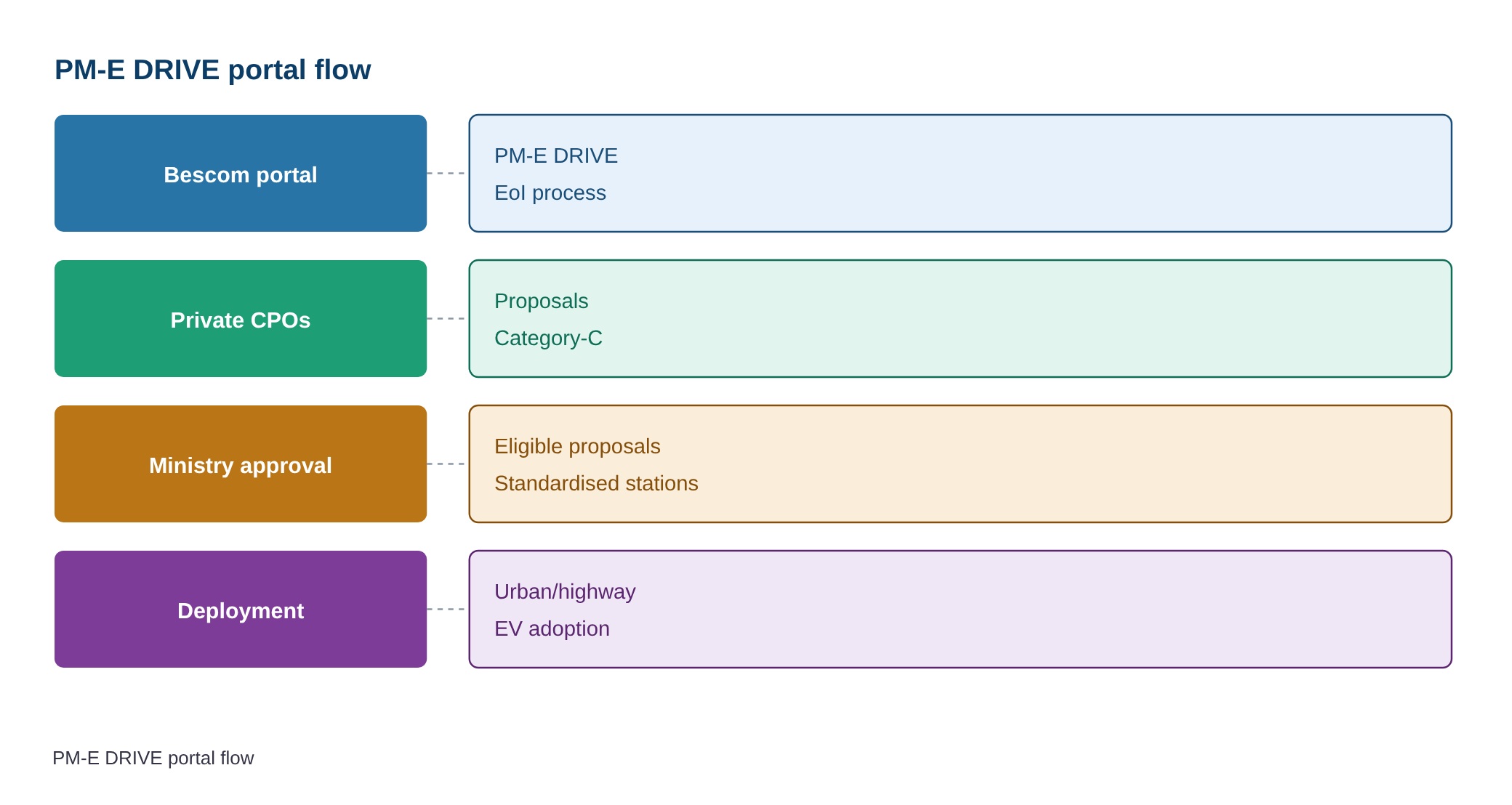
Government announces PM E-DRIVE scheme with ₹10,900 crore outlay for EV charging infrastructure. → Bescom, as state nodal agency, launches PM E-DRIVE portal and two-stage EoI process for private CPOs. → Private operators submit proposals for Category-C charging stations through the portal. → Bescom aggregates and forwards eligible proposals to the Ministry of Heavy Industries for approval. → Approved CPOs deploy standardised charging stations in urban and highway locations. → EV adoption increases due to expanded public charging network, contributing to decarbonisation goals.
Prelims Practice Questions
Q1. Consider the following statements regarding the PM E-DRIVE Scheme:
1. The scheme is launched by the Ministry of Heavy Industries with a total outlay of ₹10,900 crore.
2. ₹2,000 crore is earmarked for establishing public EV charging stations across India till March 2028.
3. The scheme exclusively targets government-owned locations for EV charging infrastructure development.
4. Private Charge Point Operators (CPOs) can participate under Category-C of the scheme.
How many of the above statements are correct?
- Only one
- Only two
- Only three
- All
Answer: All — Statements 1, 2, and 4 are correct. Statement 3 is incorrect as the scheme includes both government-owned locations (Category-A and B) and private participation (Category-C).
Q2. Assertion (A): The PM E-DRIVE Scheme aims to standardise charging station configurations for both urban and highway locations.
Reason (R): Standardisation simplifies implementation and subsidy assessment under the scheme.
Options:
A) Both A and R are true, and R is the correct explanation of A.
B) Both A and R are true, but R is NOT the correct explanation of A.
C) A is true, but R is false.
D) A is false, but R is true.
Answer: ? — Both the Assertion (A) and Reason (R) are true, and R correctly explains A as standardisation is intended to streamline implementation and subsidy processes.
Q3. Match the following categories of EV charging stations under the PM E-DRIVE Scheme with their respective stakeholders:
Column I (Category) Column II (Stakeholder)
A. Category-A 1. Private Charge Point Operators (CPOs)
B. Category-B 2. State and Central government offices
C. Category-C 3. Government-owned or government-managed public locations
Options:
A) A-2, B-3, C-1
B) A-3, B-2, C-1
C) A-1, B-3, C-2
D) A-2, B-1, C-3
Answer: ? — Category-A includes State and Central government offices (2), Category-B includes government-owned or managed public locations (3), and Category-C includes private CPOs (1).
Mains Practice Question
✍ Critically analyse the role of public-private partnerships (PPPs) in accelerating electric vehicle (EV) charging infrastructure in India, with special reference to the PM E-DRIVE Scheme. Also, examine the challenges in its implementation and suggest measures to enhance its effectiveness. (15 Marks)
Approach: MODEL-ANSWER SKELETON:
1. **Introduction to PPP in EV Infrastructure**:
– Define PPP and its relevance in India’s EV ecosystem (link to National Electric Mobility Mission Plan (NEMMP) 2020 and FAME India Scheme Phase-II).
– Highlight the need for private sector participation to meet the ambitious targets of 40% EV penetration by 2030.
2. **PM E-DRIVE Scheme as a PPP Model**:
– Outline the scheme’s structure: outlay (₹10,900 crore), allocation (₹2,000 crore for public charging), and categorisation (A, B, C).
– Explain the two-stage EoI process and the role of BESCOM as the nodal agency.
– Emphasise the standardisation of charging configurations for urban and highway locations.
3. **Strengths of the Scheme**:
– **Financial Incentives**: Subsidies and viability gap funding for private operators.
– **Regulatory Support**: Standardised configurations reduce compliance burdens.
– **Scalability**: First-come, first-served basis for 800 Category-C locations.
– **Alignment with National Goals**: Contributes to India’s commitment to net-zero emissions by 2070.
4. **Challenges in Implementation**:
– **Land Acquisition**: Delays in securing land for charging stations, especially in urban areas.
– **Grid Integration**: Technical challenges in integrating high-capacity charging stations with the grid.
– **Consumer Awareness**: Low awareness among EV owners about charging infrastructure availability.
– **Profitability Concerns**: Private operators may hesitate due to uncertain revenue streams.
– **Regulatory Gaps**: Inconsistencies in state-level policies and incentives.
5. **Measures to Enhance Effectiveness**:
– **Policy Reforms**: Simplify land acquisition processes and offer tax incentives for private operators.
– **Technology Adoption**: Promote smart charging solutions and battery-swapping models.
– **Public Awareness Campaigns**: Educate consumers on the benefits and locations of charging stations.
– **Inter-State Coordination**: Harmonise policies across states to avoid fragmentation.
– **Monitoring and Evaluation**: Establish a robust framework to track progress and address bottlenecks.
6. **Conclusion**:
– Reiterate the importance of PPP in achieving India’s EV transition goals.
– Stress the need for a balanced approach between public funding and private innovation to ensure sustainable growth.
Source: The Hindu
Generated by AanyaAi for educational purpose.

- KWML’s Feasibility Reports for Water Metro in 18 Cities: UPSC & PCS Insights - October 3, 2026
- ओडिशा में वन्यजीव अनुसंधान अनुदान कार्यक्रम शुरू, सिमिलिपाल में 300 कैमरे और बढ़ेंगे - October 3, 2026
- India Summons Pakistan High Commission Official Over Violation - October 3, 2026

No Comments