


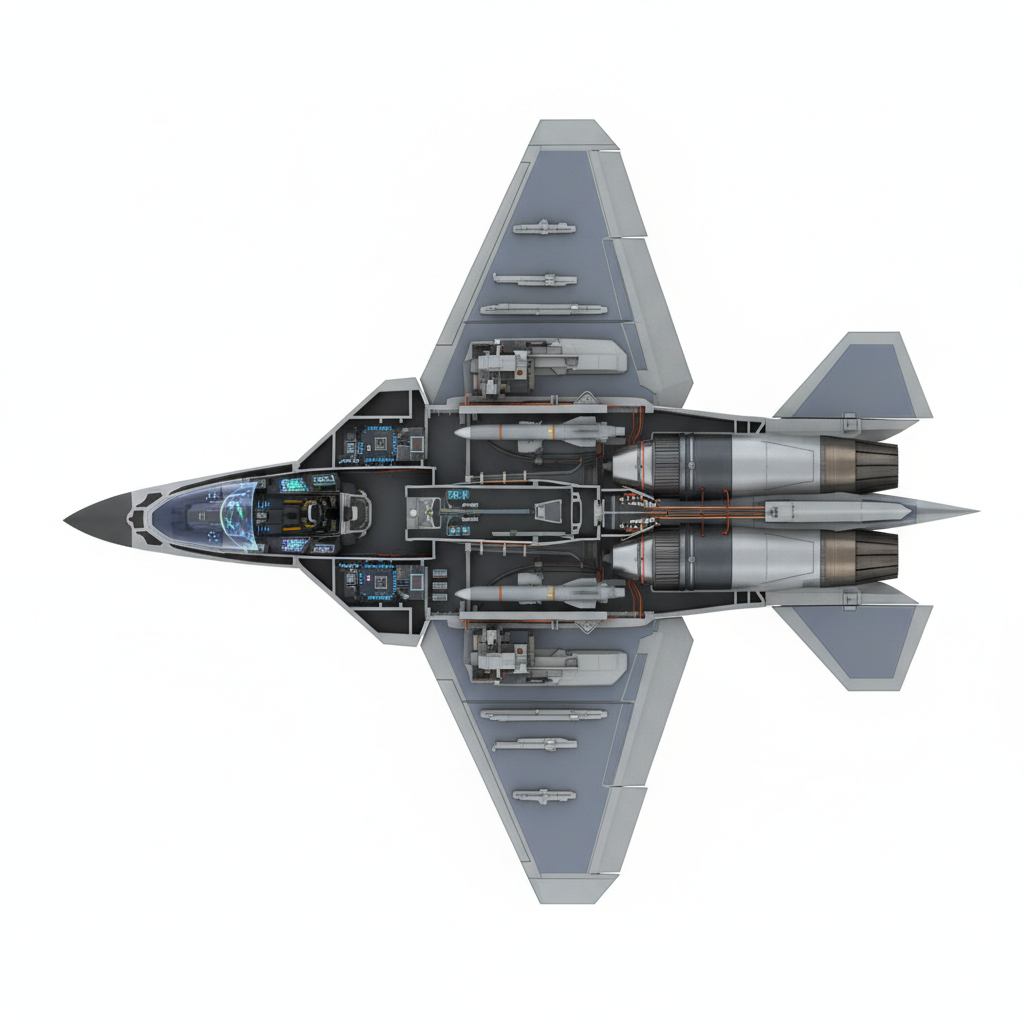
08 Aug India Joins 6th-Gen Fighter Programme: Defence Ministry’s Strategic Move
Sixth-generation fighterStealth technologyAI-driven operations✎ Sixth-generation fighter aircraft are defined by AI integration, networked warfare, and multi-domain operational capabilities, with India’s participation in programmes like FCAS or GCAP contingent on balancing strategic…
Subject Relevance — Where This Topic Fits
- GS Paper II — International Relations: Defence and Strategic Alliances | GS Paper III — Science and Technology: Indigenous Defence Technologies and R&D
- Prelims: Sixth-generation fighter aircraft, Future Combat Air System (FCAS), Advanced Medium Combat Aircraft (AMCA), Defence Acquisition Council (DAC), Indigenous defence production, Strategic partnerships in defence
- Essay: The evolving paradigm of defence modernisation in India: Balancing indigenous innovation with strategic collaborations, The role of parliamentary oversight in defence procurement: Ensuring accountability and strategic foresight
Quick Revision: Sixth-generation fighter aircraft are defined by AI integration, networked warfare, and multi-domain operational capabilities, with India’s participation in programmes like FCAS or GCAP contingent on balancing strategic partnerships with indigenous development under the AMCA programme.
Why is this in the news?
The Ministry of Defence has initiated efforts to integrate India into the development programme of sixth-generation fighter aircraft, specifically the Future Combat Air System (FCAS) led by France, as reported by a Parliamentary Standing Committee on Defence. This move underscores India’s intent to enhance its air combat capabilities through participation in cutting-edge global defence initiatives while simultaneously advancing its indigenous Advanced Medium Combat Aircraft (AMCA) programme. The development is significant against the backdrop of evolving air warfare doctrines and the necessity to bridge technological gaps with peer adversaries.
Background
- The global defence landscape is witnessing a transition towards sixth-generation fighter aircraft, characterised by stealth, AI-driven operations, and network-centric warfare capabilities.
- Two major international consortia are developing sixth-generation aircraft: (a) a tri-national consortium of the UK, Italy, and Japan, and (b) a Franco-German consortium led by France under the FCAS programme.
- India’s indigenous Advanced Medium Combat Aircraft (AMCA) programme is in advanced stages of design, with the Defence Research and Development Organisation (DRDO) leading its development to ensure self-reliance in fighter aircraft technology.
- The Indian Air Force (IAF) has emphasised the need to avoid technological lag in advanced aircraft acquisition, necessitating strategic partnerships or indigenous development to maintain operational parity.
- Parliamentary oversight through the Standing Committee on Defence has highlighted the urgency of formulating a clear roadmap for the acquisition and development of sixth-generation aircraft, ensuring alignment with long-term defence modernisation goals.
- India’s defence procurement policies, governed by the Defence Acquisition Procedure (DAP) 2020, emphasise indigenisation, strategic partnerships, and offset mechanisms to bolster domestic defence manufacturing.
What are Sixth-Generation Fighter Aircraft and the Future Combat Air System (FCAS)?
- Sixth-generation fighter aircraft represent the next evolutionary leap in combat aviation, integrating features such as artificial intelligence, directed-energy weapons, advanced stealth, and networked warfare capabilities, enabling multi-domain operations.
- The Future Combat Air System (FCAS) is a Franco-German initiative led by France, aimed at developing a next-generation combat air system that will replace the Eurofighter Typhoon and Rafale by the mid-2030s.
- FCAS is envisioned as a system-of-systems, comprising a manned Next-Generation Fighter (NGF), unmanned Remote Carrier platforms, and a combat cloud for real-time data integration and decision-making.
- The UK, Italy, and Japan are collaborating under the Global Combat Air Programme (GCAP) to develop a sixth-generation aircraft, with a focus on modular design, open architecture, and export potential to allied nations.
- India’s potential integration into FCAS or GCAP would require alignment with indigenous programmes like AMCA, ensuring technology transfer, co-development, and strategic autonomy.
- The development of sixth-generation aircraft is driven by the need to counter emerging threats, including hypersonic missiles, electronic warfare saturation, and peer adversary advancements in stealth and AI-enabled combat systems.
Key Features
| Feature | Significance |
|---|---|
| Future Combat Air System (FCAS) | A collaborative 6th-generation fighter programme led by France, Germany, and Spain, aiming to develop next-generation stealth, sensor fusion, and AI-driven combat capabilities for multi-domain operations. |
| Advanced Medium Combat Aircraft (AMCA) | India’s indigenous 5th-generation fighter programme, designed to bridge the gap between current 4th-generation platforms and future 6th-generation systems, with stealth, supercruise, and network-centric warfare features. |
| 6th-Generation Fighter Consortia | Two major international groupings: (1) UK-Italy-Japan (GCAP) and (2) France-Germany-Spain (FCAS), both developing next-gen combat aircraft with advanced propulsion, AI integration, and reduced radar cross-section. |
| Parliamentary Standing Committee on Defence | A constitutional body under Article 352 that scrutinises defence expenditure, acquisition policies, and strategic preparedness, ensuring parliamentary oversight of military modernisation. |
| Indigenous Fighter Development | The AMCA programme represents India’s strategic autonomy in fighter aircraft development, reducing reliance on foreign imports and fostering domestic aerospace industry growth. |
Why it Matters
Strategic Autonomy
- Enhances India’s self-reliance in defence manufacturing by integrating with global 6th-gen programmes while advancing indigenous AMCA development.
- Reduces dependence on foreign suppliers for critical aerospace technologies, aligning with the ‘Atmanirbhar Bharat’ initiative.
- Facilitates technology transfer and co-development opportunities, strengthening India’s position in global defence partnerships.
Air Superiority & Modernisation
- 6th-generation fighters will provide quantum leaps in stealth, sensor fusion, and AI-driven combat, ensuring air dominance in future conflicts.
- AMCA’s development ensures India retains a 5th-generation capability while transitioning to 6th-gen systems, preventing obsolescence.
- Modernisation of the IAF is critical for countering emerging threats in the Indo-Pacific and Himalayan regions.
Economic Impact
- Co-joining global programmes can reduce R&D costs through shared development and bulk procurement, optimising defence expenditure.
- Indigenous AMCA programme will boost the aerospace sector, generating employment and fostering innovation in private and public industries.
- Long-term savings from reduced import dependency can be redirected to other critical defence and social sectors.
Geopolitical Implications
- Collaboration with France (FCAS) and other consortia strengthens strategic partnerships in Europe and East Asia, balancing India’s defence diplomacy.
- Enhances interoperability with allied forces, facilitating joint operations and coalition warfare in future conflicts.
- Positions India as a key player in next-generation aerospace technology, influencing global defence standards.
Challenges
1. Technological Lag in Indigenous Development
- AMCA’s development is still in the prototype stage, with delays in engine technology and stealth integration.
- Risk of obsolescence if global 6th-gen programmes advance faster than India’s indigenous efforts.
- Dependence on foreign critical components (e.g., engines, avionics) may limit full self-reliance.
UPSC Link: Science and Technology/Indigenisation
2. High Development Costs and Budgetary Constraints
- 6th-generation fighter programmes require massive R&D investments, straining defence budgets already allocated for other priorities.
- Risk of cost overruns in AMCA and FCAS co-joining efforts, necessitating careful fiscal planning.
- Opportunity cost of diverting funds from other critical defence needs (e.g., submarines, missiles).
UPSC Link: Economic Survey/Defence Expenditure
3. Operational Integration and Interoperability
- Challenges in integrating 6th-gen fighters with existing IAF platforms, command structures, and logistics chains.
- Need for advanced training and doctrine development to exploit 6th-gen capabilities fully.
- Risk of incompatibility with allied forces’ systems if India joins a specific consortium.
UPSC Link: Jointness in Armed Forces
4. Geopolitical Alignment and Strategic Risks
- Choosing between competing consortia (GCAP vs. FCAS) may impact India’s diplomatic relations with Europe and East Asia.
- Risk of technology denial or restrictions imposed by partner nations on critical technologies.
- Potential for over-reliance on foreign partners, undermining strategic autonomy.
UPSC Link: Foreign Policy/Strategic Partnerships
5. Industrial and Human Resource Capacity
- India’s aerospace industry lacks the scale and expertise to rapidly develop 6th-gen fighters independently.
- Shortage of skilled engineers and scientists in advanced aerospace technologies, necessitating capacity building.
- Dependence on foreign OEMs for critical components and maintenance infrastructure.
UPSC Link: Make in India/Industrial Policy
Challenges — UPSC Perspective
| Issue | Concern |
|---|---|
| AMCA Development Delays | Prototyping and testing phases face delays, risking obsolescence before deployment. |
| Budgetary Allocation for 6G Programme | High R&D costs may divert funds from other critical defence modernisation projects. |
| Technology Transfer Barriers | Partner nations may restrict access to critical technologies, limiting India’s strategic gains. |
| Interoperability with Existing IAF Fleet | Integration challenges with legacy platforms (e.g., Su-30MKI, Tejas) may delay operational readiness. |
| Geopolitical Balancing Act | Choosing between GCAP and FCAS consortia may strain diplomatic relations with key partners. |
| Indigenous Engine Development | Dependence on foreign engines (e.g., GE F414) for AMCA may limit full self-reliance. |
Way Forward
- Conduct a comprehensive cost-benefit analysis of co-joining FCAS vs. pursuing AMCA independently, factoring in technology transfer, budgetary constraints, and strategic autonomy.
- Accelerate the AMCA programme by prioritising indigenous engine development (e.g., GTRE’s Kaveri successor) and stealth integration to reduce reliance on foreign components.
- Enhance interoperability by standardising communication protocols and data links between 6th-gen fighters and existing IAF platforms.
- Invest in human resource development through collaborations with IITs, DRDO, and global aerospace firms to build a skilled workforce for 6th-gen technologies.
- Strengthen defence diplomacy by engaging with both GCAP and FCAS consortia to explore hybrid participation models that maximise technology access.
- Develop a phased induction roadmap for 6th-gen fighters, aligning with the IAF’s Long-Term Integrated Perspective Plan (LTIPP) and future force structure.
- Establish a dedicated aerospace innovation ecosystem under the ‘Aatmanirbhar Bharat’ initiative to foster R&D in next-gen aviation technologies.
- Ensure parliamentary oversight by submitting regular status reports on AMCA and 6G programme progress to the Standing Committee on Defence for continuous scrutiny.
UPSC Value Addition
Keywords for Mains Answer-Writing
Sixth-Generation fighter aircraft · Future Combat Air System (FCAS) · Advanced Medium Combat Aircraft (AMCA) · Defence Acquisition Process · Indo-French Defence Cooperation · Parliamentary Standing Committee on Defence · Air Domain Capabilities · Strategic Partnership Model · Defence Industrial Base · Aeronautical Development Agency (ADA) · Make in India in Defence · Joint Development Programme · Modernisation of Indian Air Force · Defence Procurement Procedure (DPP)
Concept Flow
India’s defence modernisation needs → Recognition of obsolescence in 4th-gen fighters → Decision to co-join 6th-gen programmes (FCAS) → Parliamentary scrutiny via Standing Committee on Defence → Strategic autonomy vs. foreign dependence debate → Budgetary allocation for AMCA and FCAS → Technology transfer negotiations → Indigenous R&D acceleration → Interoperability integration → Operational deployment of 6th-gen fighters → Enhanced air superiority and geopolitical influence.
Prelims Practice Questions
Q1. Consider the following statements regarding the Future Combat Air System (FCAS):
1. FCAS is a sixth-generation fighter aircraft programme spearheaded by the French government.
2. The programme involves a consortium of France and Germany.
3. India has already finalised a contract to co-develop FCAS.
4. The Indian Air Force (IAF) is considering joining forces with one of the consortia developing sixth-generation aircraft.
How many of the above statements are correct?
- Only one
- Only two
- Only three
- All
Answer: Only three — Statements 1, 2, and 4 are correct. Statement 3 is incorrect as India has only initiated efforts to co-join the programme and has not finalised any contract.
Q2. Assertion (A): The Advanced Medium Combat Aircraft (AMCA) is being developed indigenously by India.
Reason (R): The AMCA is designed to meet the future combat requirements of the Indian Air Force and reduce dependence on foreign defence equipment.
Options:
A. Both A and R are true, and R is the correct explanation of A.
B. Both A and R are true, but R is not the correct explanation of A.
C. A is true, but R is false.
D. A is false, but R is true.
Answer: ? — Both A and R are true. The AMCA is indeed an indigenous project aimed at enhancing India’s air combat capabilities and reducing reliance on foreign defence equipment.
Q3. Match the following aircraft programmes with their respective countries/consortia:
Column I (Aircraft Programme) | Column II (Country/Consortium)
1. Future Combat Air System (FCAS) | a. UK, Italy, and Japan
2. Advanced Medium Combat Aircraft (AMCA) | b. France and Germany
3. Tempest | c. India
4. Global Combat Air Programme (GCAP) | d. France, Germany, and Spain
Options:
A. 1-b, 2-c, 3-a, 4-d
B. 1-a, 2-b, 3-c, 4-d
C. 1-d, 2-c, 3-b, 4-a
D. 1-b, 2-a, 3-d, 4-c
- A
- B
- C
- D
Answer: A — 1-b (FCAS is led by France and Germany), 2-c (AMCA is an Indian programme), 3-a (Tempest is led by UK, Italy, and Japan), 4-d (GCAP is led by France, Germany, and Spain).
Mains Practice Question
✍ The Ministry of Defence has initiated efforts to co-join the sixth-generation fighter aircraft development programme, Future Combat Air System (FCAS), spearheaded by France. In this context, critically examine the strategic imperatives for India in developing or acquiring sixth-generation fighter aircraft, and assess the challenges in integrating such systems into the Indian Air Force’s operational framework. (15 Marks)
Approach: MODEL-ANSWER SKELETON:
1. **Strategic Imperatives for India** (8 points):
– **Air Domain Dominance**: Sixth-generation aircraft are pivotal for achieving air superiority in contemporary and future warfare, given the increasing air-centric nature of conflicts (e.g., Ukraine war).
– **Indigenous Capability Building**: Highlight the role of the Aeronautical Development Agency (ADA) and Hindustan Aeronautics Limited (HAL) in developing the AMCA as a stepping stone.
– **Reduction of Import Dependence**: Cite the Defence Procurement Procedure (DPP) 2020 and the Strategic Partnership Model to argue for reducing reliance on foreign defence equipment.
– **Technological Leapfrogging**: Emphasise the need to bridge the technology gap with advanced nations (e.g., USA, Russia, China) in stealth, AI integration, and sensor fusion.
– **Deterrence and Strategic Autonomy**: Discuss how advanced fighter aircraft enhance India’s deterrence posture and reduce vulnerability to supply chain disruptions.
– **Multi-Domain Operations**: Link sixth-generation capabilities to India’s evolving doctrine of multi-domain operations (air, land, sea, cyber, space).
– **Indo-French Defence Cooperation**: Analyse the significance of the Indo-French strategic partnership in defence technology collaboration (e.g., Rafale, Scorpene submarines).
– **Make in India Initiative**: Argue how co-development aligns with the ‘Make in India’ initiative and boosts the domestic defence industrial base.
2. **Challenges in Integration** (7 points):
– **Technological Complexity**: Sixth-generation aircraft incorporate cutting-edge technologies (e.g., directed-energy weapons, AI-driven decision-making) that require significant R&D and human resource investment.
– **Cost and Budgetary Constraints**: High development and acquisition costs may strain the defence budget, necessitating prioritisation (e.g., compare with other modernisation programmes like submarines or missiles).
– **Indigenisation Hurdles**: Challenges in developing indigenous engines, avionics, and materials (e.g., Kaveri engine project delays).
– **Operational Readiness**: The need for extensive pilot training, maintenance infrastructure, and simulation facilities to integrate sixth-generation aircraft into existing squadrons.
– **Geopolitical Considerations**: Balancing partnerships with multiple consortia (e.g., France-Germany vs. UK-Italy-Japan) to avoid over-dependence or strategic misalignment.
– **Regulatory and Bureaucratic Delays**: Highlight the role of the Defence Acquisition Council (DAC) and the need for streamlined processes under DPP 2020.
– **Maintenance and Logistics**: Establishing a robust maintenance, repair, and overhaul (MRO) ecosystem for advanced aircraft, including foreign collaborations where necessary.
Source: Mint
Generated by AanyaAi for educational purpose.

- बिहार सरकार का बड़ा कदम: 25 हजार परिवारों को सौर ऊर्जा सहायता, 534 प्रखंडों में सोलर मार्ट खोले जाएंगे - September 23, 2026
- Bihar Launches Mega Solar Scheme: 25,000 Families to Benefit, 534 Solar Marts - September 23, 2026
- सुपर एल नीनो से भारत में 15,800 अतिरिक्त गर्मी से मौतें: जानिए पूरा मामला - September 23, 2026

No Comments