


08 Aug CWC Rejects Karnataka’s Mekedatu DPR Over Water Allocation Violation
✎ The Mekedatu Project’s consumptive water use of 6.95 tmcft exceeds the Supreme Court-mandated limit of 6.5 tmcft, necessitating a revised DPR compliant with the Cauvery Water Disputes Tribunal Award and CWC guidelines.
Subject Relevance — Where This Topic Fits
- GS Paper II — Issues and Challenges Pertaining to the Federal Structure, Devolution of Powers and Finances up to Local Levels and Challenges Therein | GS Paper III — Water Resources and Related Issues
- Prelims: Cauvery Water Disputes Tribunal (CWDT) Award, Central Water Commission (CWC), Mekedatu Project, Tamil Nadu-Karnataka water dispute, Inter-State River Water Disputes Act, 1956, Supreme Court’s 2018 order on Cauvery water allocation, Consumptive use of water, Live Storage Capacity, Run-of-River Hydroelectric Project, Bengaluru Metropolitan Region water supply
- Essay: Federalism in India: Balancing Development and Inter-State Equity, Water Security in India: Challenges of Inter-State River Disputes and Sustainable Management
Quick Revision: The Mekedatu Project’s consumptive water use of 6.95 tmcft exceeds the Supreme Court-mandated limit of 6.5 tmcft, necessitating a revised DPR compliant with the Cauvery Water Disputes Tribunal Award and CWC guidelines.
Why is this in the news?
The Central Water Commission (CWC) has returned Karnataka’s revised Detailed Project Report (DPR) for the Mekedatu Balancing Reservoir-cum-Drinking Water Project, citing non-compliance with the Cauvery Water Disputes Tribunal (CWDT) Award and excessive consumptive water use. This development underscores the persistent tensions in inter-state river water governance and the procedural challenges in executing large-scale water infrastructure projects in India.
Background
- The Cauvery River dispute between Karnataka and Tamil Nadu has persisted for over a century, with the Cauvery Water Disputes Tribunal (CWDT) established in 1990 to adjudicate the matter. The Tribunal’s final award, delivered in 2007, was modified by the Supreme Court in 2018, finalizing and allocating a total consumptive use of 6.5 tmcft to Karnataka for its urban and rural population in its order.
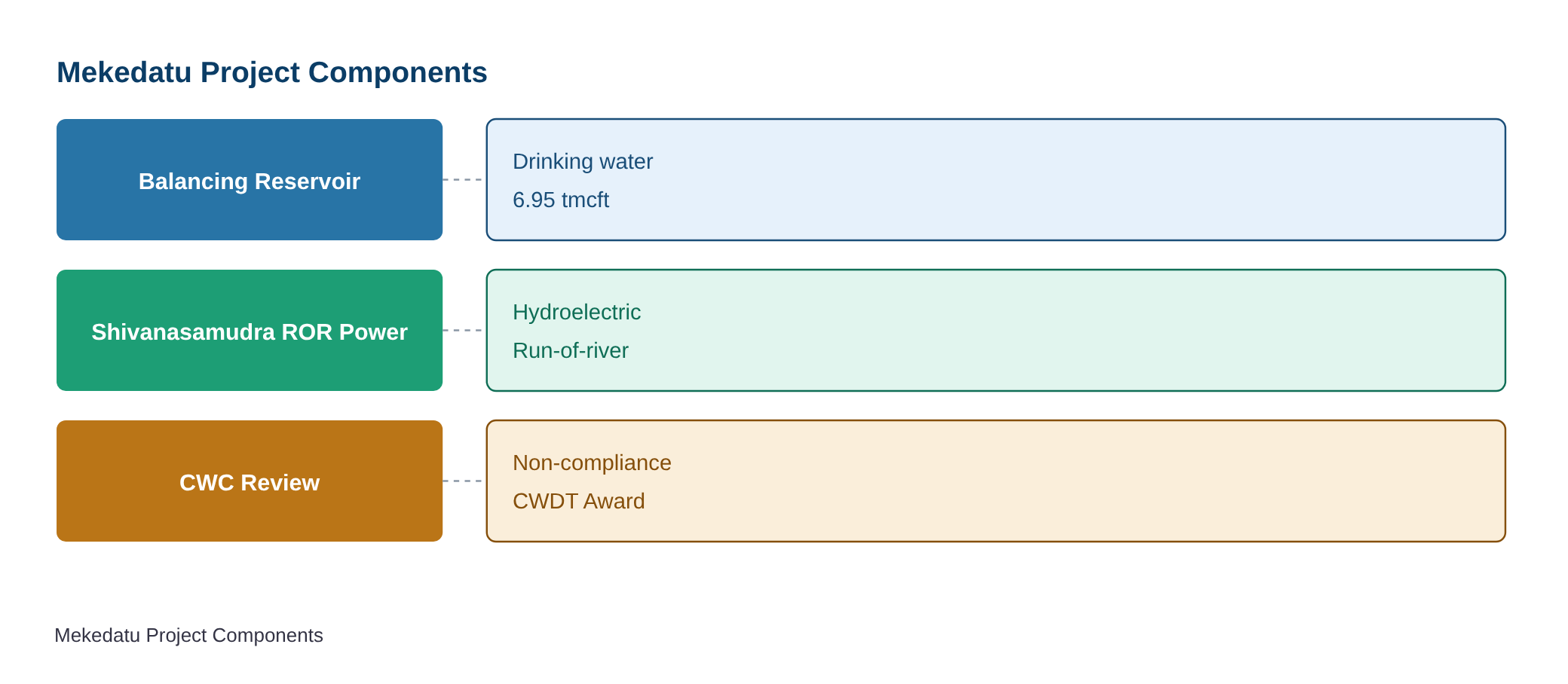
- The project gained renewed momentum in 2019 when Karnataka submitted its first DPR to the CWC, which was subsequently revised in April 2026 to include additional components such as the Shivanasamudra Run-of-River Power Project and an increased consumptive use of 6.95 tmcft.
- Tamil Nadu has consistently opposed the project, arguing that it violates the CWDT Award and Supreme Court orders by diverting water earmarked for Tamil Nadu’s agricultural and drinking water needs.
- The CWC’s role as the apex technical body for water resource development in India requires it to scrutinise DPRs for compliance with inter-state water agreements, environmental norms, and technical feasibility before granting clearance.
- The Supreme Court’s 2018 order capped Karnataka’s consumptive use at 6.5 tmcft, including existing usage, leaving limited scope for additional diversion without triggering inter-state disputes.
What is the Mekedatu Project?
- The Mekedatu Project is a proposed multi-purpose infrastructure initiative by the Government of Karnataka, located near Kanakapura in Ramanagara district, approximately 100 km from Bengaluru.
- The primary objective of the project is to construct a balancing reservoir across the Cauvery River to store and regulate water flows, thereby augmenting drinking water supply to the Bengaluru Metropolitan Region (BMR) and its adjoining areas.
- The project includes a balancing reservoir with a proposed live storage capacity of 59.46 tmcft, designed to mitigate water shortages during lean monsoon seasons and reduce dependency on upstream releases from Tamil Nadu.
- In its revised DPR (April 2026), Karnataka incorporated additional components, including the Shivanasamudra Run-of-River Power Project, which involves constructing a diversion weir to generate hydroelectric power.
- The CWC observed that the ‘proposed consumptive use of water is more than allocation’ and noted a total consumptive use of 6.5 tmcft has been finalised and allocated by the Supreme Court.
- The project is justified by Karnataka on the grounds of historical water flows to Tamil Nadu during surplus monsoon years, arguing that Karnataka’s share has been underutilised in the past.
- Environmental and ecological concerns have been raised, particularly regarding the impact on downstream flows in Tamil Nadu, which relies heavily on Cauvery water for agriculture and drinking purposes.
- The project is framed as a critical intervention to address Bengaluru’s chronic water scarcity, exacerbated by rapid urbanisation, groundwater depletion, and erratic monsoon patterns.
Key Features
| Feature | Significance |
|---|---|
| Mekedatu Balancing Reservoir-cum-Drinking Water Project | Proposed multipurpose project to augment drinking water supply to Bengaluru Metropolitan Region and adjoining areas through a balancing reservoir on the Cauvery River. |
| Consumptive Use of Water | Refers to water withdrawn from a source and not returned to it; Karnataka’s revised proposal seeks 6.95 tmcft, exceeding the Supreme Court’s allocation of 6.5 tmcft for urban and rural use. |
| Shivanasamudra Run-of-River Power Project | Additional component proposed in the revised scheme, involving diversion weir construction across the Cauvery River for hydroelectric power generation. |
| Cauvery Water Disputes Tribunal (CWDT) Award | Legal framework governing inter-state water sharing; Karnataka’s DPR must comply with its provisions and subsequent Supreme Court orders. |
| Central Water Commission (CWC) Guidelines | Technical and procedural standards for irrigation and multipurpose projects, including submission, appraisal, and acceptance protocols. |
Why it Matters
Inter-State Water Governance
- The Mekedatu project exemplifies the complexities of inter-state river water sharing under the Cauvery basin framework, necessitating adherence to judicial and tribunal awards.
- The CWC’s intervention underscores the role of central agencies in ensuring compliance with constitutional and statutory water-sharing agreements.
- The dispute highlights the need for sustainable water resource management to balance developmental needs with ecological and equity considerations.
Urban Water Security
- Bengaluru’s rapid urbanisation and projected water demand necessitate augmentation of supply sources, making Mekedatu a critical infrastructure proposal.
- The project aims to address chronic water shortages in the region, which have implications for public health, economic stability, and social equity.
- Long-term planning for water security is essential to mitigate the risks of recurring droughts and over-extraction of groundwater.
Hydroelectric Power Generation
- The inclusion of the Shivanasamudra Run-of-River Power Project in the revised DPR diversifies the project’s objectives beyond drinking water supply.
- Hydroelectric projects contribute to renewable energy generation, aligning with India’s commitments to sustainable development and climate action.
- Balancing energy generation with ecological and social impacts remains a key challenge in riverine projects.
Challenges
1. Exceeding Allocated Water Use
- Karnataka’s revised proposal seeks 6.95 tmcft of consumptive use, which exceeds the Supreme Court’s allocation of 6.5 tmcft for urban and rural use.
- The CWC has highlighted that even the 36-year-old consumptive use of 2.9 tmcft leaves a balance of only 3.6 tmcft for any new project, necessitating a reduction in the proposed quantum.
- This discrepancy risks violating inter-state water-sharing agreements and could escalate disputes with Tamil Nadu.
UPSC Link: GS-II: Inter-State Relations
2. Ecological and Environmental Concerns
- The construction of a balancing reservoir and diversion weir may alter river flow dynamics, impacting aquatic ecosystems and biodiversity in the Cauvery basin.
- Potential sedimentation and reduced downstream flow could affect agricultural practices and livelihoods in Tamil Nadu, exacerbating inter-state tensions.
- Environmental Impact Assessments (EIAs) and compliance with the Environmental Protection Act, 1986, are critical but often contentious in such projects.
UPSC Link: GS-III: Environmental Conservation
3. Technical and Procedural Compliance
- The CWC has raised concerns about the appropriateness of the proposed Live Storage Capacity of 59.46 tmcft, indicating a need for revised technical justifications.
- The DPR must align with the CWC’s guidelines for project submission, appraisal, and acceptance, which include updated drawings and detailed technical specifications.
- Delays in compliance could stall the project, delaying water supply and economic benefits for Bengaluru.
UPSC Link: GS-III: Water Resources
4. Inter-State Political and Legal Disputes
- Tamil Nadu has historically opposed Karnataka’s water diversion projects, citing potential impacts on its agricultural sector and water rights.
- Legal challenges and political posturing could prolong the approval process, necessitating robust negotiation mechanisms.
- The role of the Cauvery Management Board (CMB) and the Supreme Court’s oversight remains pivotal in resolving disputes.
UPSC Link: GS-II: Federalism
5. Financial Viability and Cost Recovery
- Large infrastructure projects like Mekedatu require substantial public investment, raising questions about cost-effectiveness and long-term financial sustainability.
- User charges for water supply and power generation must be structured to ensure equitable access and revenue generation for maintenance.
- Public-Private Partnership (PPP) models may be explored, but they introduce additional complexities in governance and accountability.
UPSC Link: GS-III: Economic Development
Challenges — UPSC Perspective
| Issue | Concern |
|---|---|
| Exceeding Allocated Water Use | Risk of violating inter-state water-sharing agreements and escalating disputes with Tamil Nadu. |
| Ecological Impact | Potential alteration of river flow dynamics, affecting biodiversity and downstream agricultural practices. |
| Technical Non-Compliance | Need for revised DPR to meet CWC guidelines, delaying project implementation. |
| Inter-State Disputes | Historical opposition from Tamil Nadu and legal challenges prolonging approval processes. |
| Financial Sustainability | High public investment and cost recovery challenges for a multipurpose project. |
Way Forward
- Karnataka must revise the DPR to align with the Supreme Court’s allocation of 6.5 tmcft for consumptive use, reducing the proposed quantum to 3.6 tmcft or less.
- Conduct a comprehensive Environmental Impact Assessment (EIA) and obtain necessary clearances under the Environmental Protection Act, 1986, to address ecological concerns.
- Engage in structured negotiations with Tamil Nadu under the aegis of the Cauvery Management Board (CMB) to resolve inter-state disputes and secure consent.
- Submit the revised DPR to the CWC with updated technical drawings, live storage capacity justifications, and compliance with the 2017 guidelines for project appraisal.
- Explore alternative water augmentation strategies, such as rainwater harvesting, groundwater recharge, and wastewater recycling, to supplement the Mekedatu project.
- Develop a robust financial model for the project, including user charges, PPP frameworks, and cost-sharing mechanisms to ensure long-term viability.
- Prioritise public consultations and stakeholder engagement to address social and environmental concerns, ensuring inclusive decision-making.
- Monitor and evaluate the project’s progress through independent third-party audits to ensure transparency and accountability in implementation.
UPSC Value Addition
Keywords for Mains Answer-Writing
Inter-State River Water Disputes (ISRWD) Act, 1956 · Cauvery Water Disputes Tribunal (CWDT) Award · Cauvery River · Mekedatu Project · Central Water Commission (CWC) · Detailed Project Report (DPR) · Consumptive Use of Water · Supreme Court directions on Cauvery · Karnataka-Tamil Nadu water sharing · Inter-State Water Disputes (Amendment) Bill, 2019 · River basin management · Urban water supply infrastructure
Constitutional & Policy Linkages
- Article 262: Adjudication of disputes relating to inter-state rivers and river valleys.
- Seventh Schedule, List I, Entry 56: Regulation and development of inter-state rivers and river valleys.
- Seventh Schedule, List II, Entry 17: Water, that is to say, water supplies, irrigation and canals, drainage and embankments, water storage and water power subject to Entry 56 of List I.
Concept Flow
Cauvery River Basin → Inter-State Water Sharing Disputes (Karnataka vs Tamil Nadu) → Supreme Court Orders (2018) → Allocation of 6.5 tmcft for Karnataka → Karnataka’s Proposal for Mekedatu Project (4.75 tmcft → 6.95 tmcft) → CWC’s Observation (Exceeds Allocation) → Revision of DPR → Compliance with CWDT Award and CWC Guidelines → Environmental and Ecological Impact Assessment → Inter-State Negotiations → Final Approval and Implementation → Water Supply Augmentation for Bengaluru Metropolitan Region
Prelims Practice Questions
Q1. Consider the following statements regarding the Mekedatu Project:
1. The project aims to provide drinking water to the Bengaluru Metropolitan Region.
2. The Central Water Commission (CWC) has approved the Detailed Project Report (DPR) without any modifications.
3. The project proposes additional consumptive use of water beyond the Supreme Court’s allocation.
4. The project includes the construction of a diversion weir across the Cauvery River for a run-of-the-river power project.
How many of the above statements are correct?
- Only one
- Only two
- Only three
- All four
Answer: Only three — Statements 1, 3, and 4 are correct. Statement 2 is incorrect as the CWC has returned the DPR for revision.
Q2. Assertion (A): The Cauvery Water Disputes Tribunal (CWDT) Award is binding on all parties and cannot be modified by the Supreme Court.
Reason (R): The Supreme Court, in its 2018 judgment, modified the allocation of water among the riparian states as per the CWDT Award.
- Both A and R are true, and R is the correct explanation of A.
- Both A and R are true, but R is not the correct explanation of A.
- A is true, but R is false.
- A is false, but R is true.
Answer: ? — Assertion (A) is false because the Supreme Court has the power to modify the CWDT Award. Reason (R) is true as the Supreme Court did modify the allocation in its 2018 judgment.
Q3. Match the following projects with their respective states:
List I (Project) | List II (State)
—————-|————–
A. Mekedatu Project | 1. Tamil Nadu
B. Shivanasamudra Run-of-River Power Project | 2. Karnataka
C. Mullaperiyar Dam | 3. Kerala
D. Kallanai Dam | 4. Puducherry
- A-2, B-2, C-1, D-3
- A-2, B-2, C-1, D-4
- A-1, B-2, C-3, D-4
- A-2, B-1, C-3, D-4
Answer: A-2, B-2, C-1, D-4 — The Mekedatu Project and Shivanasamudra Run-of-River Power Project are both in Karnataka. Mullaperiyar Dam is in Tamil Nadu, and Kallanai Dam is in Tamil Nadu (not Puducherry).
Mains Practice Question
✍ The Central Water Commission’s directive to Karnataka to revise the Detailed Project Report (DPR) for the Mekedatu Project underscores the complexities of inter-state river water governance in India. Critically examine the legal, institutional, and environmental dimensions of such inter-state water disputes. Also, analyse the role of the Supreme Court in adjudicating these disputes and the implications of its interventions for federalism in India. (15 Marks)
Approach: Introduction (1 mark): Briefly define inter-state river water disputes and cite the Mekedatu case as a contemporary example. Legal Framework (3 marks): – Mention the Inter-State River Water Disputes (ISRWD) Act, 1956, and its limitations (e.g., no permanent tribunal until 2019 amendment). – Highlight the Cauvery Water Disputes Tribunal (CWDT) Award and its binding nature under Article 262 of the Constitution. – Discuss the Supreme Court’s role in modifying the CWDT Award (e.g., 2018 judgment) and its implications for federalism. Institutional Mechanisms (3 marks): – Role of the Central Water Commission (CWC) in scrutinising DPRs and ensuring compliance with water allocation principles. – Limitations of the CWC: lack of statutory authority, delays in dispute resolution, and the need for a permanent tribunal. – The Inter-State Water Disputes (Amendment) Act, 2019: creation of the Inter-State River Water Disputes Tribunal and its potential to streamline disputes. Environmental and Equity Dimensions (4 marks): – Environmental concerns: impact of large dams on river ecosystems, biodiversity, and climate change. – Equity issues: upstream vs. downstream states, urban vs. rural water allocation, and the principle of ‘equitable apportionment’. – The Mekedatu case: Karnataka’s argument of historical water flows vs. Tamil Nadu’s concerns over reduced water availability. Supreme Court’s Interventions (3 marks): – The Supreme Court’s 2018 judgment modifying the CWDT Award: balancing equity, federalism, and judicial activism. – Critique of judicial interventions: overreach, lack of technical expertise, and delays in implementation. – Suggestions for reform: strengthening institutional mechanisms, promoting cooperative federalism, and integrating environmental considerations. Conclusion (1 mark): Summarise the need for a balanced approach that respects federalism, equity, and environmental sustainability in inter-state water governance.
Source: The Hindu
Generated by AanyaAi for educational purpose.


No Comments