


08 Aug CWC Rejects Karnataka’s Mekedatu Project DPR Over Water Allocation Violation
✎ The Mekedatu project’s consumptive water use (6.95 tmcft) exceeds Karnataka’s Supreme Court-allocated quantum (6.5 tmcft), necessitating a revised DPR to comply with inter-state water agreements and legal frameworks.
Subject Relevance — Where This Topic Fits
- GS Paper II — Polity and Governance (Inter-State Water Disputes) | GS Paper III — Environment and Water Resources
- Prelims: Cauvery Water Disputes Tribunal (CWDT), Cauvery River Authority (CRA), Inter-State River Water Disputes Act, 1956, Supreme Court’s 2018 verdict on Cauvery, consumptive water use, tmcft (thousand million cubic feet), balancing reservoir, run-of-river hydroelectric project, Live Storage Capacity, Tamil Nadu-Karnataka water dispute, Cauvery basin states
- Essay: Inter-State Water Disputes: Causes, Legal Frameworks, and Sustainable Solutions, Federalism and Resource Allocation: Balancing Development and Equity in India
Quick Revision: The Mekedatu project’s consumptive water use (6.95 tmcft) exceeds Karnataka’s Supreme Court-allocated quantum (6.5 tmcft), necessitating a revised DPR to comply with inter-state water agreements and legal frameworks.
Why is this in the news?
The Central Water Commission (CWC) has returned Karnataka’s revised Detailed Project Report (DPR) for the Mekedatu Balancing Reservoir-cum-Drinking Water Project, citing non-compliance with the Cauvery Water Disputes Tribunal (CWDT) Award and Supreme Court directives. The CWC observed that the proposed consumptive water use exceeds Karnataka’s allocated quantum under the 2018 Supreme Court verdict, necessitating a revised DPR to align with legal and technical stipulations.
Background
- The Cauvery River, a transboundary river, is governed by the Cauvery Water Disputes Tribunal (CWDT) Award, 2007, which was modified by the Supreme Court in 2018.
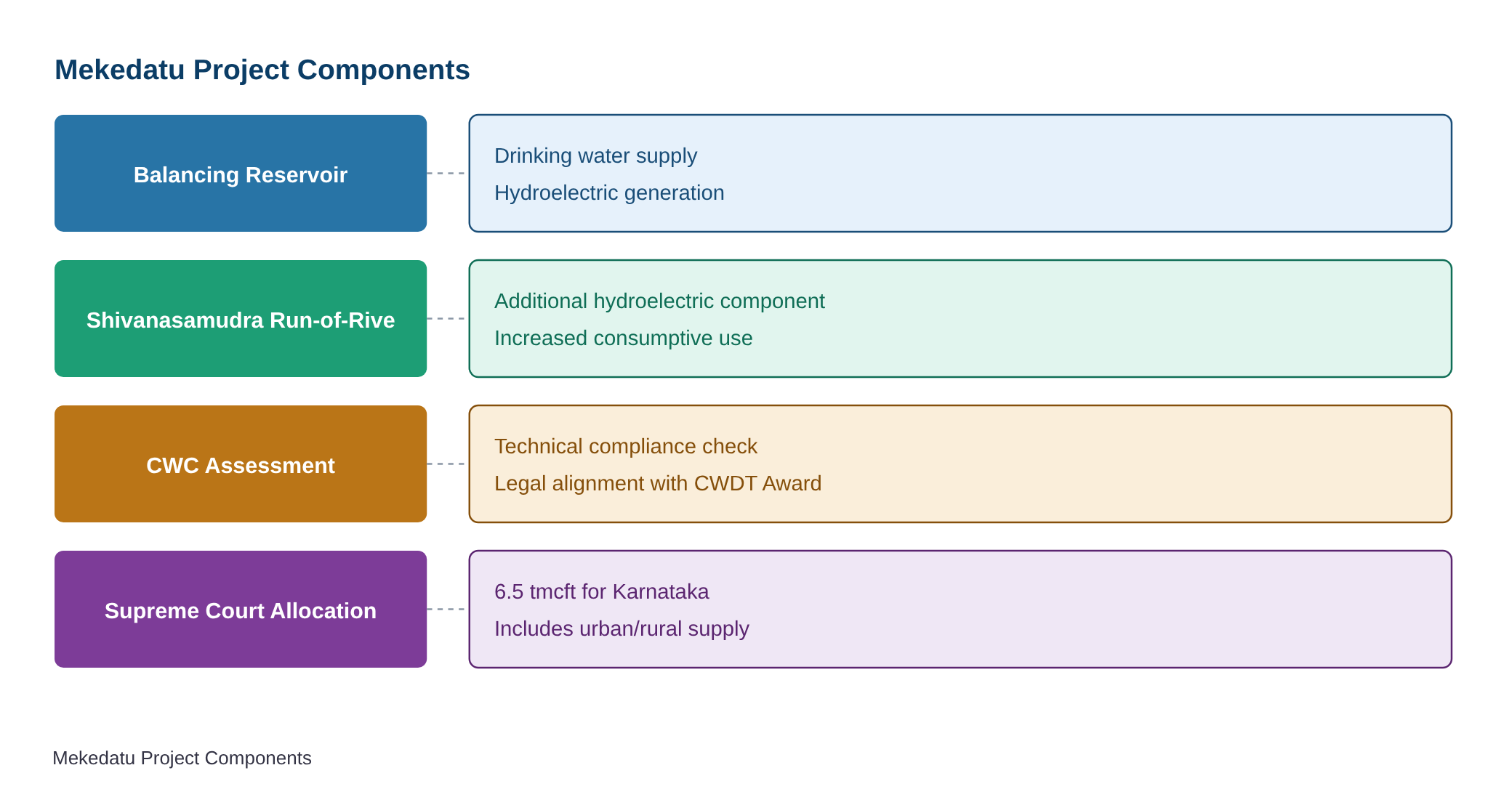
- The Mekedatu project, proposed by Karnataka in the Ramanagara district, aims to create a balancing reservoir to augment drinking water supply to Bengaluru and its environs, while also incorporating hydroelectric generation.
- The project has been a subject of contention between Karnataka and Tamil Nadu, with Tamil Nadu opposing any diversion of Cauvery waters that may reduce its share, as stipulated by the CWDT Award.
- The CWC, as the nodal agency for water resource projects, assesses DPRs for technical and legal compliance with inter-state water agreements and Supreme Court directives.
- Karnataka submitted the first DPR in 2019, followed by a revised DPR in April 2026, which included additional components such as the Shivanasamudra Run-of-River Power Project, increasing the proposed consumptive use from 4.75 tmcft to 6.95 tmcft.
- The Supreme Court, in its 2018 verdict, allocated 6.5 tmcft to Karnataka for urban and rural water supply, which includes both present and historical consumptive use.
What is the Mekedatu Project?
- The Mekedatu Project is a multipurpose initiative proposed by the Government of Karnataka to construct a balancing reservoir across the Cauvery River in the Ramanagara district, near Bengaluru.
- The primary objective is to augment drinking water supply to the Bengaluru Metropolitan Region and its adjoining areas, addressing chronic water shortages.
- The project includes a balancing reservoir with a proposed live storage capacity of 59.46 tmcft, designed to regulate water flow and ensure equitable distribution.
- In its revised DPR (April 2026), Karnataka added a hydroelectric component—the Shivanasamudra Run-of-River Power Project—proposing a diversion weir to generate electricity.
- The project aims to utilise an additional 6.95 tmcft of water for consumptive purposes, including drinking water supply.
- The balancing reservoir is intended to mitigate flood risks by storing excess monsoon flows and releasing water during lean periods to meet downstream demands.
- The project is situated in the Cauvery basin, a region governed by the Cauvery Water Disputes Tribunal Award and subsequent Supreme Court directives.
- The project has been framed as a response to Karnataka’s argument that Tamil Nadu receives disproportionately higher water volumes during good monsoon years, despite Karnataka’s allocated share.
Key Features
| Feature | Significance |
|---|---|
| Mekedatu Balancing Reservoir-cum-Drinking Water Project | A multipurpose infrastructure project proposed by Karnataka to augment drinking water supply to Bengaluru Metropolitan Region and generate hydropower through the Shivanasamudra Run-of-River Power Project. |
| Consumptive Use of Water | Refers to water diverted from the river system for human consumption or industrial use. Karnataka’s revised DPR proposes 6.95 tmcft, exceeding the Supreme Court’s allocation of 6.5 tmcft for Karnataka. |
| Cauvery Water Disputes Tribunal (CWDT) Award | A legally binding adjudication by the CWDT under the Inter-State Water Disputes Act, 1956, allocating Cauvery river waters among Karnataka, Tamil Nadu, Kerala, and Puducherry. |
| Central Water Commission (CWC) | A statutory body under the Ministry of Jal Shakti, responsible for technical scrutiny of water resource projects, including DPRs, to ensure compliance with national and inter-state water agreements. |
| Supreme Court’s Interim Order (2018) | Temporarily allocated 6.5 tmcft of Cauvery waters to Karnataka for urban and rural consumption, pending final resolution of the Cauvery dispute. |
Why it Matters
Inter-State Water Governance
- Demonstrates the persistent challenge of equitable water distribution among riparian states, particularly in inter-state river basins like the Cauvery.
- Highlights the role of constitutional and statutory bodies (CWDT, CWC, Supreme Court) in adjudicating and regulating water-sharing disputes.
- Underscores the need for rigorous technical scrutiny of water projects to prevent over-exploitation and ensure adherence to legal allocations.
Urban Water Security
- Bengaluru’s rapid urbanisation and water stress necessitate augmentation of potable water supply, making projects like Mekedatu strategically significant for the state.
- The project aims to address the gap between demand and supply in the Bengaluru Metropolitan Region, which is a critical infrastructure challenge for Karnataka.
Hydropower Generation
- The inclusion of the Shivanasamudra Run-of-River Power Project in the revised DPR adds a renewable energy dimension, aligning with India’s climate commitments under the Paris Agreement.
Judicial and Administrative Oversight
- The CWC’s intervention reflects the multi-layered governance structure for water projects, involving judicial, statutory, and technical scrutiny to balance development and equity.
Challenges
1. Inter-State Water Disputes
- Karnataka’s proposal to utilise 6.95 tmcft exceeds the Supreme Court’s allocation of 6.5 tmcft, risking legal challenges from Tamil Nadu, which relies on Cauvery waters for agriculture and livelihoods.
- Historical tensions over water-sharing in the Cauvery basin necessitate meticulous compliance with the CWDT Award and Supreme Court orders to avoid escalation.
UPSC Link: GS Paper 2: Inter-State Relations
2. Technical and Environmental Concerns
- The CWC has flagged the appropriateness of the proposed live storage capacity (59.46 tmcft), suggesting potential overestimation or misalignment with hydrological realities.
- Environmental impact assessments for the Mekedatu reservoir and diversion weir must address concerns related to river ecology, sediment flow, and downstream water availability in Tamil Nadu.
UPSC Link: GS Paper 3: Environmental Impact Assessment
3. Project Viability and Funding
- The revised DPR includes additional components (e.g., hydropower), increasing the project’s complexity and cost, which may pose challenges in securing central approvals and funding.
- Delays in approvals due to inter-state disputes or technical objections could escalate costs and impact the project’s economic viability.
UPSC Link: GS Paper 3: Infrastructure Financing
4. Legal and Procedural Compliance
- Karnataka must revise the DPR to align with the CWDT Award and CWC guidelines, ensuring all technical, legal, and environmental parameters are met before resubmission.
- Non-compliance risks rejection by the CWC, further delaying the project and exacerbating Bengaluru’s water scarcity.
UPSC Link: GS Paper 2: Constitutional Bodies
5. Climate Change and Hydrological Uncertainty
- Changing precipitation patterns and reduced snowmelt in the Cauvery basin’s catchment areas could undermine the project’s long-term water availability assumptions.
- Integrating climate resilience into the project design is essential to mitigate risks associated with variability in monsoon patterns.
UPSC Link: GS Paper 3: Climate Change
Challenges — UPSC Perspective
| Issue | Concern |
|---|---|
| Exceeding Allocated Water Use | Proposed consumptive use (6.95 tmcft) exceeds Supreme Court’s allocation (6.5 tmcft), risking inter-state legal disputes. |
| Technical Scrutiny by CWC | CWC’s observations on live storage capacity and DPR compliance may necessitate significant revisions, delaying project implementation. |
| Environmental Impact | Reservoir construction and diversion weir may disrupt river ecology and downstream water availability in Tamil Nadu. |
| Funding and Economic Viability | Inclusion of additional components (e.g., hydropower) increases project cost and complexity, posing challenges for financing and approvals. |
| Climate Variability | Uncertainty in monsoon patterns and hydrological flows may reduce the project’s long-term water supply reliability. |
Way Forward
- Karnataka must revise the DPR to align with the Supreme Court’s allocation of 6.5 tmcft and the CWDT Award, ensuring the proposed consumptive use does not exceed legal limits.
- Engage in bilateral and multilateral consultations with Tamil Nadu to address concerns regarding downstream water availability and ecological impact, fostering cooperative federalism.
- Conduct a comprehensive hydrological and environmental impact assessment to validate the proposed live storage capacity and reservoir design, incorporating climate resilience measures.
- Submit the revised DPR to the CWC for technical scrutiny, adhering to the ‘Guidelines for Submission, Appraisal & Acceptance of Irrigation and Multipurpose Projects, 2017’.
- Explore alternative water augmentation strategies, such as rainwater harvesting, wastewater recycling, and groundwater recharge, to supplement the Mekedatu project and reduce pressure on the Cauvery basin.
- Prioritise the development of the Shivanasamudra Run-of-River Power Project as a renewable energy component to enhance the project’s economic viability and align with India’s climate goals.
- Establish a multi-stakeholder monitoring committee, including representatives from Karnataka, Tamil Nadu, Kerala, Puducherry, and central agencies, to oversee project implementation and resolve disputes proactively.
UPSC Value Addition
Keywords for Mains Answer-Writing
Mekedatu project · Cauvery Water Disputes Tribunal (CWDT) Award · Central Water Commission (CWC) · Detailed Project Report (DPR) · consumptive use of water · Cauvery River water sharing · Bengaluru water supply · interstate river water disputes · Supreme Court orders on Cauvery · inter-basin water transfer · run-of-river hydroelectric projects · water allocation mechanisms · Karnataka-Tamil Nadu water disputes · Cauvery basin management
Constitutional & Policy Linkages
- [‘Article 262: Inter-State Water Disputes’, ‘Empowers Parliament to adjudicate water disputes between states.’]
- [‘Article 263: Inter-State Council’, ‘Provides a forum for resolving inter-state disputes, including water-sharing issues.’]
Concept Flow
Cauvery River Basin: Shared by Karnataka, Tamil Nadu, Kerala, and Puducherry, necessitating equitable water distribution. → Urban Water Stress: Bengaluru’s rapid growth exacerbates demand for potable water, prompting Karnataka to propose the Mekedatu project. → DPR Submission: Karnataka submits a DPR for the Mekedatu project, including a balancing reservoir and hydropower component, to the CWC for approval. → CWC Scrutiny: The CWC identifies discrepancies in consumptive use (6.95 tmcft vs. Supreme Court’s 6.5 tmcft) and technical concerns, returning the DPR for revision. → Legal and Technical Compliance: Karnataka must revise the DPR to comply with the CWDT Award, Supreme Court orders, and CWC guidelines before resubmission. → Inter-State Consultations: Karnataka engages with Tamil Nadu to address downstream water concerns and ecological impacts, aiming for cooperative resolution. → Project Implementation: Upon CWC approval, the project proceeds, augmenting Bengaluru’s water supply and generating hydropower while ensuring compliance with inter-state agreements.
Prelims Practice Questions
Q1. Consider the following statements regarding the Mekedatu project:
1. The project aims to provide drinking water to the Bengaluru Metropolitan Region.
2. The Central Water Commission (CWC) has approved the Detailed Project Report (DPR) without any modifications.
3. The project includes the construction of a balancing reservoir and a run-of-river hydroelectric project.
How many of the above statements are correct?
- Only one
- Only two
- All
- None
Answer: All — Statements 1 and 3 are correct. Statement 2 is incorrect as the CWC has returned the DPR, asking for revisions. The project indeed aims to provide drinking water and includes a balancing reservoir and a run-of-river hydroelectric project.
Q2. Assertion (A): The Cauvery Water Disputes Tribunal (CWDT) Award allocates a specific quantum of water to Karnataka for consumptive use.
Reason (R): The Supreme Court, in its order dated February 16, 2018, upheld the CWDT Award and finalised the consumptive use quantum for Karnataka.
- Both A and R are true, and R is the correct explanation of A
- Both A and R are true, but R is not the correct explanation of A
- A is true, but R is false
- A is false, but R is true
Answer: Both A and R are true, but R is not the correct explanation of A — Both the assertion and reason are true. The CWDT Award, as upheld by the Supreme Court, allocates a specific quantum of water for consumptive use to Karnataka, making R the correct explanation of A.
Q3. Match the following columns related to the Mekedatu project and Cauvery water disputes:
Column I
1. Mekedatu Balancing Reservoir
2. Cauvery Water Disputes Tribunal (CWDT) Award
3. Central Water Commission (CWC)
4. Supreme Court order dated February 16, 2018
Column II
A. Finalised consumptive use quantum for Karnataka
B. Regulatory body for water projects in India
C. Proposed project in Karnataka for drinking water and hydroelectric power
D. Tribunal constituted to resolve interstate river water disputes
- 1-C, 2-D, 3-B, 4-A; 1-D, 2-C, 3-A, 4-B; 1-B, 2-A, 3-D, 4-C; 1-A, 2-B, 3-C, 4-D
- answer_string_map_indexed_to_options_array_indexes_above
Answer: 1-C, 2-D, 3-B, 4-A; 1-D, 2-C, 3-A, 4-B; 1-B, 2-A, 3-D, 4-C; 1-A, 2-B, 3-C, 4-D — 1-C: Mekedatu Balancing Reservoir is a proposed project in Karnataka. 2-D: The Cauvery Water Disputes Tribunal (CWDT) was constituted to resolve interstate river water disputes. 3-B: The Central Water Commission (CWC) is the regulatory body for water projects in India. 4-A: The Supreme Court order dated February 16, 2018, finalised the consumptive use quantum for Karnataka.
Mains Practice Question
✍ The Mekedatu Balancing Reservoir-cum-Drinking Water Project exemplifies the complexities of interstate river water allocation and inter-basin water transfer in India. Critically examine the legal, technical, and political dimensions of such projects, with reference to the Cauvery Water Disputes Tribunal Award, the Supreme Court’s role, and the Central Water Commission’s observations. (15 Marks)
Approach: MODEL-ANSWER SKELETON:
1. **Legal Framework and Institutional Roles**:
– Discuss the Cauvery Water Disputes Tribunal (CWDT) Award (2007) and its legal status under the Inter-State Water Disputes Act, 1956.
– Examine the Supreme Court’s role in finalising consumptive use quantum (February 16, 2018 order) and its binding nature under Article 141 of the Constitution.
– Analyse the Central Water Commission (CWC)’s statutory mandate under the National Water Policy (2012) and its guidelines for project appraisal (2017).
2. **Technical and Hydrological Challenges**:
– Explain the concept of ‘consumptive use’ and its calculation in the context of the Mekedatu project (6.95 tmcft vs. allocated 6.5 tmcft).
– Discuss the hydrological feasibility of the project, including live storage capacity (59.46 tmcft) and its alignment with basin-level water availability.
– Highlight the inclusion of the Shivanasamudra Run-of-River Power Project and its implications for water allocation and environmental flow requirements.
3. **Political and Interstate Dimensions**:
– Analyse the Karnataka-Tamil Nadu water dispute and the role of political bargaining in water allocation.
– Examine the constitutional provisions (Article 262) and the need for parliamentary intervention in interstate water disputes.
– Discuss the role of state governments in project implementation and the challenges posed by federalism.
4. **Balancing Development and Equity**:
– Critically evaluate the project’s objectives (drinking water supply to Bengaluru) against the principles of equitable water distribution enshrined in the CWDT Award.
– Discuss the environmental and social impacts, including displacement and ecosystem disruption.
– Offer a balanced view on whether such projects can reconcile developmental needs with interstate obligations and judicial directives.
Source: The Hindu
Generated by AanyaAi for educational purpose.

- आंध्र प्रदेश में चार नए पुलिस आयुक्तालयों को कैबिनेट की मंजूरी, जानिए क्या होंगे फायदे - September 23, 2026
- Andhra Pradesh to get 4 new Police Commissionerates: Key UPSC insights - September 23, 2026
- AI आधारित ‘HEADS’ से भारत में अवसाद जांच में क्रांति: जानिए कैसे होगा मदद - September 23, 2026

No Comments