


08 Aug Madras HC Rules: Caste Certificate Verification Permissible Even After Retirement
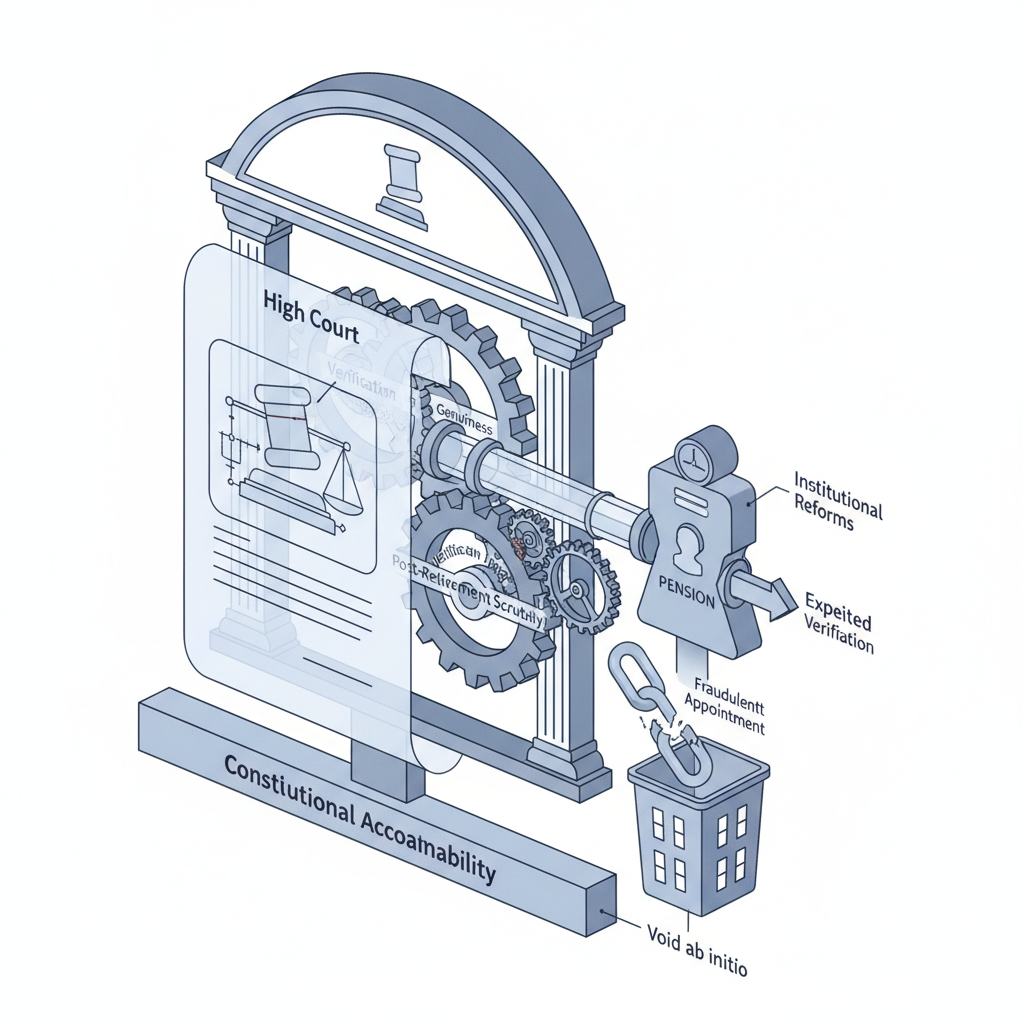
✎ Verification of community certificates in public employment is constitutionally mandated even post-retirement, as fraudulent appointments are void *ab initio*, and retiral benefits do not confer immunity from scrutiny under the…
Subject Relevance — Where This Topic Fits
- GS Paper II — Constitutional and Non-Constitutional Bodies (State Human Rights Commission, State SC/ST Commissions) | GS Paper II — Government Policies and Interventions for Development in various sectors and Issues arising out of their Design and Implementation | GS Paper IV — Ethical Governance (Transparency, Accountability, and Professional Ethics)
- Prelims: Community Certificate, Scheduled Castes and Scheduled Tribes (Prevention of Atrocities) Act, 1989, State Level Scrutiny Committee, Anthropological Expert, Kumari Madhuri Patil vs Additional Commissioner, Tribal Development, 1994, Constitutional Morality, Procedural Fairness, Retiral Benefits, Ab Initio Void
- Essay: The Role of Judicial Pronouncements in Upholding Constitutional Morality and Ethical Governance, Balancing Legal Rigour with Procedural Fairness: A Case Study of Caste Verification in Public Employment
Quick Revision: Verification of community certificates in public employment is constitutionally mandated even post-retirement, as fraudulent appointments are void *ab initio*, and retiral benefits do not confer immunity from scrutiny under the *Kumari Madhuri Patil* verification matrix.
Why is this in the news?
The Full Bench of the Madras High Court, in a landmark judgment delivered on July 30, 2026, has clarified that the verification of the genuineness of community certificates—including caste status—of government employees remains legally permissible even after their retirement. This ruling resolves conflicting judicial precedents and reinforces the principle that appointments obtained through fraud are void *ab initio*, thereby disentitling the beneficiary from protection under retiral benefits. The judgment underscores the judiciary’s commitment to constitutional accountability and the elimination of systemic fraud in public employment, while also mandating institutional reforms to expedite verification processes.
Background
- The issue of verifying the authenticity of community certificates in public employment has been a persistent challenge in India, particularly in states with significant Scheduled Caste (SC) and Scheduled Tribe (ST) populations, such as Tamil Nadu.
- The Supreme Court’s landmark judgment in *Kumari Madhuri Patil vs Additional Commissioner, Tribal Development* (1994) established a multi-point verification matrix to determine the genuineness of caste certificates, which has since been widely adopted by state governments.
- Conflicting interpretations by Division Benches of the Madras High Court regarding the permissibility of post-retirement verification created legal ambiguity, necessitating a Full Bench reference to resolve the matter.
- The judgment aligns with the constitutional mandate under Articles 14 (Right to Equality) and 16 (Equality of Opportunity in Public Employment) to ensure that public offices are not occupied by individuals who secured appointments through fraudulent means.
- The ruling also reflects broader judicial trends in India to curb the misuse of reservation benefits, as seen in recent judgments by the Supreme Court and various High Courts.
What is the Verification of Community Certificates in Public Employment?
- Community certificates (caste, tribe, or other backward class certificates) are official documents issued by competent authorities to certify an individual’s eligibility for reservation benefits in public employment, education, and welfare schemes.
- The verification process involves cross-checking the details provided in the certificate with official records, field inquiries, and anthropological assessments to determine its authenticity.
- The *Kumari Madhuri Patil* case (1994) laid down a comprehensive verification matrix, including scrutiny of revenue records, school records, caste certificates, and field verifications by committees comprising revenue officials and anthropologists.
- The verification process is governed by state-specific rules and guidelines, such as the Tamil Nadu *Instructions for Verification of Community Certificates* (2015), which mandate multi-level scrutiny before and after employment.
- Fraudulent community certificates undermine the constitutional principle of equality and the integrity of reservation policies, leading to the exclusion of genuinely deserving candidates from reserved categories.
- The judgment reinforces that appointments obtained through fraud are void *ab initio*, meaning they are legally invalid from the outset and cannot be validated by subsequent events such as retirement or the passage of time.
- The court’s directive to complete verification processes within the initial years of an employee’s service aims to prevent dilatory tactics and ensure timely accountability.
- The ruling also highlights the role of State Level Scrutiny Committees and district-level vigilance committees in ensuring strict compliance with verification protocols.
Key Features
| Feature | Significance |
|---|---|
| Full Bench ruling on post-retirement verification | Establishes that caste verification of government employees can proceed even after retirement, as appointments obtained through fraud are void ab initio, and retirement does not absolve foundational illegality. |
| Rejection of temporal immunity (pre-/post-1995) | Clarifies that no immunity exists for caste certificates issued or employment secured before or after 1995; fraud has no expiry date, as per Kumari Madhuri Patil (1994) principles. |
| Continuity of initiated verification processes | Holds that verification processes initiated before retirement must be completed post-retirement to prevent dilatory tactics and uphold constitutional accountability. |
| Strengthening of scrutiny committees | Directs immediate fortification of State and district-level scrutiny committees with manpower and anthropological experts to eliminate systemic backlogs and ensure strict compliance with verification protocols. |
| Timely verification mandate for public employers | Requires public employers to initiate and complete community certificate verification within the initial years of an employee’s service, avoiding delays until retirement or thereafter. |
Why it Matters
Constitutional and Legal
- Upholds the principle that appointments secured through fraud are void ab initio, thereby ensuring the integrity of the civil services and adherence to constitutional provisions on equality and meritocracy.
- Reinforces the Supreme Court’s directive in Kumari Madhuri Patil (1994) regarding the multi-point verification matrix for caste certificates, ensuring uniformity and rigour in verification processes across jurisdictions.
- Prevents the misuse of procedural delays to subvert accountability, thereby safeguarding the constitutional mandate of transparency and fairness in public employment.
Administrative and Governance
- Mandates institutional strengthening of scrutiny committees to address systemic inefficiencies and backlogs, thereby enhancing the efficacy of caste verification mechanisms.
- Imposes a time-bound framework for verification, reducing the likelihood of protracted inquiries and ensuring timely resolution of disputes related to caste certificates.
- Clarifies the legal authority of public employers and scrutiny committees to verify caste status at any stage, thereby reducing ambiguity in administrative processes.
Social Justice and Equity
- Protects the rights of genuinely disadvantaged communities by ensuring that reservations are not misappropriated through fraudulent caste certificates, thereby upholding the intent of affirmative action policies.
- Balances the need for rigorous verification with fairness, ensuring that employees are not subjected to unnecessary harassment while maintaining the integrity of reservation systems.
Challenges
1. Systemic Backlogs in Verification Processes
- Existing delays in verification processes due to inadequate manpower and infrastructure in scrutiny committees may impede the timely completion of inquiries.
- The need for anthropological expertise in verifying caste claims poses a challenge, particularly in states with diverse and complex social structures.
UPSC Link: GS-II: Governance, Transparency & Accountability
2. Potential for Misuse of Verification Powers
- The expanded authority of scrutiny committees to verify caste status at any stage may lead to arbitrary or politically motivated inquiries, risking misuse of power.
- Employees may face undue harassment if verification processes are not conducted with procedural fairness and transparency.
UPSC Link: GS-II: Fundamental Rights & DPSP
3. Legal and Procedural Ambiguities
- Conflicting interpretations of the Kumari Madhuri Patil (1994) judgment across jurisdictions may create confusion in the implementation of verification processes.
- The lack of a uniform national framework for caste verification may lead to inconsistencies in the application of the law across states.
UPSC Link: GS-II: Judiciary & Judicial Reforms
4. Balancing Constitutional Integrity with Fairness
- Ensuring that verification processes are thorough yet expeditious to prevent undue delays that could harm employees’ careers or reputations.
- Addressing the challenge of retroactive verification without violating principles of natural justice or creating a climate of suspicion in the bureaucracy.
UPSC Link: GS-II: Fundamental Rights & DPSP
Challenges — UPSC Perspective
| Issue | Concern |
|---|---|
| Inadequate institutional capacity | Scrutiny committees lack sufficient manpower and anthropological expertise to handle verification processes efficiently. |
| Risk of arbitrary inquiries | Expanded verification powers may lead to misuse or politically motivated investigations, undermining public trust. |
| Procedural delays | Existing backlogs and inefficiencies may delay verification, defeating the purpose of timely resolution. |
| Legal inconsistencies | Conflicting interpretations of Supreme Court judgments may create confusion in implementation across states. |
| Balancing fairness and rigour | Ensuring verification processes are thorough yet not overly burdensome or harassing to employees. |
Way Forward
- Direct the Tamil Nadu government to expedite the fortification of State and district-level scrutiny committees with adequate manpower and anthropological experts within a stipulated timeframe.
- Develop a national framework for caste verification, in consultation with state governments, to ensure uniformity and consistency in the application of the law.
- Implement a time-bound action plan for public employers to initiate and complete verification processes within the first five years of an employee’s service.
- Establish a grievance redressal mechanism for employees subjected to verification processes to address complaints of harassment or procedural unfairness.
- Conduct periodic audits of scrutiny committees to evaluate their performance and address systemic bottlenecks in verification processes.
- Sensitise administrative authorities and scrutiny committees on the principles of natural justice and procedural fairness to prevent arbitrary actions.
- Promote transparency in verification processes by publishing annual reports on the number of cases verified, findings, and actions taken.
- Encourage states to adopt digital platforms for streamlining verification processes, reducing delays and improving accessibility.
UPSC Value Addition
Keywords for Mains Answer-Writing
Madras High Court Full Bench judgment on community certificate verification · Article 14 and 16 of the Constitution of India · Kumari Madhuri Patil case (1994) · State Level Scrutiny Committee · caste verification post-retirement · constitutional accountability in public employment · fraud in service appointments · Tamil Nadu government directives on community certificates · procedural fairness in service matters · Supreme Court directives on caste verification
Constitutional & Policy Linkages
- [‘Article 14: Equality before law and equal protection of laws’, ‘Ensures fairness in verification processes and prevents arbitrary discrimination.’]
- [‘Article 16: Equality of opportunity in public employment’, ‘Upholds meritocracy and prevents fraudulent reservations from undermining constitutional guarantees.’]
- [‘Article 341: Scheduled Castes’, ‘Provides the legal framework for caste-based reservations and verification processes.’]
- [‘Article 342: Scheduled Tribes’, ‘Extends the verification mandate to tribal communities, ensuring integrity in reservation systems.’]
Concept Flow
Appointment secured through fraudulent caste certificate → Void ab initio (illegal from inception) → No immunity post-retirement → Verification permissible even after retirement → Supreme Court’s Kumari Madhuri Patil (1994) judgment → Multi-point verification matrix → Full Bench ruling → Clarification on temporal scope (pre-/post-1995) → Public employer initiates verification → Process must be completed even post-retirement → Prevents dilatory tactics and upholds constitutional accountability → Strengthening of scrutiny committees → Adequate manpower and anthropological expertise → Elimination of systemic backlogs → Strict compliance with verification protocols → Timely verification mandate → Initiation within initial years of service → Avoids delays until retirement → Ensures fairness and procedural efficiency → Balancing constitutional integrity with fairness → Prevents harassment while maintaining reservation system integrity → Upholds social justice and equity
Prelims Practice Questions
Q1. Consider the following statements regarding the verification of community certificates in India:
1. The Supreme Court in Kumari Madhuri Patil (1994) established a multi-point verification matrix for caste certificates.
2. The Madras High Court Full Bench (2026) held that verification of community certificates can be initiated even after an employee’s retirement.
3. The Constitution of India, under Article 16, guarantees equality of opportunity in matters of public employment.
4. The verification process for community certificates is governed exclusively by the State government and cannot be interfered with by the judiciary.
How many of the above statements are correct?
- Only one
- Only two
- Only three
- All four
Answer: Only three — Statements 1, 2, and 3 are correct. Statement 4 is incorrect as the judiciary can intervene to ensure constitutional compliance, as seen in the Madras High Court judgment.
Q2. Assertion (A): The Madras High Court Full Bench (2026) ruled that retirement does not absolve an employee of the consequences of fraud in securing a community certificate.
Reason (R): The court held that an appointment obtained by fraud is ab initio void and retiral benefits cannot be protected.
In the context of the above statements, which of the following is correct?
- Both A and R are true and R is the correct explanation of A
- Both A and R are true but R is not the correct explanation of A
- A is true but R is false
- A is false but R is true
Answer: Both A and R are true and R is the correct explanation of A — Both Assertion (A) and Reason (R) are true, and R correctly explains A as the court explicitly held that fraud vitiates the very foundation of an appointment, rendering it void ab initio.
Q3. Match the following provisions with their respective constitutional or statutory contexts:
List I (Provision)
A. Article 14 of the Constitution
B. Article 16 of the Constitution
C. Kumari Madhuri Patil case (1994)
D. State Level Scrutiny Committee
List II (Context)
1. Ensures equality of opportunity in public employment
2. Prohibits discrimination on grounds of religion, race, caste, sex, or place of birth
3. Establishes a multi-point verification matrix for caste certificates
4. Empowered to verify the genuineness of community certificates in Tamil Nadu
Select the correct match:
- A-2, B-1, C-3, D-4; A-1, B-2, C-3, D-4; A-2, B-1, C-4, D-3; A-1, B-2, C-4, D-3
- answer_key_mapper_json_array_to_string_for_answer_field_here
- answer_key_mapper_json_array_to_string_for_explain_field_here
Answer: ? — The correct matches are: A (Article 14) with 2 (prohibits discrimination), B (Article 16) with 1 (equality of opportunity), C (Kumari Madhuri Patil case) with 3 (multi-point verification matrix), and D (State Level Scrutiny Committee) with 4 (verification of community certificates).
Mains Practice Question
✍ The Madras High Court Full Bench (2026) has reaffirmed that fraud in securing a community certificate does not lapse with retirement, thereby upholding constitutional accountability in public employment. Critically examine the implications of this judgment for the principles of fairness, procedural justice, and the constitutional mandate of equality in public service. Also, discuss the institutional mechanisms required to balance these principles with the need for expeditious verification. (15 Marks)
Approach: EXPECTED ANSWER SKELETON:
1. **Introduction (2 marks)**: Define the context—verification of community certificates post-retirement and its constitutional underpinnings (Articles 14 and 16). State the directive of the Madras High Court Full Bench (2026) and its significance.
2. **Constitutional Principles and Judicial Reasoning (4 marks)**:
– Article 14 (Right to Equality) and Article 16 (Equality of Opportunity in Public Employment): Explain how fraud in service appointments violates these principles.
– Doctrine of ab initio voidness: Elaborate on the court’s reasoning that an appointment secured by fraud is void from inception and cannot be validated by retirement.
– Reference to Kumari Madhuri Patil (1994): Discuss the Supreme Court’s multi-point verification matrix and its relevance to the judgment.
3. **Institutional Mechanisms and Procedural Justice (4 marks)**:
– Role of State Level Scrutiny Committee and district-level vigilance committees: Explain their constitution and functions as directed by the court.
– Fast-track verification: Discuss the court’s directive to complete verification within the initial years of service and the rationale behind it.
– Balancing fairness and expeditiousness: Address potential challenges (e.g., backlogs, harassment) and suggest measures to mitigate them.
4. **Critique and Broader Implications (3 marks)**:
– Critically examine the judgment’s impact on public trust in the verification process and the judiciary’s role in upholding constitutional morality.
– Discuss whether the judgment could deter deserving candidates from applying for reserved posts due to fear of prolonged verification.
– Suggest reforms: Strengthening anthropological expertise, digital verification systems, and timelines for appeals.
5. **Conclusion (2 marks)**: Summarize the judgment’s significance in reinforcing constitutional accountability and the need for a robust, fair, and efficient verification mechanism.
Source: The Hindu
Generated by AanyaAi for educational purpose.

- केंद्र सरकार ने केरल को दिया 2,597 करोड़ रुपये का अतिरिक्त कर हस्तांतरण, पूंजीगत व्यय बढ़ाने में मदद - August 8, 2026
- Centre releases ₹2,597 crore to Kerala as additional tax devolution instalment - August 8, 2026
- बदरीनाथ हाईवे: पहली बरसात में ढह गई ऑल वेदर रोड की सुरक्षा दीवार, क्या है कारण? - August 8, 2026

No Comments