


08 Aug July 31 Deadline: Last-Minute Rush for Crop Insurance in Rayalaseema
✎ Crop insurance schemes like PMFBY and RWBCIS are critical for mitigating the financial risks of rainfed agriculture in regions like Rayalaseema, where erratic monsoons and climate variability threaten farmer livelihoods.
Subject Relevance — Where This Topic Fits
- GS Paper III — Agriculture | GS Paper III — Disaster Management | GS Paper III — Indian Economy and Issues Relating to Planning, Mobilisation of Resources, Growth, Development and Employment
- Prelims: Pradhan Mantri Fasal Bima Yojana (PMFBY), Restructured Weather-Based Crop Insurance Scheme (RWBCIS), Rayalaseema agro-climatic region, El Niño impact on Indian agriculture, monsoon variability and crop insurance, farmers’ distress in rainfed regions, small and marginal farmers, agricultural insurance penetration
- Essay: The role of insurance in mitigating agricultural risks in India: A case study of Rayalaseema, Climate change and its economic implications for Indian farmers: The case of crop insurance
Quick Revision: Crop insurance schemes like PMFBY and RWBCIS are critical for mitigating the financial risks of rainfed agriculture in regions like Rayalaseema, where erratic monsoons and climate variability threaten farmer livelihoods.
Why is this in the news?
The impending July 31 deadline for enrolment under the Pradhan Mantri Fasal Bima Yojana (PMFBY) and the Restructured Weather-Based Crop Insurance Scheme (RWBCIS) has triggered a last-minute surge in registrations across the Rayalaseema region of Andhra Pradesh, particularly in Sri Sathya Sai, Chittoor, and Annamayya districts. This rush underscores the growing recognition among farmers of crop insurance as a vital financial safeguard against the heightened risks posed by erratic monsoon patterns, delayed rainfall, and the projected El Niño impact, which exacerbates the vulnerability of rainfed agriculture in the region.
Background
- The Rayalaseema region of Andhra Pradesh is historically characterised by its heavy dependence on monsoon rains for agriculture, with over 80% of the cultivated area being rainfed, making it highly susceptible to climatic variability.
- The region has faced recurring challenges such as delayed monsoons, prolonged dry spells, and unseasonal rainfall over the past several decades, leading to significant crop losses and distress among farmers.
- The El Niño phenomenon, known to disrupt Indian monsoons, is projected to intensify weather-related risks in the 2026 agricultural season, further aggravating the vulnerability of rainfed farming systems in Rayalaseema.
- The Government of India launched the Pradhan Mantri Fasal Bima Yojana (PMFBY) in 2016 to provide comprehensive crop insurance coverage to farmers, replacing previous schemes with a more farmer-centric approach.
- The Restructured Weather-Based Crop Insurance Scheme (RWBCIS) was introduced alongside PMFBY to address the limitations of area-based insurance by incorporating weather parameters such as rainfall, temperature, and humidity as triggers for claims.
- Small and marginal farmers constitute the majority of the agricultural workforce in Rayalaseema, with limited access to formal credit and risk mitigation tools, making crop insurance a critical component of their livelihood security.
What is Crop Insurance in India?
- Crop insurance in India is a risk management tool designed to protect farmers against financial losses arising from crop failure due to natural calamities, pests, or diseases, thereby ensuring income stability.
- The Pradhan Mantri Fasal Bima Yojana (PMFBY), launched in 2016, is the flagship crop insurance scheme of the Government of India, aiming to provide affordable and comprehensive insurance coverage to farmers across the country.
- PMFBY operates on a low-premium, high-subsidy model, with farmers paying a maximum premium of 2% for kharif crops, 1.5% for rabi crops, and 5% for commercial/horticultural crops, while the remaining premium is shared between the central and state governments.
- The scheme covers a wide range of crops, including food grains (paddy, wheat, millets), oilseeds, pulses, and horticultural crops (fruits, vegetables, spices), ensuring broad-based protection for diverse agricultural systems.
- The Restructured Weather-Based Crop Insurance Scheme (RWBCIS) complements PMFBY by using weather parameters such as rainfall deficit, excess rainfall, temperature anomalies, and humidity as triggers for insurance payouts, addressing the limitations of area-based insurance models.
- Under RWBCIS, claims are triggered when predefined weather parameters deviate from normal ranges, providing timely compensation to farmers without the need for extensive loss assessment, thereby reducing delays in payouts.
- The scheme is implemented through a transparent and technology-driven process, leveraging remote sensing, drones, and digital platforms to assess crop damage and disburse claims efficiently.
- Enrolment under PMFBY and RWBCIS is voluntary for farmers, but states are encouraged to promote widespread participation, particularly in rainfed and drought-prone regions like Rayalaseema, to enhance agricultural resilience.
Key Features
| Feature | Significance |
|---|---|
| Pradhan Mantri Fasal Bima Yojana (PMFBY) | Provides financial support to farmers in case of crop failure due to natural calamities, pests, or diseases, ensuring income security and reducing distress migration. |
| Restructured Weather-Based Crop Insurance Scheme (RWBCIS) | Links insurance payouts to predefined weather indices (e.g., rainfall deficit) rather than actual crop loss, enabling faster and more transparent claim settlements. |
| Last-minute enrolment drives | Critical for ensuring maximum farmer participation before deadlines, particularly in regions with high monsoon dependency and climate vulnerability. |
| District-level implementation | Localised efforts by Agriculture and Horticulture departments in Rayalaseema districts (Sri Sathya Sai, Chittoor, Annamayya) to address regional agricultural challenges. |
| Small and marginal farmer focus | Prioritises coverage for smallholders, who constitute the majority in these districts, to mitigate livelihood risks from climate variability. |
Why it Matters
Economic
- Crop insurance acts as a risk mitigation tool, stabilising farm incomes and preventing debt traps in regions prone to erratic monsoons and climatic shocks.
- Reduces financial burden on state exchequers by minimising post-disaster relief expenditures through pre-emptive risk coverage.
- Supports horticultural crops (e.g., mango, tomato, banana), which are high-value but vulnerable to weather anomalies, safeguarding regional agrarian economies.
Agricultural
- Provides a safety net against delayed monsoons, dry spells, and unseasonal rainfall, which are recurring challenges in Rayalaseema’s rain-fed agriculture.
- Encourages adoption of risk-prone but high-yielding crops by transferring weather-related risks to insurers.
- Facilitates credit access for farmers by reducing lender perceptions of default risk, thereby enhancing agricultural productivity.
Social
- Protects livelihoods of small and marginal farmers, who form the backbone of rural economies in Chittoor and Annamayya districts.
- Mitigates distress migration by ensuring financial resilience during crop failures, particularly in drought-prone regions.
- Promotes gender-inclusive agricultural practices by enabling women farmers, who often manage smallholdings, to access insurance benefits.
Policy
- Demonstrates the Centre’s commitment to agricultural resilience under the National Mission for Sustainable Agriculture (NMSA) and the National Action Plan on Climate Change (NAPCC).
- Aligns with the Sustainable Development Goals (SDGs), particularly SDG 1 (No Poverty), SDG 2 (Zero Hunger), and SDG 13 (Climate Action).
Challenges
1. Climate Vulnerability and Weather Extremes
- Rayalaseema’s dependence on monsoons exposes agriculture to delayed onset, deficit rainfall, and unseasonal showers, leading to yield losses.
- El Niño events exacerbate drought conditions, increasing the urgency for insurance coverage but also complicating risk assessment for insurers.
- Long-term climate projections indicate heightened variability, necessitating adaptive insurance models beyond traditional indemnity-based schemes.
UPSC Link: GS3: Climate Change and Agriculture
2. Low Awareness and Penetration Gaps
- Many small and marginal farmers remain unaware of PMFBY/RWBCIS benefits or face procedural barriers in enrolment, particularly in remote areas.
- Language barriers, digital illiteracy, and lack of localised outreach limit effective dissemination of scheme details.
- Distrust in insurance mechanisms due to delayed or denied claims erodes farmer confidence in the system.
UPSC Link: GS2: Governance and Public Service Delivery
3. Implementation Bottlenecks
- Last-minute enrolment drives risk procedural lapses, such as incomplete documentation or delays in claim processing, defeating the purpose of timely coverage.
- Inadequate infrastructure for real-time weather data collection hampers the accuracy of RWBCIS payout triggers.
- Coordination gaps between state departments, insurers, and banks lead to inefficiencies in premium collection and claim settlement.
UPSC Link: GS3: Agricultural Marketing and Supply Chain
4. Financial Sustainability
- High actuarial risks in drought-prone regions may deter private insurers, necessitating government-backed schemes like PMFBY.
- Subsidised premiums strain state budgets, requiring innovative financing models (e.g., climate-resilient crop varieties, parametric insurance).
- Moral hazard risks arise if farmers reduce investment in climate-smart practices due to perceived insurance safety nets.
UPSC Link: GS3: Agricultural Finance and Insurance
5. Data and Technology Gaps
- Lack of granular, real-time data on soil moisture, temperature, and rainfall at the farm level limits the efficacy of weather-based insurance models.
- Absence of integrated digital platforms for farmer registration, premium collection, and claim settlement creates inefficiencies.
- Cybersecurity risks in digital insurance platforms pose threats to farmer data privacy and transaction integrity.
UPSC Link: GS3: Science and Technology in Agriculture
Challenges — UPSC Perspective
| Issue | Concern |
|---|---|
| Delayed monsoons | Reduces sowing windows, increases crop failure risks, and delays insurance claim settlements. |
| Small landholdings | High transaction costs for insurers due to fragmented plots and low premium volumes. |
| El Niño events | Exacerbates drought conditions, increasing actuarial risks for insurers and claim burdens on the government. |
| Procedural delays | Last-minute enrolment drives risk errors in documentation, leading to claim rejections. |
| Climate data gaps | Inadequate weather station networks hamper accurate assessment of RWBCIS payout triggers. |
| Farmer distrust | Past experiences with delayed/denied claims discourage participation, undermining scheme objectives. |
Government Initiatives — Must-Memorise for Prelims
- Pradhan Mantri Fasal Bima Yojana (PMFBY)
- Restructured Weather-Based Crop Insurance Scheme (RWBCIS)
Way Forward
- Accelerate digital enrolment drives using mobile-based platforms (e.g., PM-KISAN app) to overcome last-minute bottlenecks.
- Enhance outreach through local self-help groups (SHGs), cooperatives, and agricultural extension services to improve awareness among small farmers.
- Strengthen weather monitoring infrastructure with IoT-enabled stations and satellite-based data to improve RWBCIS accuracy.
- Introduce parametric insurance pilots in high-risk districts to complement PMFBY, linking payouts directly to weather indices.
- Streamline claim settlement processes by leveraging AI for automated verification and reducing human discretion in assessments.
- Promote climate-resilient crop varieties and water-efficient practices to reduce dependency on monsoons and insurance claims.
- Establish a grievance redressal mechanism with real-time tracking of enrolment and claim status to build farmer trust.
UPSC Value Addition
Keywords for Mains Answer-Writing
Pradhan Mantri Fasal Bima Yojana (PMFBY) · Restructured Weather-Based Crop Insurance Scheme (RWBCIS) · agricultural insurance mechanisms · monsoon dependency and crop vulnerability · Rayalaseema region distress · small and marginal farmers · El Niño impact on agriculture · climate-resilient agriculture · financial security for farmers · weather-based crop insurance · Agriculture and Horticulture departments · climate change and agriculture · farm income stabilisation · crop insurance enrolment trends
Concept Flow
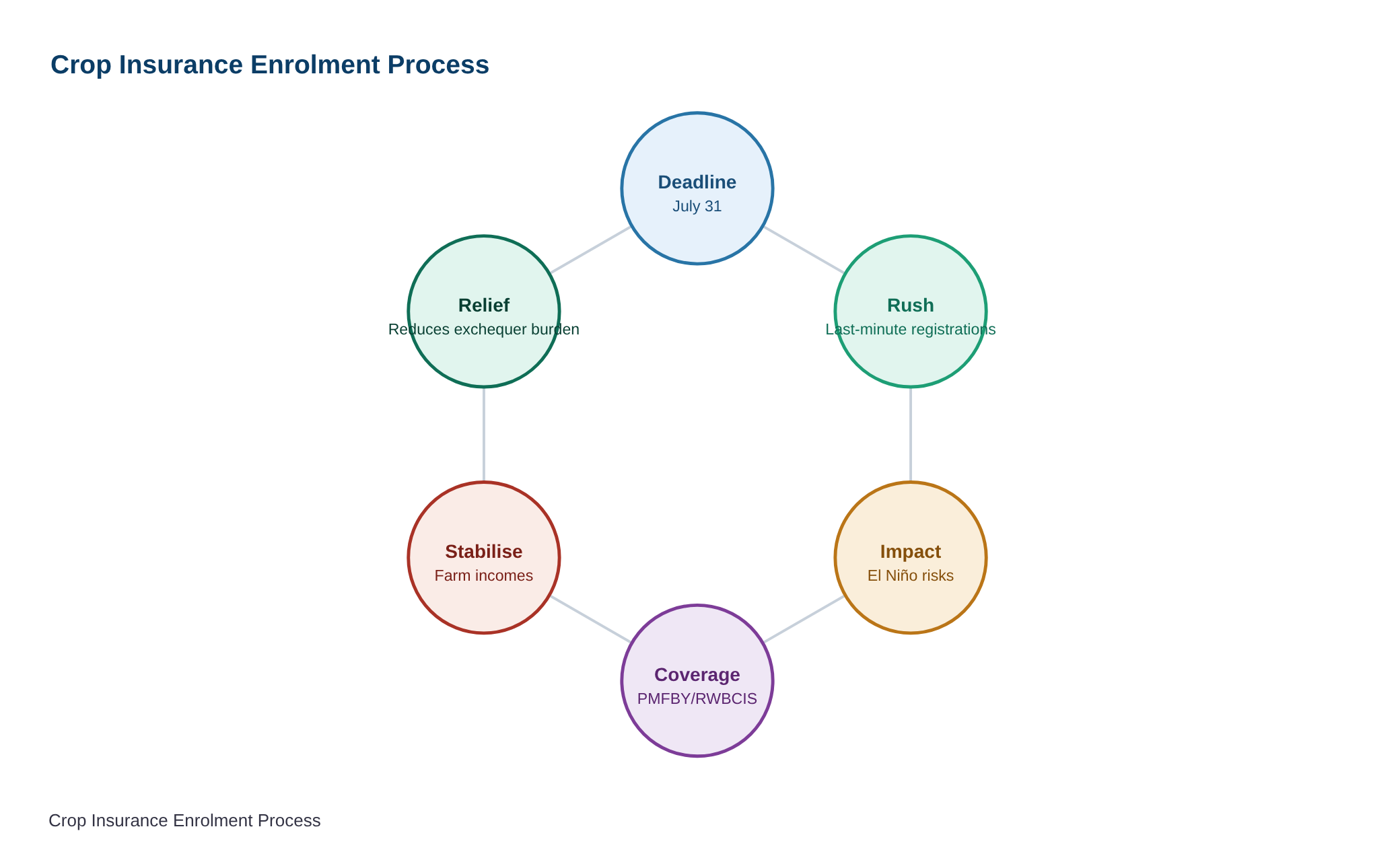
Monsoon variability and El Niño events → Increased crop failure risks in Rayalaseema → Farmer demand for risk mitigation → Enrolment under PMFBY/RWBCIS → Premium collection and data verification → Weather index monitoring (RWBCIS) or loss assessment (PMFBY) → Claim settlement or rejection → Impact on farm incomes and rural economy → Feedback loop for policy adjustments.
Prelims Practice Questions
Q1. Consider the following statements regarding the Pradhan Mantri Fasal Bima Yojana (PMFBY):
1. PMFBY provides insurance coverage for all types of crops, including horticultural crops.
2. The scheme is implemented by the Ministry of Agriculture and Farmers’ Welfare.
3. Under PMFBY, the premium rates are uniform across all states and union territories.
4. The scheme covers losses due to natural calamities such as drought, flood, and cyclone.
How many of the above statements are correct?
- Only one
- Only two
- Only three
- All
Answer: Only three — Statements 1, 2, and 4 are correct. Statement 3 is incorrect as premium rates vary by state and crop type under PMFBY.
Q2. Assertion (A): The Restructured Weather-Based Crop Insurance Scheme (RWBCIS) relies on weather parameters rather than actual crop loss for payouts.
Reason (R): RWBCIS was introduced to address the challenges of delayed claims settlement and high administrative costs in the existing crop insurance schemes.
(a) Both A and R are true, and R is the correct explanation of A.
(b) Both A and R are true, but R is not the correct explanation of A.
(c) A is true, but R is false.
(d) A is false, but R is true.
- (a)
- (b)
- (c)
- (d)
Answer: (c) — Assertion (A) is true as RWBCIS uses weather indices (e.g., rainfall deficit, temperature anomalies) to trigger payouts. Reason (R) is also true but does not directly explain why RWBCIS relies on weather parameters.
Q3. Match the following crop insurance schemes with their respective features:
Column I (Scheme) | Column II (Feature)
— | —
A. Pradhan Mantri Fasal Bima Yojana (PMFBY) | 1. Covers only horticultural crops
B. Restructured Weather-Based Crop Insurance Scheme (RWBCIS) | 2. Uses weather indices for payouts
C. National Agricultural Insurance Scheme (NAIS) | 3. Replaced by PMFBY in 2016
D. Farm Income Insurance Scheme (FIIS) | 4. Provides yield-based insurance for food crops
Select the correct match:
- A-4, B-2, C-3, D-1
- A-2, B-4, C-1, D-3
- A-3, B-1, C-4, D-2
- A-1, B-3, C-2, D-4
Answer: A-4, B-2, C-3, D-1 — Correct matches: A-4 (PMFBY covers food crops and horticultural crops), B-2 (RWBCIS uses weather indices), C-3 (NAIS was replaced by PMFBY), D-1 (FIIS was designed for horticultural crops).
Mains Practice Question
✍ The Pradhan Mantri Fasal Bima Yojana (PMFBY) and the Restructured Weather-Based Crop Insurance Scheme (RWBCIS) represent India’s evolving approach to mitigating agricultural risks amid climate variability. Critically examine the efficacy of these schemes in providing financial security to small and marginal farmers in drought-prone regions like Rayalaseema. Also, analyse the challenges in their implementation and suggest measures to enhance their outreach and impact. (15 Marks)
Approach: MODEL-ANSWER SKELETON:
1. **Introduction (2 marks)**: Define PMFBY and RWBCIS, their objectives, and the context of Rayalaseema’s vulnerability to monsoon failures and El Niño impacts. Cite enrolment data from the article (e.g., 10,279 farmers under PMFBY in Sri Sathya Sai district; 78,798 under RWBCIS) to highlight regional relevance.
2. **Efficacy of PMFBY (3 marks)**:
– **Strengths**: Yield-based coverage for food crops, actuarial premiums, and government subsidy (up to 90% for small farmers). Reference the scheme’s provision for post-harvest losses and localized calamities.
– **Limitations**: Delayed claim settlements, low awareness among small farmers, and exclusion of certain crops (e.g., horticultural crops in some states). Cite the article’s emphasis on horticulture in Chittoor and Annamayya districts.
3. **Efficacy of RWBCIS (3 marks)**:
– **Strengths**: Weather-indexed payouts reduce moral hazard and administrative delays. Suitable for regions with historical data on weather anomalies (e.g., Rayalaseema’s dry spells).
– **Limitations**: Inadequate payouts for severe localized losses, reliance on weather stations (coverage gaps in remote areas), and lack of awareness. Highlight the article’s mention of El Niño exacerbating distress.
4. **Implementation Challenges (3 marks)**:
– **Structural**: Low digital literacy among farmers, complex claim processes, and insufficient last-mile delivery by insurance companies.
– **Governance**: Weak coordination between state agriculture departments and insurers. Cite the article’s reference to last-minute enrolment drives.
– **Climate Context**: Increasing frequency of extreme weather events (e.g., delayed monsoons, unseasonal rainfall) outpacing scheme adaptations.
5. **Measures for Enhancement (4 marks)**:
– **Awareness**: Grassroots campaigns using local leaders, agricultural extension services, and digital platforms (e.g., Kisan Credit Card-linked enrolment).
– **Technology**: Integration with remote sensing (e.g., ISRO’s data) and AI for real-time weather-risk assessment.
– **Governance Reforms**: Simplify claim processes, incentivize insurers for faster settlements, and expand coverage to horticultural crops in all districts.
– **Climate Resilience**: Link insurance to climate-smart agriculture practices (e.g., drought-resistant seeds, soil moisture sensors).
6. **Conclusion (2 marks)**: Summarize the need for a hybrid approach combining yield-based and weather-indexed schemes, with robust implementation frameworks to ensure equitable coverage for small and marginal farmers.
Source: The Hindu
Generated by AanyaAi for educational purpose.

- बिहार सरकार का बड़ा फैसला: कारोबार शुरू करने में होगी आसानी, जानिए कैसे मिलेगा फायदा - September 23, 2026
- Bihar Launches Single Window Portal for 62 Business Services: UPSC & PCS Guide - September 23, 2026
- ग्रीनलैंड समझौता: अमेरिका को मिले अतिरिक्त रक्षा क्षेत्र, जानिए पूरा मामला - September 23, 2026

No Comments