


08 Aug July 31 Deadline: Last-Minute Rush for Crop Insurance in Rayalaseema
✎ PMFBY and RWBCIS are flagship crop insurance schemes designed to mitigate climate-induced agricultural risks, with the July 31 enrolment deadline serving as a critical juncture for last-minute farmer registrations in vulnerable…
Subject Relevance — Where This Topic Fits
- GS Paper III — Agriculture, Food Processing and Related Issues | GS Paper III — Disaster Management
- Prelims: Pradhan Mantri Fasal Bima Yojana (PMFBY), Restructured Weather-Based Crop Insurance Scheme (RWBCIS), Rayalaseema region, El Niño impact on agriculture, monsoon variability in India, small and marginal farmers, crop insurance penetration
- Essay: The role of insurance in agricultural risk mitigation: A case study of Rayalaseema
Quick Revision: PMFBY and RWBCIS are flagship crop insurance schemes designed to mitigate climate-induced agricultural risks, with the July 31 enrolment deadline serving as a critical juncture for last-minute farmer registrations in vulnerable regions like Rayalaseema.
Why is this in the news?
The impending July 31 deadline for enrolment under the Pradhan Mantri Fasal Bima Yojana (PMFBY) and Restructured Weather-Based Crop Insurance Scheme (RWBCIS) has triggered a last-minute surge in registration efforts in the drought-prone Rayalaseema region of Andhra Pradesh. The urgency underscores the criticality of crop insurance in mitigating climate-induced agricultural risks, particularly in monsoon-dependent districts such as Sri Sathya Sai, Chittoor, and Annamayya, where delayed monsoons and El Niño conditions exacerbate farming vulnerabilities.
Background
- The Rayalaseema region in Andhra Pradesh is historically prone to delayed monsoons, dry spells, and unseasonal rainfall, rendering agriculture highly vulnerable to climatic variability.
- The Pradhan Mantri Fasal Bima Yojana (PMFBY), launched in 2016, is a centrally sponsored crop insurance scheme aimed at providing financial support to farmers in the event of crop failure due to natural calamities, pests, or diseases.
- The Restructured Weather-Based Crop Insurance Scheme (RWBCIS), introduced as a complement to PMFBY, uses weather parameters such as rainfall, temperature, and humidity to assess crop losses and trigger payouts, offering a more data-driven approach to risk assessment.
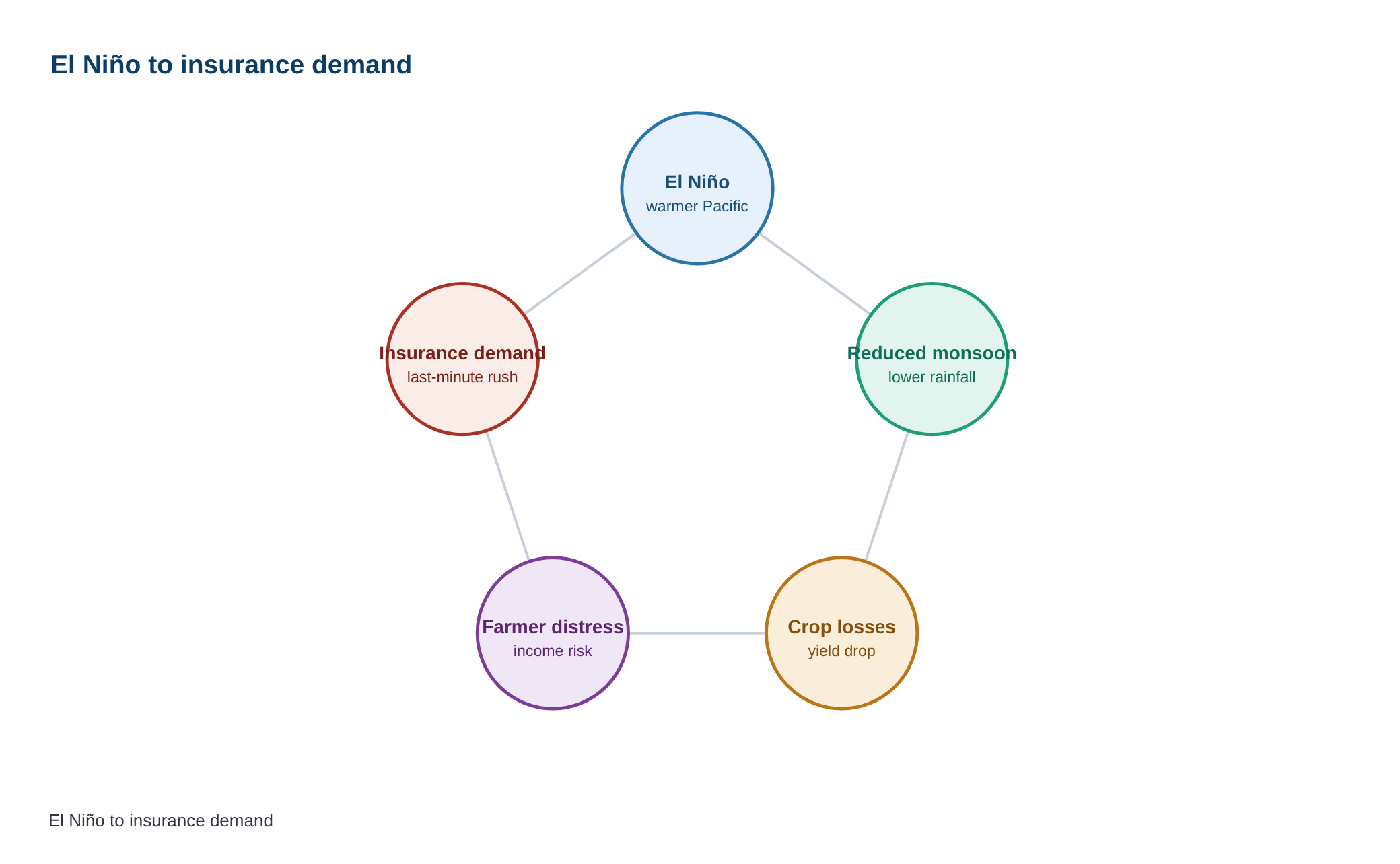
- The El Niño phenomenon, associated with warmer ocean temperatures in the Pacific, has been linked to reduced monsoon rainfall in India, further intensifying agricultural distress in regions like Rayalaseema.
- Agriculture and horticulture form the economic backbone of rural livelihoods in Chittoor and Annamayya districts, with a significant proportion of small and marginal farmers relying on these sectors for sustenance.
- The July 31 enrolment deadline for PMFBY and RWBCIS highlights the administrative challenges in ensuring last-mile coverage, particularly in remote and climatically vulnerable regions.
What is Crop Insurance in India?
- The Pradhan Mantri Fasal Bima Yojana (PMFBY) is a government-led crop insurance scheme that provides comprehensive coverage against yield losses due to natural disasters, pests, and diseases, with premiums subsidised for farmers.
- The Restructured Weather-Based Crop Insurance Scheme (RWBCIS) is a variant of PMFBY that uses weather indices (e.g., rainfall deficit, temperature anomalies) to determine payouts, offering a quicker and more objective assessment of crop losses.
- Both schemes aim to reduce the financial burden on farmers by providing timely compensation, thereby stabilising farm incomes and encouraging agricultural investments.
- The schemes are implemented through a multi-stakeholder framework involving state governments, insurance companies, and financial institutions, with premiums shared between the Centre, states, and farmers.
- PMFBY covers a wide range of crops, including food grains, oilseeds, and horticultural crops, while RWBCIS is particularly suited for high-value and perishable crops where traditional yield-based assessments may be less effective.
- The schemes are voluntary for farmers but mandatory for loanee farmers (those availing crop loans from banks) to ensure broader participation and risk pooling.
- The enrolment process involves registration at designated centres, submission of land records, and payment of a nominal premium, with claims processed through a technology-driven portal for transparency.
- Crop insurance schemes in India are aligned with global best practices, such as the use of remote sensing and digital platforms to enhance efficiency and reduce delays in claim settlements.
Key Features
| Feature | Significance |
|---|---|
| Pradhan Mantri Fasal Bima Yojana (PMFBY) | Provides financial protection to farmers against crop yield losses due to natural calamities, pests, and diseases, ensuring income security. |
| Restructured Weather-Based Crop Insurance Scheme (RWBCIS) | Insures farmers based on weather parameters rather than actual crop loss, offering timely payouts for adverse weather events. |
| Enrolment Deadline (July 31) | Critical cut-off for farmers to secure insurance coverage for the current agricultural season, preventing exclusion from safety nets. |
| Rayalaseema Region Dependence on Monsoons | Agricultural output in Sri Sathya Sai, Chittoor, and Annamayya districts is highly vulnerable to monsoon variability, necessitating risk mitigation. |
| Small and Marginal Farmers | Majority of farmers in the region are smallholders with limited risk-bearing capacity, making crop insurance indispensable for livelihood security. |
Why it Matters
Economic
- Crop insurance mitigates financial losses for farmers in drought-prone Rayalaseema, preserving rural incomes and preventing debt traps.
- Insurance coverage stabilises agricultural productivity, reducing volatility in food supply chains and market prices.
- Enhanced enrolment under PMFBY and RWBCIS strengthens the agricultural insurance ecosystem, fostering long-term sectoral resilience.
Strategic
- Climate-resilient agriculture in monsoon-dependent regions is critical for national food security and rural employment generation.
- Timely insurance payouts prevent distress migration and social unrest in agrarian communities facing weather shocks.
- Integration of weather-based insurance schemes aligns with India’s climate adaptation strategies under the National Action Plan on Climate Change.
Social
- Crop insurance acts as a social safety net, protecting the most vulnerable farmers from existential risks.
- Reduces farmer suicides linked to crop failures, particularly in regions with high dependence on rainfed agriculture.
- Promotes gender-inclusive agriculture by securing livelihoods of women farmers, who constitute a significant portion of smallholder labour.
Challenges
1. Low Awareness and Outreach
- Limited penetration of insurance schemes in remote and tribal areas of Rayalaseema, leading to under-enrolment.
- Farmers often lack understanding of claim processes and eligibility criteria, discouraging participation.
- Language barriers and digital illiteracy hinder access to insurance information and enrolment facilities.
UPSC Link: GS3: Agricultural Marketing
2. Weather Variability and El Niño Impact
- Increasing frequency of El Niño events exacerbates drought conditions, raising the demand for insurance but also straining payout mechanisms.
- Erratic rainfall patterns disrupt sowing schedules, reducing the efficacy of traditional insurance models.
- Climate change intensifies weather extremes, necessitating adaptive insurance frameworks.
UPSC Link: GS3: Disaster Management
3. Administrative and Logistical Bottlenecks
- Last-minute rush for enrolment strains departmental resources, leading to delays and errors in processing.
- Inadequate infrastructure for field verification and claim settlements in remote districts.
- Coordination gaps between state agencies, banks, and insurance providers hinder seamless implementation.
UPSC Link: GS2: Centre-State Relations
4. Financial Sustainability of Schemes
- High claim ratios in drought-prone regions pose fiscal challenges for insurance providers and the government.
- Subsidies under PMFBY and RWBCIS strain public finances, requiring periodic review and rationalisation.
- Risk pooling across diverse agro-climatic zones is complex, affecting the viability of insurance models.
UPSC Link: GS3: Food Security
5. Smallholder Farmer Exclusion
- High premium costs and lack of collateral deter small and marginal farmers from enrolling.
- Informal land tenancy and fragmented holdings complicate insurance coverage and claim settlements.
- Digital KYC and bank account requirements exclude landless labourers and tenant farmers.
UPSC Link: GS3: Land Reforms
Challenges — UPSC Perspective
| Issue | Concern |
|---|---|
| Premium Affordability | High premiums deter small farmers from enrolling despite subsidies. |
| Claim Settlement Delays | Bureaucratic hurdles and verification processes prolong payouts, defeating the purpose of insurance. |
| Data Accuracy | Inadequate weather and yield data in remote areas leads to disputes and under-compensation. |
| Fraudulent Practices | Fake enrolments and inflated claims undermine the financial viability of insurance schemes. |
| Policy Exclusions | Certain natural calamities (e.g., hailstorms) are often excluded, leaving gaps in coverage. |
| Technology Adoption | Low digital literacy limits access to online enrolment and claim portals. |
Government Initiatives — Must-Memorise for Prelims
- Pradhan Mantri Fasal Bima Yojana (PMFBY)
- Restructured Weather-Based Crop Insurance Scheme (RWBCIS)
Way Forward
- Accelerate awareness campaigns in local languages, leveraging agricultural extension services and SHGs to educate farmers on insurance benefits and processes.
- Strengthen last-mile delivery through mobile enrolment camps and digital kiosks in remote villages to overcome logistical barriers.
- Enhance real-time weather data collection using IoT sensors and satellite imagery to improve the accuracy of RWBCIS payouts.
- Rationalise premium subsidies based on agro-climatic risk zones to ensure financial sustainability while maintaining affordability.
- Simplify claim settlement procedures by digitising verification and disbursement processes to reduce delays.
- Integrate crop insurance with other welfare schemes (e.g., PM-KISAN) to create a comprehensive safety net for farmers.
- Promote climate-resilient agriculture through crop diversification and drought-resistant varieties to reduce reliance on insurance.
- Establish grievance redressal mechanisms at the district level to address farmer complaints and disputes promptly.
UPSC Value Addition
Keywords for Mains Answer-Writing
Pradhan Mantri Fasal Bima Yojana (PMFBY) · Restructured Weather-Based Crop Insurance Scheme (RWBCIS) · Rayalaseema region vulnerability to monsoon variability · small and marginal farmers · agricultural insurance as financial safety net · El Niño impact on agriculture · regional agrarian distress · horticulture and crop diversification · climate-resilient agriculture · farmers’ livelihood security · monsoon-dependent agriculture · crop insurance enrolment challenges
Concept Flow
El Niño-induced drought → Reduced monsoon rainfall → Crop yield losses → Farmer distress → Increased demand for crop insurance → Last-minute enrolment rush → Administrative bottlenecks → Delays in processing → Farmer dissatisfaction → Reduced trust in schemes → PMFBY and RWBCIS enrolment → Financial protection → Stabilised farm incomes → Sustained agricultural productivity → Smallholder farmer exclusion → Persistent vulnerability → Social and economic inequities → Need for inclusive insurance models → Weather data inaccuracies → Disputed claims → Legal disputes → Erosion of scheme credibility → Climate change intensification → Higher insurance payouts → Fiscal strain → Policy review and reform
Prelims Practice Questions
Q1. Consider the following statements regarding the Pradhan Mantri Fasal Bima Yojana (PMFBY):
1. It is a voluntary scheme for all farmers.
2. It covers post-harvest losses due to cyclones and unseasonal rainfall.
3. The premium rates for food crops are fixed at 2% for kharif and 1.5% for rabi.
4. The scheme is implemented through the Ministry of Agriculture and Farmers’ Welfare.
How many of the above statements are correct?
- Only one
- Only two
- Only three
- All four
Answer: All four — Statements 1, 2, and 4 are correct. Statement 3 is incorrect as the premium rates are 2% for kharif and 1.5% for rabi for food crops, but the scheme is implemented through the Ministry of Agriculture and Farmers’ Welfare.
Q2. Assertion (A): The Restructured Weather-Based Crop Insurance Scheme (RWBCIS) is designed to mitigate risks associated with weather variability.
Reason (R): It provides compensation based on weather parameters such as rainfall deficit or excess, rather than actual crop loss.
Options:
A. Both A and R are true, and R is the correct explanation of A.
B. Both A and R are true, but R is not the correct explanation of A.
C. A is true, but R is false.
D. A is false, but R is true.
- A
- B
- C
- D
Answer: A — Both the assertion and reason are true. RWBCIS indeed mitigates weather-related risks by compensating based on weather parameters. The reason correctly explains the assertion.
Q3. Match the following crop insurance schemes with their respective features:
Column I (Scheme) | Column II (Feature)
— | —
1. PMFBY | A. Covers only horticulture crops
2. RWBCIS | B. Compensation based on weather parameters
3. National Agricultural Insurance Scheme (NAIS) | C. Voluntary participation with premium subsidies
4. Pradhan Mantri Kisan Samman Nidhi (PM-KISAN) | D. Provides income support to farmers
Options:
A. 1-B, 2-A, 3-D, 4-C
B. 1-C, 2-B, 3-A, 4-D
C. 1-C, 2-B, 3-D, 4-A
D. 1-A, 2-C, 3-B, 4-D
- A
- B
- C
- D
Answer: B — Correct matches: PMFBY (1-C), RWBCIS (2-B), NAIS (3-A), PM-KISAN (4-D).
Mains Practice Question
✍ Critically examine the significance of crop insurance schemes like the Pradhan Mantri Fasal Bima Yojana (PMFBY) and the Restructured Weather-Based Crop Insurance Scheme (RWBCIS) in mitigating agrarian distress in monsoon-dependent regions such as Rayalaseema. Also, assess the challenges in their effective implementation and suggest measures to enhance their outreach and impact. (15 Marks)
Approach: MODEL-ANSWER SKELETON:
1. **Introduction (2 marks)**: Define crop insurance schemes (PMFBY and RWBCIS) and their objectives. Highlight the vulnerability of Rayalaseema to monsoon variability and climate change.
2. **Significance in mitigating agrarian distress (5 marks)**:
– Financial safety net for small and marginal farmers against weather-related risks.
– PMFBY: Covers yield losses due to natural calamities; RWBCIS: Compensates based on weather parameters (e.g., rainfall deficit).
– Reduces debt burden and prevents farmer suicides by providing timely compensation.
– Encourages adoption of modern agricultural practices by reducing risk perception.
– Aligns with Sustainable Development Goal 1 (No Poverty) and Goal 2 (Zero Hunger).
3. **Challenges in implementation (5 marks)**:
– **Low awareness and last-minute rush**: As seen in Rayalaseema, where enrolment surges before deadlines.
– **Exclusion errors**: Marginal farmers and tenant farmers often left out due to bureaucratic hurdles.
– **Delayed claim settlements**: Procedural delays and lack of transparency in assessment.
– **Premium affordability**: While subsidies exist, small farmers struggle with even subsidised premiums.
– **Climate variability**: Increasing frequency of extreme weather events overwhelms the schemes.
4. **Measures to enhance outreach and impact (3 marks)**:
– **Digitalisation**: Use of AI/ML for real-time weather data and automated claim processing.
– **Grassroots awareness campaigns**: Involve local leaders, NGOs, and cooperatives to educate farmers.
– **Simplified enrolment processes**: Decentralise registration through Common Service Centres (CSCs) and mobile apps.
– **Integration with other schemes**: Link PMFBY with PM-KISAN and soil health cards for holistic support.
– **Strengthening grievance redressal**: Establish fast-track tribunals for dispute resolution.
5. **Conclusion (2 marks)**: Summarise the role of crop insurance as a critical tool for climate-resilient agriculture, while acknowledging the need for systemic reforms to ensure equitable access and efficiency.
Source: The Hindu
Generated by AanyaAi for educational purpose.

- बिहार सरकार का बड़ा फैसला: कारोबार शुरू करने में होगी आसानी, जानिए कैसे मिलेगा फायदा - September 23, 2026
- Bihar Launches Single Window Portal for 62 Business Services: UPSC & PCS Guide - September 23, 2026
- ग्रीनलैंड समझौता: अमेरिका को मिले अतिरिक्त रक्षा क्षेत्र, जानिए पूरा मामला - September 23, 2026

No Comments