


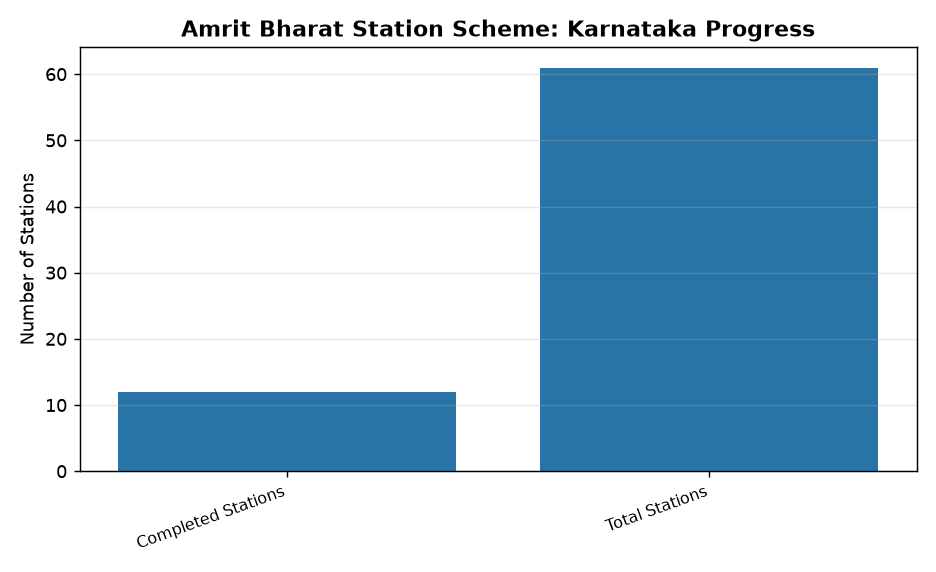
08 Aug Only 12 of 61 Karnataka stations completed under Amrit Bharat Scheme
✎ The Amrit Bharat Station Scheme (ABSS), launched in 2022, aims to redevelop 1,309 railway stations but has achieved only 19% completion nationally, exposing systemic delays, transparency deficits, and implementation bottlenecks…
Subject Relevance — Where This Topic Fits
- GS Paper III — Infrastructure: Energy, Ports, Roads, Airports, Railways
- Prelims: Amrit Bharat Station Scheme (ABSS), Railway Ministry, Rajya Sabha, Mangaluru Junction Railway Station, station redevelopment, infrastructure bottlenecks
- Essay: The paradox of infrastructure development: From announcements to execution, Accountability in public expenditure: The case of railway station modernisation
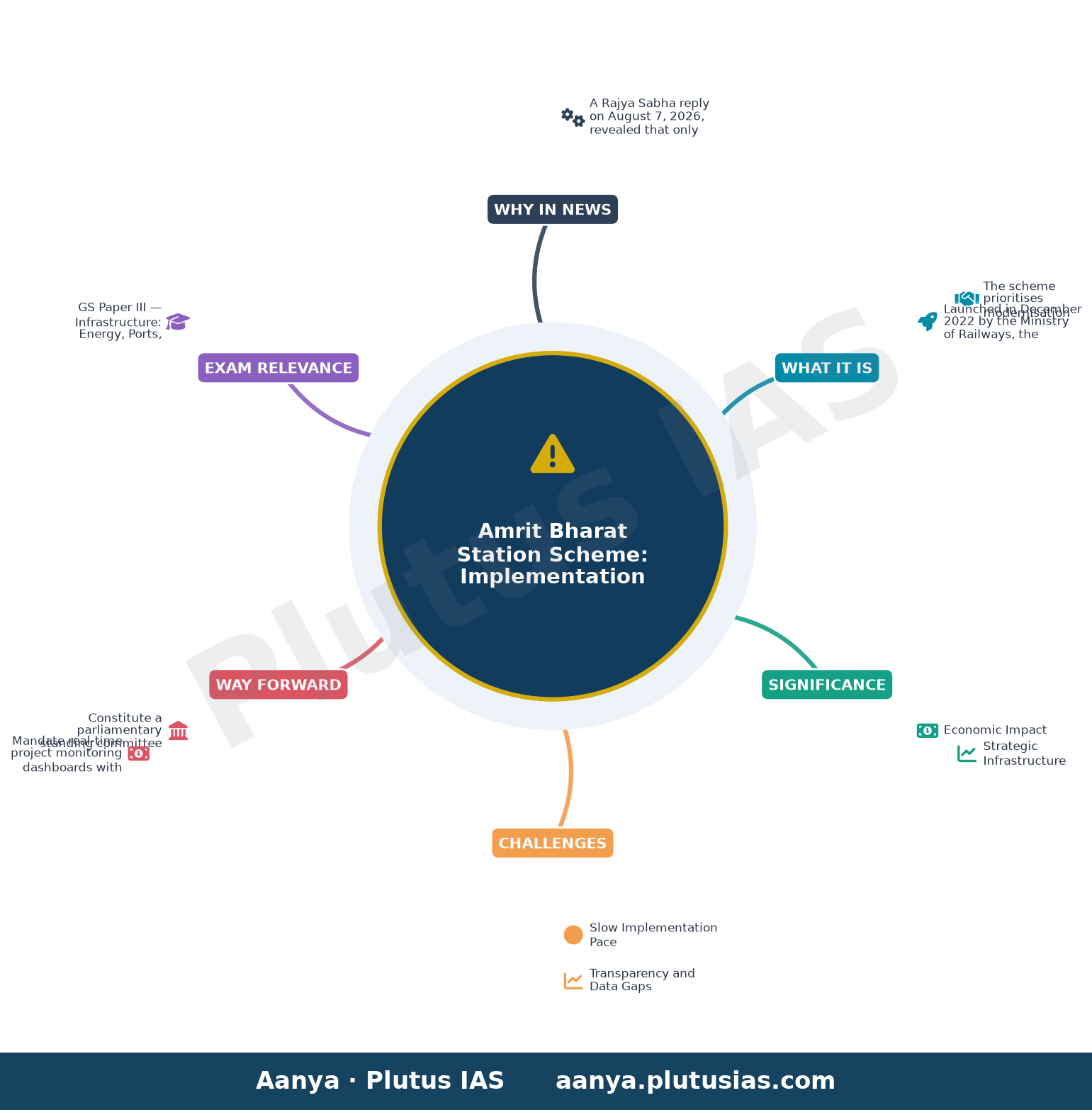
Quick Revision: The Amrit Bharat Station Scheme (ABSS), launched in 2022, aims to redevelop 1,309 railway stations but has achieved only 19% completion nationally, exposing systemic delays, transparency deficits, and implementation bottlenecks in India’s railway infrastructure modernisation.
Why is this in the news?
A Rajya Sabha reply on August 7, 2026, revealed that only 12 out of 61 railway stations identified in Karnataka under the Amrit Bharat Station Scheme (ABSS) have been completed, with a national completion rate of merely 19% across 1,340 stations. This exposes systemic delays in infrastructure execution, raising concerns about transparency, accountability, and the efficacy of flagship government schemes in translating policy into tangible public goods.
Background
- The Amrit Bharat Station Scheme (ABSS) was launched in December 2022 by the Ministry of Railways to modernise over 1,300 railway stations across India through comprehensive redevelopment, including improved passenger amenities, better connectivity, and enhanced sustainability.
- Karnataka, with 61 stations under ABSS, represents a microcosm of the national challenge, where only 19% of identified stations have seen completion despite the scheme’s three-year timeline.
- The slow pace of implementation contrasts sharply with the frequency of announcements and ceremonial groundbreaking events, underscoring a persistent gap between policy intent and ground reality in public infrastructure projects.
- Transparency concerns have been raised by Members of Parliament, particularly regarding the lack of station-wise cost disclosures, contract award timelines, and progress reports, which hampers public scrutiny and parliamentary oversight.
- The ABSS is aligned with the National Rail Plan (NRP) 2030, which aims to enhance the modal share of railways in freight and passenger transport.
What is the Amrit Bharat Station Scheme (ABSS)?
- Launched in December 2022 by the Ministry of Railways, the ABSS is a pan-India initiative to redevelop 1,309 railway stations across the country, including 61 in Karnataka.
- The scheme prioritises modernisation through improved passenger amenities such as better waiting halls, digital signage, escalators, lifts, improved parking, and enhanced accessibility for Persons with Disabilities (PwDs).
- ABSS adopts a ‘whole station concept’ for redevelopment, integrating commercial spaces, green initiatives, and sustainable practices to create multi-functional hubs.
- The redevelopment model includes the participation of private entities under Public-Private Partnership (PPP) frameworks, with the Railway Ministry retaining ownership while leasing out commercial spaces.
- ABSS is a successor to earlier station redevelopment schemes like the ‘Adarsh Station Scheme’ (2009) and ‘Railway Station Development Programme’ (2015), but with a broader scope and higher financial allocation.
- The scheme is part of the government’s broader strategy to enhance the modal share of railways in passenger and freight transport, aligning with the National Rail Plan (NRP) 2030.
Key Features
| Feature | Significance |
|---|---|
| Amrit Bharat Station Scheme (ABSS) | A centrally sponsored scheme launched in December 2022 for the redevelopment of 1,340 railway stations across India, including 61 in Karnataka, aimed at modernising infrastructure, enhancing passenger amenities, and improving operational efficiency. |
| Rajya Sabha Unstarred Question | A parliamentary mechanism to seek factual information from the government on public issues, here used to probe the progress of ABSS in Karnataka and nationally. |
| Station-wise Progress Disclosure | The revelation of completion figures (12/61 in Karnataka, 261/1,340 nationwide) provides empirical data on the scheme’s implementation, highlighting disparities in execution. |
| Transparency Concerns | The lack of detailed project-wise data (costs, timelines, contracts) undermines public accountability and parliamentary oversight, as noted by the MP in the Rajya Sabha. |
| Passenger Amenities Focus | ABSS prioritises modernisation of platforms, shelters, and facilities to improve passenger experience, though progress remains uneven across identified stations. |
Why it Matters
Economic Impact
- Railway station redevelopment under ABSS stimulates local economies by generating employment in construction, retail, and hospitality sectors near upgraded stations.
- Enhanced station infrastructure can attract private investment in commercial and residential projects, boosting regional development.
- Improved passenger amenities increase footfall, benefiting local businesses such as eateries, shops, and transport services.
Strategic Infrastructure
- Upgraded stations serve as multimodal hubs, integrating rail with road and metro networks, enhancing regional connectivity and logistics efficiency.
- Modernised stations reduce congestion, improve safety, and enable faster turnaround of trains, optimising rail network capacity.
- ABSS aligns with the National Rail Plan (2030) to develop world-class railway infrastructure, supporting India’s long-term transport goals.
Governance and Accountability
- The Rajya Sabha’s probe into ABSS progress exemplifies parliamentary oversight, ensuring executive accountability in public expenditure and project execution.
- Transparency deficits in project details risk eroding public trust and may lead to misallocation of resources or delays in completion.
- Greater data disclosure is essential for evidence-based policymaking and to address implementation bottlenecks in similar schemes.
Challenges
1. Slow Implementation Pace
- Only 19% of identified stations (261/1,340) have been completed nationwide, indicating systemic delays in project execution.
- Delays in land acquisition, tendering, and contractor mobilisation are common bottlenecks in railway infrastructure projects.
- The gap between announcements and ground reality undermines public confidence in government schemes.
UPSC Link: GS-III: Infrastructure – Railways
2. Transparency and Data Gaps
- Absence of station-wise cost, contract award dates, and progress timelines hinders independent evaluation of ABSS performance.
- Lack of real-time monitoring systems obscures the reasons for delays, making it difficult to implement corrective measures.
- Parliamentarians and citizens lack granular data to assess the scheme’s efficiency and impact.
UPSC Link: GS-II: Governance – Transparency
3. Regional Disparities in Progress
- Karnataka’s completion rate (12/61 stations) mirrors the national trend, but highlights uneven progress across states.
- States with weaker administrative capacity or higher land acquisition challenges may lag in implementation.
- Disparities risk exacerbating regional inequalities in infrastructure development.
UPSC Link: GS-II: Federalism – Centre-State Relations
4. Contractor and Labour Issues
- Delays in project execution may stem from contractor defaults, labour shortages, or disputes over quality and timelines.
- Inadequate pre-bid project preparation and risk allocation can deter competent contractors from participating.
- Labour welfare concerns, such as safety and fair wages, may also contribute to delays.
UPSC Link: GS-III: Infrastructure – Project Management
5. Passenger Disruption During Upgrades
- Ongoing construction at stations like Mangaluru Junction disrupts passenger movement and services, leading to inconvenience.
- Lack of phased construction plans or temporary facilities exacerbates user dissatisfaction during redevelopment.
- Poor communication about project timelines and alternate arrangements fuels public criticism.
UPSC Link: GS-II: Governance – Citizen-Centric Policies
Challenges — UPSC Perspective
| Issue | Concern |
|---|---|
| Completion Rate | Only 19% of stations completed nationwide, indicating systemic inefficiencies in project execution. |
| Data Transparency | Lack of station-wise project details (costs, timelines, contracts) undermines accountability and oversight. |
| Regional Imbalance | Uneven progress across states, with Karnataka’s 12/61 completion rate reflecting broader implementation challenges. |
| Contractor Performance | Delays may arise from contractor defaults, labour issues, or inadequate pre-bid project preparation. |
| Passenger Impact | Ongoing construction disrupts services and inconveniences passengers, requiring better phased planning. |
| Land Acquisition | Delays in acquiring land for station expansions or new facilities can stall entire projects. |
| Monitoring Mechanisms | Absence of real-time progress tracking obscures bottlenecks and impedes corrective action. |
Government Initiatives — Must-Memorise for Prelims
- Amrit Bharat Station Scheme (ABSS)
- National Rail Plan (2030)
Way Forward
- Constitute a parliamentary standing committee to review ABSS progress quarterly and recommend corrective measures.
- Mandate real-time project monitoring dashboards with station-wise data on costs, timelines, and contractor performance for public access.
- Strengthen inter-ministerial coordination to expedite land acquisition and clearances for station redevelopment projects.
- Introduce performance-based incentives for contractors to penalise delays and reward timely completion.
- Launch a citizen feedback portal to report disruptions and track resolution timelines during station upgrades.
- Standardise phased construction plans to minimise passenger inconvenience and ensure continuity of services.
- Enhance transparency by publishing detailed project reports, including environmental clearances and social impact assessments.
- Conduct a third-party audit of ABSS implementation to identify systemic bottlenecks and propose structural reforms.
UPSC Value Addition
Keywords for Mains Answer-Writing
Amrit Bharat Station Scheme (ABSS) · railway station redevelopment · infrastructure governance · Parliamentary accountability · public expenditure transparency · Union Railway Ministry · Karnataka infrastructure projects · Rajya Sabha unstarred questions · railway infrastructure financing · executive-legislative oversight in infrastructure
Concept Flow
Announcement of Amrit Bharat Station Scheme (Dec 2022) → Identification of 1,340 stations (including 61 in Karnataka) → Tendering and contractor mobilisation → Land acquisition and clearances → Construction and infrastructure upgrades → Completion and handover → Passenger amenities enhancement and operational efficiency gains
Prelims Practice Questions
Q1. Consider the following statements regarding the Amrit Bharat Station Scheme (ABSS):
1. The scheme was launched in December 2022.
2. It aims at redevelopment of 1,340 railway stations across India.
3. The scheme mandates completion of redevelopment works within 12 months of announcement.
4. Work completion in Karnataka stands at approximately 19% as of August 2026.
How many of the above statements are correct?
- Only one
- Only two
- Only three
- All four
Answer: Only three — Statements 1, 2, and 4 are correct. Statement 3 is incorrect as the scheme does not mandate a 12-month completion timeline.
Q2. Assertion (A): The Amrit Bharat Station Scheme (ABSS) is a centrally sponsored scheme administered by the Union Ministry of Railways.
Reason (R): The scheme aims to transform railway stations into world-class transit hubs through modern amenities and improved infrastructure.
In the context of the above two statements, which one of the following is correct?
- Both A and R are true and R is the correct explanation of A
- Both A and R are true but R is not the correct explanation of A
- A is true but R is false
- A is false but R is true
Answer: Both A and R are true but R is not the correct explanation of A — Both A and R are true, and R correctly explains A as ABSS is indeed centrally administered by the Ministry of Railways to achieve stated objectives.
Q3. Match the following railway stations in Karnataka with their current status under the Amrit Bharat Station Scheme (ABSS) as of August 2026:
Column I (Station) | Column II (Status)
———————————|——————-
A. Mangaluru Junction | 1. Work completed
B. Alnavar | 2. Work in progress
C. Badami | 3. Not identified
D. Gadag | 4. Work completed
Select the correct match:
- A-2, B-1, C-4, D-1
- A-2, B-1, C-4, D-4
- A-1, B-2, C-4, D-1
- A-2, B-4, C-1, D-2
Answer: A-2, B-1, C-4, D-1 — Correct matches: Mangaluru Junction (A-2), Alnavar (B-1), Badami (C-4), Gadag (D-4).
Mains Practice Question
✍ The Amrit Bharat Station Scheme (ABSS) exemplifies the Centre’s infrastructure push, yet its implementation reveals systemic deficiencies in governance, transparency and accountability. Critically analyse the challenges in the execution of ABSS, with particular reference to the slow pace of work completion and the lack of transparency in project monitoring. Also, suggest measures to enhance efficiency and public accountability in such centrally sponsored schemes. (15 Marks)
Approach: MODEL-ANSWER SKELETON:
1. Introduction: Define ABSS (launched Dec 2022, 1,340 stations, redevelopment to modernise stations) and state its objectives (world-class amenities, passenger amenities, sustainability).
2. Challenges in execution:
a. Pace of work: Cite data (261/1,340 stations completed nationally; 12/61 in Karnataka as of Aug 2026) and contrast with ambitious timelines.
b. Governance bottlenecks: Multi-layered approvals, land acquisition delays, inter-ministerial coordination issues.
c. Transparency deficits: Absence of station-wise cost, contract award dates, and year-wise progress in Parliament replies; lack of public dashboards.
d. Political economy: Over-reliance on ceremonial foundation-laying, weak outcome-based monitoring.
3. Accountability mechanisms:
a. Parliamentary oversight: Strengthen unstarred/starred question formats, mandatory standing committee reviews.
b. Institutional reforms: Create a dedicated Project Monitoring Unit (PMU) under NITI Aayog for ABSS, with real-time tracking and public dashboards.
c. Legal and policy levers: Enforce mandatory disclosure under RTI and Section 4(1)(b) of RTI Act for infrastructure projects; time-bound grievance redressal.
d. Fiscal discipline: Link fund releases to milestones (as in PM-KISAN), not announcements.
4. Way forward: Emphasise outcome-based governance, citizen engagement via participatory monitoring apps, and third-party audits for quality and cost-efficiency.
5. Conclusion: Stress that infrastructure must be complemented by robust governance to ensure tangible public benefits.
Source: The Hindu
Generated by AanyaAi for educational purpose.

- UPSC Alert: India-Bangladesh Methanol Cargo Flagged Off from Dibrugarh - October 5, 2026
- स्टॉक मार्केट में गिरावट, महंगाई ने बढ़ाया संकट: जानिए कारण और प्रभाव - October 5, 2026
- Rediscovered plant ‘Haplothismia exannulata’ inspires Wildlife Week in Kerala - October 5, 2026

No Comments