



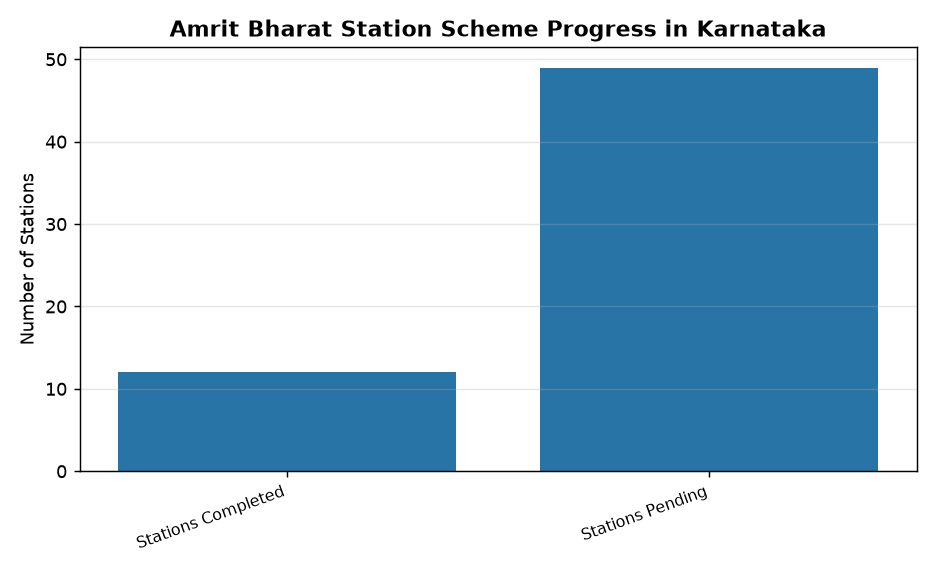
08 Aug Karnataka’s Amrit Bharat Station Scheme: Only 12 of 61 Stations Completed
✎ The Amrit Bharat Station Scheme aims to redevelop 1,340 railway stations, but only 19% completion nationally and 19.67% in Karnataka highlights systemic delays, transparency gaps, and accountability deficits in India’s…
Subject Relevance — Where This Topic Fits
- GS Paper III — Infrastructure: Energy, Ports, Roads, Airports, Railways
- Prelims: Amrit Bharat Station Scheme, Railway Ministry, Rajya Sabha, Mansoor Ali Khan, Ashwini Vaishnaw, Mangaluru Junction Railway Station, Public Accountability, Transparency in Infrastructure Projects
- Essay: Infrastructure Development in India: Balancing Ambition with Execution, Public Accountability and Governance: The Role of Transparency in Infrastructure Projects
Quick Revision: The Amrit Bharat Station Scheme aims to redevelop 1,340 railway stations, but only 19% completion nationally and 19.67% in Karnataka highlights systemic delays, transparency gaps, and accountability deficits in India’s infrastructure governance.
Why is this in the news?
The Rajya Sabha reply on August 7, 2026, revealed that only 12 of the 61 Karnataka railway stations identified under the Amrit Bharat Station Scheme (ABSS) have been completed, with a national completion rate of merely 19%. This underscores systemic implementation challenges, including delayed timelines, lack of transparency, and accountability deficits in India’s flagship railway station redevelopment initiative, prompting concerns over the efficacy of infrastructure governance and public expenditure.
Background
- The Amrit Bharat Station Scheme (ABSS) was launched by the Railway Ministry in December 2022 to modernise 1,340 railway stations across India through multi-modal redevelopment, aiming to enhance passenger amenities, accessibility, and sustainability.
- Karnataka was allocated 61 stations under ABSS, including major junctions like Mangaluru, Dharwad, and Hosapete, reflecting the state’s strategic importance in India’s railway network.
- The scheme replaces the earlier ‘Model Station’ scheme and aligns with the broader ‘Viksit Bharat@2047’ vision, emphasizing last-mile connectivity and inclusive infrastructure development.
- Railway infrastructure in Karnataka, particularly in coastal and hinterland regions, faces challenges such as land acquisition delays, environmental clearances, and coordination gaps between central and state agencies.
- Public expectations have risen post-independence-era neglect of railway stations, with citizens demanding world-class facilities akin to global benchmarks in urban transit hubs.
What is the Amrit Bharat Station Scheme (ABSS)?
- A centrally sponsored scheme launched by the Ministry of Railways in December 2022 to redevelop 1,340 railway stations across India, including 61 in Karnataka, with a focus on modernisation and passenger-centric amenities.
- The scheme aims to transform railway stations into ‘world-class’ transit hubs by integrating last-mile connectivity, digital infrastructure, and sustainable design principles, including renewable energy integration and water conservation.
- Key objectives include improving passenger experience through better signage, seating, toilets, and accessibility for differently-abled individuals, alongside commercial development of station precincts to enhance revenue streams.
- The redevelopment model adopts a ‘hub-and-spoke’ approach, where station precincts are developed as multi-functional spaces, integrating retail, office spaces, and public amenities while preserving heritage structures where applicable.
- The scheme replaces the earlier ‘Model Station’ scheme and is aligned with the ‘Station Development Programme’ of the Indian Railways, which seeks to redefine station architecture and passenger services.
- Implementation is overseen by the Railway Board in collaboration with zonal railways, state governments, and municipal bodies, with project execution delegated to designated agencies like the Rail Vikas Nigam Limited (RVNL).
- Monitoring is conducted through the ‘Railway Station Redevelopment Dashboard’, though the lack of granular data in responses to parliamentary queries raises questions about transparency and real-time tracking.
UPSC Value Addition
Keywords for Mains Answer-Writing
Amrit Bharat Station Scheme (ABSS) · Railway station redevelopment · Infrastructure governance · Parliamentary accountability · Public expenditure transparency · Union Railway Ministry · Rajya Sabha unstarred questions · Karnataka infrastructure projects · Railway infrastructure financing · Multi-modal connectivity
Prelims Practice Questions
Q1. Consider the following statements regarding the Amrit Bharat Station Scheme (ABSS):
1. The scheme was launched in December 2022.
2. It aims at redeveloping 1,340 railway stations across India.
3. The scheme mandates 100% completion of all identified stations within two years of announcement.
4. The scheme includes provisions for multi-modal connectivity at redeveloped stations.
How many of the above statements are correct?
- Only one
- Only two
- Only three
- All
Answer: Only three — Statements 1, 2, and 4 are correct. Statement 3 is incorrect as there is no mandatory two-year completion timeline under the scheme.
Q2. Assertion (A): The Amrit Bharat Station Scheme (ABSS) is a centrally sponsored scheme administered by the Ministry of Railways.
Reason (R): The scheme prioritises the redevelopment of railway stations to enhance passenger amenities and multi-modal connectivity.
In the context of the above two statements, which one of the following is correct?
- Both A and R are true, and R is the correct explanation of A
- Both A and R are true, but R is not the correct explanation of A
- A is true, but R is false
- A is false, but R is true
Answer: A is true, but R is false — A is true as ABSS is centrally sponsored and administered by the Ministry of Railways. R is also true but does not directly explain A, as it describes the scheme’s objectives rather than its administrative structure.
Q3. Match the following railway stations in Karnataka with their respective districts:
Column I (Station) | Column II (District)
——————-|——————-
A. Alnavar | 1. Udupi
B. Bagalkot | 2. Dakshina Kannada
C. Bantwal | 3. Belagavi
D. Mangaluru | 4. Bagalkot
Choose the correct match:
- A-3, B-4, C-1, D-2
- A-4, B-3, C-2, D-1
- A-3, B-4, C-2, D-1
- A-1, B-2, C-3, D-4
Answer: A-3, B-4, C-1, D-2 — Alnavar is in Belagavi district, Bagalkot station is in Bagalkot district, Bantwal is in Dakshina Kannada district, and Mangaluru is in Dakshina Kannada district.
Mains Practice Question
✍ The Amrit Bharat Station Scheme (ABSS) was envisaged as a transformative initiative to modernise India’s railway stations through a hub-and-spoke model of redevelopment. Critically analyse the implementation challenges faced by the scheme, with particular reference to transparency, accountability, and inter-state disparities. Also, outline the constitutional and administrative framework governing centrally sponsored schemes in India. (15 Marks)
Approach: MODEL-ANSWER SKELETON:
1. **Introduction (2 Marks)**: Define ABSS (launched Dec 2022) and its objectives (redevelopment of 1,340 stations, multi-modal connectivity, passenger amenities). Mention the current implementation status (261/1,340 stations completed as of Aug 2026).
2. **Implementation Challenges (6 Marks)**:
– **Transparency and Accountability**: Highlight the lack of station-wise project costs, contract award dates, and year-wise progress data in Parliament replies (as noted by MP Mansoor Ali Khan). Discuss the absence of public dashboards or RTI-friendly disclosures.
– **Pace of Progress**: Cite the 19% completion rate (261/1,340) and Karnataka’s 12/61 stations, attributing delays to procedural bottlenecks (land acquisition, tendering, environmental clearances).
– **Inter-State Disparities**: Contrast Karnataka’s progress with other states (e.g., Gujarat, Maharashtra) and discuss factors like state government coordination, local political economy, and resource allocation.
3. **Constitutional and Administrative Framework (4 Marks)**:
– **Centrally Sponsored Schemes (CSS)**: Explain the classification under Article 282 of the Constitution (financial assistance to states for specified purposes). Mention the NITI Aayog’s role in scheme formulation and monitoring.
– **Railway Ministry’s Jurisdiction**: Discuss the Railway Board’s administrative control over ABSS, including the role of the Railway Minister and Parliamentary Standing Committee on Railways.
– **State Government Role**: Highlight the need for state-level coordination (e.g., land acquisition under Entry 18, List II of the Seventh Schedule) and potential conflicts.
4. **Way Forward (3 Marks)**:
– **Reforms**: Suggest measures like real-time project tracking (e.g., PRAGATI platform), mandatory disclosure of contracts under RTI, and incentivising states through performance-linked grants.
– **Judicial Oversight**: Cite recent Supreme Court judgments on transparency in public expenditure (e.g., *Common Cause v. Union of India*, 2018) to argue for judicial accountability.
– **Stakeholder Engagement**: Emphasise the role of citizen oversight (e.g., grievance redressal via *Rail Madad* portal) and third-party audits.
**Balanced View**: Acknowledge the scheme’s potential (e.g., economic multiplier effects, urban renewal) while critiquing its execution gaps. Conclude with a balanced assessment of whether ABSS can achieve its objectives without systemic reforms.
Source: The Hindu
Generated by AanyaAi for educational purpose.

- KWML’s Feasibility Reports for Water Metro in 18 Cities: UPSC & PCS Insights - October 3, 2026
- ओडिशा में वन्यजीव अनुसंधान अनुदान कार्यक्रम शुरू, सिमिलिपाल में 300 कैमरे और बढ़ेंगे - October 3, 2026
- India Summons Pakistan High Commission Official Over Violation - October 3, 2026

No Comments