


08 Aug Women’s Representation in Judiciary: UPSC & State PCS Analysis for 2026
✎ Gender inclusivity in the judiciary is not merely about representation but about integrating women’s perspectives across all legal domains to ensure equitable justice delivery, as highlighted by the Karnataka High Court’s…
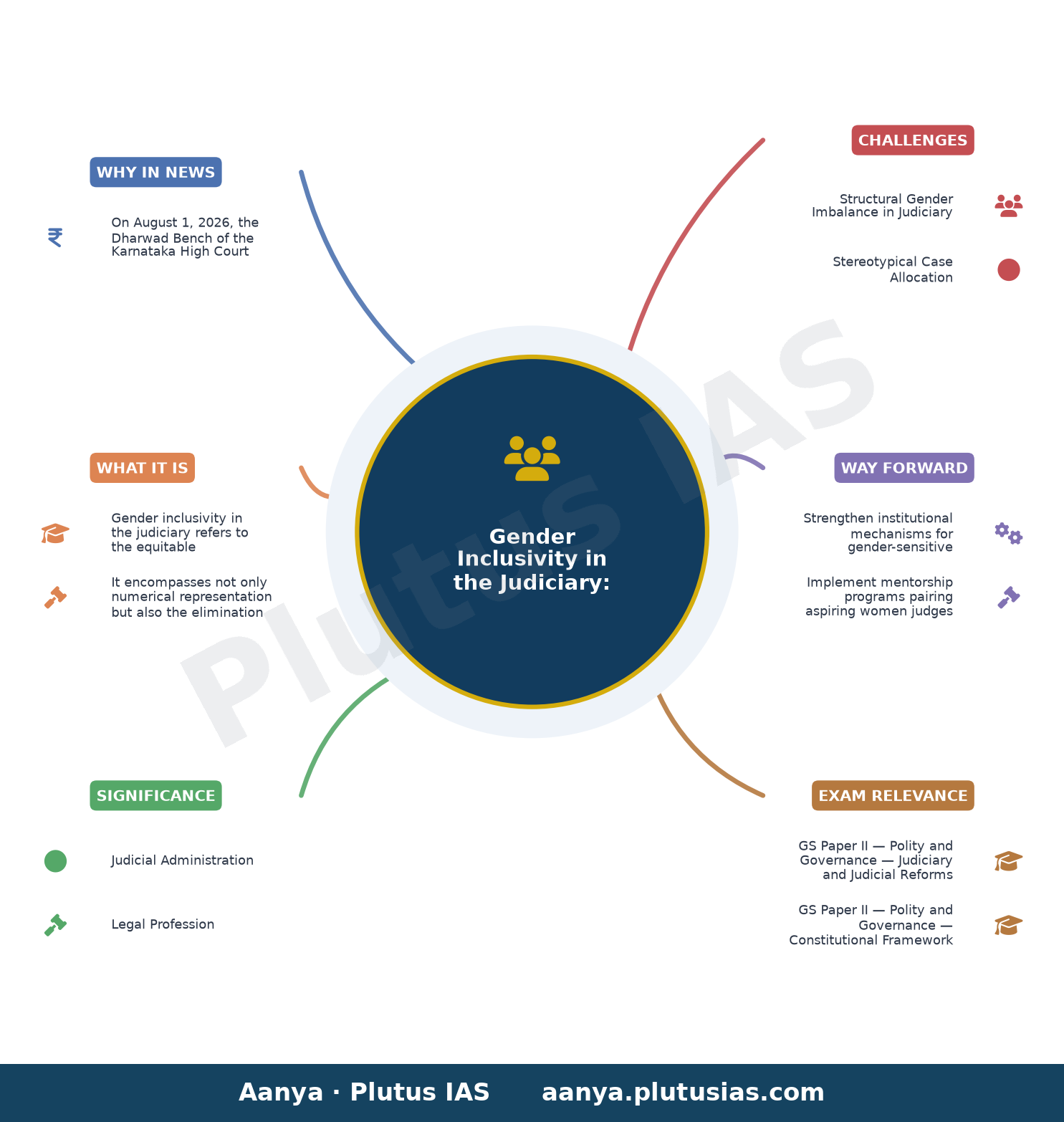
Subject Relevance — Where This Topic Fits
- GS Paper II — Polity and Governance — Judiciary and Judicial Reforms | GS Paper II — Polity and Governance — Constitutional Framework and Fundamental Rights
- Prelims: Judicial appointments, gender representation in judiciary, constitutional courts, POCSO Act, Advocate General, all-women benches, Karnataka High Court
- Essay: The Role of Women in Shaping Equitable Legal Systems, Judicial Reforms and Social Justice: Bridging the Gender Divide
Quick Revision: Gender inclusivity in the judiciary is not merely about representation but about integrating women’s perspectives across all legal domains to ensure equitable justice delivery, as highlighted by the Karnataka High Court’s all-women bench milestone.
Why is this in the news?
On August 1, 2026, the Dharwad Bench of the Karnataka High Court achieved a historic milestone when all judicial benches were presided over exclusively by women judges, and the State was represented solely by women law officers. This event, coupled with statements by Justices Anu Sivaraman, P.S. Hemalekha, and S. Sunil Dutt Yadav, underscores the judiciary’s evolving discourse on gender inclusivity. The remarks highlight the necessity of integrating women’s perspectives across all branches of law, challenging traditional gendered assumptions in legal adjudication and legal practice.
Background
- The Indian judiciary has historically been male-dominated, with women constituting only 11.5% of High Court judges as of 2024, despite women comprising nearly 50% of law graduates.
- The Constitution of India guarantees equality under Article 14 and prohibits discrimination under Article 15, yet systemic barriers persist in judicial appointments and case adjudication.
- The Protection of Children from Sexual Offences (POCSO) Act, 2012, has seen a rise in cases, necessitating gender-sensitive adjudication to address the unique vulnerabilities of female litigants and victims.
- The collegium system for judicial appointments has faced criticism for lack of transparency and gender bias, with women often overlooked for senior positions.
- The Supreme Court’s 2021 judgment in *Supreme Court Advocates-on-Record Association v. Union of India* reiterated the need for diversity in judicial appointments, including gender representation.
- State initiatives, such as the constitution of all-women benches in lower courts, have been sporadically implemented but remain rare at the High Court level.
What is Gender Inclusivity in the Judiciary?
- Gender inclusivity in the judiciary refers to the equitable representation of women in judicial appointments, adjudication, and legal practice, ensuring their perspectives are integral to legal decision-making across all domains.
- It encompasses not only numerical representation but also the elimination of gender bias in case allocation, courtroom dynamics, and institutional policies.
- The judiciary’s legitimacy depends on its ability to reflect societal diversity, including gender, to foster public trust and deliver justice that is perceived as fair and impartial.
- Women bring distinct experiential knowledge to legal adjudication, particularly in cases involving gender-based violence, family law, and employment disputes, where empathy and contextual understanding are critical.
- The principle aligns with constitutional values of equality (Article 14), non-discrimination (Article 15), and the directive to promote justice (Article 38), as enshrined in the Directive Principles of State Policy.
- Judicial diversity enhances the quality of legal reasoning by incorporating multiple viewpoints, reducing the risk of systemic biases in judgments.
- The concept is distinct from tokenism; it advocates for substantive inclusion where women are empowered to influence legal discourse and policy formulation.
- Institutional mechanisms, such as reservation in higher judiciary or mentorship programs, are debated but remain contentious due to concerns over meritocracy and judicial independence.
Key Features
| Feature | Significance |
|---|---|
| All-women Benches at Dharwad Bench | Demonstrated institutional capacity of women judges to preside over diverse case categories, including civil, criminal, and constitutional matters, challenging gendered assumptions in judicial administration. |
| Exclusive representation by women law officers | Highlighted the competence of women advocates in handling high-stakes litigation, reinforcing the principle of equality in legal practice and prosecution. |
| Judicial pronouncements on gender inclusivity | Emphasised the necessity of integrating women’s perspectives across all branches of law, not merely in gender-specific cases, to enhance judicial equity. |
| Constitutional court milestone | Marked a rare instance of gender parity in judicial proceedings, setting a precedent for inclusive judicial administration in higher judiciary. |
| Advocate General’s all-women team | Showcased systemic support from the executive branch in promoting gender diversity within the legal profession and judiciary. |
Why it Matters
Judicial Administration
- Enhanced legitimacy of the judiciary by demonstrating gender inclusivity in adjudication processes.
- Challenged traditional gender biases in judicial appointments and case allocation, fostering a more representative legal system.
- Set a precedent for future initiatives aimed at gender parity in constitutional courts and subordinate judiciary.
Legal Profession
- Validated the professional competence of women advocates in high-stakes litigation, countering stereotypes about their suitability for complex cases.
- Encouraged greater participation of women in legal practice, particularly in roles traditionally dominated by men (e.g., prosecution, government law officers).
- Strengthened the pipeline for future judicial appointments by showcasing the capabilities of women legal practitioners.
Societal Impact
- Reinforced constitutional principles of equality and non-discrimination (Article 14) in the public domain, particularly in institutions of power.
- Inspired confidence among women aspirants in legal and judicial careers by normalising their presence in leadership roles.
- Promoted a cultural shift in legal institutions toward gender-sensitive adjudication and practice.
Challenges
1. Structural Gender Imbalance in Judiciary
- Women constitute only ~15% of judges in higher judiciary (as of 2024), despite comprising nearly 50% of law graduates.
- Glass ceiling effects persist in appointments to constitutional courts and senior administrative roles.
- Lack of institutional mechanisms to ensure gender parity in judicial appointments and case allocations.
UPSC Link: Judicial Appointments: Collegium System and Gender Representation
2. Stereotypical Case Allocation
- Women judges are often confined to ‘gender-specific’ cases (e.g., POCSO, family disputes), limiting their exposure to diverse legal domains.
- Perpetuates the notion that women lack expertise in ‘hard law’ areas (e.g., taxation, constitutional law, corporate law).
- Undermines the principle of judicial impartiality by associating women judges with specific types of cases.
UPSC Link: Judicial Role Allocation and Gender Bias
3. Institutional Resistance to Change
- Entrenched patriarchal norms within legal institutions may resist initiatives promoting gender diversity.
- Lack of proactive policies (e.g., quotas, mentorship programs) to accelerate women’s representation in judiciary.
- Tokenism in gender-sensitive initiatives without substantive structural reforms.
UPSC Link: Gender Justice in Constitutional Institutions
4. Socio-Cultural Barriers
- Persistent societal biases against women in professional leadership roles, particularly in male-dominated sectors like law.
- Work-life balance challenges, including societal expectations around caregiving, deter women from pursuing judicial careers.
- Lack of family and institutional support systems to enable women to balance professional and personal responsibilities.
UPSC Link: Gender Stereotypes and Professional Growth
Challenges — UPSC Perspective
| Issue | Concern |
|---|---|
| Low representation of women in higher judiciary | Undermines the judiciary’s legitimacy as a representative institution and limits diversity of perspectives in adjudication. |
| Gendered assumptions in case allocation | Reinforces stereotypes and restricts women judges to specific case types, affecting their career progression and institutional credibility. |
| Lack of institutional mechanisms for gender parity | Absence of quotas, mentorship programs, or accountability frameworks to ensure equitable representation. |
| Cultural resistance to gender-sensitive reforms | Deep-rooted biases within legal institutions may impede efforts to promote gender inclusivity. |
| Work-life balance challenges for women judges | Societal expectations around caregiving may discourage women from pursuing judicial careers or lead to attrition. |
| Tokenism in gender initiatives | Superficial measures without structural reforms fail to address systemic gender disparities. |
Way Forward
- Strengthen institutional mechanisms for gender-sensitive judicial appointments, including transparent selection criteria and diversity benchmarks.
- Implement mentorship programs pairing aspiring women judges with senior legal professionals to bridge the experience gap.
- Conduct periodic audits of case allocation to ensure equitable distribution across all legal domains for women judges.
- Promote gender-neutral case assignment policies to dismantle stereotypes about women’s suitability for specific case types.
- Enhance family and institutional support systems (e.g., childcare facilities, flexible work arrangements) for women in the judiciary.
- Launch awareness campaigns within legal fraternity to challenge unconscious biases against women in judicial roles.
- Encourage state governments to emulate the Dharwad Bench model by constituting all-women Benches on a pilot basis.
- Integrate gender sensitivity training into judicial education to foster a culture of inclusivity in adjudication processes.
UPSC Value Addition
Keywords for Mains Answer-Writing
Gender representation in judiciary · Judicial diversity and inclusivity · Women judges in constitutional courts · Protection of Children from Sexual Offences Act (POCSO) 2012 · Article 14 of the Constitution (Right to Equality) · Article 15(3) (Special provisions for women) · Judicial appointments and collegium system · Gender-sensitive adjudication · All-women benches in High Courts · Judicial accountability and transparency · Legal profession and gender parity · Constitutional morality and judicial functioning
Constitutional & Policy Linkages
- Article 14: Right to Equality and Non-Discrimination — Ensures gender parity in judicial appointments and case allocations.
- Article 15(3): Special Provisions for Women — Permits affirmative action to address historical disadvantages in judiciary.
- Article 39A: Equal Justice and Free Legal Aid — Mandates equitable access to justice, including through gender-sensitive judicial processes.
- Article 51A(e): Fundamental Duty — Inculcates respect for gender equality in public institutions, including judiciary.
Concept Flow
Historical underrepresentation of women in judiciary → Persistent gender biases in case allocation → Institutionalisation of stereotypes → Calls for gender-inclusive adjudication → Demonstration of competence via all-women Benches → Policy push for systemic reforms → Long-term goal of gender parity in judiciary.
Prelims Practice Questions
Q1. Consider the following statements regarding the Protection of Children from Sexual Offences (POCSO) Act, 2012:
1. The Act mandates the appointment of women judges exclusively for cases involving children.
2. The Act defines a child as any person below the age of 18 years.
3. The Act provides for the establishment of Special Courts for the trial of offences under the Act.
How many of the above statements are correct?
- Only one
- Only two
- All three
- None
Answer: All three — Statement 1 is incorrect as the POCSO Act does not mandate exclusive appointment of women judges for such cases. Statements 2 and 3 are correct as per Sections 2(d) and 28 of the POCSO Act, 2012.
Q2. Assertion (A): The collegium system in India ensures gender diversity in judicial appointments.
Reason (R): The collegium system is a transparent process that evaluates candidates solely on merit, including gender representation.
In the context of the above two statements, which one of the following is correct?
- Both A and R are true and R is the correct explanation of A
- Both A and R are true but R is NOT the correct explanation of A
- A is true but R is false
- A is false but R is true
Answer: A is false but R is true — Assertion (A) is false as the collegium system has been critiqued for lacking explicit mechanisms to ensure gender diversity. Reason (R) is also false as the collegium system is not entirely transparent and does not explicitly prioritize gender representation.
Q3. Match the following constitutional provisions with their respective descriptions:
Column I
1. Article 14
2. Article 15(3)
3. Article 16
4. Article 32
Column II
A. Right to Constitutional Remedies
B. Equality before law
C. Special provisions for women and children
D. Equality of opportunity in matters of public employment
Select the correct match:
- 1-B, 2-C, 3-D, 4-A
- 1-A, 2-B, 3-C, 4-D
- 1-D, 2-A, 3-B, 4-C
- 1-C, 2-D, 3-A, 4-B
Answer: 1-B, 2-C, 3-D, 4-A — The correct matches are: Article 14 (B) – Equality before law, Article 15(3) (C) – Special provisions for women and children, Article 16 (D) – Equality of opportunity in matters of public employment, Article 32 (A) – Right to Constitutional Remedies.
Mains Practice Question
✍ The representation of women in the judiciary remains disproportionately low despite constitutional guarantees of equality. Critically examine the structural and institutional barriers to gender inclusivity in the Indian judiciary, with reference to recent judicial initiatives such as all-women benches. Also, assess the implications of such initiatives for judicial accountability and constitutional morality. (15 Marks)
Approach: MODEL-ANSWER SKELETON:
1. **Constitutional Framework**:
– Article 14 (Right to Equality) and Article 15(3) (Special provisions for women) as foundational guarantees.
– Article 16 (Equality of opportunity in public employment) and its relevance to judicial appointments.
2. **Current Representation Data**:
– Cite the latest data on women judges in the Supreme Court and High Courts (e.g., Supreme Court has ~10% women judges as of 2024).
– Highlight the underrepresentation in constitutional courts and tribunals.
3. **Structural Barriers**:
– **Collegium System**: Lack of explicit gender diversity criteria; opacity in appointments.
– **Socio-Cultural Factors**: Patriarchal norms, work-life balance challenges, and lack of mentorship.
– **Institutional Bias**: Stereotypes in case allocation, lack of gender-sensitive training for judges.
4. **Judicial Initiatives**:
– **All-Women Benches**: Reference the Dharwad Bench milestone (August 1, 2026) and its significance.
– **Gender-Sensitive Adjudication**: Role of women judges in cases under POCSO, family law, and service matters.
– **Representation in Law Officers**: All-women team of law officers representing the State.
5. **Judicial Accountability and Constitutional Morality**:
– **Accountability**: How gender diversity enhances legitimacy and public trust in the judiciary.
– **Constitutional Morality**: Link to Dr. B.R. Ambedkar’s vision of an inclusive judiciary (e.g., debates in the Constituent Assembly).
– **Critique**: Whether such initiatives are symbolic or substantive in addressing systemic barriers.
6. **Way Forward**:
– **Reforms**: Suggest measures such as gender quotas in judicial appointments, mandatory gender sensitization programs, and transparency in the collegium system.
– **Judicial Training**: Emphasize gender-responsive adjudication training for judges.
– **Legal Profession**: Encourage women’s participation in the bar and higher judiciary through mentorship and support systems.
7. **Conclusion**:
– Reiterate the need for a multi-pronged approach to achieve gender inclusivity in the judiciary, balancing constitutional guarantees with institutional reforms.
Source: The Hindu
Generated by AanyaAi for educational purpose.

- भारत-आसियान व्यापार 128 अरब डॉलर तक पहुंचा, जानिए क्या हुआ 14वें पूर्वी एशिया शिखर सम्मेलन में - September 24, 2026
- UPSC Focus: India’s Role in 14th EAS & 23rd ASEAN-India Economic Meetings - September 24, 2026
- यूपीएससी-एसयूवाई: कचरा उठाने से मिली आर्थिक सुरक्षा, सरकारी योजना से बदला जीवन - September 24, 2026

No Comments