


08 Aug Mekedatu Dam: Centre Reaffirms Stand, Lok Sabha Reply Sparks Row
✎ The Mekedatu dam project is a multi-purpose initiative by Karnataka to address Bengaluru’s water needs, but its legal and constitutional validity hinges on the Supreme Court’s interpretation of the Cauvery Water Disputes Tribunal…
Subject Relevance — Where This Topic Fits
- GS Paper II — Functions and Responsibilities of the Union and the States | GS Paper III — Water Resources and Related Issues
- Prelims: Inter-State Water Disputes Act, 1956, Cauvery Water Disputes Tribunal (CWDT) Award, Riparian Rights, Doctrine of Prior Appropriation, Supreme Court’s Jurisdiction under Article 131
- Essay: Inter-State Relations and Cooperative Federalism in India: Balancing Development and Equity, Water Governance in India: Challenges of Equity, Sustainability, and Federalism
Quick Revision: The Mekedatu dam project is a multi-purpose initiative by Karnataka to address Bengaluru’s water needs, but its legal and constitutional validity hinges on the Supreme Court’s interpretation of the Cauvery Water Disputes Tribunal Award and the principles of inter-State water-sharing.
Why is this in the news?
The Union Government’s reiteration of its stance on the Mekedatu dam project in the Lok Sabha has reignited the long-standing inter-State dispute between Karnataka and Tamil Nadu over the Cauvery river. The Minister of State for Jal Shakti invoked the Supreme Court’s 2018 judgment on the Cauvery dispute to assert that Karnataka is not required to obtain consent from lower riparian states for constructing structures across the river. This assertion has been contested by Tamil Nadu, which argues that the project could disrupt the regulated flow regime established by the Cauvery Water Disputes Tribunal Award, thereby violating inter-State water-sharing norms.
Background
- The Cauvery river is a perennial river originating in Karnataka and flowing through Tamil Nadu, Kerala, and the Union Territory of Puducherry, making it a critical inter-State water resource.
- The Cauvery Water Disputes Tribunal (CWDT), constituted under the Inter-State Water Disputes Act, 1956, delivered its final award in 2007, allocating specific water shares to Karnataka, Tamil Nadu, Kerala, and Puducherry.
- The Supreme Court, in its 2018 judgment, modified the CWDT Award.
- Karnataka has proposed the Mekedatu dam project to meet Bengaluru’s drinking water needs and generate hydroelectric power, while Tamil Nadu has raised concerns about potential adverse impacts on its agricultural and drinking water security.
- The dispute has historical roots, with multiple agreements, tribunals, and judicial interventions failing to resolve the issue permanently, reflecting the complexities of inter-State water governance in India.
What is the Mekedatu Dam Project?
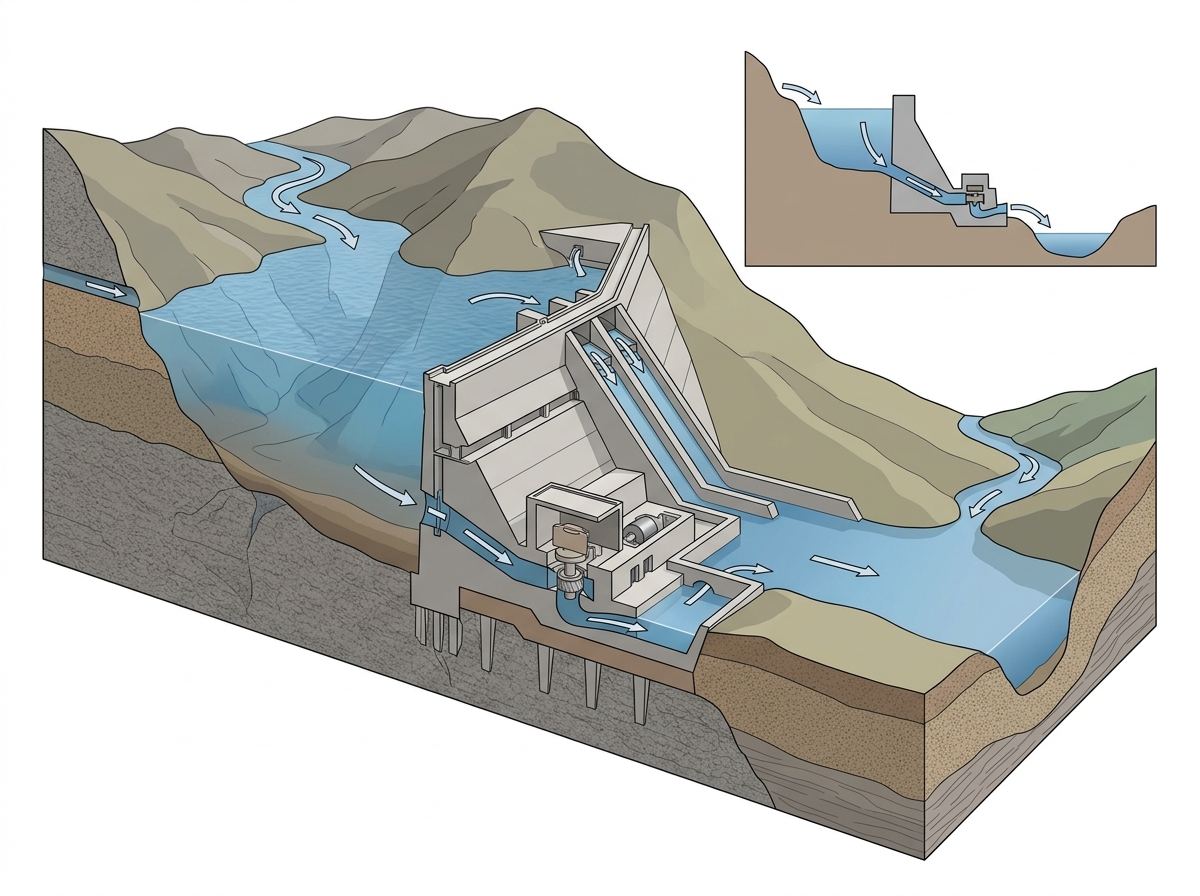
- The Mekedatu dam is proposed to be constructed across the Cauvery river near Mekedatu in Karnataka’s Ramanagara district, approximately 40 km from Bengaluru.
- The project aims to meet Bengaluru’s growing drinking water demands and generate hydroelectric power.
- The dam is envisaged as a multi-purpose project, including a balancing reservoir to regulate water flow and ensure uninterrupted supply to Bengaluru.
- Karnataka argues that the project is essential for its urban water security and does not violate the CWDT Award, as it does not alter the quantum of water allocated to Tamil Nadu.
- Tamil Nadu contends that the project could disrupt the regulated flow regime, reduce water availability in the Cauvery delta, and violate the CWDT Award’s provisions on scheduled deliveries to lower riparian states.
- The project has been a subject of political and legal contention, with both states invoking constitutional provisions, judicial precedents, and inter-State water-sharing norms to support their positions.
- The Union Government’s stance, as reiterated in Parliament, is based on the Supreme Court’s interpretation of the CWDT Award, which does not mandate prior consent from riparian states for construction of structures.
- The dispute highlights the broader challenges of balancing developmental needs with inter-State equity and sustainability in water governance.
Key Features
| Feature | Significance |
|---|---|
| Mekedatu dam project | A proposed multi-purpose dam across the Cauvery River in Karnataka to address Bengaluru’s drinking water deficit and hydropower generation. |
| Supreme Court’s 2018 Cauvery dispute judgment | Affirmed Karnataka’s right to construct structures on the Cauvery under the Cauvery Water Disputes Tribunal’s final award, subject to compliance with regulated flow regimes. |
| Cauvery Water Disputes Tribunal (CWDT) Award, 2007 | Established a regulated flow regime for Cauvery water sharing among riparian states (Karnataka, Tamil Nadu, Kerala, Puducherry), including scheduled deliveries to lower riparian states. |
| Union government’s stance on consent | Asserted that Karnataka is not required to obtain prior consent from other riparian states for constructing structures on the Cauvery, citing the CWDT Award and Supreme Court judgment. |
| Tamil Nadu’s objections | Argued that the Mekedatu project could disrupt the regulated flow regime, violating the CWDT Award’s prohibition on upper riparian states affecting scheduled deliveries to lower riparian states. |
Why it Matters
Inter-State Water Disputes
- The Mekedatu project exemplifies the persistent challenge of balancing water-sharing agreements among riparian states under the framework of the Inter-State Water Disputes Act, 1956.
- The Supreme Court’s 2018 judgment underscores the primacy of the CWDT Award in resolving inter-state disputes, reinforcing the legal sanctity of tribunal awards.
- The dispute highlights the need for robust institutional mechanisms to address evolving water demands while ensuring equitable distribution as per historical agreements.
Urban Water Security
- Bengaluru’s rapid urbanisation and water scarcity necessitate long-term infrastructure solutions, including inter-basin transfers and storage projects like Mekedatu.
- The project aligns with Karnataka’s broader strategy to secure water resources for domestic, industrial, and agricultural sectors, particularly in drought-prone regions.
- However, the project’s implementation must balance urban needs with downstream ecological and livelihood impacts in Tamil Nadu’s Cauvery delta.
Judicial Precedents and Federalism
- The Supreme Court’s interpretation of the CWDT Award reaffirms the supremacy of tribunal awards over state-level concerns, reinforcing the Centre’s role in inter-state water disputes.
- The Centre’s reiteration of its stance in Parliament underscores the constitutional obligation of the Union to uphold tribunal awards and mediate disputes, even amid state-level opposition.
- The episode raises questions about the efficacy of judicial remedies in resolving politically sensitive inter-state disputes, where state governments may resist compliance.
Challenges
1. Legal and Jurisdictional Challenges
- Tamil Nadu’s contention that the project violates the CWDT Award’s prohibition on upper riparian states altering scheduled deliveries to lower riparian states.
- The absence of a clear mechanism for post-award modifications to tribunal awards, leading to prolonged legal and political disputes.
- The risk of judicial overreach if the Supreme Court is compelled to adjudicate on the project’s compliance with the award, given the Centre’s stance.
- The potential for the dispute to escalate to the Supreme Court again, testing the finality of the 2018 judgment and the CWDT Award.
UPSC Link: GS-II: Inter-State Relations
2. Ecological and Livelihood Concerns
- The project’s potential to reduce water availability in Tamil Nadu’s Cauvery delta, impacting agriculture, drinking water supply, and ecosystem services.
- The risk of altering the river’s sediment flow, which could degrade deltaic fertility and increase salinity intrusion in coastal regions.
- The need for comprehensive environmental impact assessments (EIAs) to evaluate long-term ecological consequences, including biodiversity loss and groundwater depletion.
UPSC Link: GS-III: Environmental Conservation
3. Political and Diplomatic Strains
- The Centre’s refusal to reconsider its stance despite Tamil Nadu’s protests may strain Centre-State relations, particularly under a coalition government.
- The project could become a tool for political mobilisation in Tamil Nadu, with potential electoral repercussions for both Dravida Munnetra Kazhagam (DMK) and Bharatiya Janata Party (BJP).
- The risk of the dispute spilling over into broader Tamil Nadu-Karnataka relations, affecting cultural and economic ties.
UPSC Link: GS-II: Centre-State Relations
4. Technical and Financial Hurdles
- The project’s estimated cost and funding mechanisms remain unclear, raising questions about Karnataka’s fiscal capacity to complete the dam within stipulated timelines.
- The need for advanced hydrological modelling to ensure the project does not exacerbate downstream water scarcity during drought years.
- The potential for delays due to legal challenges, public protests, or environmental clearances, which could render the project economically unviable.
UPSC Link: GS-III: Infrastructure Development
Challenges — UPSC Perspective
| Issue | Concern |
|---|---|
| Compliance with CWDT Award | Tamil Nadu argues the project violates the award’s prohibition on upper riparian states altering scheduled deliveries to lower riparian states. |
| Ecological Impact on Cauvery Delta | Risk of reduced water availability, sediment flow disruption, and salinity intrusion affecting agriculture and livelihoods. |
| Centre-State Relations | Centre’s refusal to reconsider stance may strain relations, particularly if Tamil Nadu escalates the dispute politically. |
| Judicial Overreach | Potential for the Supreme Court to be drawn into adjudicating compliance, testing the finality of the 2018 judgment. |
| Funding and Viability | Uncertainty over project cost, funding sources, and economic viability amid legal and environmental delays. |
| Public and Political Opposition | Risk of protests in Tamil Nadu and Karnataka, with potential electoral repercussions for ruling parties. |
Way Forward
- Constitute a high-powered inter-state committee under the Inter-State Water Disputes Act, 1956, to reassess the project’s compliance with the CWDT Award and its downstream impacts.
- Undertake a joint environmental impact assessment (EIA) involving Karnataka, Tamil Nadu, and independent experts to evaluate ecological and livelihood risks.
- Explore alternative water management strategies for Bengaluru, such as rainwater harvesting, wastewater recycling, and inter-basin transfers from non-Cauvery sources.
- Strengthen institutional mechanisms for post-award modifications to tribunal awards, including provisions for stakeholder consultations and dispute resolution.
- Enhance transparency by sharing detailed project reports, hydrological data, and mitigation plans with all riparian states and affected communities.
- Leverage the Centre’s role as a neutral mediator to facilitate dialogue between Karnataka and Tamil Nadu, focusing on equitable water-sharing arrangements.
- Invest in research and technology to improve water-use efficiency in agriculture and urban sectors, reducing pressure on the Cauvery basin.
- Formulate a long-term Cauvery basin management plan that integrates climate change projections, population growth, and ecosystem conservation.
UPSC Value Addition
Keywords for Mains Answer-Writing
Mekedatu dam project · Cauvery Water Disputes Tribunal · Inter-State River Water Disputes Act, 1956 · Riparian rights · Supreme Court judgment on Cauvery (2018) · Federalism in water governance · Karnataka-Tamil Nadu water dispute · Union government’s stand on inter-state water projects · Cauvery delta farmers’ concerns · Constitutional provisions on water sharing (Article 262) · Inter-State Water Disputes Tribunal · Doctrine of prior appropriation · Equitable apportionment of river waters · Environmental and ecological impact of dams · Centre-State relations in water governance
Constitutional & Policy Linkages
- Article 262: Adjudication of inter-state water disputes by Parliament.
Concept Flow
Urban water scarcity in Bengaluru → Karnataka’s proposal for Mekedatu dam → Tamil Nadu’s objections citing CWDT Award → Centre’s reiteration of legal stance in Parliament → Supreme Court’s 2018 judgment on Cauvery dispute → Escalation of political and legal tensions → Need for inter-state dialogue and sustainable water management.
Prelims Practice Questions
Q1. Consider the following statements regarding the Mekedatu dam project:
1. The project is proposed by Karnataka across the Cauvery river to meet Bengaluru’s drinking water needs.
2. The Union government has cited the Supreme Court judgment of February 2018 to assert that Karnataka does not require consent from other riparian states for the project.
3. The Cauvery Water Disputes Tribunal’s final award prohibits any upper riparian state from taking action that affects scheduled deliveries to lower riparian states.
How many of the above statements are correct?
- Only one
- Only two
- All three
- None
Answer: All three — Statements 1 and 3 are correct. Statement 2 is incorrect because the Union government’s position is based on the Supreme Court judgment citing the absence of a requirement for consent from other riparian states, not the assertion that no consent is needed.
Q2. Assertion (A): The Mekedatu dam project is being opposed by Tamil Nadu on the grounds that it violates the Cauvery Water Disputes Tribunal’s final award.
Reason (R): The award specifically prohibits any upper riparian state from taking action that affects scheduled deliveries to lower riparian states.
Options:
A. Both A and R are true, and R is the correct explanation of A.
B. Both A and R are true, but R is not the correct explanation of A.
C. A is true, but R is false.
D. A is false, but R is true.
Answer: ? — Both Assertion (A) and Reason (R) are true, and R correctly explains A as Tamil Nadu’s opposition is grounded in the prohibition clause of the Tribunal’s award.
Mains Practice Question
✍ Critically examine the constitutional and legal framework governing inter-state river water disputes in India, with particular reference to the Mekedatu dam project. Also, analyse the implications of the Union government’s stand on federalism and inter-state relations. (15 Marks)
Approach: MODEL-ANSWER SKELETON:
1. Constitutional Framework: Art. 262 (Inter-State Water Disputes Act, 1956) and Art. 263 (Inter-State Council) — role of Parliament in adjudicating disputes.
2. Judicial Framework: Cauvery Water Disputes Tribunal (CWDT) and its final award (2007), Supreme Court judgment (2018) — key clauses on riparian rights and prior appropriation.
3. Mekedatu Project: Karnataka’s justification (drinking water for Bengaluru) vs. Tamil Nadu’s opposition (impact on Cauvery delta and scheduled deliveries).
4. Federalism Implications: Centre’s stand on non-requirement of consent from riparian states — conflict with cooperative federalism and inter-state harmony.
5. Legal Precedents: Relevant judgments (e.g., Krishna-Godavari dispute, Narmada Bachao Andolan) on balancing development and equity.
6. Way Forward: Need for consensus-building, environmental impact assessments, and adherence to the doctrine of equitable apportionment.
Source: The Hindu
Generated by AanyaAi for educational purpose.

- KWML’s Feasibility Reports for Water Metro in 18 Cities: UPSC & PCS Insights - October 3, 2026
- ओडिशा में वन्यजीव अनुसंधान अनुदान कार्यक्रम शुरू, सिमिलिपाल में 300 कैमरे और बढ़ेंगे - October 3, 2026
- India Summons Pakistan High Commission Official Over Violation - October 3, 2026

No Comments