


08 Aug SC/ST Scholarship Students Forced to Pay Lakhs in Cash by Private Medical Colleges
✎ The Post-Matric Scholarship Scheme for SC/ST students is constitutionally mandated (Article 46) but systematically undermined by private medical colleges demanding illegal cash payments.
Subject Relevance — Where This Topic Fits
- GS Paper II — Welfare Schemes for Vulnerable Sections (Scheduled Castes and Scheduled Tribes) | GS Paper II — Government Policies and Interventions for Development in various sectors | GS Paper III — Issues relating to Direct and Indirect Farm Subsidies and Minimum Support Prices; Issues of Buffer Stocks and Food Security; Technology Missions; Economics of Animal-Rearing | GS Paper IV — Ethical Governance and Probity in Public Life
- Prelims: Post-Matric Scholarship Scheme for SC/ST, Article 15(4) and Article 46 (Directive Principles of State Policy), Private Unaided Educational Institutions (Regulation of Admission and Fixation of Fees) Act, 2006, National Commission for Scheduled Castes (NCSC), TAHDCO (Tamil Nadu Adi Dravidar Housing and Development Corporation), G.O. 72 of 2018 (Tamil Nadu) on Scholarship Disbursement
- Essay: The Role of Constitutional Safeguards in Protecting Marginalised Communities in a Market-Driven Education System, Ethical Governance: Balancing Access to Higher Education with Accountability in Private Institutions
Quick Revision: The Post-Matric Scholarship Scheme for SC/ST students is constitutionally mandated (Article 46) but systematically undermined by private medical colleges demanding illegal cash payments.
Why is this in the news?
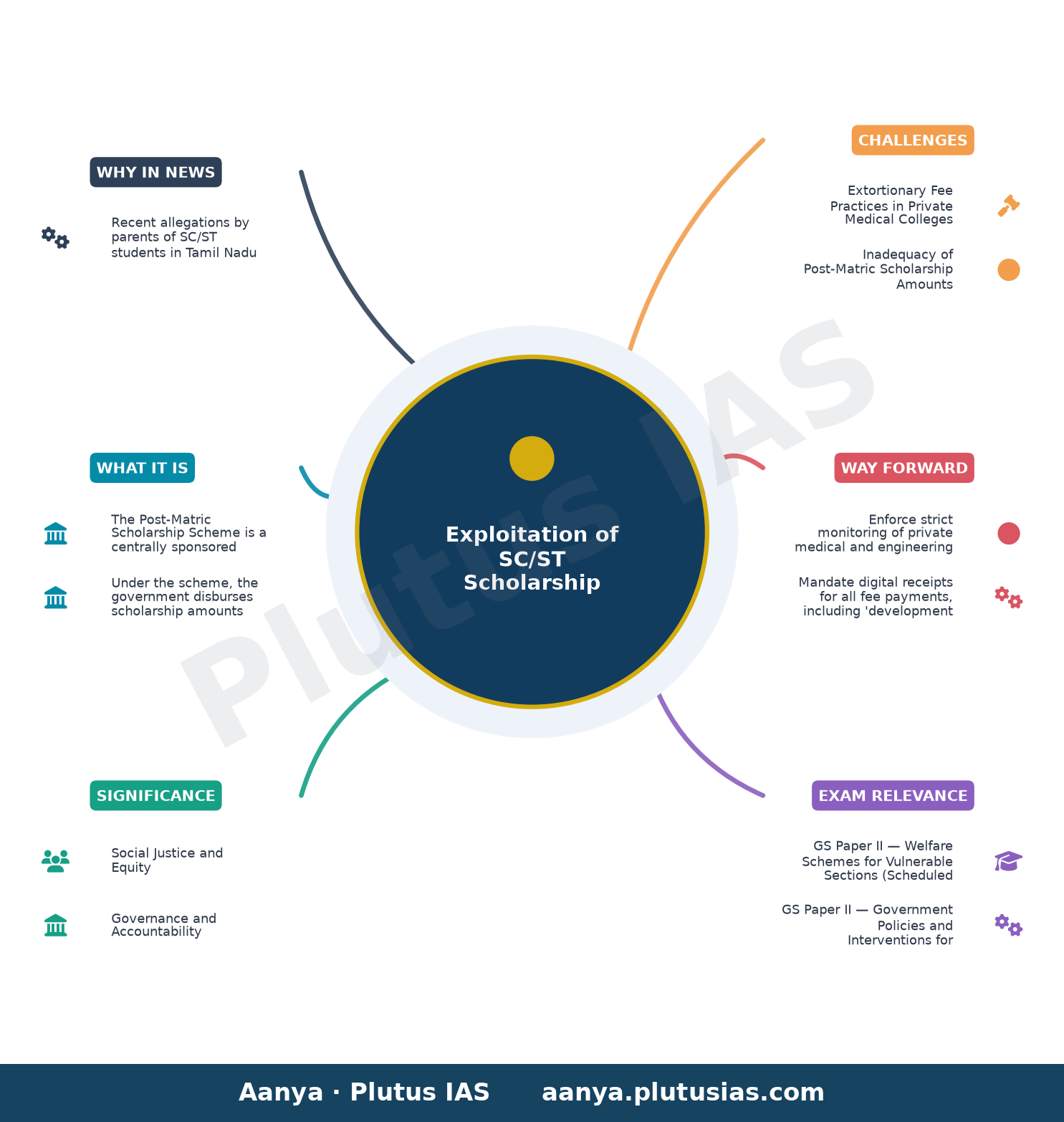
Recent allegations by parents of SC/ST students in Tamil Nadu reveal a systemic pattern of coercive financial demands by private medical colleges, amounting to ₹6–10 lakh annually in cash, despite scholarships covering tuition fees. This malpractice, occurring under the guise of ‘development fees’ or other heads, not only violates the Post-Matric Scholarship Scheme but also undermines constitutional provisions for equity in education. The issue has escalated to a demand for income-tax raids and the withdrawal of G.O. 72 (2018), highlighting regulatory and governance failures in private higher education.
Background
- Article 46 of the Constitution directs the State to promote educational and economic interests of the weaker sections, particularly SCs and STs, to protect them from social injustice and exploitation.
- Article 15(4) empowers the State to make special provisions for the advancement of socially and educationally backward classes, including SCs and STs.
- Tamil Nadu’s G.O. 72 (2018) sanctioned ₹50,000 per annum as scholarship for SC/ST students in engineering colleges, but private institutions have circumvented this by inflating fees for government quota seats.
- The National Commission for Scheduled Castes (NCSC) has historically intervened in cases of discrimination and exploitation in educational institutions, including fee-related malpractices.
What is the Post-Matric Scholarship Scheme for SC/ST and How Does It Interact with Private Medical Colleges?
- The Post-Matric Scholarship Scheme is a centrally sponsored initiative administered by state governments, providing full tuition fee coverage and maintenance allowance to SC/ST students pursuing post-matriculation courses, including medical education.
- Under the scheme, the government disburses scholarship amounts directly to institutions or students, depending on the state’s implementation model. In Tamil Nadu, the scholarship is credited to the student’s account or paid to the institution.
- Private medical colleges, despite receiving government scholarship funds, often demand additional ‘development fees’ or ‘management fees’ from SC/ST students, citing lack of transparency in scholarship disbursement or administrative delays.
- The scheme’s objectives include reducing dropout rates among SC/ST students by alleviating financial burdens, but systemic loopholes allow institutions to exploit students by demanding exorbitant cash payments.
- The malpractice is exacerbated by the lack of receipts for such payments, making it difficult for students to seek redressal or prove extortion.
- The issue is not isolated to Tamil Nadu; similar complaints have emerged from other states, indicating a pan-India pattern of regulatory failure in private higher education institutions.
- The demand for a fee fixation committee for arts and science colleges reflects the broader need for statutory caps on fees in private institutions to prevent profiteering under the guise of ‘scholarship adjustments’.
- The role of state corporations like TAHDCO in facilitating loans for affected students is compromised when loan disbursement requires government endorsements, creating additional barriers for marginalised families.
Key Features
| Feature | Significance |
|---|---|
| Post-Matric Scholarship Scheme for SC/ST | Ensures educational equity by covering tuition fees for marginalised communities, reducing financial barriers to higher education. |
| Private Medical Colleges’ ‘Development Fee’ | An illicit practice exploiting scholarship beneficiaries, circumventing regulatory oversight by demanding cash payments without receipts. |
| Government Quota vs. Management Quota in Private Colleges | Government quota seats are subsidised, while management quota seats are fee-based; scholarships are intended to cover tuition but are insufficient for total costs. |
| TAHDCO Loan Endorsement Requirement | Institutionalises financial vulnerability by mandating government official endorsements, delaying loan disbursement and exacerbating parental distress. |
| G.O. 72 (2018) for Engineering Scholarships | Limited scholarship amount (₹50,000) fails to match inflated private college fees, pushing students into debt or exclusion from education. |
Why it Matters
Social Justice and Equity
- Violation of constitutional guarantees under Articles 15(4) and 46, which mandate protection and promotion of educational opportunities for SC/ST communities.
- Undermines affirmative action policies by imposing financial burdens on beneficiaries of reservation, negating the intended benefits of scholarships.
- Perpetuates intergenerational poverty by forcing economically weaker SC/ST families to liquidate assets or incur high-interest debt for education.
Governance and Accountability
- Exposes systemic regulatory failures in monitoring private educational institutions, particularly in fee structures and scholarship disbursement mechanisms.
- Highlights the absence of transparent grievance redressal mechanisms for scholarship beneficiaries in higher education.
- Raises questions about the efficacy of the All India Council for Technical Education (AICTE) and Medical Council of India (MCI) in enforcing fee norms for reserved category students.
Economic Implications
- Disproportionate financial strain on SC/ST households, with parents resorting to distress sales of assets or informal borrowing, exacerbating debt cycles.
- Potential long-term impact on the healthcare workforce, as financial barriers may deter qualified SC/ST candidates from pursuing medical education.
- Erosion of public trust in government scholarship schemes due to mismanagement and exploitation by private institutions.
Challenges
1. Extortionary Fee Practices in Private Medical Colleges
- Demand for ₹6–10 lakh in cash annually under spurious heads like ‘development fee’, bypassing official fee structures.
- Absence of receipts or formal documentation, enabling unchecked exploitation and complicating legal recourse.
- Systematic exclusion of SC/ST students from 1,400+ medical seats in Tamil Nadu annually due to financial coercion.
UPSC Link: GS2: Issues relating to development and management of Social Sector/Services relating to Health, Education, Human Resources.
2. Inadequacy of Post-Matric Scholarship Amounts
- Scholarship amounts (e.g., ₹50,000 for engineering) are grossly insufficient to cover tuition fees in private colleges, which have surged to ₹1.5 lakh annually.
- No adjustment mechanism for inflation or rising costs, rendering scholarships ineffective over time.
- Scholarship disbursement delays compound financial hardships, particularly for students from economically weaker sections.
UPSC Link: GS2: Welfare schemes for vulnerable sections of the population by the Centre and States and the performance of these schemes.
3. Regulatory and Institutional Gaps
- Lack of stringent monitoring by statutory bodies (AICTE/MCI) over fee structures for reserved category students.
- Absence of a centralised grievance redressal mechanism for scholarship beneficiaries in private institutions.
- Over-reliance on state-level endorsements (e.g., TAHDCO loans) creates bureaucratic bottlenecks, delaying financial aid.
UPSC Link: GS2: Role of civil services in a democracy.
4. Financial Vulnerability of Beneficiaries
- Parents forced to sell assets (e.g., gold jewellery, houses) or incur high-interest debt to meet illegal fee demands.
- Exploitation by informal lenders (usury) due to delays in government loan disbursement, trapping families in debt traps.
- Psychological and social costs, including stigma and discrimination, exacerbate the financial burden on SC/ST communities.
UPSC Link: GS1: Social empowerment, communalism, regionalism & secularism.
5. Lack of Transparency in Fee Structures
- Private colleges obfuscate fee structures by categorising payments under ambiguous heads (e.g., ‘development fee’), avoiding regulatory scrutiny.
- No standardised reporting of fee components for scholarship beneficiaries, enabling arbitrary demands.
- Income Tax Department raids, as suggested by activists, could uncover systemic financial irregularities but require proactive enforcement.
UPSC Link: GS2: Transparency & accountability in governance.
Challenges — UPSC Perspective
| Issue | Concern |
|---|---|
| Illicit Cash Demands | Exploitation of scholarship beneficiaries through unregulated, cash-based ‘development fees’ without receipts. |
| Insufficient Scholarship Amounts | Post-matric scholarships (e.g., ₹50,000) fail to cover rising private college fees, pushing students into debt. |
| Regulatory Gaps in Fee Monitoring | Statutory bodies (AICTE/MCI) lack stringent oversight over fee structures for reserved category students. |
| Bureaucratic Delays in Loan Disbursement | TAHDCO loan endorsements create bottlenecks, delaying financial aid and exacerbating distress. |
| Asset Liquidation and Debt Traps | Parents forced to sell property or borrow at high interest rates to meet illegal fee demands. |
| Absence of Grievance Redressal Mechanisms | No centralised platform for scholarship beneficiaries to report exploitation or seek redressal. |
Government Initiatives — Must-Memorise for Prelims
- Post-Matric Scholarship Scheme for SC/ST (Ministry of Social Justice and Empowerment)
- TAHDCO (Tamil Nadu Adi Dravidar Housing and Development Corporation) Loan Schemes
Way Forward
- Enforce strict monitoring of private medical and engineering colleges by AICTE and MCI to cap fee structures for scholarship beneficiaries.
- Mandate digital receipts for all fee payments, including ‘development fees’, to ensure transparency and traceability.
- Increase post-matric scholarship amounts for professional courses (e.g., medicine, engineering) to match current fee structures, with periodic reviews.
- Establish a centralised grievance redressal portal for scholarship beneficiaries to report exploitation and seek timely intervention.
- Constitute a fees fixation committee for Arts and Science colleges, as demanded, to standardise fee structures for SC/ST students.
- Streamline loan disbursement processes (e.g., TAHDCO) by reducing bureaucratic endorsements and leveraging digital verification.
- Conduct Income Tax Department raids during admission seasons to uncover systemic financial irregularities in private colleges.
- Launch awareness campaigns in SC/ST communities to educate beneficiaries about their rights and legal recourse against exploitation.
UPSC Value Addition
Keywords for Mains Answer-Writing
Post-Matric Scholarship Scheme for SC/ST · Private Medical Colleges and Exorbitant Fees · Reservation Policy and Higher Education · Social Justice and Empowerment · Economic Barriers in Education · Administrative Corruption in Education · Government of Tamil Nadu Orders (G.O. 72 of 2018) · Scheduled Castes and Scheduled Tribes (Prevention of Atrocities) Act · Judicial Review of Educational Policies · Education as a Fundamental Right under Article 21A
Constitutional & Policy Linkages
- Article 15(4): Special provisions for the advancement of socially and educationally backward classes.
- Article 46: Promotion of educational and economic interests of Scheduled Castes and Scheduled Tribes.
Concept Flow
Post-Matric Scholarship Scheme for SC/ST → Covers tuition fees for marginalised communities → Private colleges demand additional ‘development fees’ in cash → Absence of receipts enables exploitation → Parents forced to liquidate assets or incur debt → Financial distress and exclusion from education → Regulatory gaps in monitoring enable systemic abuse → Need for stricter oversight and fee regulation.
Prelims Practice Questions
Q1. Consider the following statements regarding the Post-Matric Scholarship Scheme for Scheduled Castes (SCs) and Scheduled Tribes (STs) in India:
1. The scheme is implemented by the Ministry of Social Justice and Empowerment.
2. Under the scheme, the government reimburses tuition fees for both government and management quota seats in private medical colleges.
3. The scholarship amount is directly credited to the students’ bank accounts without any intermediaries.
4. The scheme mandates that private educational institutions cannot levy additional fees beyond the scholarship amount.
How many of the above statements are correct?
- Only one
- Only two
- Only three
- All
Answer: Only three — Statements 1 and 2 are correct as the scheme is indeed implemented by the Ministry of Social Justice and Empowerment and reimburses tuition fees for both quota types. Statement 3 is incorrect because the scholarship amount is often routed through institutions, leading to intermediaries. Statement 4 is incorrect as the scheme does not explicitly prohibit additional fee demands by private institutions.
Q2. Assertion (A): The Government of Tamil Nadu, through G.O. 72 of 2018, sanctioned ₹50,000 as scholarship for tuition fees in engineering colleges.
Reason (R): The scholarship amount was increased to ₹1.5 lakh per annum for management quota seats in private engineering colleges due to the rising cost of education.
Options:
A. Both A and R are true, and R is the correct explanation of A.
B. Both A and R are true, but R is not the correct explanation of A.
C. A is true, but R is false.
D. A is false, but R is true.
Answer: ? — Assertion (A) is true as G.O. 72 of 2018 sanctioned ₹50,000 for tuition fees. Reason (R) is also true but does not explain A, as the increase to ₹1.5 lakh was a separate development due to fee hikes by private colleges, not directly linked to the G.O.
Q3. Match the following pairs related to educational policies and schemes in India:
Column I Column II
A. Post-Matric Scholarship Scheme 1. Ministry of Education
B. G.O. 72 of 2018 2. Ministry of Social Justice and Empowerment
C. Reservation in Higher Education 3. Tamil Nadu Government
D. Right to Education Act 4. Constitutional Provision (Article 15)
Options:
A. A-2, B-3, C-4, D-1
B. A-1, B-2, C-3, D-4
C. A-3, B-1, C-2, D-4
D. A-4, B-3, C-2, D-1
- A
- B
- C
- D
Answer: A — A. Post-Matric Scholarship Scheme is implemented by the Ministry of Social Justice and Empowerment (2). B. G.O. 72 of 2018 is a Tamil Nadu Government Order (3). C. Reservation in Higher Education is a constitutional provision under Article 15 (4). D. Right to Education Act is under the Ministry of Education (1).
Mains Practice Question
✍ The phenomenon of private medical colleges in India levying exorbitant additional fees from Scheduled Caste (SC) and Scheduled Tribe (ST) students, despite the Post-Matric Scholarship Scheme, reflects systemic failures in the implementation of social justice policies in education. Critically examine this assertion with reference to constitutional provisions, judicial precedents, and administrative lacunae. Also, suggest measures to ensure equitable access to higher education for marginalised communities. (15 Marks)
Approach: Introduction: Define the Post-Matric Scholarship Scheme and its objectives under the Ministry of Social Justice and Empowerment. Highlight the constitutional mandate for social justice and equality (Articles 15, 16, 46, and 21A). Constitutional and Legal Framework: Discuss the Right to Education (Article 21A) and the constitutional provisions prohibiting discrimination (Articles 15 and 16). Reference the Supreme Court’s interpretation in *Unnikrishnan v. State of Andhra Pradesh* (1993) on the right to education. Administrative and Policy Failures: Critique the implementation gaps in the Post-Matric Scholarship Scheme, including the role of state governments (e.g., Tamil Nadu’s G.O. 72 of 2018) and the lack of stringent monitoring by the Ministry of Social Justice and Empowerment. Reference the allegations of corruption and lack of receipts in private medical colleges. Judicial and Quasi-Judicial Responses: Discuss the role of the judiciary in addressing such issues, including the Supreme Court’s directives in *Indra Sawhney v. Union of India* (1992) on reservation and *T.M.A. Pai Foundation v. State of Karnataka* (2002) on private educational institutions. Highlight the need for judicial activism in protecting marginalised students. Systemic Causes: Analyse the root causes, including the commercialisation of education, lack of transparency in fee structures, and the nexus between private institutions and administrative authorities. Reference the role of regulatory bodies like the Medical Council of India (MCI) and the National Medical Commission (NMC). Measures for Equitable Access: Suggest reforms such as (a) strengthening the Post-Matric Scholarship Scheme with direct benefit transfers (DBT) to students’ accounts, (b) establishing a national fees fixation committee for private institutions, (c) mandatory audits of private colleges receiving government scholarship funds, and (d) stricter enforcement of the Scheduled Castes and Scheduled Tribes (Prevention of Atrocities) Act against exploitative practices. Conclusion: Emphasise the need for a multi-stakeholder approach involving the central government, state governments, judiciary, and civil society to ensure that social justice policies translate into tangible outcomes for marginalised communities.
Source: The Hindu
Generated by AanyaAi for educational purpose.

- KWML’s Feasibility Reports for Water Metro in 18 Cities: UPSC & PCS Insights - October 3, 2026
- ओडिशा में वन्यजीव अनुसंधान अनुदान कार्यक्रम शुरू, सिमिलिपाल में 300 कैमरे और बढ़ेंगे - October 3, 2026
- India Summons Pakistan High Commission Official Over Violation - October 3, 2026

No Comments