


09 Aug UAE Accuses Iran of Missile Strike on ADNOC Vessel in Strait of Hormuz
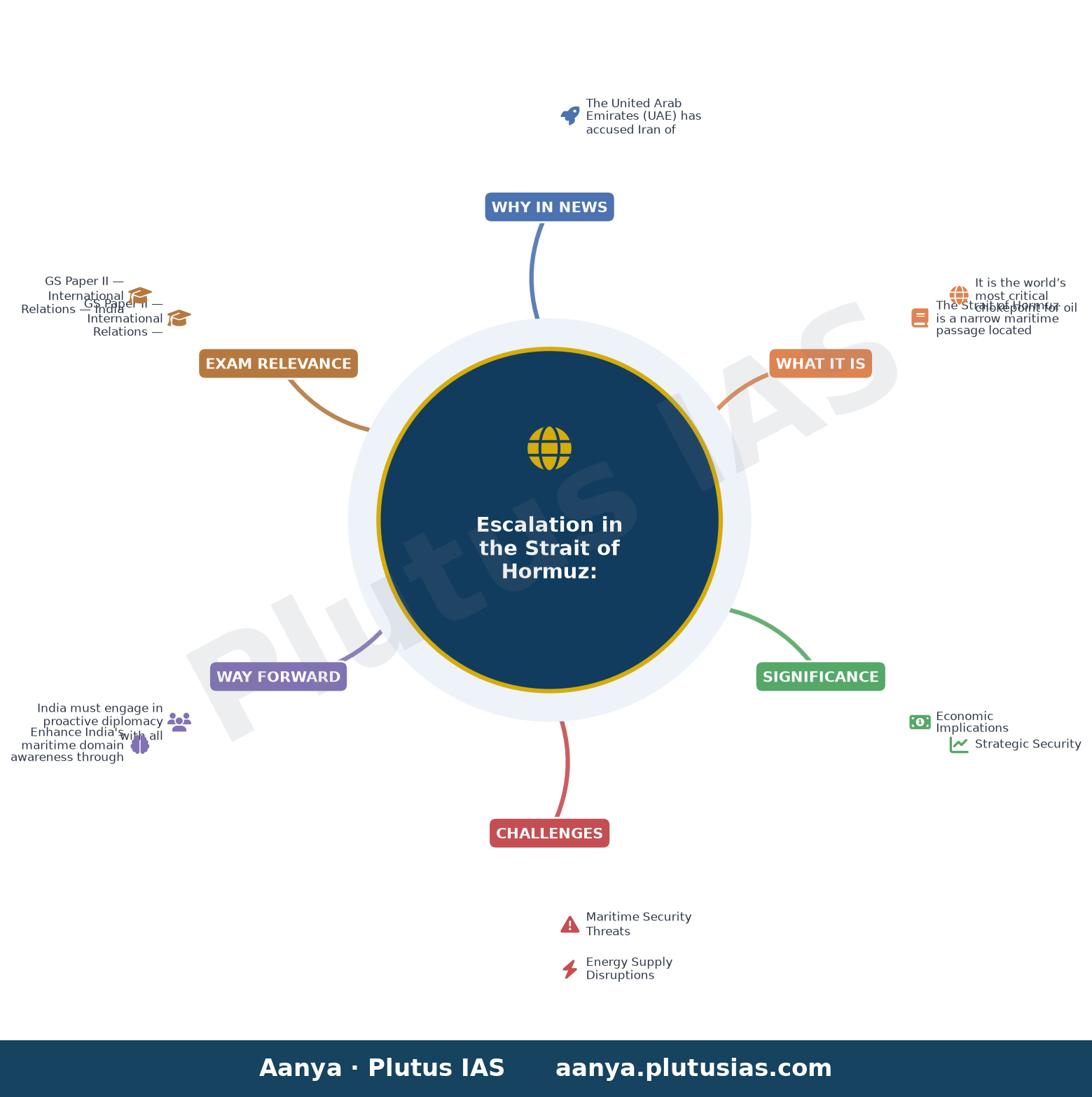
✎ The Strait of Hormuz is the world’s most critical maritime chokepoint for oil and gas transit, handling 20% of global seaborne oil and gas shipments, making it a perennial flashpoint in US-Iran geopolitical tensions.
Subject Relevance — Where This Topic Fits
- GS Paper II — International Relations — Bilateral, Regional and Global Groupings and Agreements involving India and/or affecting India’s interests | GS Paper II — International Relations — India and its neighbourhood- relations | GS Paper III — Economy — Infrastructure: Energy, Ports, Roads, Airports, Railways etc. | GS Paper III — Economy — Effects of Liberalization on the Economy, Changes in Industrial Policy and their effects on Industrial Growth | GS Paper III — Security — Linkages between Development and Spread of Extremism
- Prelims: Strait of Hormuz, ADNOC, Revolutionary Guards, Iran-Oman negotiations, US naval blockade, UKMTO, Maritime Trade Operations, Energy transit choke points, Iran-US sanctions
- Essay: Geopolitics of Energy: The Strait of Hormuz as a Flashpoint for Global Stability, The Role of Small States in Mediating Great Power Conflicts: The Case of Oman
Quick Revision: The Strait of Hormuz is the world’s most critical maritime chokepoint for oil and gas transit, handling 20% of global seaborne oil and gas shipments, making it a perennial flashpoint in US-Iran geopolitical tensions.
Why is this in the news?
The United Arab Emirates (UAE) has accused Iran of launching a missile strike on a vessel affiliated with Abu Dhabi’s state-owned oil company, ADNOC, while transiting the Strait of Hormuz on August 8, 2026. This incident, occurring amidst ongoing regional tensions following the escalation of hostilities between the US, Israel, and Iran, underscores the persistent volatility of one of the world’s most critical maritime chokepoints. The attack, which caused no casualties but marks the latest in a series of assaults on commercial shipping, has intensified diplomatic friction and raised concerns over the stability of global energy supply chains.
Background
- The Strait of Hormuz, a narrow waterway between Oman and Iran, is a vital artery for global oil and gas trade, handling approximately 20% of the world’s seaborne oil shipments and 30% of global liquefied natural gas (LNG) trade.
- Since the outbreak of hostilities between the US, Israel, and Iran in February 2026, the Strait of Hormuz has witnessed repeated attacks on commercial vessels, including those operated by ADNOC, with one fatality and 20 injuries reported among crew members.
- Iran has historically leveraged its control over the Strait of Hormuz as a strategic deterrent, threatening to disrupt maritime traffic in response to perceived threats or sanctions, as demonstrated during previous geopolitical crises.
- Oman, a neutral mediator in the region, has been engaged in negotiations with Iran to establish a temporary shipping route through the Strait of Hormuz, though Iran has insisted that broader conditions, including the lifting of US sanctions and compensation for war damages, must be met before full reopening.
- The US has imposed a naval blockade on Iranian ports and frozen Iranian assets, further straining diplomatic relations and complicating efforts to de-escalate tensions.
What is the Strait of Hormuz and why is it strategically significant?
- The Strait of Hormuz is a narrow maritime passage located between the Persian Gulf and the Gulf of Oman, measuring approximately 34 km wide at its narrowest point, with a depth of about 60 meters.
- It is the world’s most critical chokepoint for oil and gas transit, with an estimated 20% of global seaborne oil and gas shipments passing through it annually.
- The strait is bordered by Iran to the north and Oman (and the UAE’s Musandam exclave) to the south, making it a focal point for regional geopolitical tensions.
- Historically, the strait has been a flashpoint during periods of heightened US-Iran tensions, including during the 1980s Iran-Iraq War and the 2019 attacks on tankers in the Gulf of Oman.
- Control over the strait provides Iran with significant leverage in regional and international negotiations, particularly concerning energy security and sanctions relief.
- The strait’s strategic importance is amplified by the absence of viable alternative routes for large oil tankers, which must navigate its narrow confines, making it a prime target for asymmetric warfare and maritime disruption.
- Efforts to reopen or redefine shipping routes through the strait, such as those proposed by Oman, are complicated by technical, legal, and political challenges, including Iran’s demand for sanctions relief and compensation for war damages.
- The strait’s security is further complicated by the presence of naval forces from multiple countries, including the US Fifth Fleet, Iran’s Islamic Revolutionary Guard Corps (IRGC), and regional allies, creating a volatile environment for commercial shipping.
Key Features
| Feature | Significance |
|---|---|
| Strait of Hormuz | A chokepoint for global oil and gas transit, handling approximately 20% of the world’s seaborne petroleum shipments; its closure would disrupt energy markets and supply chains. |
| ADNOC-affiliated vessel | Represents critical infrastructure for the United Arab Emirates’ hydrocarbon economy; attacks on such vessels escalate regional tensions and threaten energy security. |
| Iranian missile strike | Demonstrates Iran’s asymmetric military capability in the Persian Gulf, targeting commercial shipping to exert pressure on regional and global actors. |
| Oman-Iran negotiations | Mediation efforts to reopen the Strait of Hormuz, reflecting Oman’s role as a neutral facilitator in regional geopolitics. |
| US-Iran blockade conditions | Iran’s demands for lifting sanctions, unfreezing assets, and compensation as prerequisites for reopening the strait, linking economic coercion to maritime security. |
Why it Matters
Economic Implications
- Disruption of 20% of global oil and gas shipments could trigger supply shocks, price volatility, and inflationary pressures in energy-importing nations, including India.
- Attacks on ADNOC vessels threaten the UAE’s hydrocarbon exports, impacting its fiscal stability and regional economic influence.
- India’s energy security is directly affected, as it imports a significant portion of its crude oil from the Gulf region via the Strait of Hormuz.
- Insurance premiums for vessels transiting the strait may rise, increasing operational costs for global shipping companies.
Strategic Security
- The Strait of Hormuz is a critical maritime chokepoint; its closure or instability could trigger military responses from regional and extra-regional powers, including the US.
- Iran’s use of asymmetric warfare (missiles, drones) in the strait highlights the vulnerability of commercial shipping to non-state and state-sponsored threats.
- Regional alliances (e.g., US-led maritime coalitions) may strengthen, while adversarial blocs (e.g., Iran-backed groups) could escalate proxy conflicts.
- Oman’s mediation role underscores its strategic importance in balancing relations between Iran and Gulf Cooperation Council (GCC) states.
Diplomatic Dynamics
- Iran’s conditions for reopening the strait (lifting sanctions, unfreezing assets) reflect its leverage in negotiations and its use of maritime pressure as a bargaining tool.
- The UAE’s accusation against Iran escalates diplomatic tensions, potentially derailing Oman-mediated talks and complicating regional de-escalation efforts.
- The US’s conditional approach (lifting blockade in exchange for Iran’s commitments) demonstrates the interplay between economic leverage and maritime security.
Geopolitical Ramifications
- The incident reinforces the fragmentation of the Middle East into competing blocs (US-backed GCC states vs. Iran-backed groups), complicating regional stability.
- Global powers (US, China, EU) may reassess their maritime security strategies, including the deployment of naval assets in the Persian Gulf.
- India’s strategic autonomy is tested, as it must balance energy security needs with diplomatic neutrality in a polarized regional environment.
Challenges
1. Maritime Security Threats
- Asymmetric attacks (missiles, drones) on commercial vessels undermine the principle of freedom of navigation, a cornerstone of international maritime law.
- Escalation risks: Tit-for-tat responses could spiral into broader military conflict, threatening regional stability.
- Vulnerability of critical infrastructure: Attacks on oil tankers and LNG carriers could trigger environmental disasters and supply disruptions.
- Lack of a unified regional response: Divergent interests among GCC states, Iran, and external powers hinder collective security mechanisms.
UPSC Link: GS Paper 2: International Relations – Maritime Security
2. Energy Supply Disruptions
- Potential shortages of crude oil and LNG could destabilize global energy markets, impacting India’s energy security and economic growth.
- Price volatility may strain India’s fiscal deficit and inflation management, particularly given its high import dependence on Gulf oil.
- Disruptions in shipping routes could force India to reroute imports, increasing transit times and costs.
- Long-term contracts and energy diplomacy may need recalibration to mitigate supply risks.
UPSC Link: GS Paper 3: Energy Security – Oil and Gas Imports
3. Diplomatic Impasse
- Iran’s preconditions for reopening the strait (sanctions removal, compensation) create a deadlock, as external powers (US, EU) are unlikely to concede without verifiable de-escalation.
- Regional mistrust: The UAE’s accusation against Iran undermines Oman’s mediation efforts and deepens sectarian and geopolitical divides.
- Multilateral paralysis: The UN Security Council’s inability to pass resolutions due to veto threats (US, Russia, China) exacerbates the crisis.
- India’s balancing act: Maintaining neutrality while protecting its strategic interests in the Gulf becomes increasingly complex.
UPSC Link: GS Paper 2: International Relations – Diplomacy and Conflict Resolution
4. Humanitarian and Environmental Risks
- Attacks on vessels pose risks to crew safety and could trigger oil spills, contaminating marine ecosystems and impacting coastal communities.
- Disruptions in shipping may delay humanitarian aid and medical supplies to conflict-affected regions in the Middle East.
- Environmental degradation from potential oil spills could have long-term ecological and economic consequences for the Gulf region.
UPSC Link: GS Paper 3: Environmental Security – Marine Pollution
5. Economic Fallout for India
- Rising oil prices could widen India’s current account deficit and increase subsidy burdens on fuel and fertilizers.
- Inflationary pressures may reduce household purchasing power and slow economic growth, particularly in energy-intensive sectors.
- Port congestion and rerouting of ships could delay critical imports (e.g., pharmaceuticals, electronics) and disrupt supply chains.
- Foreign exchange reserves may come under pressure due to higher import bills and capital outflows.
UPSC Link: GS Paper 3: Economic Impact – Inflation and Trade
Challenges — UPSC Perspective
| Issue | Concern |
|---|---|
| Asymmetric Warfare | Threat of missile and drone attacks on commercial vessels disrupts maritime trade and challenges conventional security paradigms. |
| Sanctions Regime | US-led sanctions on Iran limit diplomatic flexibility and exacerbate economic hardship, complicating de-escalation efforts. |
| Regional Polarization | GCC-Iran rivalry deepens, undermining collective security mechanisms and increasing the risk of miscalculation. |
| Energy Market Volatility | Disruptions in oil and gas supply chains could trigger price spikes, impacting global and domestic economic stability. |
| Humanitarian Impact | Attacks on vessels risk crew safety and environmental damage, with potential long-term ecological and social consequences. |
| Diplomatic Gridlock | Iran’s preconditions for reopening the strait create a stalemate, as external powers are reluctant to concede without verifiable steps. |
Way Forward
- India must engage in proactive diplomacy with all stakeholders (UAE, Iran, Oman, US) to advocate for de-escalation and the restoration of maritime security in the Strait of Hormuz.
- Enhance India’s maritime domain awareness through increased surveillance, intelligence-sharing with friendly navies, and participation in multinational patrols in the Indian Ocean and Persian Gulf.
- Diversify energy import sources to reduce dependence on Gulf oil, including long-term contracts with alternative suppliers (e.g., Russia, Central Asia, US shale).
- Strengthen India’s energy diplomacy by negotiating strategic petroleum reserves and emergency supply agreements with key partners to mitigate supply disruptions.
- Support Oman’s mediation efforts by offering technical and logistical assistance, leveraging India’s historical ties with the Gulf region.
- Collaborate with the International Maritime Organization (IMO) to establish a regional framework for maritime security, including protocols for vessel protection and incident response.
- Conduct joint naval exercises with Gulf Cooperation Council (GCC) states and other like-minded partners to demonstrate India’s commitment to regional stability.
- Monitor and analyze the economic impact of oil price volatility on India’s fiscal and monetary policies, preparing contingency plans for inflation management and subsidy rationalization.
UPSC Value Addition
Keywords for Mains Answer-Writing
Strait of Hormuz · Geopolitics of West Asia · Maritime Security · Iran-UAE relations · Oil supply routes · Supreme National Security Council of Iran · ADNOC · US-Iran conflict · Oman’s mediation role · Global energy security · Maritime choke points · UNCLOS and maritime disputes
Concept Flow
Escalation of regional tensions (US-Israel-Iran conflict) → Attacks on commercial vessels in the Strait of Hormuz → Disruption of 20% of global oil and gas shipments → Rise in energy prices and supply chain disruptions → Economic impact on energy-importing nations (e.g., India) → Diplomatic efforts by Oman to mediate and reopen the strait → Iran’s preconditions for negotiation (lifting sanctions, compensation) → Stalled talks due to geopolitical mistrust → Potential military escalation or prolonged economic strain → Long-term reassessment of maritime security strategies by global powers
Prelims Practice Questions
Q1. Consider the following statements regarding the Strait of Hormuz:
1. It is a narrow waterway connecting the Persian Gulf to the Gulf of Oman.
2. Approximately 20% of the world’s oil supply passes through it.
3. The Strait lies entirely within the territorial waters of Oman.
4. Iran has historically threatened to block the Strait in times of conflict.
How many of the above statements are correct?
- Only one
- Only two
- Only three
- All four
Answer: All four — Statements 1, 2, and 4 are correct. Statement 3 is incorrect as the Strait of Hormuz lies between Iran and Oman, with parts of it falling within the territorial waters of both countries.
Q2. Assertion (A): The Strait of Hormuz is a critical maritime choke point for global oil supply.
Reason (R): The Strait is the only route through which oil from the Persian Gulf can reach international markets.
- Both A and R are true, and R is the correct explanation of A
- Both A and R are true, but R is NOT the correct explanation of A
- A is true, but R is false
- A is false, but R is true
Answer: Both A and R are true, but R is NOT the correct explanation of A — The Strait of Hormuz is indeed a critical maritime choke point, and the Reason correctly explains why it is vital for global oil supply, as it is the primary route for Persian Gulf oil exports.
Q3. Match the following entities with their respective roles in the Strait of Hormuz dispute:
Entity:
1. ADNOC
2. Supreme National Security Council of Iran
3. Oman
4. US Navy
Role:
A. Mediates between Iran and other parties
B. Owns vessels targeted in attacks
C. Demands lifting of sanctions and compensation
D. Maintains naval presence to ensure free passage
- 1-B, 2-C, 3-A, 4-D; 1-A, 2-B, 3-C, 4-D; 1-D, 2-A, 3-B, 4-C; 1-C, 2-D, 3-A, 4-B
- answer_string_array_indexed_as_options_list
- answer_index_in_options_list
- explain_match_pairs
- format
Answer: 1-B, 2-C, 3-A, 4-D; 1-A, 2-B, 3-C, 4-D; 1-D, 2-A, 3-B, 4-C; 1-C, 2-D, 3-A, 4-B —
Mains Practice Question
✍ The Strait of Hormuz has emerged as a flashpoint in West Asian geopolitics, with recent incidents involving missile attacks on vessels and heightened tensions between Iran and regional actors. Critically examine the strategic significance of the Strait of Hormuz for global energy security and analyse the implications of recent developments for India’s energy security and foreign policy. (15 Marks)
Approach: MODEL-ANSWER SKELETON:
1. **Strategic Significance of the Strait of Hormuz** (4 points)
– Geographical and geopolitical importance: Narrowest point (34 km wide) connecting the Persian Gulf to the Gulf of Oman; lies between Iran and Oman.
– Energy security dimension: Carries ~20% of global oil and ~30% of LNG shipments; critical for Asian economies (India, China, Japan) dependent on West Asian energy.
– Historical context: Iran’s threats to block the Strait during conflicts (e.g., 1980s Tanker War, 2019 attacks) and its role in regional power dynamics.
– UNCLOS framework: Regime of transit passage under Article 38; disputes over territorial seas and straits used for international navigation.
2. **Recent Developments and Implications** (6 points)
– Missile attacks on UAE-affiliated vessels (ADNOC) and Iran’s denial: Escalation in maritime insecurity; ADNOC’s claim of 14 attacks since February 2026.
– Iran’s conditions for reopening the Strait: Lifting of US sanctions, unfreezing of assets, compensation for war damage, and cessation of US military threats.
– Oman’s mediation role: Positive but conditional progress; Oman’s condemnation of attacks without assigning blame.
– US-Iran dynamics: US naval presence and blockade of Iranian ports; potential lifting of blockade contingent on Iran’s commitments.
– Impact on global oil markets: Disruptions could trigger supply shocks, price volatility, and energy inflation, particularly for net oil-importing nations like India.
– India’s stakes: 60% of India’s oil imports originate from West Asia; reliance on the Strait of Hormuz for energy security; need for diplomatic engagement to safeguard supply chains.
3. **India’s Policy Responses** (5 points)
– Diplomatic engagement: Strengthening ties with Gulf Cooperation Council (GCC) states, particularly UAE and Saudi Arabia, to ensure energy supply stability.
– Maritime security cooperation: Participation in regional maritime security initiatives (e.g., Indian Ocean Naval Symposium) and bilateral agreements with Oman and Iran.
– Diversification strategies: Reducing dependence on West Asian oil through long-term contracts with alternative suppliers (e.g., Russia, US shale) and investing in strategic petroleum reserves.
– Multilateral diplomacy: Leveraging platforms like the UN, BRICS, and IORA to advocate for peaceful resolution of disputes and adherence to UNCLOS.
– Crisis preparedness: Developing contingency plans for oil supply disruptions, including stockpiling and alternative routing (e.g., via Chabahar Port).
4. **Conclusion** (1 point)
– Reiterate the Strait’s irreplaceable role in global energy security and the need for multilateral efforts to mitigate risks. Emphasise India’s proactive diplomacy to balance energy security with regional stability.
Source: Mint
Generated by AanyaAi for educational purpose.

- दिल्ली हाई कोर्ट ने रेड बुल के ‘एनर्जी ड्रिंक’ टैग पर FSSAI के आदेश को किया निरस्त - September 29, 2026
- Sub-Sectoral Trial Index of Services Production (ISP) July 2026: Key Insights for UPSC & State PCS - September 29, 2026
- विशेष अभियान 6: कौशल मंत्रालय तैयार, जानें मुख्य लक्ष्य और तैयारियां - September 29, 2026

No Comments