


09 Aug UPSC Alert: Centre Merges Ambedkar Schemes for SC/ST Welfare from March 2023
✎ The merger of Dr. Ambedkar Foundation schemes into the Centrally Sponsored Scheme aims to streamline welfare delivery for SC/ST communities by eliminating duplication and aligning with constitutional safeguards under the…
Subject Relevance — Where This Topic Fits
- GS Paper II — Governance, Polity and Social Justice | GS Paper V — Social Justice and Empowerment
- Prelims: Scheduled Castes and Scheduled Tribes (Prevention of Atrocities) Act, 1989, Protection of Civil Rights Act, 1955, Centrally Sponsored Schemes (CSS), Dr. Ambedkar Foundation, Inter-caste marriage incentives
- Essay: Role of constitutional safeguards in social justice, Efficacy of welfare schemes in addressing systemic discrimination
Quick Revision: The merger of Dr. Ambedkar Foundation schemes into the Centrally Sponsored Scheme aims to streamline welfare delivery for SC/ST communities by eliminating duplication and aligning with constitutional safeguards under the Protection of Civil Rights Act, 1955, and the Scheduled Castes and Scheduled Tribes (Prevention of Atrocities) Act, 1989.
Why is this in the news?
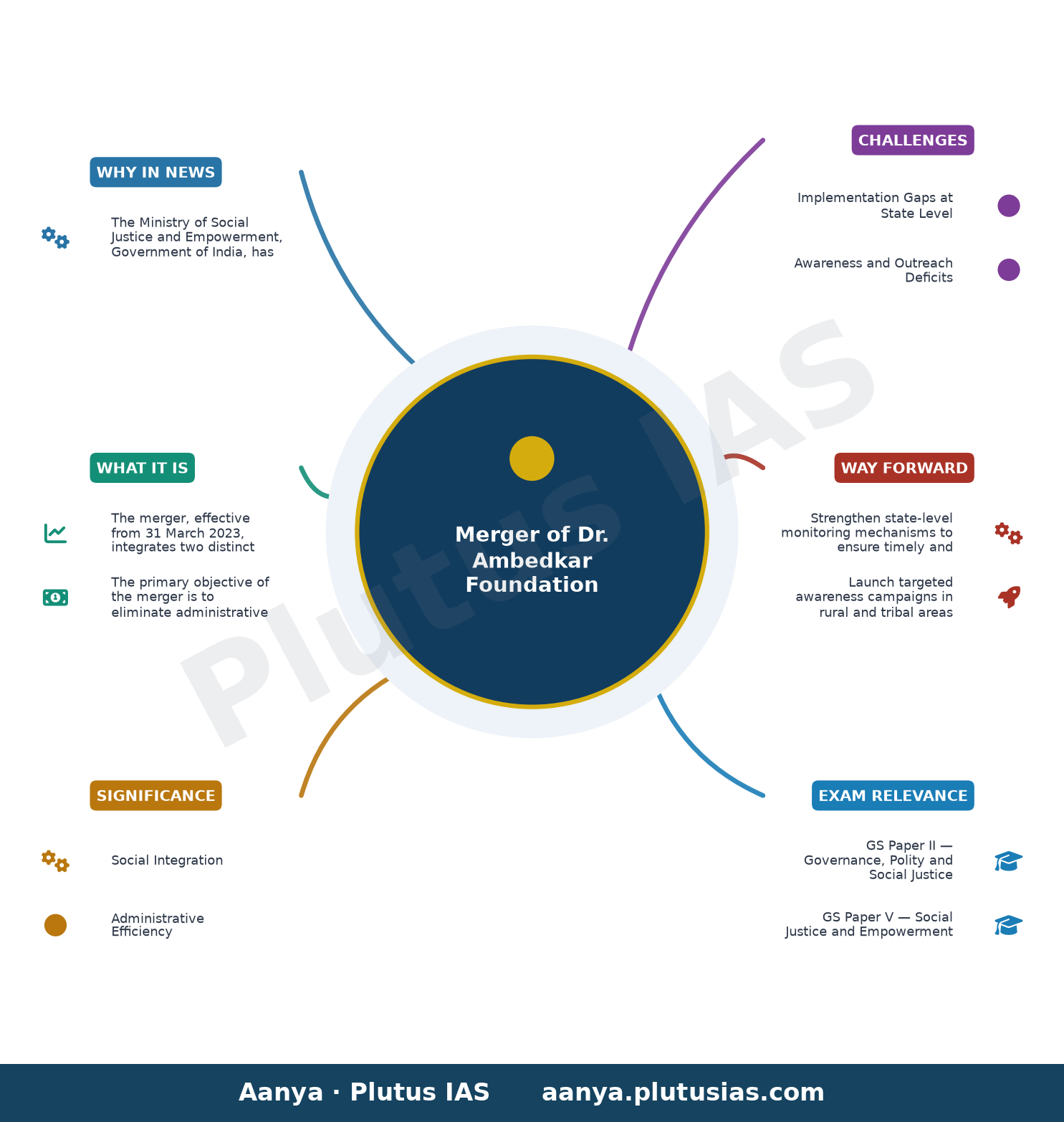
The Ministry of Social Justice and Empowerment, Government of India, has informed the Rajya Sabha that two flagship schemes under the Dr. Ambedkar Foundation—namely, the ‘Dr. Ambedkar Scheme for Social Integration through Inter-Caste Marriages’ and the ‘Dr. Ambedkar National Relief to the Scheduled Castes/Scheduled Tribes Victims of Atrocities Scheme’—were merged into a centrally sponsored scheme (CSS) with effect from 31 March 2023. This merger was undertaken to eliminate duplication in implementation and streamline the delivery of welfare benefits to marginalised communities, particularly victims of caste-based atrocities and beneficiaries of inter-caste marriages. The decision was communicated by the Minister of State for Social Justice and Empowerment, Shri Ramdas Athawale, in response to an unstarred question (No. 2052) in the Rajya Sabha.
Background
- The Dr. Ambedkar Foundation was established under the Ministry of Social Justice and Empowerment to implement welfare schemes aimed at promoting social justice and empowerment of Scheduled Castes (SCs).
- The ‘Dr. Ambedkar Scheme for Social Integration through Inter-Caste Marriages’ was launched to incentivise inter-caste marriages, thereby fostering social cohesion and breaking caste barriers.
- The ‘Dr. Ambedkar National Relief to the Scheduled Castes/Scheduled Tribes Victims of Atrocities Scheme’ provided financial relief and rehabilitation support to victims of caste-based atrocities under the Scheduled Castes and Scheduled Tribes (Prevention of Atrocities) Act, 1989.
- Prior to the merger, these schemes operated independently, leading to administrative inefficiencies, overlapping benefits, and delays in disbursement of funds.
- The Protection of Civil Rights Act, 1955, and the Scheduled Castes and Scheduled Tribes (Prevention of Atrocities) Act, 1989, are pivotal legislations aimed at eradicating caste-based discrimination and violence in India.
- Centrally Sponsored Schemes (CSS) are joint initiatives between the Centre and states, where the funding is shared between the two, but the implementation is primarily the responsibility of state governments and Union Territory administrations.
What is the Merger of Dr. Ambedkar Foundation Schemes into the Centrally Sponsored Scheme?
- The merger, effective from 31 March 2023, integrates two distinct schemes—one for inter-caste marriage incentives and another for relief to victims of atrocities—into a single Centrally Sponsored Scheme (CSS) under the Department of Social Justice and Empowerment.
- The primary objective of the merger is to eliminate administrative duplication, reduce delays in fund disbursement, and ensure a more efficient and targeted delivery of welfare benefits to eligible beneficiaries.
- The merged scheme aligns with the existing legal framework, including the Protection of Civil Rights Act, 1955, and the Scheduled Castes and Scheduled Tribes (Prevention of Atrocities) Act, 1989, thereby reinforcing the implementation of these legislations.
- Under the merged scheme, state governments and Union Territory administrations are responsible for the implementation, while the central government provides financial assistance to support the welfare measures.
- The merger has facilitated the settlement of pending cases, with approximately ₹9 crore disbursed as incentives for 385 inter-caste marriage cases under the ‘Dr. Ambedkar Scheme for Social Integration through Inter-Caste Marriages’.
- The initiative reflects the government’s commitment to promoting social integration, addressing caste-based discrimination, and providing timely relief to victims of atrocities.
Key Features
| Feature | Significance |
|---|---|
| Merger of Schemes | Eliminates duplication in implementation of welfare measures for inter-caste marriages and atrocity victims under Dr. Ambedkar Foundation. |
| Centre-Sponsored Scheme Integration | Ensures uniform funding and administrative oversight by merging into the existing centrally sponsored scheme under the Department of Social Justice and Empowerment. |
| Relief for Pending Cases | Special initiative to disburse ₹9 crore as incentive for 385 inter-caste marriage cases, addressing backlog post-merger. |
| Legal Framework Alignment | Links with the Protection of Civil Rights Act, 1955 and the SC/ST (Prevention of Atrocities) Act, 1989, ensuring statutory compliance in relief distribution. |
| State-Level Implementation | Transfers responsibility to state governments and union territories for effective execution, with central financial assistance. |
Why it Matters
Social Integration
- Promotes inter-caste harmony by incentivizing inter-caste marriages through financial support, reducing caste-based social barriers.
- Strengthens the constitutional mandate of social justice under Articles 15, 16, and 17 by addressing structural inequalities.
- Facilitates rehabilitation of victims of atrocities by providing structured relief mechanisms under statutory frameworks.
Administrative Efficiency
- Streamlines welfare delivery by consolidating overlapping schemes, reducing bureaucratic delays and fund misallocation.
- Enhances transparency and accountability in fund disbursement through centralized monitoring of the merged scheme.
- Ensures timely relief to beneficiaries by resolving pending cases through special initiatives post-merger.
Legal and Policy Coherence
- Aligns welfare schemes with statutory protections under the Protection of Civil Rights Act, 1955 and the SC/ST (Prevention of Atrocities) Act, 1989.
- Reinforces the state’s obligation to protect marginalized communities under constitutional provisions and international commitments (e.g., CEDAW, ICERD).
Economic Impact
- Provides financial security to vulnerable groups, reducing economic dependence and vulnerability to exploitation.
- Stimulates local economies in regions with high incidence of caste-based atrocities through direct cash transfers.
Challenges
1. Implementation Gaps at State Level
- Risk of uneven execution across states due to varying administrative capacities and political will.
- Delays in fund disbursement may persist if state governments lack robust monitoring mechanisms.
UPSC Link: GS-II: Centre-State Relations
2. Awareness and Outreach Deficits
- Low awareness among target groups about eligibility and application processes for merged schemes.
- Cultural stigma around inter-caste marriages may deter potential beneficiaries from availing incentives.
UPSC Link: GS-II: Social Sector Issues
3. Data Disparities and Monitoring
- Inconsistent data collection on atrocities and inter-caste marriages across states hinders accurate assessment of scheme impact.
- Lack of real-time monitoring tools may lead to underreporting or misallocation of funds.
UPSC Link: GS-II: Governance Issues
4. Legal and Bureaucratic Hurdles
- Complexity in integrating multiple legal frameworks may create procedural bottlenecks.
- Resistance from vested interests (e.g., caste-based organizations) could impede smooth implementation.
UPSC Link: GS-II: Government Policies
5. Sustainability of Funding
- Dependence on central funds may lead to discontinuity if budgetary allocations are reduced in future fiscal years.
- Need for periodic review to ensure adequacy of financial resources for growing beneficiary demands.
UPSC Link: GS-III: Budgetary Allocations
Challenges — UPSC Perspective
| Issue | Concern |
|---|---|
| State-Level Capacity | Variation in administrative efficiency across states may lead to unequal benefit distribution. |
| Stigma and Social Barriers | Cultural resistance to inter-caste marriages may limit scheme uptake despite incentives. |
| Data Fragmentation | Lack of standardized data on atrocities and inter-caste marriages complicates impact assessment. |
| Fund Disbursement Delays | Bureaucratic bottlenecks in state machinery may cause delays in relief distribution. |
| Legal Complexity | Overlapping legal provisions may create confusion in eligibility criteria and relief mechanisms. |
| Awareness Deficit | Inadequate outreach programs may leave marginalized groups unaware of available support. |
Government Initiatives — Must-Memorise for Prelims
- Dr. Ambedkar Scheme for Social Integration through Inter-Caste Marriages
- Dr. Ambedkar National Relief to the Scheduled Castes/Scheduled Tribes Victims of Atrocities Scheme
- Centre-Sponsored Scheme for Implementation of Protection of Civil Rights Act, 1955 and SC/ST (Prevention of Atrocities) Act, 1989
Way Forward
- Strengthen state-level monitoring mechanisms to ensure timely and equitable disbursement of funds under the merged scheme.
- Launch targeted awareness campaigns in rural and tribal areas to educate potential beneficiaries about scheme benefits and application processes.
- Develop a unified digital portal for real-time tracking of atrocities and inter-caste marriage cases to improve data accuracy and transparency.
- Conduct periodic reviews of the merged scheme to assess its impact and recommend course corrections based on ground realities.
- Enhance coordination between central and state authorities to address implementation gaps and reduce bureaucratic delays.
- Expand financial allocations for the scheme to accommodate growing beneficiary demands and inflationary pressures.
- Introduce incentives for state governments that demonstrate exemplary performance in scheme implementation and beneficiary outreach.
- Establish grievance redressal mechanisms at the district level to address complaints and ensure accountability in fund utilization.
UPSC Value Addition
Keywords for Mains Answer-Writing
Dr. Ambedkar Foundation Schemes · Inter-caste Marriages · Scheduled Castes and Scheduled Tribes (Prevention of Atrocities) Act, 1989 · Protection of Civil Rights Act, 1955 · Centrally Sponsored Schemes · Social Justice and Empowerment Ministry · Dr. Ambedkar National Relief Scheme · Social Integration · Atrocity Victims Relief · Union Government Schemes · State Government Implementation · Scheduled Castes and Scheduled Tribes Welfare
Constitutional & Policy Linkages
- Article 15 (Prohibition of Discrimination)
- Article 16 (Equality of Opportunity)
- Article 17 (Abolition of Untouchability)
- Article 46 (Promotion of Educational and Economic Interests of SCs/STs)
Concept Flow
Caste-based social stratification → Social exclusion and discrimination → Enactment of protective legislations (Protection of Civil Rights Act, 1955; SC/ST (Prevention of Atrocities) Act, 1989) → Identification of gaps in welfare delivery → Launch of Dr. Ambedkar Foundation schemes for inter-caste marriages and atrocity victims → Duplication and inefficiency in scheme implementation → Decision to merge schemes into a single centrally sponsored scheme (31 March 2023) → Special initiative for pending cases → Disbursement of ₹9 crore to 385 inter-caste marriage cases → State-level implementation with central funding → Accountability and monitoring under the merged scheme → Enhanced social integration and relief delivery → Reduction in caste-based atrocities and promotion of inter-caste harmony
Prelims Practice Questions
Q1. Consider the following statements regarding the Scheduled Castes and Scheduled Tribes (Prevention of Atrocities) Act, 1989:
1. The Act mandates the establishment of Special Courts for the speedy trial of offences under the Act.
2. The Act provides for the appointment of a Special Public Prosecutor for the trial of offences under the Act.
3. The Act does not cover offences committed against Scheduled Tribes.
How many of the above statements are correct?
- Only one
- Only two
- All
- None
Answer: Only two — Statement 1 and 2 are correct as per Section 14 and 15 of the Act. Statement 3 is incorrect as the Act covers both Scheduled Castes and Scheduled Tribes.
Q2. Assertion (A): The Protection of Civil Rights Act, 1955, and the Scheduled Castes and Scheduled Tribes (Prevention of Atrocities) Act, 1989, are implemented through a centrally sponsored scheme.
Reason (R): The centrally sponsored scheme provides financial assistance to state governments and union territory administrations for effective implementation of these Acts.
Options:
A. Both A and R are true, and R is the correct explanation of A.
B. Both A and R are true, but R is not the correct explanation of A.
C. A is true, but R is false.
D. A is false, but R is true.
Answer: ? — Both A and R are true, and R correctly explains A as the centrally sponsored scheme is designed to support state-level implementation of these Acts.
Q3. Match the following schemes with their respective objectives:
Column I
1. Dr. Ambedkar Scheme for Social Integration through Inter-Caste Marriages
2. Dr. Ambedkar National Relief to the Scheduled Castes/Scheduled Tribes Victims of Atrocities Scheme
3. Centrally Sponsored Scheme for Implementation of Protection of Civil Rights Act, 1955 and SC/ST (PoA) Act, 1989
Column II
A. Financial assistance to inter-caste married couples
B. Relief and rehabilitation for victims of atrocities
C. Central assistance to state governments for implementation of Acts
Options:
1-A, 2-B, 3-C
1-B, 2-A, 3-C
1-C, 2-A, 3-B
1-A, 2-C, 3-B
Answer: ? — 1-A: The scheme provides financial incentives for inter-caste marriages. 2-B: The scheme offers relief to victims of atrocities. 3-C: The centrally sponsored scheme supports state governments in implementing the Acts.
Mains Practice Question
✍ Critically examine the rationale behind the merger of the ‘Dr. Ambedkar Scheme for Social Integration through Inter-Caste Marriages’ and the ‘Dr. Ambedkar National Relief to the Scheduled Castes/Scheduled Tribes Victims of Atrocities Scheme’ into a centrally sponsored scheme under the Ministry of Social Justice and Empowerment. Also, assess the implications of this merger on the effectiveness of welfare delivery for marginalised communities. (15 Marks)
Approach: MODEL-ANSWER SKELETON:
1. **Rationale for Merger (6 marks)**
– **Avoidance of Duplication**: Highlight the administrative inefficiency and overlap in implementation of the two schemes, leading to wastage of resources and delayed relief.
– **Streamlining Welfare Delivery**: Emphasise the need for a unified framework to ensure faster disbursal of funds (e.g., ₹9 crore released for 385 inter-caste marriage cases) and reduce bureaucratic delays.
– **Alignment with Legal Frameworks**: Link the merger to the Protection of Civil Rights Act, 1955, and the Scheduled Castes and Scheduled Tribes (Prevention of Atrocities) Act, 1989, ensuring synergy between legislative intent and welfare schemes.
– **Government’s Policy Objective**: Reference the broader goal of social integration and empowerment of marginalised communities as articulated in the National Scheduled Castes and Scheduled Tribes Development Strategy.
2. **Implications for Welfare Delivery (6 marks)**
– **Positive Outcomes**: Discuss improved efficiency in fund utilisation, reduced pendency of cases, and enhanced accountability of state governments in implementation (e.g., central assistance to states/UTs).
– **Challenges**: Potential issues such as over-centralisation, reduced flexibility for state-specific adaptations, and the risk of delayed disbursal due to bureaucratic hurdles.
– **Impact on Marginalised Groups**: Analyse how the merger may benefit inter-caste couples and atrocity victims through timely relief, while also addressing concerns of exclusion or procedural complexities.
3. **Critical Assessment and Way Forward (3 marks)**
– **Balanced View**: Acknowledge that while the merger addresses systemic inefficiencies, its success depends on robust monitoring mechanisms and proactive state participation.
– **Suggestions**: Recommend periodic reviews, grievance redressal mechanisms, and capacity-building for implementing agencies to ensure the scheme’s objectives are met.
Source: PIB (Press Information Bureau)
Generated by AanyaAi for educational purpose.

- KWML’s Feasibility Reports for Water Metro in 18 Cities: UPSC & PCS Insights - October 3, 2026
- ओडिशा में वन्यजीव अनुसंधान अनुदान कार्यक्रम शुरू, सिमिलिपाल में 300 कैमरे और बढ़ेंगे - October 3, 2026
- India Summons Pakistan High Commission Official Over Violation - October 3, 2026

No Comments