


09 Aug Madras HC: Caste Certificate Verification Permissible Post-Retirement for Govt Employees
✎ Verifications of community certificates are constitutionally permissible even post-retirement if initiated prior to superannuation, as fraudulent appointments are void *ab initio* and do not confer any legal rights or retiral…
Subject Relevance — Where This Topic Fits
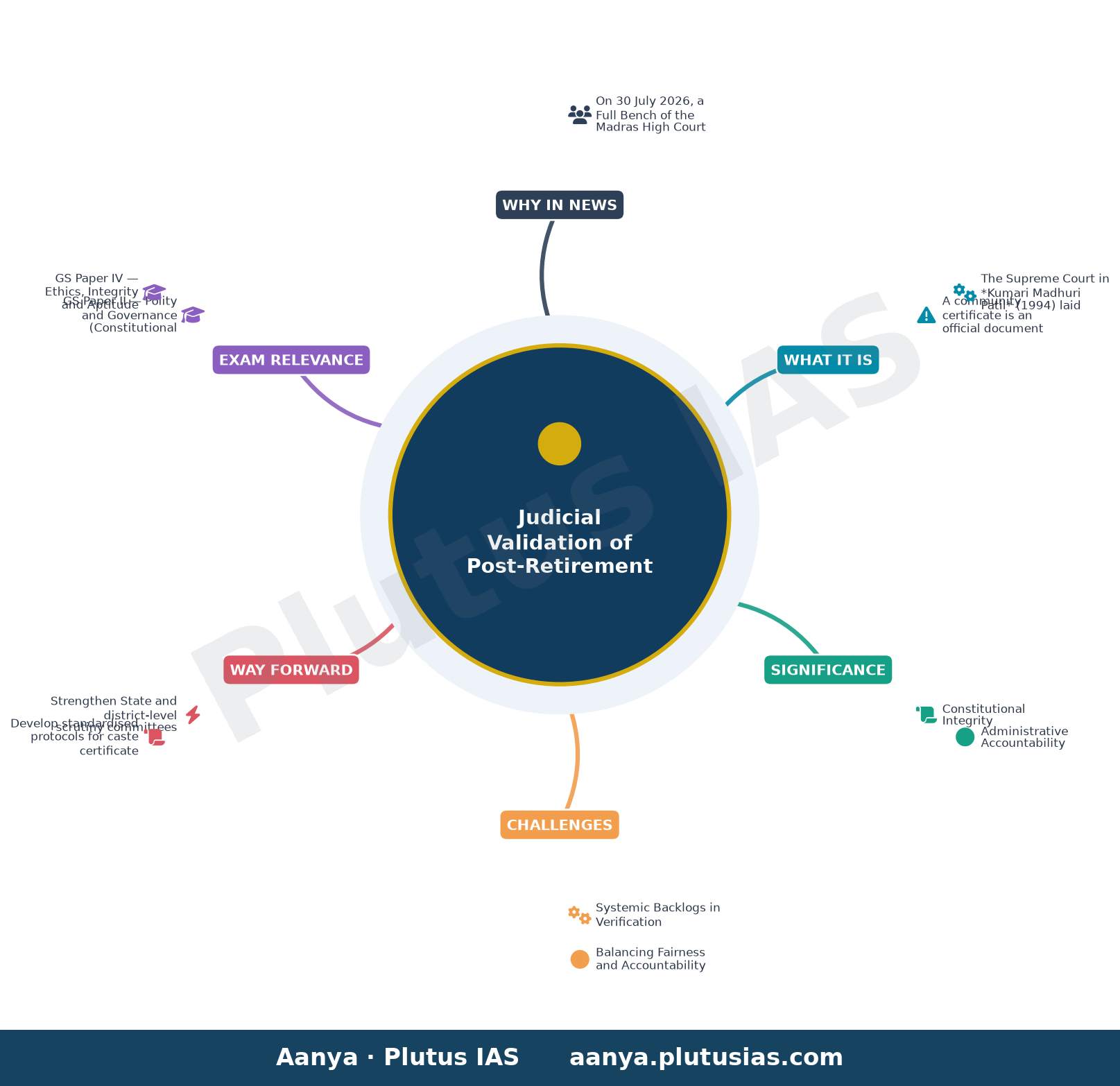
- GS Paper II — Polity and Governance (Constitutional Provisions, Judicial Review, Administrative Law) | GS Paper IV — Ethics, Integrity and Aptitude (Probity in Governance, Conflict of Interest)
- Prelims: Community Certificate, Caste Verification, Article 16(4), Kumari Madhuri Patil Case (1994), SC/ST (Prevention of Atrocities) Act, OBC Reservation, Retiral Benefits, Ab Initio Void, Full Bench, Madras High Court
- Essay: The Role of Judicial Pronouncements in Upholding Constitutional Integrity in Public Administration, Balancing Administrative Efficiency with Constitutional Safeguards: A Case Study of Caste Verification Mechanisms
Quick Revision: Verifications of community certificates are constitutionally permissible even post-retirement if initiated prior to superannuation, as fraudulent appointments are void *ab initio* and do not confer any legal rights or retiral benefits.
Why is this in the news?
On 30 July 2026, a Full Bench of the Madras High Court delivered a landmark judgment affirming that the verification of the genuineness of community certificates of government employees—including those who have retired—is legally permissible and constitutionally mandated. The ruling resolves conflicting judicial precedents, reinforces the principle that appointments secured through fraud are void *ab initio*, and underscores the state’s duty to ensure procedural integrity in public employment, irrespective of the employee’s retirement status.
Background
- The issue arises from conflicting Division Bench judgments of the Madras High Court on whether post-retirement verification of caste certificates is permissible, particularly when such verification was initiated prior to retirement.
- The Supreme Court’s landmark judgment in *Kumari Madhuri Patil v. Additional Commissioner, Tribal Development* (1994) established a multi-point verification matrix for caste certificates to prevent fraudulent claims in reservation benefits.
- The Constitution of India, under Article 16(4), empowers the state to make provisions for the reservation of appointments or posts in favour of any backward class of citizens, provided such reservations are not in excess of the constitutional ceiling.
- Tamil Nadu, like other states, operates a two-tier verification system comprising State Level Scrutiny Committees and district-level vigilance committees to validate caste certificates before and after employment.
- The judgment addresses systemic backlogs in verification processes, which have led to delays and potential misuse of reservation benefits over decades.
- The ruling aligns with the constitutional principle that no benefit derived from a fraudulent act can be protected, as such acts are void *ab initio* and do not confer any legal rights.
What is the Legal Framework Governing Caste Certificate Verification in Public Employment?
- A community certificate is an official document issued by a competent authority certifying a person’s caste or community status, used to avail reservation benefits in public employment and education under Articles 15(4) and 16(4) of the Constitution.
- The Supreme Court in *Kumari Madhuri Patil* (1994) laid down a rigorous verification process involving documentary evidence, field enquiries, and anthropological verification to prevent fraudulent claims.
- State governments are constitutionally obligated to verify the genuineness of caste certificates to ensure that reservation benefits are availed only by eligible beneficiaries, thereby upholding the principle of equality of opportunity under Article 16(1).
- The verification process is not limited to pre-employment stages; it may extend to post-employment or post-retirement stages if fraud is suspected, as appointments obtained through fraud are void *ab initio* and do not confer any legal rights or entitlements.
- The Madras High Court’s judgment reinforces that retirement does not immunize an employee from scrutiny if the verification process was lawfully initiated prior to superannuation, as the foundational illegality persists.
- The court emphasized that delayed procedures cannot be used as a tool for harassment but must be conducted with due diligence and fairness to balance constitutional accountability with individual rights.
- The judgment directs state authorities to strengthen institutional mechanisms, including the appointment of anthropological experts, to expedite verification processes and eliminate systemic backlogs.
Key Features
| Feature | Significance |
|---|---|
| Full Bench ruling on post-retirement verification | Establishes that caste certificate verification is not time-barred, even after retirement, as fraud vitiates the foundational appointment. |
| Rejection of ‘retiral immunity’ argument | Retiral benefits cannot shield an appointment obtained through fraud, as such appointments are void ab initio. |
| Empowerment of scrutiny committees | Public employers and scrutiny committees are authorised to verify caste certificates regardless of the year of issuance or appointment. |
| Fast-tracking of verification processes | Directs public employers to complete verification within the initial years of service to prevent dilatory tactics. |
| Institutional strengthening mandate | Tamil Nadu government must fortify State and district-level scrutiny committees with manpower and anthropological experts to eliminate backlogs. |
Why it Matters
Constitutional Integrity
- Upholds the principle that fraud in appointments undermines constitutional guarantees of equal opportunity in public employment.
- Reinforces the doctrine that appointments obtained through misrepresentation are void ab initio, irrespective of time elapsed.
- Ensures that the foundational illegality of fraudulent appointments is not insulated by retirement or passage of time.
Administrative Accountability
- Mandates proactive verification of caste certificates to prevent systemic misuse of reservation benefits.
- Directs timely completion of verification to avoid procedural delays that could defeat constitutional accountability.
- Strengthens institutional mechanisms to ensure strict compliance with Supreme Court-mandated verification protocols.
Judicial Precedent
- Clarifies conflicting judicial interpretations by harmonising rulings on post-retirement verification of caste certificates.
- Affirms the supremacy of the Supreme Court’s 1994 judgment in *Kumari Madhuri Patil v. Addl. Commissioner, Tribal Development* in establishing verification protocols.
- Rejects the argument that procedural mechanics grant immunity to older deceptions, ensuring no statute of limitations for fraud.
Challenges
1. Systemic Backlogs in Verification
- Existing delays in verification processes due to inadequate manpower and anthropological expertise in scrutiny committees.
- Risk of prolonged inquiries leading to harassment of employees, as highlighted by the court.
- Potential for dilatory tactics by employees to delay verification until retirement.
UPSC Link: GS-II: Reservation Policies and Judicial Pronouncements
2. Balancing Fairness and Accountability
- Need to ensure that verification processes are rigorous but do not become instruments of harassment or victimisation.
- Challenge of distinguishing genuine errors in caste certificates from deliberate fraud.
- Risk of over-reliance on verification leading to erosion of trust in reservation systems.
UPSC Link: GS-II: Fundamental Rights and Administrative Justice
3. Institutional Capacity Constraints
- Shortage of trained personnel in scrutiny committees to conduct thorough and timely verifications.
- Lack of standardised protocols for anthropological verification, leading to inconsistencies.
- Inadequate digital infrastructure to streamline verification processes and maintain records.
UPSC Link: GS-II: Role of Civil Services in Policy Implementation
4. Legal and Procedural Complexities
- Conflicting interpretations of previous judicial orders creating ambiguity in enforcement.
- Complexity of verifying caste certificates issued decades ago due to lack of contemporaneous records.
- Potential for prolonged legal battles over verification outcomes, delaying justice.
UPSC Link: GS-II: Judicial Review and Constitutional Morality
Challenges — UPSC Perspective
| Issue | Concern |
|---|---|
| Delays in verification | Prolonged processes may lead to harassment and undermine the purpose of reservation policies. |
| Inadequate institutional capacity | Scrutiny committees lack manpower and expertise to conduct thorough verifications efficiently. |
| Legal ambiguities | Conflicting judicial interpretations create uncertainty in the application of verification protocols. |
| Risk of victimisation | Overzealous verification may result in unjust consequences for employees with genuine claims. |
| Data integrity | Lack of standardised records for older caste certificates complicates verification processes. |
| Procedural harassment | Employees may face undue hardship due to prolonged and intrusive verification inquiries. |
Way Forward
- Strengthen State and district-level scrutiny committees with dedicated manpower and anthropological experts to expedite verifications.
- Develop standardised protocols for caste certificate verification, including timelines and documentation requirements.
- Digitise and integrate caste certificate records across departments to facilitate seamless verification and reduce delays.
- Conduct periodic training for verification committees to ensure consistency and adherence to Supreme Court guidelines.
- Establish a grievance redressal mechanism for employees facing undue harassment during verification processes.
- Encourage proactive self-declaration and verification of caste certificates by employees within the initial years of service.
- Ensure transparency in verification outcomes by publishing anonymised data on cases of fraud and corrective actions.
- Collaborate with academic institutions and anthropological experts to refine verification methodologies and reduce subjectivity.
UPSC Value Addition
Keywords for Mains Answer-Writing
Community certificates verification · Madras High Court Full Bench judgment · Caste status scrutiny post-retirement · Kumari Madhuri Patil case (1994) · Constitutional accountability in public employment · State Level Scrutiny Committee · Anthropological verification of caste · Fraud in appointment and ab initio void · Retiral benefits and foundational illegality · Public employers’ duty to verify certificates
Constitutional & Policy Linkages
- Article 14: Equality before law and equal protection of laws — ensures no immunity for fraudulent appointments.
- Article 16(4): Reservation in favour of backward classes — upholds the need for verification to prevent misuse.
Concept Flow
Public employee secures government appointment using fraudulent caste certificate → Appointment is void ab initio due to fraud → Verification process initiated prior to retirement → Retirement does not extinguish the foundational illegality → Court rules verification permissible post-retirement → Scrutiny committees empowered to verify regardless of time elapsed → Institutional strengthening mandated to eliminate backlogs → Timely completion of verification directed to prevent dilatory tactics → Balancing constitutional accountability with fairness in procedural justice.
Prelims Practice Questions
Q1. Consider the following statements regarding the verification of community certificates in India:
1. The Supreme Court in Kumari Madhuri Patil (1994) established a multi-point verification matrix for caste certificates.
2. The Madras High Court has ruled that verification of community certificates can be initiated only during an employee’s service period and not after retirement.
3. Fraudulent appointments obtained through fake community certificates are considered void ab initio.
How many of the above statements are correct?
- Only one
- Only two
- All three
- None
Answer: Only two — Statement 1 is correct as the Supreme Court in Kumari Madhuri Patil (1994) laid down guidelines for verification of caste certificates. Statement 2 is incorrect as the Madras High Court has ruled that verification can be initiated even after retirement. Statement 3 is correct as fraudulent appointments are deemed void ab initio.
Q2. Assertion (A): The verification of a government employee’s caste status can be initiated after retirement if the process was lawfully commenced prior to superannuation.
Reason (R): The Madras High Court has held that retirement does not absolve the foundational illegality of a fraudulent appointment.
Options:
A. Both A and R are true, and R is the correct explanation of A.
B. Both A and R are true, but R is not the correct explanation of A.
C. A is true, but R is false.
D. A is false, but R is true.
Answer: ? — Assertion (A) is true as the Madras High Court ruled that verification initiated before retirement does not lapse post-retirement. Reason (R) is also true and correctly explains (A) as it highlights that foundational illegality persists despite retirement.
Q3. Match the following columns regarding legal provisions and judgments related to community certificates verification:
Column I
1. Kumari Madhuri Patil case
2. Void ab initio principle
3. State Level Scrutiny Committee
4. Fraudulent appointment consequences
Column II
A. Supreme Court judgment establishing verification matrix
B. Legal doctrine rendering fraudulent appointments invalid from inception
C. Institutional body empowered to verify caste certificates
D. Loss of retiral benefits due to foundational illegality
- 1-A, 2-B, 3-C, 4-D
- 1-B, 2-A, 3-D, 4-C
- 1-C, 2-D, 3-A, 4-B
- 1-D, 2-C, 3-B, 4-A
Answer: 1-A, 2-B, 3-C, 4-D — 1 matches with A (Kumari Madhuri Patil case established verification matrix). 2 matches with B (void ab initio principle invalidates fraudulent appointments from inception). 3 matches with C (State Level Scrutiny Committee is the institutional body for verification). 4 matches with D (fraudulent appointments lead to loss of retiral benefits).
Mains Practice Question
✍ The Madras High Court has recently held that verification of the genuineness of community certificates is legally permissible even after an employee’s retirement if the process was lawfully initiated prior to superannuation. Critically examine the constitutional and legal implications of this judgment with reference to the doctrine of void ab initio and the Supreme Court’s framework in Kumari Madhuri Patil (1994). Also, discuss the institutional mechanisms required to ensure strict compliance with the verification process. (15 Marks)
Approach: MODEL-ANSWER SKELETON:
1. **Introduction**: Briefly state the context of the Madras High Court’s judgment and its significance in ensuring constitutional accountability in public employment.
2. **Legal Framework for Verification**:
– Kumari Madhuri Patil (1994): Supreme Court’s multi-point verification matrix and its legal basis.
– Constitutional provisions: Articles 14, 16, and 335 (equality, reservation, and administrative efficiency).
– Doctrine of void ab initio: Legal principle rendering fraudulent appointments invalid from inception.
3. **Constitutional Implications of the Judgment**:
– **Void ab initio and Retiral Benefits**: Explain how fraudulent appointments are void from the start and how this judgment upholds constitutional integrity by denying retiral benefits.
– **Constitutional Accountability**: Discuss how the judgment reinforces the principle of accountability in public employment and prevents dilatory tactics.
– **Balancing Fairness and Rigor**: Analyze the court’s emphasis on fairness while ensuring strict compliance with verification processes.
4. **Institutional Mechanisms for Compliance**:
– **State Level Scrutiny Committee**: Role in verifying caste certificates and strengthening institutional capacity (anthropological experts, manpower).
– **District-Level Vigilance Committees**: Local-level mechanisms for verification and monitoring.
– **Public Employers’ Duty**: Initiate and complete verification within the initial years of service to prevent backlogs.
5. **Challenges and Way Forward**:
– Systemic backlogs and the need for institutional strengthening.
– Ensuring transparency and avoiding harassment in verification processes.
– Role of the judiciary in interpreting constitutional provisions dynamically.
6. **Conclusion**: Summarize the judgment’s contribution to constitutional governance and the need for proactive institutional mechanisms to uphold integrity in public employment.
Source: The Hindu
Generated by AanyaAi for educational purpose.

- KWML’s Feasibility Reports for Water Metro in 18 Cities: UPSC & PCS Insights - October 3, 2026
- ओडिशा में वन्यजीव अनुसंधान अनुदान कार्यक्रम शुरू, सिमिलिपाल में 300 कैमरे और बढ़ेंगे - October 3, 2026
- India Summons Pakistan High Commission Official Over Violation - October 3, 2026

No Comments