


09 Aug Karnataka’s Amrit Bharat Station Scheme: Only 12 of 61 stations completed
✎ A Rajya Sabha reply on August 7, 2026, revealed that only 12 of the 61 railway stations identified in Karnataka under the Amrit Bharat Station Scheme (ABSS) have been completed, with just 261 of 1,340 stations nationwide…
Subject Relevance — Where This Topic Fits
- GS Paper III — Infrastructure: Energy, Ports, Roads, Airports, Railways
- Prelims: Amrit Bharat Station Scheme (ABSS), Railway Ministry, Rajya Sabha unstarred question, Mangaluru Junction Railway Station, rail infrastructure gaps, public accountability in governance
- Essay: Governance and Transparency in Public Infrastructure Projects, Challenges in India’s Railway Modernisation Agenda
Why is this in the news?
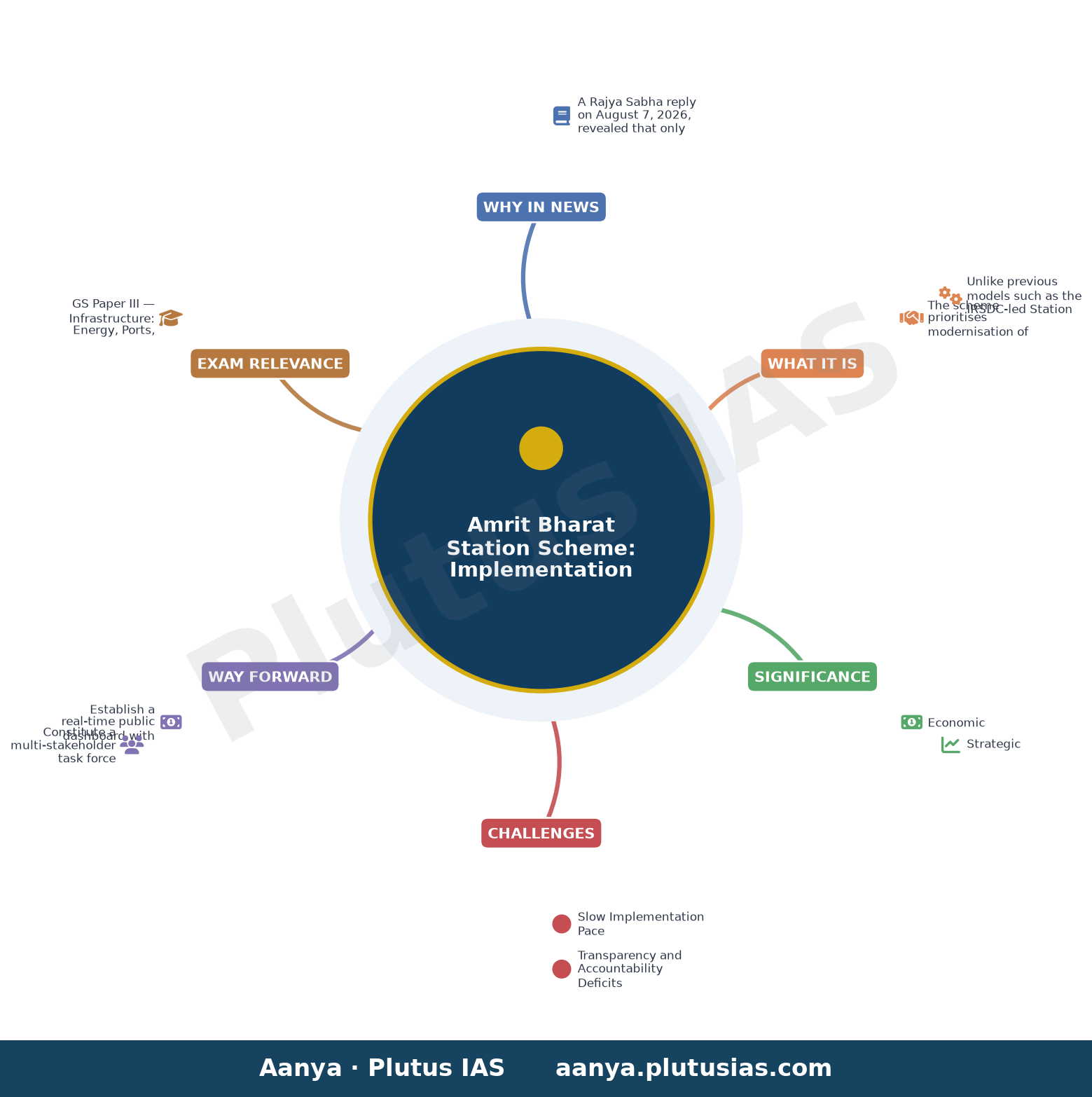
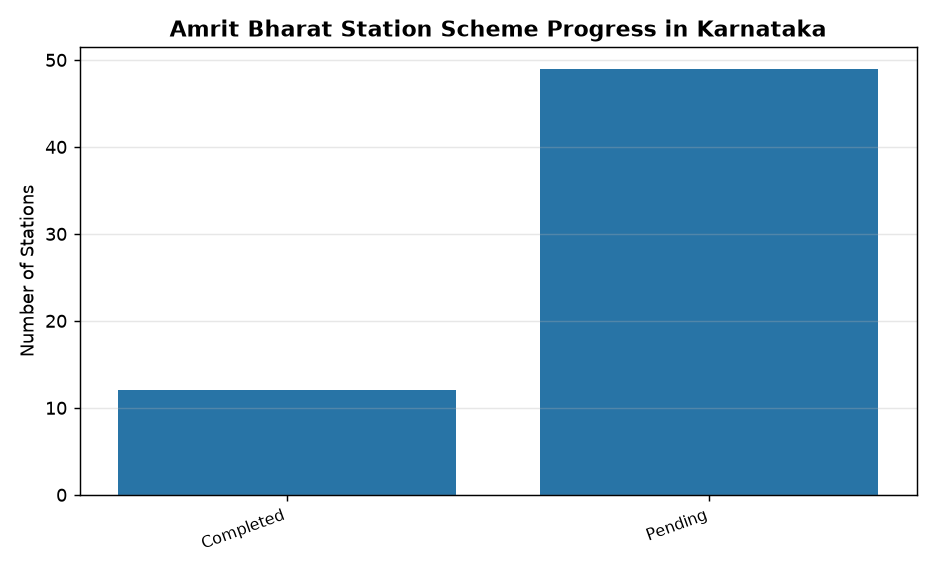
A Rajya Sabha reply on August 7, 2026, revealed that only 12 of the 61 railway stations identified in Karnataka under the Amrit Bharat Station Scheme (ABSS) have been completed, with just 261 of 1,340 stations nationwide achieving completion. This exposes significant implementation delays, raising concerns about transparency, accountability, and the efficacy of flagship infrastructure initiatives in meeting public expectations.
Background
- The scheme replaces the earlier Station Redevelopment Programme and focuses on phased development without disrupting station operations, unlike the now-discontinued Indian Railway Stations Development Corporation Limited (IRSDC) model.
- Karnataka, with 61 stations under ABSS, represents a microcosm of the national challenge, where only 19% of targeted stations have seen completion, highlighting systemic implementation bottlenecks.
- Public discourse has increasingly scrutinised the ABSS for its slow pace, with critics pointing to repeated announcements and ceremonial groundbreaking events without commensurate tangible outcomes.
- The Rajya Sabha reply underscores a broader governance deficit, including lack of transparency in project costs, contract awards, and progress tracking, which undermines parliamentary oversight and public trust.
- Railway infrastructure development is critical for India’s economic integration, given the modal share of railways in freight and passenger transport, particularly for long-distance and inter-state mobility.
What is the Amrit Bharat Station Scheme (ABSS)?
- The scheme prioritises modernisation of passenger amenities, including improved waiting halls, toilets, signage, lighting, landscaping, and accessibility features for persons with disabilities, while preserving the heritage character of stations where applicable.
- Unlike previous models such as the IRSDC-led Station Redevelopment Programme, ABSS avoids large-scale land acquisition and focuses on low-impact, modular improvements that can be executed without station shutdowns.
- Key components of ABSS include the development of multimodal hubs, integration with bus terminals, provision of free Wi-Fi, and installation of escalators and lifts where feasible, subject to technical and financial feasibility.
- The scheme operates under a decentralised model, with zonal railways and divisional offices responsible for execution, while the Railway Board provides policy direction and monitors progress through the PRAGATI platform.
- ABSS is part of the broader Indian Railways’ Vision 2030, which aims to enhance passenger experience, improve operational efficiency, and increase non-fare revenue through commercial exploitation of station land and air space.
- Funding for ABSS is provided under the Rashtriya Rail Sanraksha Kosh (RRSK) and other railway budgets, with no reliance on public-private partnerships (PPPs) for core infrastructure upgrades, though commercial development may involve private participation.
- The scheme aligns with the National Infrastructure Pipeline (NIP) and the PM Gati Shakti National Master Plan, which seek to integrate transport infrastructure for seamless multi-modal connectivity.
Key Features
| Feature | Significance |
|---|---|
| Amrit Bharat Station Scheme (ABSS) | A centrally sponsored scheme launched in December 2022 for the redevelopment of 1,340 railway stations across India, including 61 in Karnataka, with a focus on modernising passenger amenities, improving connectivity, and enhancing station aesthetics. |
| Redevelopment Targets | Includes upgrading passenger infrastructure such as waiting halls, toilets, digital signage, and accessibility features, alongside aesthetic improvements like landscaping and façade upgrades. |
| Progress Monitoring Mechanism | Parliamentary replies, such as the Rajya Sabha unstarred question, serve as a formal mechanism to assess the implementation pace and accountability of centrally sponsored schemes. |
| Transparency Concerns | Lack of station-wise project costs, contract award dates, and year-wise progress data undermines public scrutiny and parliamentary oversight of the scheme’s execution. |
| State-wise Implementation | Karnataka’s progress (12 of 61 stations completed) reflects broader national trends, with only 19% of stations across India achieving completion, indicating systemic implementation challenges. |
Why it Matters
Economic
- Stimulates local economies through infrastructure-led development, creating employment in construction, hospitality, and allied sectors near redeveloped stations.
- Enhances regional connectivity, potentially boosting tourism and trade by improving access to key urban and semi-urban hubs.
- Long-term fiscal benefits through increased passenger footfall, leading to higher revenue from commercial spaces and ancillary services.
Strategic
- Improves last-mile connectivity, aligning with the government’s broader infrastructure push to integrate rail networks with urban planning.
- Supports the ‘Viksit Bharat’ vision by ensuring world-class passenger amenities, reducing congestion, and enhancing safety standards.
- Strengthens India’s global image as a nation investing in modern, inclusive, and sustainable public infrastructure.
Social
- Enhances accessibility for differently-abled passengers through universal design principles in station redevelopment.
- Improves passenger experience by addressing long-standing issues such as inadequate waiting facilities and poor sanitation.
- Promotes inclusive growth by prioritising stations in tier-2 and tier-3 cities, which often lack comparable infrastructure.
Challenges
1. Slow Implementation Pace
- Only 19% of stations (261 of 1,340) completed nationwide, with Karnataka at 19.67% (12 of 61), indicating systemic delays in project execution.
- Delays attributed to land acquisition bottlenecks, contractor-related issues, and bureaucratic hurdles in multi-stakeholder coordination.
- Lack of real-time monitoring and public dashboards to track progress, leading to opacity in project timelines.
UPSC Link: Infrastructure: Challenges in implementation
2. Transparency and Accountability Deficits
- Parliamentary replies lack granular data on project costs, contractor details, and milestones, impeding oversight.
- Absence of citizen-centric platforms for grievance redressal and progress tracking, reducing public trust in scheme execution.
- Risk of cost overruns and substandard work due to inadequate third-party audits and quality control mechanisms.
UPSC Link: Governance: Transparency and accountability
3. Resource Allocation and Prioritisation
- Concentration of projects in select states (e.g., Karnataka’s 61 stations) raises questions about equitable distribution of funds.
- Potential diversion of funds to high-visibility projects, leaving smaller stations with delayed or incomplete redevelopment.
- Need for dynamic resource reallocation based on ground realities, such as passenger footfall and strategic importance.
UPSC Link: Resource Mobilisation: Challenges
4. Stakeholder Coordination Failures
- Multi-agency involvement (Railway Ministry, state governments, contractors) leads to coordination gaps and delayed approvals.
- Lack of integrated planning between station redevelopment and broader urban transport projects (e.g., metro connectivity).
- Inadequate consultation with local communities and passengers, resulting in design mismatches with user needs.
UPSC Link: Inter-State Relations: Coordination issues
5. Sustainability and Long-Term Viability
- Risk of underutilised assets post-redevelopment due to poor demand assessment or lack of post-project maintenance plans.
- Environmental concerns over land use changes, waste management, and energy efficiency in redeveloped stations.
- Need for sustainable financing models, such as public-private partnerships (PPPs), to ensure long-term upkeep.
UPSC Link: Sustainable Development: Infrastructure challenges
Challenges — UPSC Perspective
| Issue | Concern |
|---|---|
| Project Delays | Only 19% completion rate nationwide, with Karnataka at ~20%, indicating systemic implementation challenges. |
| Data Opacity | Lack of station-wise costs, contractor details, and progress timelines hampers parliamentary and public oversight. |
| Equitable Distribution | Concentration of projects in select states raises questions about fairness in fund allocation. |
| Stakeholder Gaps | Multi-agency coordination failures delay approvals and lead to disjointed execution. |
| Sustainability Risks | Potential underutilisation of assets and environmental concerns due to inadequate long-term planning. |
Way Forward
- Establish a real-time public dashboard with station-wise progress, costs, and timelines to enhance transparency and accountability.
- Constitute a multi-stakeholder task force comprising Railway Ministry, state governments, and contractors to expedite approvals and resolve bottlenecks.
- Implement dynamic resource reallocation mechanisms to prioritise stations based on passenger footfall, strategic importance, and equitable distribution.
- Introduce third-party quality audits and post-project maintenance plans to ensure sustainability and prevent asset underutilisation.
- Strengthen grievance redressal mechanisms, such as dedicated helplines or mobile apps, to address public concerns and improve user experience.
- Promote public-private partnerships (PPPs) to leverage private sector expertise in station operations, commercialisation, and maintenance.
- Integrate station redevelopment with broader urban transport projects (e.g., metro, bus terminals) to create seamless multi-modal connectivity.
UPSC Value Addition
Keywords for Mains Answer-Writing
Amrit Bharat Station Scheme (ABSS) · Railway station redevelopment · Infrastructure governance · Transparency in public expenditure · Parliamentary accountability · Railway Ministry initiatives · Karnataka infrastructure projects · Public-private partnerships in infrastructure · Rajya Sabha unstarred questions · Monitoring of centrally sponsored schemes
Concept Flow
Central Government announces Amrit Bharat Station Scheme (Dec 2022) → Identification of 1,340 stations (61 in Karnataka) → State governments and contractors initiate redevelopment works → Parliamentary oversight via Rajya Sabha questions → Disclosure of progress reveals delays (19% completion) → Public scrutiny highlights transparency gaps → Need for accountability and corrective measures arises.
Prelims Practice Questions
Q1. Consider the following statements regarding the Amrit Bharat Station Scheme (ABSS):
1. The scheme was launched in December 2022.
2. It aims at redeveloping 1,340 railway stations across India.
3. The scheme mandates 100% completion of redevelopment works within two years of announcement.
4. The scheme includes provisions for modern amenities, improved passenger amenities, and better connectivity.
How many of the above statements are correct?
- Only one
- Only two
- Only three
- All four
Answer: Only three — Statements 1, 2, and 4 are correct. Statement 3 is incorrect as the scheme does not mandate a strict two-year completion timeline; progress has been slower than projected.
Q2. Assertion (A): The Amrit Bharat Station Scheme (ABSS) is a centrally sponsored scheme under the Ministry of Railways.
Reason (R): The scheme aims to redevelop railway stations to enhance passenger experience and operational efficiency.
Options:
A. Both A and R are true, and R is the correct explanation of A.
B. Both A and R are true, but R is not the correct explanation of A.
C. A is true, but R is false.
D. A is false, but R is true.
Answer: ? — Assertion (A) is true as ABSS is a centrally sponsored scheme under the Ministry of Railways. Reason (R) is also true and correctly explains the objective of the scheme.
Q3. Match the following railway stations in Karnataka with their respective districts:
Column I (Station) | Column II (District)
——————-|——————-
A. Mangaluru Junction | 1. Bagalkot
B. Badami | 2. Dakshina Kannada
C. Gadag | 3. Gadag
D. Bagalkot | 4. Bagalkot
Options:
A. A-2, B-1, C-3, D-4
B. A-1, B-2, C-3, D-4
C. A-3, B-1, C-2, D-4
D. A-4, B-2, C-3, D-1
Answer: ? — A. Mangaluru Junction is in Dakshina Kannada district (2). B. Badami is in Bagalkot district (1). C. Gadag is in Gadag district (3). D. Bagalkot station is also in Bagalkot district (4).
Mains Practice Question
✍ The Amrit Bharat Station Scheme (ABSS) represents a significant initiative under the Ministry of Railways to modernise railway stations across India. Critically examine the implementation challenges faced by the scheme, with particular reference to transparency, accountability, and the pace of project completion. Also, analyse the implications of such delays for public trust in infrastructure governance. (15 Marks)
Approach: MODEL-ANSWER SKELETON:
1. **Introduction (2 marks)**: Define ABSS, its objectives (modern amenities, improved passenger facilities, better connectivity), and its launch timeline (December 2022). Mention the target of redeveloping 1,340 stations, including 61 in Karnataka.
2. **Implementation Challenges (5 marks)**:
– **Transparency**: Highlight the lack of station-wise project costs, contract award dates, and year-wise progress data as raised in the Rajya Sabha (August 2026). Cite the absence of detailed disclosures despite parliamentary queries.
– **Accountability**: Discuss the slow pace of completion (only 19% of stations across India and 12 out of 61 in Karnataka). Reference the criticism by MP Mansoor Ali Khan regarding repeated announcements without tangible outcomes.
– **Governance**: Explain the role of the Ministry of Railways in project execution, the involvement of multiple stakeholders (e.g., contractors, state governments), and the lack of a robust monitoring mechanism.
3. **Pace of Completion (4 marks)**:
– Analyse the reasons for delays: bureaucratic hurdles, land acquisition issues, funding constraints, and coordination gaps between central and state agencies.
– Reference the data: 261 stations completed out of 1,340 nationwide, and 12 out of 61 in Karnataka as of August 2026.
– Compare with the projected timelines and explain the gap between announcements and ground reality.
4. **Implications for Public Trust (3 marks)**:
– Discuss the erosion of public confidence in infrastructure governance due to ceremonial ground-breaking events without commensurate completion.
– Highlight the broader impact on India’s infrastructure development narrative, including investor confidence and citizen expectations.
5. **Conclusion (1 mark)**: Summarise the need for greater transparency, accountability, and a time-bound action plan to restore credibility in the scheme.
Source: The Hindu
Generated by AanyaAi for educational purpose.

- KWML’s Feasibility Reports for Water Metro in 18 Cities: UPSC & PCS Insights - October 3, 2026
- ओडिशा में वन्यजीव अनुसंधान अनुदान कार्यक्रम शुरू, सिमिलिपाल में 300 कैमरे और बढ़ेंगे - October 3, 2026
- India Summons Pakistan High Commission Official Over Violation - October 3, 2026

No Comments