


09 Aug Women Judges in Judiciary: Why Their Role Matters for UPSC Exam
✎ Gender inclusivity in the judiciary is not merely a matter of numerical representation but a constitutional imperative to ensure equitable justice, as mandated by Articles 14, 15(3), and 51A(e) of the Indian Constitution.
Subject Relevance — Where This Topic Fits
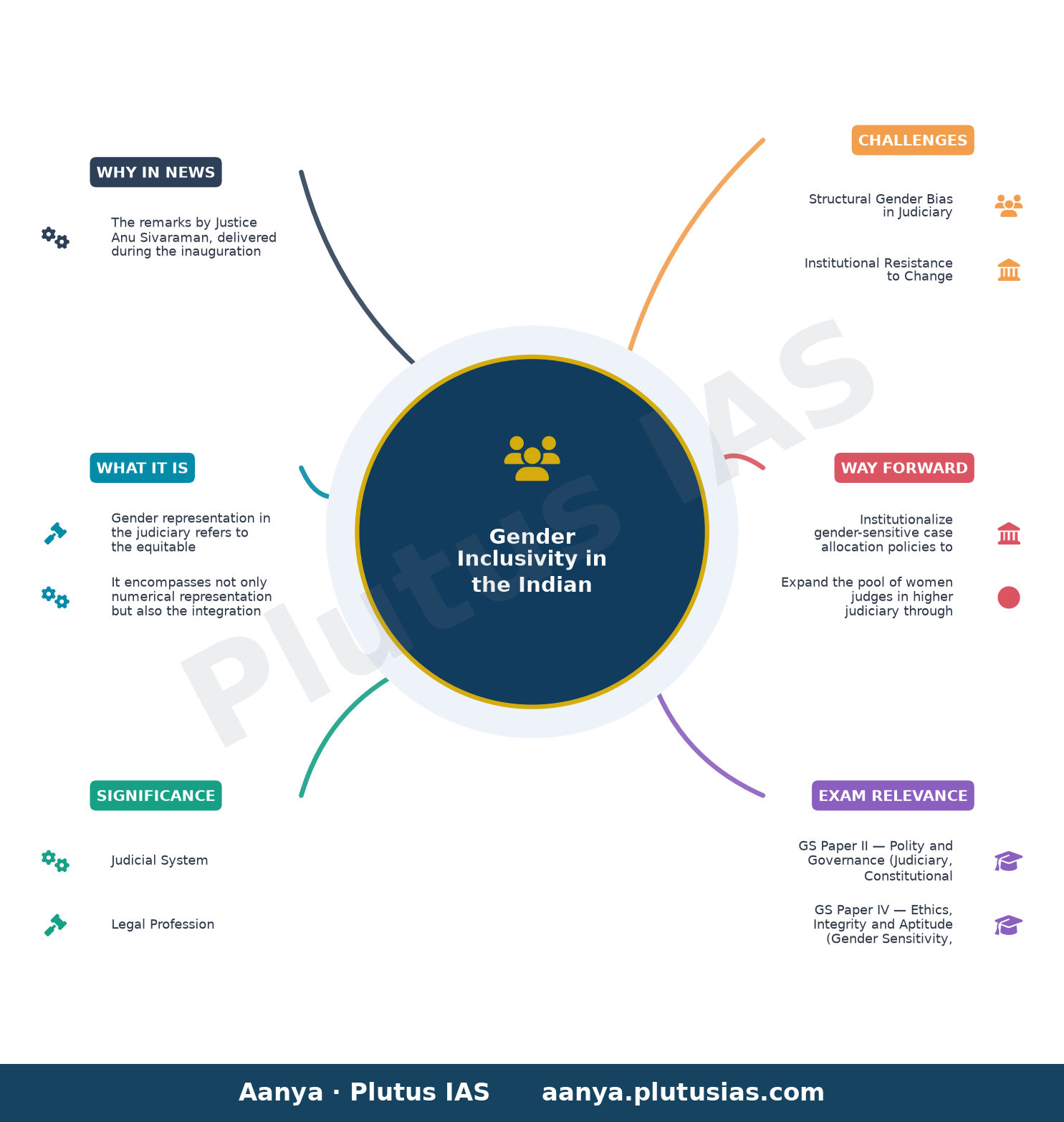
- GS Paper II — Polity and Governance (Judiciary, Constitutional Provisions, Gender Justice) | GS Paper IV — Ethics, Integrity and Aptitude (Gender Sensitivity, Inclusivity)
- Prelims: Judicial appointments, Collegium System, Article 21, POCSO Act, Gender Representation in Judiciary, All-Women Benches, Advocate General, Protection of Women from Domestic Violence Act 2005
- Essay: The Role of Gender Inclusivity in Strengthening Democratic Institutions, Judicial Diversity as a Pillar of Social Justice
Quick Revision: Gender inclusivity in the judiciary is not merely a matter of numerical representation but a constitutional imperative to ensure equitable justice, as mandated by Articles 14, 15(3), and 51A(e) of the Indian Constitution.
Why is this in the news?
The remarks by Justice Anu Sivaraman, delivered during the inauguration of the Dharwad Bench Advocates’ Association, underscore the critical need for integrating women’s perspectives across all branches of the judiciary. This discourse gains significance against the backdrop of a rare judicial milestone in Karnataka, where all benches at the Dharwad Bench were presided over exclusively by women judges, accompanied by an all-women team of law officers representing the State. The event highlights systemic gaps in gender representation within the legal profession and judicial adjudication, while also serving as a catalyst for re-evaluating institutional practices to foster inclusivity.
Background
- The Indian judiciary, despite constitutional guarantees of equality under Article 14 and Article 15(3), continues to grapple with underrepresentation of women in higher echelons of judicial hierarchy, particularly in High Courts and the Supreme Court.
- The Protection of Children from Sexual Offences (POCSO) Act, 2012, and the Protection of Women from Domestic Violence Act, 2005, are often cited as domains where women’s perspectives are deemed essential, yet broader legal domains such as taxation, service matters, and constitutional adjudication remain largely gender-neutral in practice.
- Judicial diversity is increasingly recognised as a tool for enhancing the legitimacy and effectiveness of the judiciary, as diverse benches are better positioned to address intersectional legal challenges and societal inequities.
What is Gender Representation in the Judiciary?
- Gender representation in the judiciary refers to the equitable participation of women and other marginalised genders in judicial roles, including judges, law officers, and legal practitioners, across all levels of the legal hierarchy.
- It encompasses not only numerical representation but also the integration of gender-sensitive perspectives in judicial decision-making, ensuring that legal outcomes are inclusive and reflective of societal diversity.
- Women’s participation in the judiciary is often linked to the principles of natural justice and procedural fairness, as diverse benches are better equipped to address biases in legal interpretation and application.
- The judiciary’s role in upholding gender justice extends beyond family law and POCSO cases to include areas such as labour law, property rights, electoral disputes, and constitutional matters, where gender-neutral adjudication remains a challenge.
- The lack of gender diversity in the higher judiciary perpetuates a cycle of exclusion, as judicial appointments often rely on informal networks and seniority-based selections, which are historically male-dominated.
Key Features
| Feature | Significance |
|---|---|
| All-women judicial benches at Dharwad Bench | Demonstrates institutional capacity of women judges to preside over diverse case categories, including civil, criminal, service, and taxation matters, challenging gendered assumptions about judicial competence. |
| Exclusive representation by women law officers | Highlights the professional parity of women advocates in high-stakes litigation, including constitutional and statutory matters, reinforcing gender neutrality in legal representation. |
| Judicial emphasis on women’s perspectives across all case types | Underscores the need for gender-sensitive adjudication in POCSO, family disputes, and other areas, aligning with constitutional mandates for equality and justice. |
| Constitution of ten women judges for simultaneous proceedings | Signals systemic readiness to integrate gender diversity in judicial decision-making, setting a precedent for inclusivity in constitutional courts. |
| Advocate General’s office constituting an all-women team | Reflects institutional support for gender parity in legal practice, with leadership roles assigned to women in a traditionally male-dominated domain. |
Why it Matters
Judicial System
- Reinforces the principle that judicial competence is gender-neutral, countering historical underrepresentation of women in adjudicatory roles.
- Demonstrates the judiciary’s capacity to self-correct through institutional mechanisms that promote gender diversity in decision-making.
- Sets a precedent for constitutional courts to institutionalize gender-sensitive practices without compromising professional standards.
Legal Profession
- Validates the professional equality of women advocates in high-stakes litigation, including constitutional and statutory matters.
- Challenges entrenched gender biases in legal practice, particularly in roles such as law officers and senior advocates.
- Encourages law firms and bar associations to adopt inclusive hiring and promotion policies.
Societal Impact
- Promotes the visibility of women in positions of legal authority, inspiring younger women to pursue careers in law and judiciary.
- Fosters public trust in the judiciary by reflecting societal diversity in its highest echelons.
- Contributes to the evolution of gender-just jurisprudence by integrating women’s perspectives into all areas of law.
Challenges
1. Structural Gender Bias in Judiciary
- Despite progress, women remain underrepresented in higher judiciary, particularly in Supreme Court and High Court benches.
- Gender stereotypes persist in case allocation, with women judges disproportionately assigned to family law or POCSO matters.
- Lack of systemic support for women in legal practice, including mentorship and work-life balance policies.
UPSC Link: GS-II: Judiciary – Composition and Challenges
2. Institutional Resistance to Change
- Traditional norms within the judiciary may resist gender-inclusive practices, viewing them as deviations from established protocols.
- Hierarchical structures in legal institutions can perpetuate exclusionary practices, limiting upward mobility for women.
- Cultural barriers in legal education and bar associations may discourage women from pursuing litigation or judicial roles.
UPSC Link: GS-II: Governance – Institutional Reforms
3. Sustainability of Gender-Inclusive Initiatives
- Ensuring that one-off events (e.g., all-women benches) translate into long-term systemic changes in judicial culture.
- Addressing the intersectionality of gender with caste, class, and regional disparities in legal representation.
- Balancing gender diversity with meritocracy to avoid perceptions of tokenism in judicial appointments.
UPSC Link: GS-II: Social Justice – Inclusive Governance
Challenges — UPSC Perspective
| Issue | Concern |
|---|---|
| Underrepresentation in higher judiciary | Limited participation of women in Supreme Court and High Court benches despite constitutional guarantees of equality. |
| Gendered case allocation | Women judges disproportionately assigned to family law or POCSO matters, reinforcing stereotypes about their expertise. |
| Work-life balance in legal profession | Lack of institutional support for women advocates juggling professional and personal responsibilities. |
| Cultural resistance in legal institutions | Traditional norms and hierarchical structures that perpetuate exclusionary practices. |
| Intersectional disparities | Gender disparities compounded by caste, class, and regional factors in legal representation. |
Way Forward
- Institutionalize gender-sensitive case allocation policies to ensure equitable distribution of cases among judges.
- Expand the pool of women judges in higher judiciary through targeted recruitment and mentorship programs.
- Mandate gender parity in law officer appointments and senior advocate designations in government and constitutional bodies.
- Introduce gender sensitization programs for judicial officers and legal professionals to challenge entrenched biases.
- Strengthen data collection on gender representation in judiciary and legal practice to inform evidence-based reforms.
- Encourage bar councils and law universities to promote gender diversity in litigation and academia.
- Leverage technology to support women in legal practice, such as virtual court facilities to address work-life balance challenges.
UPSC Value Addition
Keywords for Mains Answer-Writing
Judicial diversity · Gender representation in judiciary · Constitutional courts · Women judges · All-women benches · Judicial appointments · POCSO Act · Protection of Women from Domestic Violence Act, 2005 · Article 14 of the Constitution · Judicial accountability · Legal profession · Gender justice · Constitutional morality · Judicial independence
Constitutional & Policy Linkages
- Article 14: Equality before law and equal protection of laws.
- Article 15(1): Prohibition of discrimination on grounds of sex.
- Article 15(3): Special provisions for women and children.
- Article 16: Equality of opportunity in public employment.
- Article 51A(e): Fundamental duty to renounce practices derogatory to the dignity of women.
Concept Flow
Historical gender bias in judiciary and legal profession → Systemic underrepresentation of women in adjudicatory roles → Need for gender-sensitive adjudication → Institutional initiatives like all-women benches → Reinforcement of gender-neutral judicial competence → Long-term systemic reforms for inclusivity.
Prelims Practice Questions
Q1. Consider the following statements regarding the representation of women in the Indian judiciary:
1. The Constitution of India explicitly mandates reservation for women in judicial appointments.
2. The Supreme Court of India has never had a woman Chief Justice.
3. The Protection of Children from Sexual Offences (POCSO) Act, 2012, requires mandatory representation of women judges in its adjudication.
4. The Karnataka High Court witnessed an all-women bench on August 1, 2026, presided over exclusively by women judges.
How many of the above statements are correct?
- Only one
- Only two
- Only three
- All
Answer: Only three — Statement 1 is incorrect: The Constitution does not mandate reservation for women in judicial appointments. Statement 2 is correct: The Supreme Court has not had a woman Chief Justice to date. Statement 3 is incorrect: The POCSO Act does not mandate representation of women judges. Statement 4 is correct: The Karnataka High Court witnessed an all-women bench on August 1, 2026.
Q2. Assertion (A): The presence of women judges in constitutional courts enhances the legitimacy of judicial decisions.
Reason (R): Women judges bring diverse perspectives that can address gender biases in legal interpretation and ensure more equitable justice.
In the context of the above two statements, which one of the following is correct?
- Both A and R are true, and R is the correct explanation of A.
- Both A and R are true, but R is not the correct explanation of A.
- A is true, but R is false.
- A is false, but R is true.
Answer: Both A and R are true, but R is not the correct explanation of A. — Both the assertion and reason are true. The presence of women judges in constitutional courts is widely regarded as enhancing the legitimacy of judicial decisions by incorporating diverse perspectives. The reason correctly explains the assertion by highlighting the role of women judges in addressing gender biases.
Q3. Match the following constitutional provisions with their respective significance in promoting gender justice:
Column I (Provision) | Column II (Significance)
—|—
A. Article 14 | 1. Ensures equality before law and equal protection of laws
B. Article 15(3) | 2. Empowers the State to make special provisions for women and children
C. Article 39(d) | 3. Ensures equal pay for equal work
D. Article 42 | 4. Directs the State to make provisions for securing just and humane conditions of work
Select the correct match:
- A-1, B-2, C-3, D-4
- A-2, B-1, C-4, D-3
- A-1, B-3, C-2, D-4
- A-4, B-2, C-3, D-1
Answer: A-1, B-2, C-3, D-4 — A-1: Article 14 guarantees equality before law and equal protection of laws. B-2: Article 15(3) empowers the State to make special provisions for women and children. C-3: Article 39(d) ensures equal pay for equal work. D-4: Article 42 directs the State to make provisions for securing just and humane conditions of work.
Mains Practice Question
✍ Critically examine the significance of gender diversity in the higher judiciary with reference to constitutional provisions, judicial appointments, and recent judicial practices. Also, analyse the challenges in achieving equitable representation of women in constitutional courts. (15 Marks)
Approach: MODEL-ANSWER SKELETON:
1. **Constitutional Foundations** (4 marks):
– Article 14 (Right to Equality), Article 15(3) (Special provisions for women and children), Article 39(d) (Equal pay for equal work), Article 42 (Just and humane conditions of work).
– Article 16 (Equality of opportunity in public employment) and its interpretation in judicial appointments.
– Judicial pronouncements such as *Indra Sawhney v. Union of India* (1992) on reservations and *Vishaka Guidelines* (1997) on gender justice.
2. **Judicial Appointments and Representation** (4 marks):
– Current status of women judges in the Supreme Court and High Courts (use latest data if available).
– Collegium system and its role in promoting or hindering gender diversity.
– The need for a structured mechanism to ensure proportional representation.
3. **Recent Judicial Practices** (3 marks):
– The Karnataka High Court’s initiative of all-women benches on August 1, 2026, as a case study.
– The role of women judges in adjudicating cases under the Protection of Women from Domestic Violence Act, 2005, and the POCSO Act, 2012.
– Landmark judgments by women judges (e.g., *Independent Thought v. Union of India*, 2017; *Hitesh Verma v. State of J&K*, 2020).
4. **Challenges and Way Forward** (4 marks):
– Structural barriers: societal norms, lack of mentorship, work-life balance.
– Institutional biases in appointments and promotions.
– Proposals such as the *Malhotra Committee Report* (2015) on gender diversity in the judiciary.
– Role of the executive and judiciary in fostering inclusivity (e.g., NJAC vs. Collegium debate).
Balance of views: Acknowledge arguments for and against reservation, while emphasizing the need for systemic reforms to ensure equitable representation.
Source: The Hindu
Generated by AanyaAi for educational purpose.

- भारत-आसियान व्यापार 128 अरब डॉलर तक पहुंचा, जानिए क्या हुआ 14वें पूर्वी एशिया शिखर सम्मेलन में - September 24, 2026
- UPSC Focus: India’s Role in 14th EAS & 23rd ASEAN-India Economic Meetings - September 24, 2026
- यूपीएससी-एसयूवाई: कचरा उठाने से मिली आर्थिक सुरक्षा, सरकारी योजना से बदला जीवन - September 24, 2026

No Comments