


09 Aug YSRCP Slams AP Govt Over Krishna Water Policy: UPSC Polity & Governance Analysis
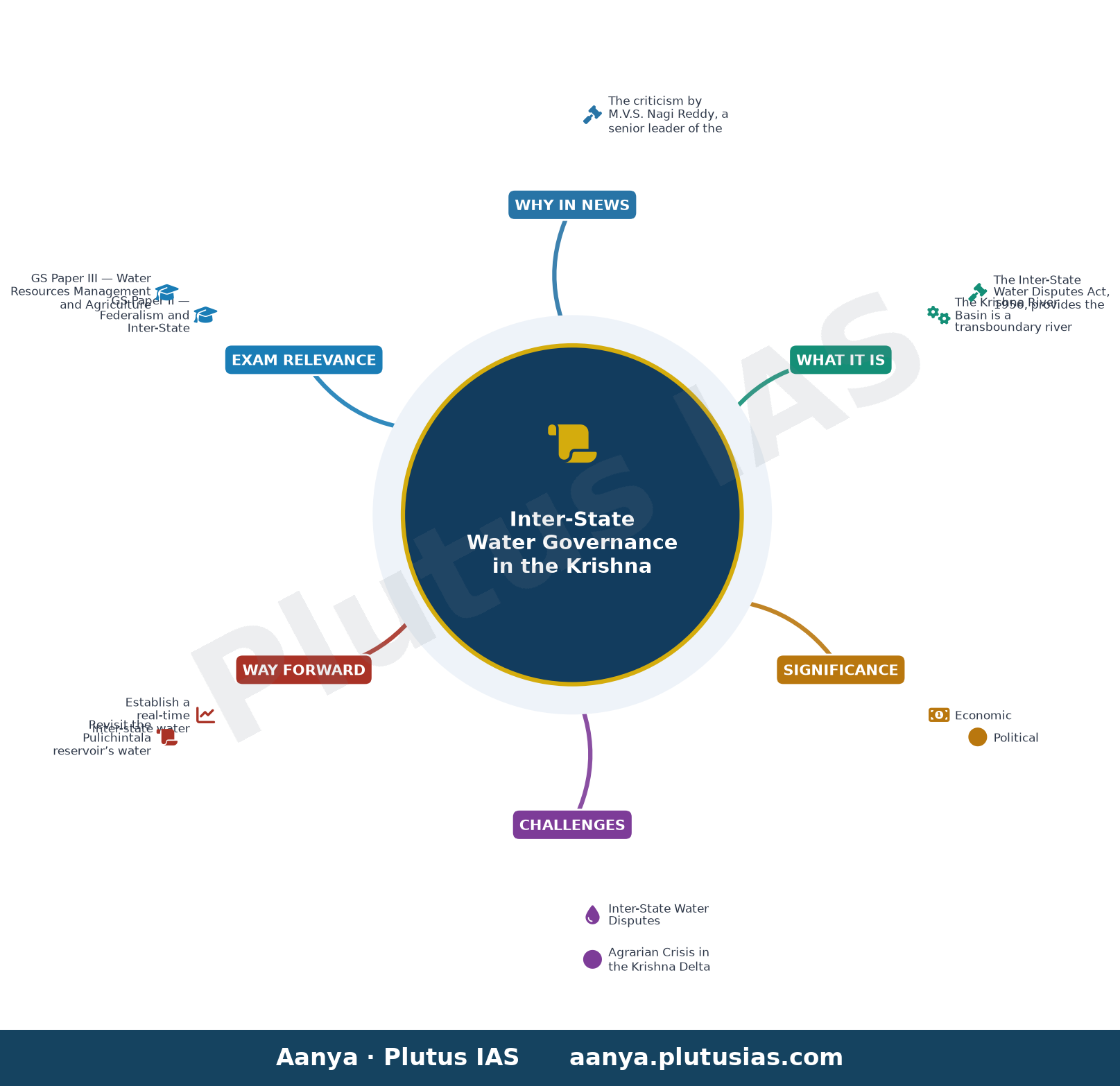
✎ The criticism by M.V.S. Nagi Reddy, a senior leader of the YSRCP, highlights the policy contradictions in the utilisation of Krishna River water between Andhra Pradesh and Telangana, particularly in the context of drought-prone…
Subject Relevance — Where This Topic Fits
- GS Paper II — Federalism and Inter-State Relations | GS Paper III — Water Resources Management and Agriculture
- Prelims: Krishna River Basin, Inter-State Water Disputes Act, 1956, Pulichintala Project, Handri-Neeva Lift Irrigation Scheme, K.C. Canal, Minimum Drawdown Level (MDL), TMC (Thousand Million Cubic Feet), Kharif Season, Ayacut, Lift Irrigation Schemes
- Essay: Water Governance and Federalism: Balancing Development and Equity, Agrarian Crisis in India: Causes and Policy Solutions
Why is this in the news?
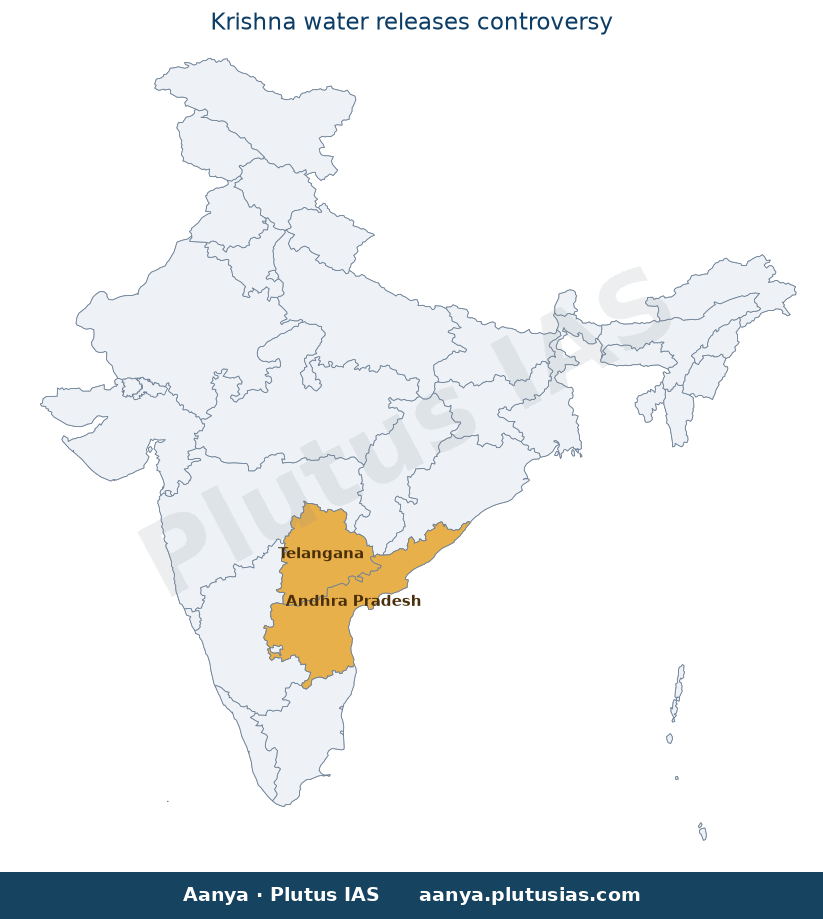
The criticism by M.V.S. Nagi Reddy, a senior leader of the YSRCP, highlights the policy contradictions in the utilisation of Krishna River water between Andhra Pradesh and Telangana, particularly in the context of drought-prone regions and the Krishna delta. The allegation that the State government is advising farmers against paddy cultivation despite available water resources underscores the governance failures in inter-state water sharing and agricultural planning, which directly impacts food security and rural livelihoods.
Background
- The Krishna River, India’s third-longest river, is a critical water source for the states of Maharashtra, Karnataka, Telangana, and Andhra Pradesh, with its basin covering approximately 258,948 square kilometres.
- The Krishna Water Disputes Tribunal (KWDT-I) was constituted in 1969 to adjudicate inter-state water sharing disputes, and its award was published in 1973, allocating 2,130 TMC of water among the basin states. However, disputes persist over the implementation of the award, particularly regarding the utilisation of surplus water.
- Telangana has operationalised several lift irrigation schemes, including Bhima-I, Bhima-II, Nettempadu, Koilsagar, and Kalwakurthy, to utilise its share of Krishna water, while Andhra Pradesh has faced delays in commissioning similar projects like Handri-Neeva and Muchumarri.
- The Krishna delta in Andhra Pradesh, covering 10.5 lakh acres of ayacut, is a major rice-producing region, with paddy, sugarcane, and aquaculture as principal economic activities. The delta’s agrarian economy is highly dependent on timely water releases from the Krishna basin.
- Recent drought conditions in the region have exacerbated water scarcity, necessitating judicious utilisation of available water resources to prevent agrarian distress.
What is the Krishna River Basin and its Governance Framework?
- The Krishna River Basin is a transboundary river system spanning four Indian states—Maharashtra, Karnataka, Telangana, and Andhra Pradesh—with its catchment area covering 258,948 square kilometres.
- The Inter-State Water Disputes Act, 1956, provides the legal framework for resolving inter-state water disputes, with the tribunal’s award being binding on the states involved.
- Major projects in the basin include the Nagarjuna Sagar Dam (Andhra Pradesh/Telangana), Srisailam Dam (Andhra Pradesh), Pulichintala Project (Andhra Pradesh), and the Almatti Dam (Karnataka), which regulate water flow and storage.
- The concept of ‘ayacut’ refers to the command area of an irrigation project, where water is distributed for agricultural purposes. The Krishna delta in Andhra Pradesh has an ayacut of 10.5 lakh acres, primarily dependent on Krishna water.
- Lift irrigation schemes, such as Handri-Neeva and Muchumarri in Andhra Pradesh and Bhima-I, Bhima-II in Telangana, are designed to utilise water from lower elevations by pumping it to higher command areas, addressing topographical constraints.
- The Minimum Drawdown Level (MDL) is the lowest water level in a reservoir from which water can be drawn for irrigation or other uses without compromising structural integrity or ecological balance.
- The kharif season, coinciding with the monsoon period (June–October), is critical for paddy cultivation in the Krishna delta, where water availability directly influences agricultural output and rural livelihoods.
Key Features
| Feature | Significance |
|---|---|
| Krishna River Basin | A transboundary river basin shared by Maharashtra, Karnataka, Telangana, and Andhra Pradesh, critical for irrigation, drinking water, and hydroelectric power generation in peninsular India. |
| Jurala Project | A major dam on the Krishna River in Telangana, enabling regulated water releases for downstream states and irrigation projects. |
| Srisailam Reservoir | A key multi-purpose reservoir on the Krishna River, serving hydroelectric power generation, irrigation, and flood control in Andhra Pradesh and Telangana. |
| Pulichintala Project | A balancing reservoir on the Krishna River designed to stabilise water supply to the Krishna delta, particularly for irrigation and drinking water needs. |
| Handri-Neeva and Muchumarri Lift Schemes | Critical irrigation projects in Andhra Pradesh that lift water from the Krishna River to drought-prone regions, ensuring agricultural productivity in non-command areas. |
Why it Matters
Economic
- Agrarian livelihoods in the Krishna delta depend heavily on paddy cultivation, sugarcane, and aquaculture, which are water-intensive sectors contributing significantly to regional GDP.
- Delayed or inadequate water releases to the delta can trigger a cascading economic impact, including reduced farm incomes, increased rural indebtedness, and migration to urban areas.
- The Handri-Neeva and Muchumarri lift schemes are vital for drought-prone regions, ensuring food security and preventing agricultural distress in non-command areas of Andhra Pradesh.
Political
- Inter-state water disputes, particularly between Andhra Pradesh and Telangana, are exacerbated by perceived inequities in water allocation and utilisation, leading to political tensions and electoral repercussions.
- Criticism from opposition parties (e.g., YSRCP) highlights governance failures in water resource management, potentially influencing public opinion and electoral outcomes in Andhra Pradesh.
- The Pulichintala project’s water storage policy reflects a trade-off between drinking water supply and irrigation needs, which can become a contentious issue in state-level politics.
Environmental
- Excessive water releases or delays in utilisation can disrupt ecological flows, affecting riverine ecosystems and groundwater recharge in the Krishna basin.
- The Krishna delta, a Ramsar wetland site, faces ecological stress due to fluctuating water levels, impacting biodiversity and coastal livelihoods.
Administrative
- The State Water Resources Department (WRD) and Metropolitan Water Supply and Sewerage Board (Metrowater) must coordinate to balance drinking water supply (e.g., for Chennai) with irrigation demands in Andhra Pradesh.
- Real-time monitoring of reservoir levels, inflows, and outflows is essential to prevent mismanagement and ensure equitable water distribution across states.
Challenges
1. Inter-State Water Disputes
- The Krishna Water Disputes Tribunal (KWDT) awards of 1973 and 2010 allocate water shares among riparian states, but implementation remains contentious due to varying interpretations of surplus/deficit conditions.
- Telangana’s utilisation of Krishna water through lift schemes (e.g., Bhima-I, Bhima-II) while Andhra Pradesh delays releases from Handri-Neeva and Muchumarri raises questions about compliance with tribunal awards.
- Political narratives often overshadow technical assessments, complicating consensus on water-sharing mechanisms.
UPSC Link: GS Paper 2: Inter-State Relations
2. Agrarian Crisis in the Krishna Delta
- Paddy cultivation in the delta is non-negotiable for livelihoods, but water scarcity forces governments to advise against it, leading to economic losses for tenant farmers and smallholders.
- Delayed water releases disrupt the kharif sowing cycle, forcing farmers to switch to less remunerative crops or abandon cultivation, exacerbating rural distress.
- Aquaculture and sugarcane, though water-intensive, are economically critical, but their sustainability hinges on predictable water availability.
UPSC Link: GS Paper 3: Agriculture
3. Reservoir Management and Prioritisation
- The Pulichintala project’s decision to reserve 29 tmc ft. for drinking water until June 2027 conflicts with irrigation needs, raising questions about long-term water security planning.
- Heavy inflows into reservoirs (e.g., Srisailam) are not fully utilised for irrigation due to administrative delays or policy constraints, leading to wastage of surplus water.
- Balancing drinking water supply (e.g., for Chennai) with irrigation demands requires robust inter-state coordination and data-driven decision-making.
UPSC Link: GS Paper 3: Water Resources
4. Institutional and Governance Gaps
- The State Agriculture Mission and Water Resources Department often operate in silos, leading to disjointed policy implementation and conflicting advisories to farmers.
- Lack of real-time data sharing between states on reservoir levels, inflows, and outflows hampers equitable water distribution and crisis management.
- Farmer advisory mechanisms (e.g., against paddy cultivation) lack alternative livelihood support, leaving vulnerable communities without safety nets.
UPSC Link: GS Paper 2: Constitutional Bodies
5. Climate Change and Hydrological Uncertainty
- Increasing variability in monsoon patterns and glacial melt in the Krishna basin’s upper catchments exacerbates water scarcity, making long-term planning more complex.
- Drought-prone regions reliant on lift schemes face heightened vulnerability as reduced river flows limit water availability for irrigation.
UPSC Link: GS Paper 3: Climate Change
Challenges — UPSC Perspective
| Issue | Concern |
|---|---|
| Krishna Water Disputes Tribunal Awards | Implementation challenges due to varying surplus/deficit interpretations and political narratives. |
| Delta Agriculture Dependency | Water scarcity forces unsustainable advisories, risking livelihoods and food security. |
| Reservoir Prioritisation | Trade-offs between drinking water and irrigation needs lead to policy conflicts and wastage. |
| Inter-State Coordination | Lack of real-time data sharing and institutional silos hinder equitable water distribution. |
| Climate Variability | Increasing hydrological uncertainty complicates long-term water resource planning. |
| Governance and Advisory Mechanisms | Farmer advisories lack alternative livelihood support, exacerbating agrarian distress. |
Government Initiatives — Must-Memorise for Prelims
- Pulichintala Project (Andhra Pradesh)
- Handri-Neeva Lift Scheme (Andhra Pradesh)
- Muchumarri Lift Scheme (Andhra Pradesh)
- Bhima-I and Bhima-II Lift Schemes (Telangana)
Way Forward
- Establish a real-time inter-state water data sharing platform to monitor reservoir levels, inflows, and outflows across the Krishna basin.
- Revisit the Pulichintala reservoir’s water storage policy to balance short-term drinking water needs with long-term irrigation requirements, ensuring transparency in decision-making.
- Strengthen farmer advisory mechanisms by integrating alternative livelihood options (e.g., crop diversification, aquaculture training) to mitigate economic risks during water scarcity.
- Constitute a joint technical committee comprising representatives from Andhra Pradesh, Telangana, and Maharashtra to assess surplus/deficit conditions and recommend equitable water releases.
- Prioritise the completion and commissioning of pending irrigation projects (e.g., Handri-Neeva, Muchumarri) to reduce dependency on delta water and enhance drought resilience.
- Develop a climate-resilient water management plan for the Krishna basin, incorporating hydrological projections and adaptive strategies for drought-prone regions.
- Enhance institutional coordination between the State Water Resources Department, Agriculture Department, and Metrowater to align irrigation, drinking water, and ecological flow priorities.
- Promote participatory governance by involving farmer cooperatives and local bodies in water allocation decisions to build trust and reduce policy resistance.
UPSC Value Addition
Keywords for Mains Answer-Writing
Krishna River water sharing disputes · Inter-State River Water Disputes Act, 1956 · Andhra Pradesh-Telangana water allocation · Krishna Water Disputes Tribunal · Pulichintala Project · Pattiseema Lift Irrigation Scheme · Handri-Neeva Lift Irrigation Scheme · K.C. Canal · Kharif season irrigation policy · Agrarian crisis in delta regions · Minimum drawdown level of reservoirs · Lift irrigation schemes in peninsular India · Srisailam Reservoir · Jurala Project
Concept Flow
Monsoon variability and glacial melt → Reduced inflows into Krishna River reservoirs → Inter-state disputes over water allocation → Administrative delays in releases → Farmer advisories against paddy cultivation → Agrarian distress in delta regions → Political criticism and electoral repercussions → Need for climate-resilient water management and inter-state cooperation
Prelims Practice Questions
Q1. Consider the following statements regarding the Krishna River water sharing disputes between Andhra Pradesh and Telangana:
1. The Pulichintala Project is designed to stabilise irrigation in the Krishna delta.
2. The Handri-Neeva and Muchumarri lift schemes are operational in Telangana.
3. The Krishna Water Disputes Tribunal was constituted under the Inter-State River Water Disputes Act, 1956.
4. The Pattiseema Lift Irrigation Scheme diverts water from the Godavari to the Krishna basin.
How many of the above statements are correct?
- Only one
- Only two
- Only three
- All four
Answer: All four — Statements 1, 3, and 4 are correct. Statement 2 is incorrect as the Handri-Neeva and Muchumarri lift schemes are operational in Andhra Pradesh, not Telangana.
Q2. Assertion (A): The Inter-State River Water Disputes Act, 1956, empowers the Central Government to constitute a Tribunal for adjudicating inter-state river water disputes.
Reason (R): The Act mandates that the Tribunal’s decision is binding on the concerned states and cannot be challenged in any court of law.
Options:
A. Both A and R are true, and R is the correct explanation of A.
B. Both A and R are true, but R is not the correct explanation of A.
C. A is true, but R is false.
D. A is false, but R is true.
Answer: ? — Both the Assertion and Reason are true. The Act empowers the Central Government to constitute a Tribunal (A), and the Tribunal’s decision is binding on the states and cannot be challenged in any court (R).
Q3. Match the following lift irrigation schemes with their respective states:
Column I (Scheme) | Column II (State)
——————————–|——————
1. Handri-Neeva | A. Telangana
2. Bhima-I | B. Andhra Pradesh
3. Muchumarri | C. Karnataka
4. Kalwakurthy | D. Maharashtra
- 1-B, 2-A, 3-B, 4-C
- 1-B, 2-A, 3-C, 4-A
- 1-A, 2-B, 3-B, 4-C
- 1-B, 2-C, 3-A, 4-B
Answer: 1-B, 2-A, 3-B, 4-C — Handri-Neeva and Muchumarri are lift irrigation schemes in Andhra Pradesh (1-B, 3-B). Bhima-I is in Telangana (2-A), and Kalwakurthy is in Karnataka (4-C).
Mains Practice Question
✍ The release and utilisation of Krishna River water has become a recurring source of inter-state conflict between Andhra Pradesh and Telangana, exacerbating agrarian distress in delta regions. Critically examine the institutional and policy failures that have contributed to this situation. Also, analyse the constitutional and legal mechanisms available to resolve such disputes, with reference to recent judicial interventions. (15 Marks)
Approach: MODEL-ANSWER SKELETON:
1. **Institutional Failures**:
– Failure of the Krishna Water Disputes Tribunal (constituted under the Inter-State River Water Disputes Act, 1956) to deliver a time-bound and binding award, leading to ad-hocism in water allocation.
– Lack of a permanent dispute resolution mechanism under Article 262(1) of the Constitution, which envisages Parliament to provide for adjudication of inter-state water disputes.
– Absence of a robust data-sharing mechanism between riparian states (Andhra Pradesh, Telangana, Karnataka, Maharashtra) to ensure transparency and evidence-based decision-making.
2. **Policy Failures**:
– Over-reliance on lift irrigation schemes (e.g., Handri-Neeva, Muchumarri) without synchronised reservoir operations, leading to suboptimal utilisation of available water.
– Delayed releases from projects like Pulichintala and Pattiseema due to prioritisation of drinking water needs, neglecting irrigation commitments.
– Absence of a drought-resilient cropping strategy for delta regions, where paddy cultivation remains economically and socially entrenched despite water scarcity.
3. **Constitutional and Legal Mechanisms**:
– **Article 262**: Provides for the adjudication of inter-state water disputes by Parliament through legislation (e.g., Inter-State River Water Disputes Act, 1956).
– **Article 262(2)**: Bars the jurisdiction of the Supreme Court and other courts in inter-state water disputes, making the Tribunal’s decision final and binding.
– **Recent Judicial Interventions**:
– *Krishna Water Disputes Tribunal-II* (2010): Awarded 299.84 TMC of Krishna water to Andhra Pradesh, Telangana, Karnataka, and Maharashtra, but implementation remains contentious.
– *Supreme Court’s 2018 Order*: Directed the Centre to frame a scheme for the implementation of the Tribunal’s award, highlighting the need for executive intervention.
4. **Way Forward**:
– Strengthening the institutional framework by amending the Inter-State River Water Disputes Act to include provisions for data-sharing, dispute prevention, and time-bound awards.
– Promoting integrated water resource management (IWRM) through coordinated reservoir operations and conjunctive use of surface and groundwater.
– Encouraging crop diversification in delta regions to reduce water-intensive paddy cultivation, supported by market incentives and farmer education.
Balance of Views:
– **Executive View**: Emphasises the need for Centre-led mediation to resolve disputes (e.g., setting up a permanent tribunal).
– **State View**: Argues for greater autonomy in water management, citing federal principles and regional equity.
– **Judicial View**: Upholds the primacy of constitutional mechanisms but highlights the need for timely implementation of awards.
Source: The Hindu
Generated by AanyaAi for educational purpose.

- KWML’s Feasibility Reports for Water Metro in 18 Cities: UPSC & PCS Insights - October 3, 2026
- ओडिशा में वन्यजीव अनुसंधान अनुदान कार्यक्रम शुरू, सिमिलिपाल में 300 कैमरे और बढ़ेंगे - October 3, 2026
- India Summons Pakistan High Commission Official Over Violation - October 3, 2026

No Comments